

Table of Contents
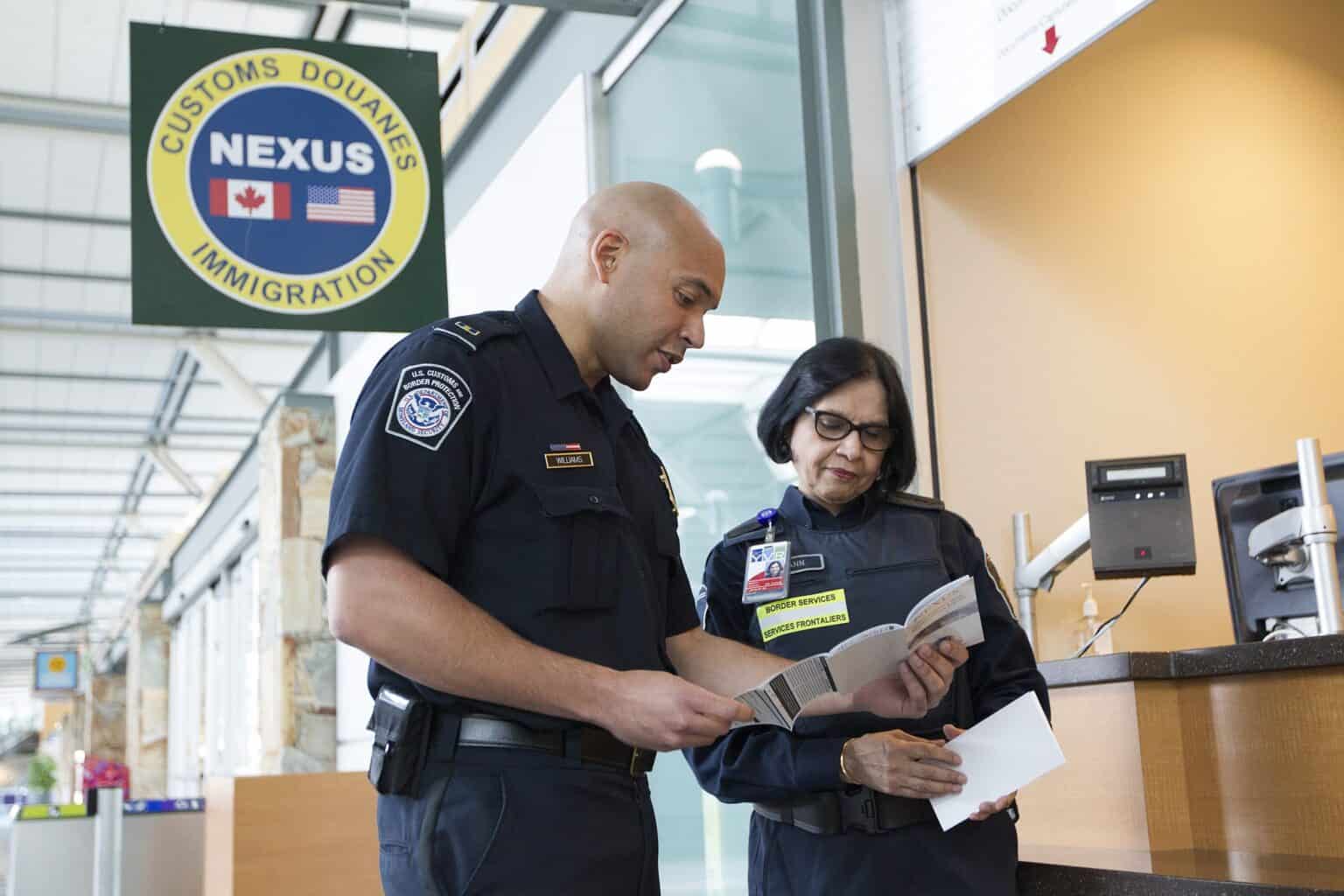
Get NEXUS if you are a U.S. or Canadian citizen or permanent resident and can get to a NEXUS enrollment center. It costs the same $120 as Global Entry, CBP lets members use Global Entry processing when flying into the U.S., and it adds fast lanes into Canada by air, land and water for nothing extra.
Get Global Entry if you live far from the Canadian border, if you hold a passport from one of its other partner countries, or if you would rather not need a yes from two governments.
Below, the two are compared on price, where each works, eligibility, the interview, approval and family rules, using the fees and lists on cbp.gov and the Canada Border Services Agency (CBSA) site as of November 2026.
| Criterion | Global Entry | NEXUS | Edge |
|---|---|---|---|
| Fee for 5 years | $120 | $120 (was $50 until October 1, 2024) | Even |
| Extra cost of the Canada lanes* | Not available | $0 over Global Entry | NEXUS |
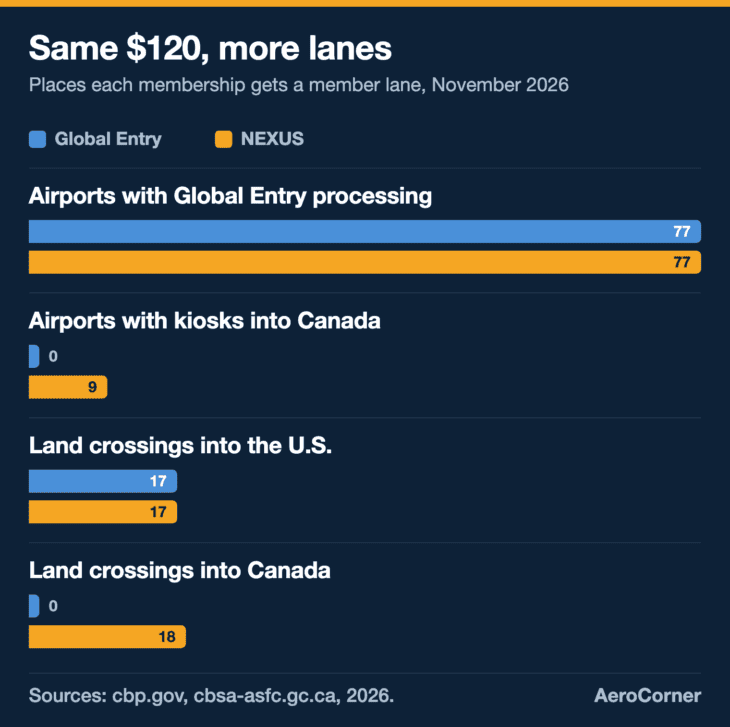
| Flying into the U.S. | Global Entry processing at 77 airports | Global Entry processing at participating airports | Even |
| Flying into Canada | No member lane | Kiosks and eGates at 9 airports | NEXUS |
| Driving across the border | NEXUS lanes into the U.S. only (17 crossings) | 17 crossings into the U.S., 18 into Canada | NEXUS |
| Airport security | TSA PreCheck | TSA PreCheck, plus CATSA member lines in Canada where available | NEXUS |
| Who can apply | U.S. citizens and permanent residents, plus citizens of 23 partner countries | U.S. and Canadian citizens and permanent residents, plus Mexican members of Mexico’s trusted traveler program | Global Entry |
| Interview | One CBP interview, at an enrollment center or on arrival | Two parts, CBP and CBSA; the CBSA part happens in Canada | Global Entry |
| Who approves | CBP; 80% approved within 2 weeks | CBP and CBSA; a denial by either country ends it | Global Entry |
| Kids under 18 | Free with a member or pending parent | Free with a parent approved in a trusted traveler program | Even |
How we compared
Fees, eligibility and interview rules are the ones listed on cbp.gov and cbsa-asfc.gc.ca on November 28, 2026. The 77 Global Entry airports are our count of CBP’s Global Entry airport list, 8 of them in Canada. CBP says NEXUS members may use Global Entry processing at participating airports, so the chart gives NEXUS the same 77. The 9 Canadian kiosk airports and 18 land crossings into Canada are CBSA’s figures; the 17 crossings into the U.S. are our count of CBP’s NEXUS lane list. Both memberships last five years. Card credits are listed as facts only.
Price, and what the Canada lanes now cost
Global Entry costs $120 for five years, and CBP says the fee is non-refundable even if you are denied. NEXUS costs the same: CBP and CBSA both list a $120 (USD) non-refundable fee per adult for a five-year membership.
That price is new. CBSA’s April 2024 release said the NEXUS fee had been set more than 20 years earlier and would rise from $50 to $120 on October 1, 2024, which it worked out at $24 a year.
So the old math has flipped. NEXUS used to save you $70 over Global Entry; now the Canada lanes, kiosks and security lines cost exactly $0 on top of what Global Entry charges. Either way you pay $24 a year.
Edge: Even. The fees match, which is why the rest of this page is about reach and paperwork, not price.
Flying into the U.S.
This is where most people assume Global Entry wins, and it does not. CBP’s NEXUS page says members may use Global Entry processing at participating airports, giving them the same expedited arrival at no additional cost.
CBP lists 77 airports with Global Entry processing. Eight are in Canada (Calgary, Edmonton, Halifax, Montreal, Ottawa, Toronto Pearson, Vancouver and Winnipeg), where you clear U.S. customs before you board at a preclearance facility.
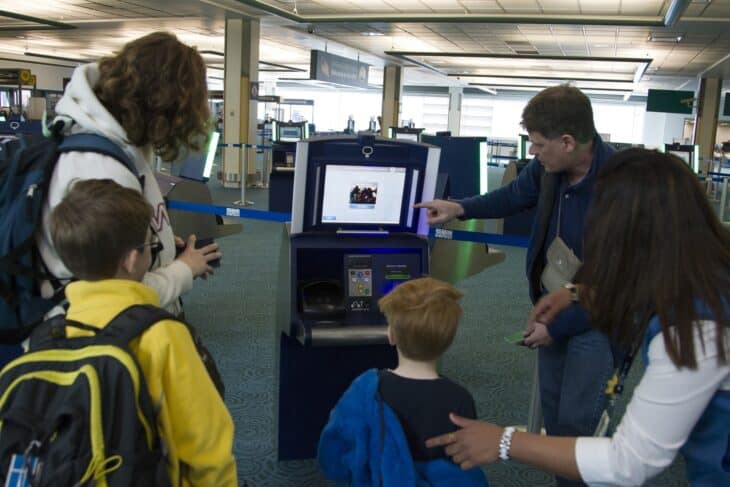

There is one practical difference at those Canadian airports. CBP says the Global Entry card cannot be used at Global Entry kiosks, which take only a passport or permanent resident card, while NEXUS cards are accepted at the kiosks in Canadian preclearance airports.
Edge: Even. A NEXUS member gets the Global Entry lane on the way home, so this criterion is a tie.
Flying into Canada
Global Entry does nothing for you when you land in Canada. NEXUS does: CBSA says members flying in from anywhere in the world can use NEXUS kiosks or eGates at 9 major airports, the same eight as above plus Billy Bishop Toronto City Airport.
The kiosk checks your face against your stored passport photo, prints a receipt, and you show it to an officer on the way out. A kiosk takes you and up to 4 other members; eGates take one traveler at a time, aged 14 or older.
If you have goods to declare, you still declare them to an officer after the kiosk. CBSA also bars NEXUS processing when you carry commercial goods, restricted items or CAN$10,000 or more in currency.
Edge: NEXUS. It is the only one of the two with a member lane into Canada.
Driving across the border
NEXUS was built for the land border. CBSA says it runs dedicated NEXUS lanes at 18 crossings into Canada, and CBP lists 17 crossings into the U.S., from Blaine, Washington to Calais, Maine. Some crossings, such as the Whirlpool Rapids Bridge at Niagara Falls, are open only to NEXUS members.
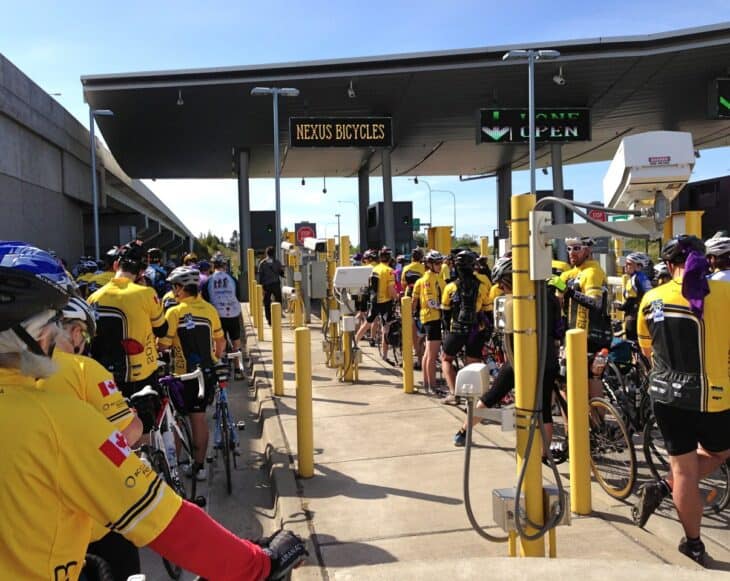
Global Entry gets you halfway. CBP says the Global Entry card works in NEXUS lanes when entering the U.S., but is not valid for entry into Canada through them.
The catch for families: everyone in the car must be a member to use a NEXUS lane, regardless of age, and CBSA says each person needs their own card. One non-member passenger sends the whole car to the regular line.
Edge: NEXUS. It opens the member lanes in both directions, where Global Entry opens only the southbound ones.
NEXUS covers boats too
CBSA says NEXUS boaters can report their arrival in Canada by phone to the Telephone Reporting Centre between 30 minutes and 4 hours before landing, at 396 marine reporting centres, with up to 29 members aboard. Heading south, CBSA says NEXUS is available at all marine crossings into the U.S.
Airport security: PreCheck and CATSA
Both memberships include TSA PreCheck. TSA says that for Global Entry, NEXUS and SENTRI members the Known Traveler Number is the nine-digit CBP PASSID on the back of the card, and it has to be on your airline reservation, because showing the card at the checkpoint does not get you in the lane.
NEXUS adds Canada’s side. CBSA lists expedited screening in the Canadian Air Transport Security Authority (CATSA) security lines, where available, as a NEXUS benefit. Global Entry lists no Canadian security line among its benefits. If PreCheck is all you need, our Global Entry vs TSA PreCheck comparison runs the cheaper option.
Edge: NEXUS. Same PreCheck, plus a faster security line when you fly out of Canada.
Who can apply
Global Entry is open to U.S. citizens and lawful permanent residents and to citizens of 23 partner countries, from Argentina and Australia to the United Kingdom, Japan and Mexico. Canada is not on that list as a Global Entry country: CBP says Canadians get Global Entry benefits through NEXUS membership.
NEXUS is open to U.S. and Canadian citizens and permanent residents, and to Mexican nationals enrolled in Mexico’s trusted traveler program. A British or Japanese traveler, then, can only pick Global Entry, and a Canadian can only pick NEXUS.
NEXUS also carries one disqualifier Global Entry does not list: a criminal pardon from any country. Both programs list criminal convictions, including driving under the influence, and customs violations as grounds for ineligibility.
Edge: Global Entry. It is open to more nationalities, though only NEXUS is open to Canadians.
The interview
Global Entry needs one interview with CBP. You book it at a Global Entry enrollment center or, if you are coming home from abroad, do it on arrival at a participating airport, bringing your passport and a second ID.
NEXUS needs two: one with CBP and one with CBSA, in either order. CBP says the Canadian part is done with CBSA at select Canadian airport enrollment centers, and the U.S. part can be done through Enrollment on Arrival at participating airports and preclearance locations.
CBP lists 25 NEXUS enrollment centers: 10 in Canada and 15 on the U.S. side, all in border states from Washington to Maine. For someone in Atlanta or Dallas, that means planning a trip north, while a Global Entry applicant can finish the interview through Enrollment on Arrival when flying home via a participating airport.
Edge: Global Entry. One interview, at many more places, beats two interviews with one of them in Canada.
Approval and families
Global Entry has one gatekeeper. CBP says 80% of applications are approved within 2 weeks, though some take 12 months or longer.
NEXUS has two. Both the U.S. and Canada run their own background checks, and CBP says a denial by either country keeps you out of the program. CBP gives no typical approval time for NEXUS.
Kids are free in both. Global Entry waives the fee for anyone under 18 whose parent or guardian is enrolled or pending, and NEXUS waives it for under-18s whose parent or guardian is approved in a trusted traveler program. Each child still needs their own application and interview.
That makes two parents and two kids $240 for five years in either program. CBSA’s 2024 release put NEXUS at more than 1.8 million members, most of them Canadian.
Edge: Global Entry on approval, with one agency to satisfy. On families it is even: kids are free in both.
Who should pick which
| If you… | Pick | Because |
|---|---|---|
| Live in a border state and visit Canada even occasionally | NEXUS | Same $120, plus member lanes into Canada by air, land and water |
| Are a Canadian citizen or permanent resident | NEXUS | Canada is not a Global Entry country; NEXUS gives you its benefits |
| Fly abroad often but rarely go to Canada, and live far from the border | Global Entry | One interview, which you can do on arrival |
| Are a citizen of the UK, Japan, Germany or another partner country | Global Entry | NEXUS is not open to you |
| Have a pardon, or worry Canada may refuse you | Global Entry | NEXUS needs both countries to say yes |
| Only want shorter airport security lines | Neither | TSA PreCheck alone is cheaper |
If PreCheck plus a faster passport line is the goal and Canada does not matter, our CLEAR vs Global Entry comparison covers the other program people stack on top.
Some travel credit cards reimburse the fee. Chase, for one, lists a statement credit of up to $120 every four years on the Sapphire Reserve for a Global Entry, TSA PreCheck or NEXUS application charged to the card.
Myth: NEXUS is the $50 bargain
Several pages ranking for this search still quote NEXUS at $50 for five years. That fee ended on October 1, 2024, when CBP and CBSA raised it to $120, the same as Global Entry. NEXUS is no longer the cheap option. It is the same price with more lanes, and a harder interview to schedule.
FAQ
Sources and references used for research and fact-checking.
- U.S. Customs and Border Protection, NEXUS Program Overview and Benefits
- U.S. Customs and Border Protection, Apply For or Renew a NEXUS Membership
- U.S. Customs and Border Protection, Completing Your NEXUS Interview
- U.S. Customs and Border Protection, Eligibility for Global Entry
- U.S. Customs and Border Protection, How to Apply for Global Entry
- U.S. Customs and Border Protection, Global Entry Enrollment on Arrival
- U.S. Customs and Border Protection, Airports with Global Entry
- U.S. Customs and Border Protection, Global Entry Card
- U.S. Customs and Border Protection, International Arrangements
- Canada Border Services Agency, NEXUS Program
- Canada Border Services Agency, How to use NEXUS to enter Canada
- Canada Border Services Agency, Where you can use NEXUS
- Canada Border Services Agency, The CBSA and U.S. CBP provide an update on the NEXUS program
- Transportation Security Administration, What is a Known Traveler Number (KTN)?
- Chase, Chase Sapphire Reserve
Get the Newsletter
The latest aviation news and stories sent to your inbox.
About the Author

Tim is the owner and lead editor of AeroCorner since 2019, overseeing aviation content covering aircraft, airlines, airports, and the broader aviation industry. Through years of researching, writing, editing, and publishing aviation-focused content, he has developed extensive practical knowledge of commercial aviation and air travel. Based in Asia and a frequent traveler himself, Tim also brings firsthand passenger experience to AeroCorner’s coverage. Outside of publishing, he has also explored aviation firsthand through hands-on flight training in New Zealand.