


Table of Contents
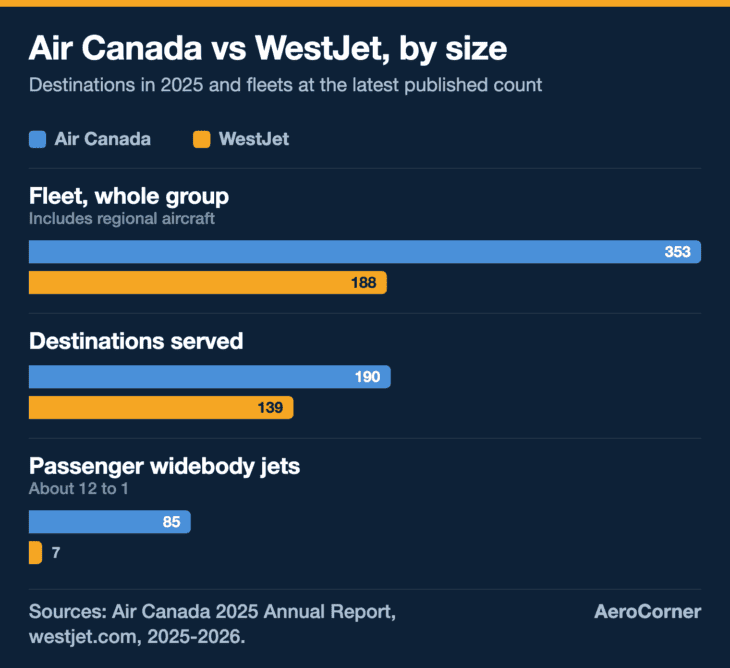
Pick Air Canada if you are flying long haul, want a lie-flat bed, or are checking a bag on the cheapest fare. It flies 85 passenger widebodies to WestJet’s 7, serves 190 destinations to WestJet’s 139, and charges $45 for a first bag on its Basic fare, against $55 to $65 prepaid on WestJet’s UltraBasic.
Pick WestJet if a younger aircraft matters to you, or if you fly with Delta, its partner since 2011 and now a shareholder. Its fleet averages under 10 years old, against 13.8 years for Air Canada and Rouge. On punctuality there is no real gap: Cirium had the two within a third of a percentage point in 2025.
This comparison uses each airline’s own fleet, seat, fare and bag pages, Air Canada’s 2025 annual report, Cirium’s on-time data and the Canadian Transportation Agency’s complaint statistics, as of October 2026. For what the fare letters on your ticket mean, see our guide to flight classes and fare codes.
| Criterion | Air Canada | WestJet | Edge |
|---|---|---|---|
| Destinations, 2025 | 190, on 6 continents | 139 | Air Canada |
| Passenger widebodies (lie-flat business) | 85 | 7 (all 787-9) | Air Canada |
| Average fleet age | 13.8 years (mainline and Rouge, Dec. 2025) | Under 10 years | WestJet |
| Economy seat width, main narrowbody | 19 in (48 cm), A220-300 | 16.3 to 17.3 in (41 to 44 cm), 737-8 MAX | Air Canada |
| First checked bag, cheapest fare, North America | $45 (Basic) | $55 to $65 prepaid (UltraBasic) | Air Canada |
| Loyalty points on the cheapest fare | 1 Aeroplan point per $1 | None on UltraBasic | Air Canada |
| On-time arrivals, 2025 (Cirium) | 73.26% | 73.58% | Even |
| CTA complaints per 100 flights (Oct. 2024 to Sept. 2025) | 4.6 | 5.1 | Air Canada |
| Free Wi-Fi | Aeroplan members, North America flights, since May 2025 | WestJet Rewards members, Starlink rollout since Feb. 2025 | Air Canada |
| Skytrax rating, 2026 | 4-Star; Best Airline in North America | 3-Star | Air Canada |
How we compared
Fleet counts are Air Canada’s at December 31, 2025, from its 2025 annual report, and WestJet’s fleet page as read on October 29, 2026 (the page carries no date). Bag fees are each airline’s published North America prices before tax: Air Canada’s apply to tickets bought on or after April 13, 2026, and WestJet’s are its prepaid prices, which its fee table gives as ranges without naming a currency. The round-trip bag math is two flights times the first-bag fee: Air Canada 2 x $45 = $90, WestJet 2 x $55 to $65 = $110 to $130. Air Canada does not publish economy seat pitch on its own pages, so we compare seat width, which it does publish.
Price, bags and fare rules
Both airlines sell a stripped-down bottom fare, and the two are close cousins. Air Canada Basic and WestJet UltraBasic allow no changes and no refunds, and charge for seat selection.
Neither includes a full-size carry-on in North America. Since January 3, 2025, Air Canada Basic gets a personal item only on flights within Canada and to the US, Mexico, Central America and the Caribbean, and a bag found at the gate costs $65 to $78. WestJet UltraBasic includes no carry-on except on flights to Europe and Asia.
The difference is the checked bag. On tickets bought from April 13, 2026, Air Canada charges $45 for a first bag and $60 for a second on Basic and Standard fares, while Flex includes the first bag. WestJet’s prepaid prices for the US and Canada run $55 to $65 for a first bag on UltraBasic and $45 to $53 on Econo.
Over a round trip with one checked bag on the cheapest fare, that is $90 in bag fees on Air Canada and $110 to $130 on WestJet. The fare itself changes by route and date, so compare the total, not the headline price.
Myth: WestJet is always the cheaper airline
On the cheapest fares, WestJet’s bag fee is the higher one. A round trip with one checked bag adds $90 on Air Canada Basic and $110 to $130 on WestJet UltraBasic, before tax. UltraBasic also earns no WestJet Rewards points, while Air Canada Basic earns 1 Aeroplan point per dollar.
Edge: Air Canada. Its cheapest fare has the lower first-bag fee and still earns points.
Economy seats
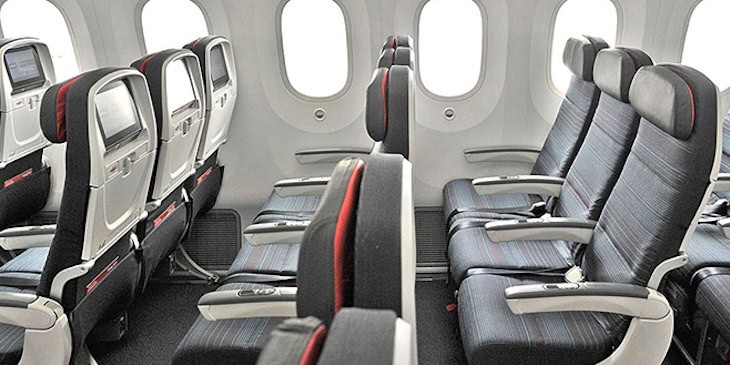
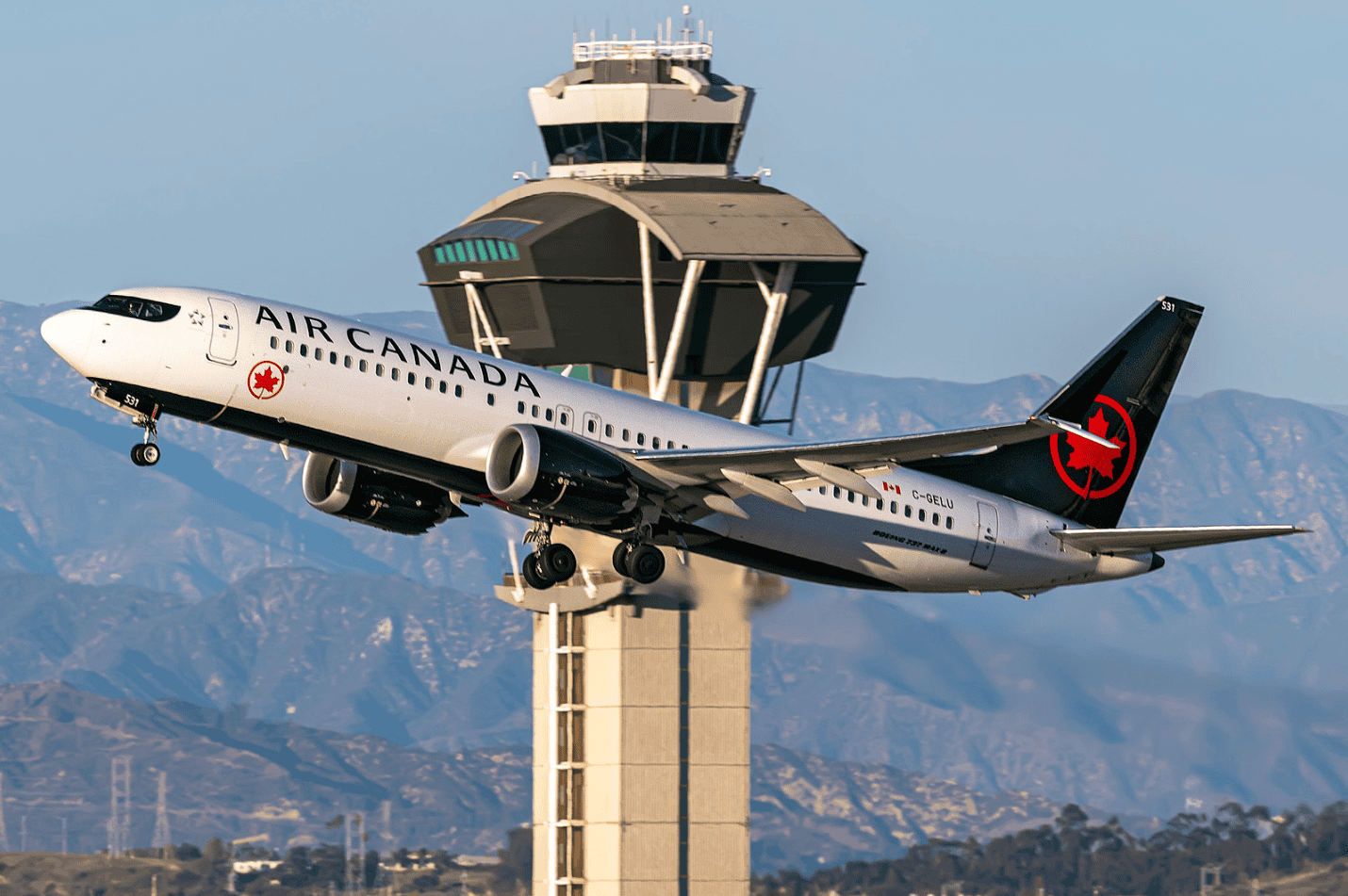
Air Canada’s Airbus A220-300 is the standout economy seat in either fleet. Its 125 economy seats sit five across, in a 3-2 layout, and each is 19 inches (48 cm) wide, the widest in Air Canada’s fleet by its own fact sheet. Every seat has a 12-inch screen.
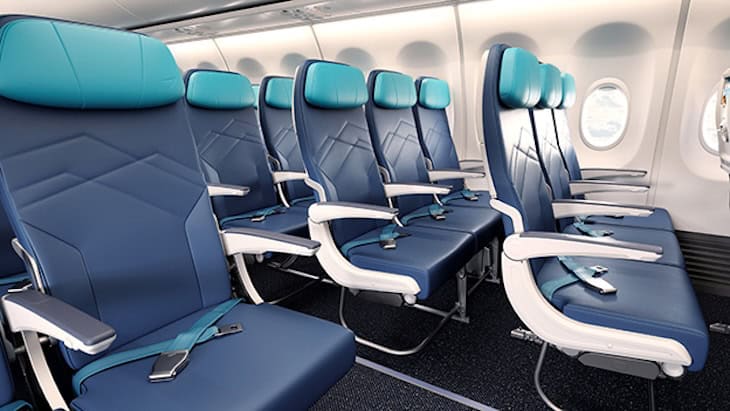
WestJet’s workhorse is the Boeing 737-8 MAX, with economy seats 16.3 to 17.3 inches (41 to 44 cm) wide and 30 inches (76 cm) of pitch. Its Extended Comfort rows add legroom, at 34 to 36 inches (86 to 91 cm).
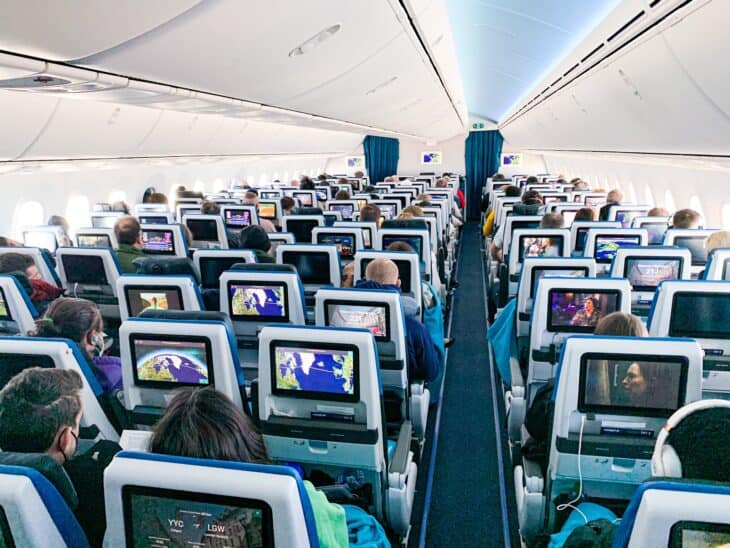
On the 787-9, WestJet’s economy seat is 17 inches (43 cm) wide with 31 inches (79 cm) of pitch. Air Canada does not publish its economy pitch on its own pages, so the honest comparison is width, where the A220 wins clearly.
Not every Air Canada flight is an A220. Its 41 A220s share short-haul flying with 737 MAX 8s, A320-family jets and Rouge, the leisure brand, whose 33 Airbus jets averaged 20 years old at the end of 2025.
Edge: Air Canada. The A220’s 19-inch seat beats anything in WestJet economy, as long as you book a route it flies.
Business class and premium cabins
This is the widest gap between the two airlines. Air Canada flies 85 passenger widebodies, Boeing 787s, 777s and A330s, and sells Signature Class on them: suites that become fully flat beds up to 6 feet 7 inches (2.0 m) long.

WestJet has one widebody type, the 787-9, and seven of them. They carry a lie-flat Business cabin with seats 22 inches (56 cm) wide, so a WestJet flight to Europe can be just as good up front, but on far fewer routes.
Premium economy is close. Air Canada’s has 38 inches (97 cm) of pitch and 7 inches of recline, with seats 19.5 inches (50 cm) wide on the 787-8, while WestJet Premium on the 787-9 has 38 inches of pitch and 19 inches (48 cm) of width. Our premium economy vs economy guide runs the numbers on whether the upgrade is worth it.
On short flights, WestJet’s Premium cabin on the 737-8 MAX is a strong seat: rows 1 to 3, two by two, 38 inches of pitch and 21.3 inches (54 cm) wide. Air Canada sells a 12-seat, 2-2 Business cabin on the A220 and on Rouge’s 737 MAX.
Edge: Air Canada. About 12 times as many widebodies with lie-flat beds means far more routes where you can get one.
Routes and network
Air Canada served 190 destinations directly on six continents in 2025, from hubs in Toronto, Montreal and Vancouver. It carried 45.3 million passengers that year and runs more than 1,000 flights a day on average.
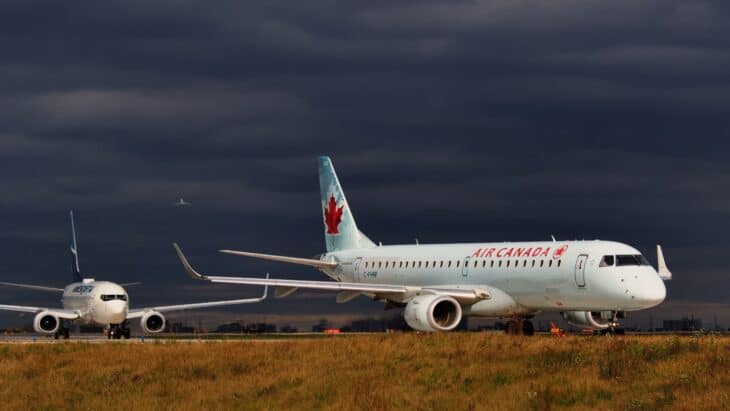

For US travelers, Air Canada’s 2026 network reaches 50 US airports, with up to 382 daily departures. It is a founding member of Star Alliance and runs a joint business with United on Canada to US routes.
WestJet flew to 139 destinations in 2025 from a single global connecting hub in Calgary, and had served more than 22.6 million guests by December 19. It belongs to no alliance; its biggest partners, Delta, Korean Air and Air France-KLM, bought 25% of the airline between them in October 2025.
Edge: Air Canada. More destinations, three hubs instead of one, and Star Alliance connections almost everywhere.
Fleet age
WestJet says its fleet averages under 10 years old. It flies 69 737-8 MAX, 53 737-800s, 24 737-700s and seven 787-9s, plus 35 De Havilland Q400 turboprops at WestJet Encore, 188 aircraft in all.

Air Canada’s 223 mainline aircraft averaged 12.9 years at the end of 2025, and 13.8 years with Rouge included. Air Canada Express adds 97 regional aircraft flown by partners, for 353 in all.
Air Canada is renewing fast. It expected two 787-10s and 10 A321XLRs during 2026, and it has 8 A350-1000s and more A220s on order.
Edge: WestJet. A younger fleet on average, though Air Canada’s new A220s and 787s are as new as anything WestJet flies.
On-time performance and strikes
In Cirium’s 2025 review of North American airlines, WestJet landed 73.58% of its flights within 15 minutes of schedule, eighth in the region. Air Canada was ninth at 73.26%, across nearly twice as many flights. Both trailed Delta, first at 80.90%.
Both have had strikes in the past year. Air Canada’s flight attendants struck in August 2025. After a federal back-to-work order and a wage offer members rejected, an arbitrator set their wages on February 18, 2026.
WestJet’s flight attendants walked out on August 2, 2026, canceling 495 flights that day, and reached a tentative deal after barely a day. Jazz, which flies Air Canada Express, reached a tentative deal with its flight attendants in September 2026 after a strike vote, and ratification was still pending.
Edge: Even. A third of a point apart on punctuality, and each has had a strike in the past 15 months.
Complaints and customer ratings
The Canadian Transportation Agency counts complaints per 100 flights. From October 2024 to September 2025, Air Canada averaged 4.6 and WestJet 5.1, both far behind Porter at 1.7 and well ahead of Flair at 12.2.
If something goes wrong, both are large carriers under Canada’s Air Passenger Protection Regulations. A delay within the airline’s control that is not needed for safety pays CA$400 for 3 to 6 hours, CA$700 for 6 to 9 hours and CA$1,000 for 9 hours or more, if you claim within a year.
Skytrax rates Air Canada 4-Star and WestJet 3-Star. At the 2026 World Airline Awards, Air Canada was named Best Airline in North America for the second year running and placed 17th in the world, while WestJet dropped out of the North American top 10.
Edge: Air Canada. Fewer complaints per flight and the higher independent rating.
Wi-Fi and entertainment
Since May 1, 2025, Air Canada has offered free, streaming-speed Wi-Fi sponsored by Bell to Aeroplan members on flights within North America, Mexico and the Caribbean, including Rouge and Air Canada Express CRJ900s. United MileagePlus members get it too, and Air Canada planned to add long-haul flights in 2026.
WestJet began installing free Starlink Wi-Fi for WestJet Rewards members in February 2025 and passed its 100th aircraft in October 2025. Its own aircraft pages still list Wi-Fi as a paid service, so check your flight before counting on it.
Air Canada also has more seatback screens, on the A220, the 787 and Rouge’s 737 MAX. WestJet’s 737s stream films to your own device, and only its 787s have screens.
Edge: Air Canada. Free Wi-Fi across most of its North American flying since 2025, and more screens.
Loyalty programs
Since January 1, 2026, Aeroplan has awarded 1 point per dollar of base fare on every Air Canada fare, Basic included, and elite members earn 2 to 6 times that. Flights on Star Alliance partners count toward Aeroplan status too.
WestJet Rewards is simpler. 100 points are worth CA$1 off a base fare, base members earn 1 point per dollar, and points never expire, but UltraBasic earns nothing. The spend needed for Silver, Gold and Platinum status rises on January 1, 2027, to $5,000, $8,000 and $15,000.
Edge: Air Canada. Points on every fare and the reach of Star Alliance; WestJet’s fixed point value suits people who never plan award trips.
The 12-to-1 widebody gap
Air Canada flies 85 passenger widebodies; WestJet flies 7. That is 33% of Air Canada’s mainline and Rouge fleet against 4% of WestJet’s, and it is why the two airlines feel alike on a flight to Florida and nothing alike on a flight to Tokyo.
Who should pick which
| If you… | Pick | Because |
|---|---|---|
| Fly long haul to Europe or Asia | Air Canada | 85 widebodies with lie-flat Signature Class against 7 |
| Check a bag on the cheapest fare | Air Canada | $90 in bag fees per round trip, against $110 to $130 |
| Fly mostly within Canada or to the US in economy | Air Canada, on an A220 route | A 19-inch seat and a seatback screen |
| Want a premium seat on a short flight | WestJet | Premium on the 737-8 MAX: 38 in pitch, 21.3 in wide |
| Collect United or Star Alliance miles | Air Canada | Star Alliance member, with free Wi-Fi for MileagePlus members |
| Fly Delta or start in Calgary | WestJet | Delta partner since 2011, with Calgary as its connecting hub |
| Care most about being on time | Either | 73.58% vs 73.26% in 2025 |
For most travelers, Air Canada is the better airline in 2026: more routes, wider short-haul seats, cheaper bags on its bottom fare and the higher ratings. WestJet wins on fleet age and on the Calgary and Delta connections, and is the right call when its schedule or total price is better on your route.
FAQ
Sources and references used for research and fact-checking.
- Air Canada, 2025 Annual Report
- Air Canada, Corporate Profile
- WestJet, Our aircraft
- WestJet, Boeing 737-8 MAX
- WestJet, Boeing 787-9 Dreamliner
- Air Canada, Airbus A220-300 fact sheet
- Air Canada, Premium Economy
- Air Canada, Signature Service
- Air Canada, Air Canada's 737 MAX aircraft begin Air Canada Rouge service
- Air Canada, Baggage fee changes
- Air Canada, Carry-on baggage
- Air Canada, Fare options and fees within Canada
- WestJet, Our fares
- WestJet, Baggage
- Air Canada, Earn Aeroplan points on Air Canada flights
- WestJet, Earn WestJet points
- WestJet, WestJet Rewards
- WSB-TV, How Delta ranked with on-time arrivals in 2025
- Canadian Transportation Agency, Air travel complaints per 100 flights by airline, October 2024 to September 2025
- Canadian Transportation Agency, Flight delays and cancellations: compensation
- Air Canada, Air Canada named Best Airline in North America at the 2026 Skytrax World Airline Awards
- Travel Market Report, Air Canada named Best Airline in North America at 2026 Skytrax awards
- Skytrax, Air Canada airline rating
- Skytrax, WestJet airline rating
- Air Canada, Free Wi-Fi for Aeroplan members sponsored by Bell
- Air Canada, In-flight entertainment and connectivity
- Travelweek, WestJet equips 100th aircraft with free Wi-Fi
- WestJet, WestJet Wrapped 2025
- WestJet, Our strategy
- WestJet, Onex closes sale of 25 per cent equity stake in WestJet to Delta, Korean Air and Air France-KLM
- Delta Air Lines (SEC filing), Delta, WestJet and Korean Air investment announcement
- Air Canada, Star Alliance and other airline partners
- CP24, Arbitrator settles flight attendant wages at Air Canada
- Las Vegas Sun (AP), WestJet reaches tentative deal with flight attendants
- BNN Bloomberg, Jazz Aviation reaches tentative contract with flight attendants
- NTSB, Jazz Aviation, Air Canada Express Flight 8646 Collides with Fire Truck on LaGuardia Runway
Get the Newsletter
The latest aviation news and stories sent to your inbox.
About the Author

Tim is the owner and lead editor of AeroCorner since 2019, overseeing aviation content covering aircraft, airlines, airports, and the broader aviation industry. Through years of researching, writing, editing, and publishing aviation-focused content, he has developed extensive practical knowledge of commercial aviation and air travel. Based in Asia and a frequent traveler himself, Tim also brings firsthand passenger experience to AeroCorner’s coverage. Outside of publishing, he has also explored aviation firsthand through hands-on flight training in New Zealand.