

Table of Contents
Alaska has 774 open airports and landing facilities, according to the FAA’s airport master records effective November 26, 2026. That is the fourth-highest count of any state, behind Texas (1,862), Florida (929) and California (863).
On the measures that matter to travelers, Alaska leads. It has the most public-use airports, by far the most seaplane bases, and 80 airports with scheduled airline service in 2025. California, Texas and Florida have 77 between them.
How Many Airports Are in Alaska?
The FAA answer is 774 for late 2026. In the FAA’s records, “airport” means any registered landing facility: runway airports, seaplane bases and heliports alike.
The file holds 777 Alaska records in all, but 3 private strips are marked closed indefinitely. Of the 774 open ones, 392 are open to the public and 382 are private.
That public count matters more here than anywhere else. The state transportation department says 82% of Alaska communities are cut off from the road system, so for most towns the airport is the road.
Alaska airports at a glance
774 open landing facilities in FAA data effective November 26, 2026. 586 runway airports. 131 seaplane bases. 392 open to the public, the most of any state. 80 commercial service airports in 2025. 24 primary airports with 10,000 or more boardings. 1 medium hub, Anchorage, with 55% of the state’s airline passengers.
What the 774 Actually Are
Split by type and by who may use them, Alaska looks nothing like the other big states. Its heliports are few, its seaplane bases are many, and half its fields are open to anyone.
| Facility type | Public use | Private use | Total |
|---|---|---|---|
| Airports (runways) | 283 | 303 | 586 |
| Seaplane bases | 105 | 26 | 131 |
| Heliports | 4 | 53 | 57 |
| Total | 392 | 382 | 774 |
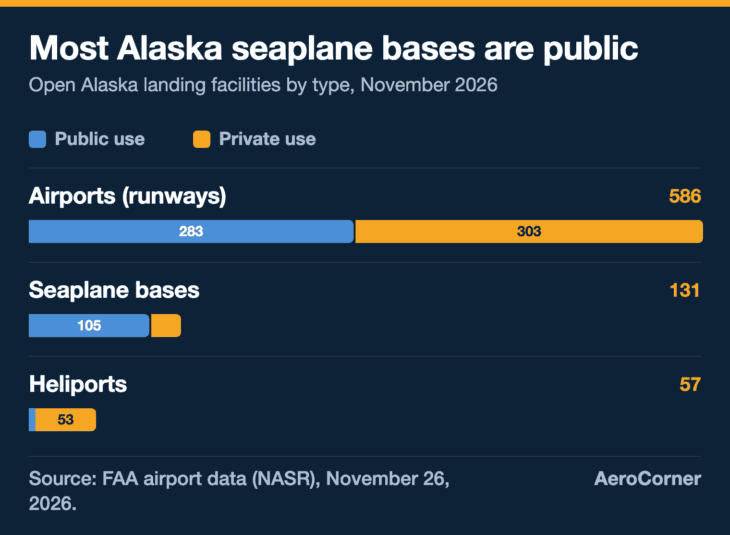
The seaplane bases are the Alaska signature. The state has 131 of the 561 in the US, almost a quarter, and 105 of the 224 that are open to the public. No other state has more than 29 public ones.
Even that undercounts the water flying. 25 more Alaska fields are filed as runway airports but also list a water runway, among them Fairbanks, Juneau, Ketchikan and Kenai. Lake Hood in Anchorage is one: a 2,200-foot (671 m) gravel strip beside water lanes up to 4,541 feet (1,384 m) long.
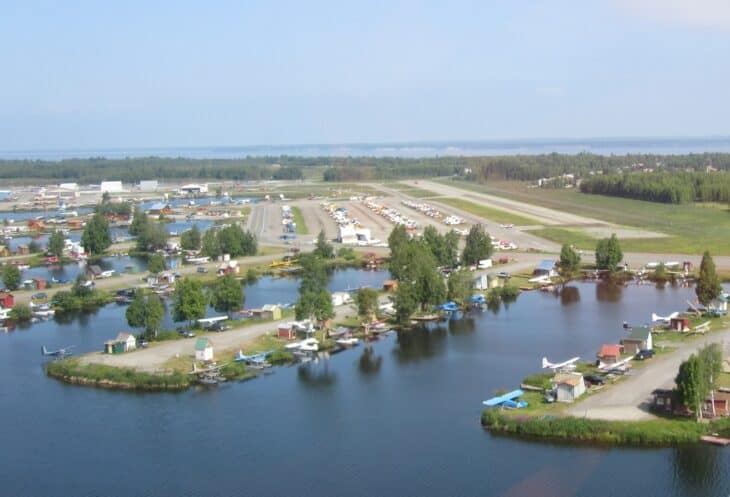

Pavement is rare. 509 of the 586 runway airports have no asphalt or concrete runway, and neither do 226 of the 283 public ones. Gravel, dirt and turf are the norm, the home ground of the bush pilot.
Private strips cluster near Anchorage. The Matanuska-Susitna Borough, north of the city, holds 186 landing facilities, 132 of them private airstrips. That one borough has more than Connecticut (97) and Vermont (84) combined.
Ownership leans public too. The state transportation department, DOT&PF, says it runs a rural system of 235 airports, on top of the international airports at Anchorage and Fairbanks. A control tower is rare: the FAA file lists one at just 14 of the 774 facilities, military bases included.
How Many Alaska Airports Have Airline Flights?
80 Alaska airports were commercial service airports in 2025, the most of any state by a wide margin. To qualify, an airport needs scheduled passenger service and at least 2,500 boardings a year. California is next with 29.
24 of the 80 are primary airports, with more than 10,000 boardings. The other 56 are smaller. The three smallest, Kiana, Cold Bay and Nulato, each cleared the 2,500 line by fewer than 75 boardings.
| Airport | FAA hub size | 2025 boardings |
|---|---|---|
| Anchorage (ANC) | Medium | 2.73 million |
| Fairbanks (FAI) | Small | 563,672 |
| Juneau (JNU) | Nonhub | 369,999 |
| Bethel (BET) | Nonhub | 169,624 |
| Ketchikan (KTN) | Nonhub | 147,342 |
| Deadhorse (SCC) | Nonhub | 106,752 |
| Sitka (SIT) | Nonhub | 94,471 |
| Kodiak (ADQ) | Nonhub | 84,831 |
| Nome (OME) | Nonhub | 72,120 |
| Kenai (ENA) | Nonhub | 64,627 |
| Kotzebue (OTZ) | Nonhub | 57,929 |
| Utqiagvik (BRW) | Nonhub | 43,574 |
| King Salmon (AKN) | Nonhub | 37,302 |
| Dillingham (DLG) | Nonhub | 33,595 |
| Anchorage, Merrill Field (MRI) | Nonhub | 26,386 |
| Petersburg (PSG) | Nonhub | 24,579 |
| Homer (HOM) | Nonhub | 22,117 |
| Unalaska (DUT) | Nonhub | 20,507 |
| Cordova (CDV) | Nonhub | 18,124 |
| Klawock (AKW) | Nonhub | 16,988 |
| Wrangell (WRG) | Nonhub | 14,611 |
| Galena (GAL) | Nonhub | 12,046 |
| Yakutat (YAK) | Nonhub | 11,406 |
| Gustavus (GST) | Nonhub | 10,243 |
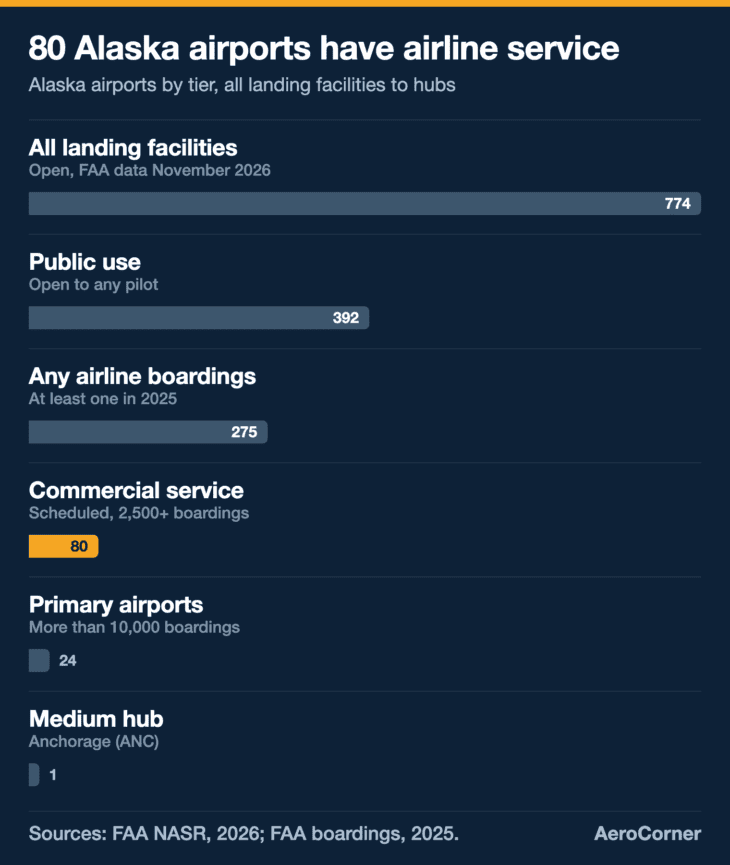
Those 80 airports boarded 4.97 million passengers in 2025. Anchorage alone carried 2.73 million, or 55 percent. Fairbanks and Juneau add 19 percent more, and the rest is spread thin across the bush.
Go below the commercial service line and the reach of airline flying gets wider still. 275 Alaska airports logged at least one airline boarding in 2025, out of 1,676 in the whole US. Texas, next, had 107.
Some of those surprise. The private airstrip at the Red Dog mine logged 15,766 boardings, more than four of the state’s primary airports. Lake Brooks, a seaplane base in Katmai National Park, logged 5,762, the most of any Alaska seaplane base.
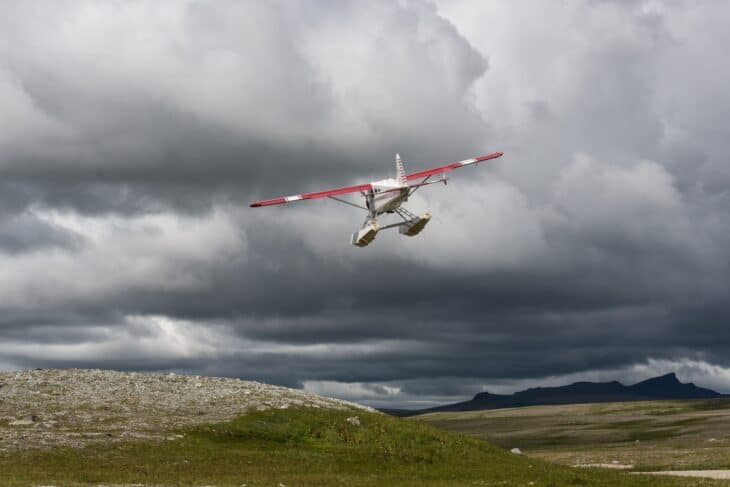

Deadhorse: a North Slope airport that outflies Sitka
Deadhorse, on the North Slope near the Arctic coast, boarded 106,752 passengers in 2025, up 10% from 96,967 in 2024. That put it sixth in Alaska, ahead of Sitka, Kodiak and Nome.
Why Other Sites Give a Different Number
Search the question and you will see 774, 392, 235, 131, 80, 26 and 24. All of them are real counts. They just count different things.
235 is the state's airports, not the state's total
DOT&PF’s 235 is the rural airport system it owns and runs. It leaves out Anchorage and Fairbanks, which the state runs separately as the Alaska International Airport System, plus every city, borough, federal, military and private field. The FAA total is 774.
The airline counts split three ways. 80 airports are commercial service, 24 are primary, and 26 hold an FAA operating certificate under 14 CFR Part 139, the rule for airports that serve larger airline aircraft.
Those groups do not line up, because the FAA writes Alaska exceptions into Part 139. Three primary airports have no certificate at all: Merrill Field in Anchorage, Klawock and Galena. Meanwhile the Red Dog mine strip, which is private and has no scheduled service, holds one.
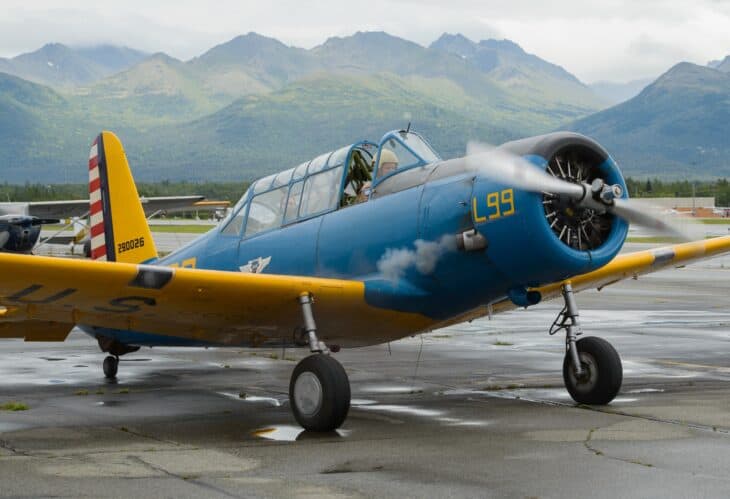

Seaplane counts vary with the definition too. The FAA’s 131 counts only facilities filed as seaplane bases, so Lake Hood, with three water lanes beside its gravel strip, is counted as an airport. Any list of “places a floatplane can land” is longer. Our guide to seaplanes vs floatplanes explains the aircraft that use them.
Military fields add another layer. The FAA file lists 27 military-owned sites in Alaska: 16 Air Force, 7 Army and 4 Coast Guard. They range from Elmendorf and Eielson air force bases to remote radar stations such as Tin City and Cape Lisburne.
How Alaska Compares With Other States
Alaska ranks fourth for total landing facilities with 774, behind Texas with 1,862, Florida with 929 and California with 863. Nationally, the same FAA file lists 19,163 open facilities; our breakdown of how many airports are in the US explains where they all are.
It ranks second for runway airports, with 586 to Texas’s 1,382. Texas makes up the difference with 465 heliports, mostly private, where Alaska has 57.
Count what the public can use and Alaska comes out on top, with 392 public-use facilities to Texas’s 389 and California’s 243. On primary airports it matches California with 24, one behind Texas. Our count of how many airports are in Texas shows the opposite profile: more than twice the fields, under a third of the airline airports.
FAQ
Sources and references used for research and fact-checking.
- Federal Aviation Administration, NASR 28-day subscription: airport data (APT CSV), effective November 26, 2026
- Federal Aviation Administration, CY 2025 Commercial Service Airports: passenger boardings, rank order and percent change from 2024
- Federal Aviation Administration, CY 2025 Enplanements at All Airports
- Federal Aviation Administration, Airport Categories
- Federal Aviation Administration, Part 139 Airport Certification
- Alaska Department of Transportation and Public Facilities, Statewide Aviation
- Alaska Department of Transportation and Public Facilities, Alaska International Airport System
Get the Newsletter
The latest aviation news and stories sent to your inbox.
About the Author

Tim is the owner and lead editor of AeroCorner since 2019, overseeing aviation content covering aircraft, airlines, airports, and the broader aviation industry. Through years of researching, writing, editing, and publishing aviation-focused content, he has developed extensive practical knowledge of commercial aviation and air travel. Based in Asia and a frequent traveler himself, Tim also brings firsthand passenger experience to AeroCorner’s coverage. Outside of publishing, he has also explored aviation firsthand through hands-on flight training in New Zealand.