


Your statement says you earned 62,000 miles this year. You have never flown 62,000 miles in your life, and the card that gave them to you has no aircraft.
Open the airline app and the number is not there either. The balance sits in the bank’s own account, under a name like Membership Rewards or Ultimate Rewards, waiting.
That gap is not a technicality. It is the single most valuable thing about those points, and it is the thing most people accidentally throw away in their first year of holding the card.
How Do Credit Card Airline Miles Work?
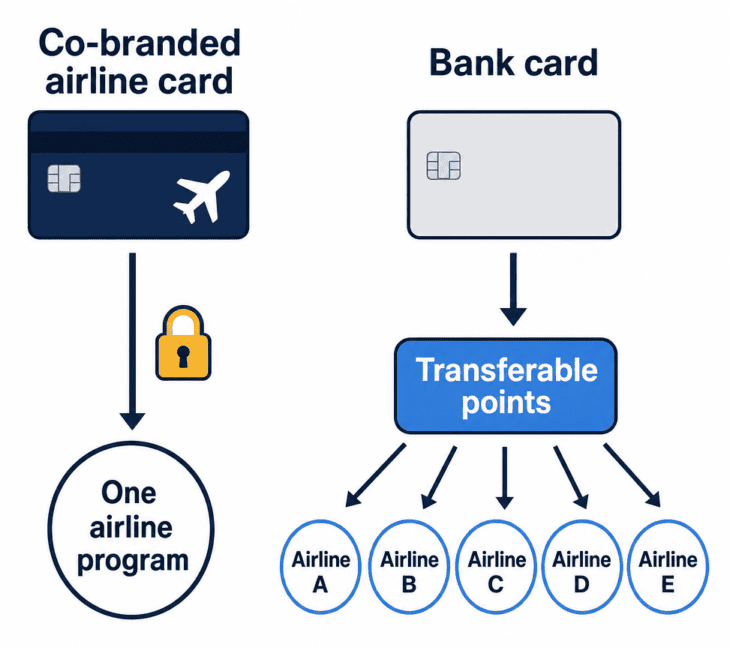
There are two completely different products sold under the same word. The first is a co-branded airline card, the Delta card or the United card, which earns actual miles that land directly in that airline’s frequent flyer account. Those miles belong to the airline from the moment you earn them.
The second is a bank card that earns a transferable currency: American Express Membership Rewards, Chase Ultimate Rewards, or Capital One miles. Those are the bank’s own points, not an airline’s, and they are worth nothing to any airline until you choose to move them.
The moving is the whole mechanism. You link your frequent flyer account to the bank’s rewards account, pick a number of points, and the bank converts them into that airline’s miles at a published ratio. Then, and only then, do you own airline miles.
The answer in one line
Co-branded airline cards earn one airline’s miles directly. Bank cards earn a transferable currency that becomes airline miles only when you convert it, and you get to choose which airline and when. The second kind is worth more, because you are buying the choice, not the seat.
The Difference That Actually Costs People Money
A Delta SkyMile can only ever become a Delta seat. If Delta has no award space on the route and date you want, that balance does nothing for you at all.
An Amex point has not committed to anything yet. When you find a seat, you look across sixteen airline programs, decide which one prices that flight best, and move the points there.
Award seats are capacity controlled. Airlines release a limited number of them per flight, and two programs looking at the same aircraft will often price the same seat very differently.
Holding one airline’s miles means you get one quote. Holding transferable points means you get every quote, then buy the cheapest one after you have seen them all.
That is why published valuations consistently price the big transferable currencies above most single-airline miles, even where the transfer ratio is a flat 1:1.
You are not being paid for the miles. You are being paid for not having chosen yet, which is also why what a mile is actually worth depends so heavily on which kind you are holding.
Which Bank Points Turn Into Which Airline Miles
Each bank negotiates its own partner list, and the lists barely overlap where US carriers are concerned. This is the part worth checking before you apply for anything.
| Currency | Airline partners | US airlines reachable | Typical ratio |
|---|---|---|---|
| Amex Membership Rewards | 16 | Delta, JetBlue | 1:1, except Cathay and Emirates at 5:4, JetBlue at 1:0.8, Aeromexico at 1:1.6 |
| Chase Ultimate Rewards | 10 | United, Southwest, JetBlue | 1:1 on all ten |
| Capital One miles | 18 | JetBlue | 1:1 on 14, Emirates, EVA and JAL at 2:1.5, JetBlue at 5:3 |
Read down the third column and the structure jumps out. United is a Chase partner and nobody else’s, Delta is an Amex partner and nobody else’s, and Southwest is Chase only.
So the practical question is not which card earns the most points. It is which bank has a deal with the airline that actually flies out of your airport.
Can you transfer Amex points to American Airlines?
No, and not from Chase or Capital One either. American Airlines AAdvantage is not a transfer partner of any of the three major bank currencies, which makes it the odd one out among the US majors.
There was one route in, briefly. Bilt Rewards transferred to AAdvantage at 1:1 until the two companies ended the partnership on 24 June 2024, and nothing has replaced it since.
What remains is Marriott Bonvoy at 3:1, and it is a poor deal. Marriott hands most airline partners a 5,000 mile bonus on every 60,000 points transferred, but American is one of the three programs excluded from it, so 60,000 hotel points buy exactly 20,000 AAdvantage miles.
How a Transfer Works, and Why It Is a One-Way Door
Mechanically it is easy. Link the loyalty account once, choose an amount, confirm. Amex requires a minimum of 1,000 points in multiples of 1,000, and says transfers typically take up to 48 hours, though several partners post within minutes.
Amex is also the only one of the three that charges you for the privilege. Its terms set an excise tax offset fee of $0.0006 per point on transfers into a US airline program, capped at $99 per transaction.
What the Amex transfer fee actually costs
At $0.0006 a point, moving 100,000 Membership Rewards points to Delta SkyMiles costs $60, charged to your card. The $99 cap bites at 165,000 points, so every point above that transfers free. Chase and Capital One charge nothing, and Amex charges nothing on transfers to hotel partners or non-US airlines.
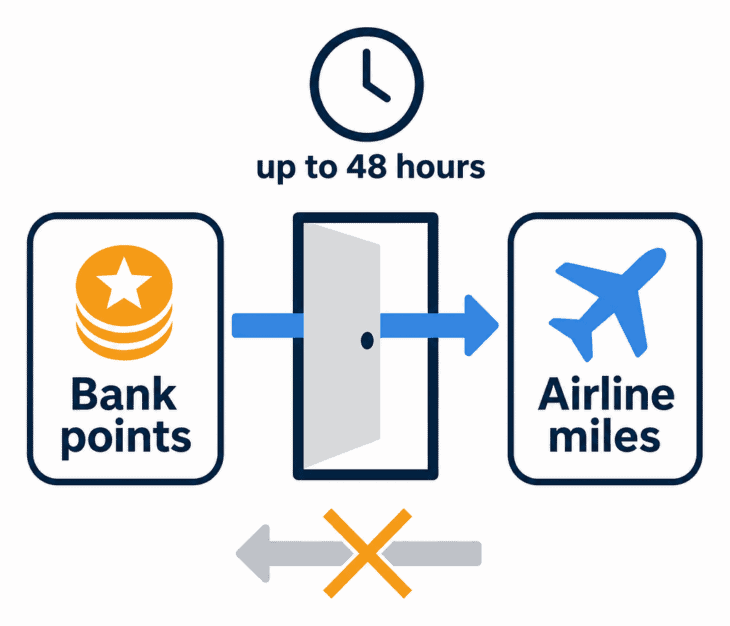
The fee is trivial next to the real constraint. Every one of these transfers is permanent, and the banks say so in plain language: once you transfer points, the transfer cannot be reversed, and transferred points cannot be converted back.
There is no cooling-off period and no support line that will undo it. If you move 90,000 points to an airline and then find the seat has gone, you own 90,000 of that airline’s miles and nothing else.
Which gives the one rule that matters here: find the award seat first, transfer second. Confirm the space is bookable, then move the points, then book, ideally in the same sitting.
The moment they land, they also inherit the airline’s rules rather than the bank’s. That includes the program’s expiry clock on inactive accounts, its fuel surcharges, and its right to reprice the award, since most major programs now set award prices dynamically rather than from a fixed chart.
Transfer Bonuses Are a Deal and a Trap
Every few weeks a bank runs a promotion on one partner. Recent ones have ranged from 10% to 80%, with most landing between 20% and 40%, and they usually run for three to six weeks.
The maths is genuinely good. A 30% bonus turns 100,000 bank points into 130,000 airline miles, which is the closest thing to free money in this hobby.
The trap is that a bonus is designed to make you transfer before you have a use. It is a deadline attached to an irreversible decision, which is a combination worth being suspicious of.
A 30% bonus into a program you never end up redeeming from is not a 30% gain. It is a total loss of flexible points in exchange for a bigger pile of stuck ones.
The workable test is simple. If you would have transferred to that partner this month anyway, the bonus is a gift. If the bonus is the reason you are considering it, it is an advertisement.
The Myth: A Mile Is a Mile
The assumption that costs the most
That 100,000 bank points and 100,000 airline miles are the same balance because the number is the same. They are not the same asset, and the conversion runs one way only.
Take 100,000 Membership Rewards points and 100,000 Delta SkyMiles. Amex transfers to Delta at 1:1, so on paper these two balances are identical.
They are not. The first can become any of sixteen programs, chosen months from now with full knowledge of where you want to go and what is available. The second can become a Delta seat, or nothing.
You can turn the flexible balance into the rigid one at any time. You can never turn it back, and that asymmetry is the entire reason the first is worth more.
The second half of the myth is that ratios are always 1:1. Amex to JetBlue runs at 1:0.8, so 100,000 points is 80,000 TrueBlue points, and Capital One to JetBlue at 5:3 leaves you 60,000. Check the ratio before you assume the number carries across.
None of this makes co-branded airline cards a mistake. If you fly one airline out of a hub it dominates, its own card is often the better tool, and it usually carries the baggage and boarding perks the bank card does not.
It is just a different product, bought for a different reason than the ones that make cash fares move. One buys certainty on a route you already fly. The other buys the freedom to change your mind.
So the next time a statement tells you that you earned miles, the useful question is which kind. If they are sitting in the bank’s account rather than an airline’s, you are holding something better than miles: you are holding the right to decide later.
Spend that right carefully. It only converts once, and it converts in one direction.
Sources and references used for research and fact-checking.
- American Express, Membership Rewards Program Terms and Conditions, August 2026
- Upgraded Points, Full List of Amex Transfer Partners: Airline and Hotel
- Upgraded Points, Full List of Chase Transfer Partners: Airlines and Hotels
- Capital One, Capital One Miles Transfer Partners: A How-To Guide
- Upgraded Points, Bilt and American Airlines To End Partnership in June
- AwardWallet, Transfer Marriott Bonvoy Points to Nearly 40 Airline Partners
- NerdWallet, Current Credit Card Transfer Bonuses
Get the Newsletter
The latest aviation news and stories sent to your inbox.
About the Author

Tim is the owner and lead editor of AeroCorner since 2019, overseeing aviation content covering aircraft, airlines, airports, and the broader aviation industry. Through years of researching, writing, editing, and publishing aviation-focused content, he has developed extensive practical knowledge of commercial aviation and air travel. Based in Asia and a frequent traveler himself, Tim also brings firsthand passenger experience to AeroCorner’s coverage. Outside of publishing, he has also explored aviation firsthand through hands-on flight training in New Zealand.