


Table of Contents
The best handheld aviation radio for most pilots in 2026 is the Icom IC-A25N: a 6-watt NAV/COM with GPS, VOR navigation, Bluetooth and an IP57 waterproof case for $599.95. If you want a backup that can fly an ILS, the Yaesu FTA-850L is the only radio in this guide with a glideslope.
If you only need to talk, the Icom IC-A16 is the best value. Below are nine picks from $170 to $600, from full NAV/COM backups to a listen-only scanner for plane spotters.
Every power, battery, weight and price figure comes from the manufacturer’s spec sheet or a major pilot shop, checked in October 2026.
Two corrections before you shop. Aviation voice radio is AM, not FM. And owning a handheld does not make it legal to call the tower from your backyard: the FCC limits that, not the FAA.
AeroCorner is a participant in the Amazon Services LLC Associates Program. We earn from qualifying purchases made through links on this page, at no extra cost to you.
| Radio | Best for | Type | Power (PEP) | Battery life | Weight | Price |
|---|---|---|---|---|---|---|
| Icom IC-A25N | Best overall | NAV/COM, GPS | 6 W | Up to 10.5 hr | 12.0 oz (340 g) | $599.95 |
| Yaesu FTA-850L | IFR backup (ILS) | NAV/COM, GPS | 6 W | 10 hr | 13.9 oz (395 g) | $519.95 |
| Sporty’s PJ2 GPS | GPS backup for ForeFlight users | COM, GPS | 6 W | 8 to 10 hr | 17.1 oz (486 g) | $399 |
| Yaesu FTA-550L | Budget NAV/COM | NAV/COM | 5 W | 13.5 hr | 14.5 oz (410 g) | $359.95 |
| Icom IC-A16B | Best COM-only | COM | 6 W | 17 hr | 9.1 oz (257 g) | $399.95 |
| Icom IC-A25C | COM with a big screen | COM | 6 W | Up to 10.5 hr | 12.0 oz (340 g) | $549.95 |
| Sporty’s PJ2+ | Student pilots | COM | 6 W | 6 AA batteries | Not published | $249.95 |
| Yaesu FTA-250L | Smallest and cheapest | COM | 5 W | 16 hr | 10.6 oz (300 g) | $239.95 |
| Uniden BC125AT | Plane spotters | Receive only | None | 2 AA batteries | Not published | $169.99 |
How we picked
We did not bench-test these radios. Each pick is chosen from the current lineups of Icom, Yaesu, Sporty’s and Uniden on what the published specs say about navigation features, transmit power, battery, weight, warranty and price, then matched to the flying it suits best. Where a maker’s web page and its own manual disagree, we use the manual and say so.
The best handheld aviation radios in 2026, reviewed
1. Icom IC-A25N: best handheld aviation radio overall
Check the Icom IC-A25N on Amazon
The IC-A25N is the benchmark handheld. It does everything a backup radio should, in a waterproof body that weighs 12.0 oz (340 g) with its battery.
It transmits at 6 W PEP (1.8 W carrier), covers the full COM and NAV bands, and adds a VOR display with a course deviation indicator. Built-in GPS, with GLONASS and SBAS, drives a waypoint navigator that stores 10 flight plans and 300 waypoints.
Bluetooth lets it pair with a headset or import flight plans from Icom’s phone apps. A dedicated 121.5 MHz key, a “flip-flop” recall of your last 10 channels, and 300 memory channels round it out.
Two limits. It has VOR but no ILS, so it cannot show a localizer or glideslope. And the GPS has no full aviation database, as Sporty’s points out, so it will not replace your tablet. The 10.5-hour battery figure is with Bluetooth off and GPS on.
Key specs: 6 W PEP / 1.8 W carrier, 2,350 mAh Li-ion (6 AA case optional), up to 10.5 hours, 2.3-inch LCD, IP57, 8.33 kHz capable, 3-year warranty, $599.95.
2. Yaesu FTA-850L: best for IFR backup
Check the Yaesu FTA-850L on Amazon
The FTA-850L is the one handheld here that can fly a full instrument landing system approach. It receives the localizer and the glideslope, and shows both on a color course deviation indicator.
That makes it the pick for instrument pilots who want a backup that can get them down after a total electrical failure in cloud. It also has VOR, 66-channel WAAS GPS with flight-route navigation, and Bluetooth 5.3.
Its 2.4-inch color TFT screen is the only color display among the Icom and Yaesu radios here. Yaesu’s manual rates it at 6.0 W PEP (1.8 W carrier), IPX5 water resistance and MIL-STD-810H, with 400 memory channels.
Like the Icom, it carries no aviation database, so there is no direct-to or nearest-airport function. The FTA-850AA ($349.95) is the same radio shipped with an AA tray and a 12-volt adapter instead of the lithium pack and wall charger.
Key specs: 6 W PEP / 1.8 W carrier, 2,200 mAh Li-ion, 10 hours (battery saver on), 13.9 oz (395 g) with battery, antenna and clip, IPX5, 3-year warranty, $519.95.
3. Sporty’s PJ2 GPS: best GPS backup for ForeFlight users
See the PJ2 GPS at Sporty’s Pilot Shop (a Sporty’s exclusive, not sold on Amazon)
The PJ2 GPS is Sporty’s newest radio, built to send its GPS position to ForeFlight over Bluetooth. If your panel GPS dies, your tablet keeps a position source.
It runs on a 2,500 mAh lithium pack (about 8 to 10 hours) or six AA batteries (6 to 8 hours), so a flat lithium pack does not ground the radio. Holding the 2 key for three seconds jumps straight to 121.5 MHz and shows your GPS coordinates.
It has no VOR or ILS, so it is a COM radio with GPS, not a NAV/COM. It is also heavy at 1.07 lb (486 g) with the lithium pack, and Sporty’s warranty runs one year against Icom’s and Yaesu’s three.
Key specs: 6 W PEP / 1.8 W carrier, Li-ion or 6 AA, 100 memories, 100 user waypoints, Bluetooth audio, 8.33 kHz capable, 1-year warranty, $399.
4. Yaesu FTA-550L: best budget NAV/COM
Check the Yaesu FTA-550L on Amazon
The FTA-550L is the cheapest way to get VOR navigation in a handheld. It shows a VOR course deviation indicator and a localizer, from a 5 W PEP (1.5 W carrier) transmitter with 13.5 hours of battery life.
Read the fine print on “ILS,” though. Yaesu’s web page advertises “VOR and ILS navigation features,” but the manual shows the glideslope indicator only on the older FTA-750L. The 550 gives you a localizer, not a full ILS.
There is no GPS or Bluetooth, and the 1.7-inch dot-matrix screen is plain next to the FTA-850L’s color display. For $234.95, the FTA-550 AA is the same radio on a six-AA tray, the lowest price for any NAV/COM here.
Key specs: 5 W PEP / 1.5 W carrier, Li-ion pack, 13.5 hours, 14.5 oz (410 g), IPX5, 200 memories, 8.33 kHz capable, 3-year warranty, $359.95.
5. Icom IC-A16B: best COM-only handheld
Check the Icom IC-A16B (Bluetooth) on Amazon
If you only need to talk and listen, the IC-A16B is the radio to buy. It has the longest battery life in this guide, over 17 hours from a 2,400 mAh pack, and it is the lightest transceiver at 9.1 oz (257 g).
Its 1,500 mW speaker is the loudest of the Icom and Yaesu radios here, which matters in an open cockpit or on a noisy ramp. It also carries an IP67 rating, a 121.5 MHz quick-access button and NOAA weather alerts.
The B is the Bluetooth version. The plain IC-A16 drops Bluetooth and costs $349.95.
Key specs: 6 W PEP / 1.8 W carrier, 2,400 mAh Li-ion, 17 hours (Bluetooth and backlight off), 9.1 oz (257 g), IP67, 200 memories, 8.33 kHz capable, 3-year warranty, $399.95.
6. Icom IC-A25C: best COM-only radio with a big screen
Check the Icom IC-A25C on Amazon
The IC-A25C is the IC-A25N’s body without the navigation. You get the same 2.3-inch screen, IP57 case, 300 memories and 6 W PEP transmitter, but no GPS, no Bluetooth and no VOR.
Choose it over the IC-A16 if you want the larger display and channel-group memory of the A25 family. Otherwise the A16 is lighter, lasts longer and costs $200 less.
The IC-A25C Sport is the AA version: it ships with the six-AA case instead of the lithium pack, and sells for about $330 to $370 at avionics shops.
Key specs: 6 W PEP / 1.8 W carrier, 2,350 mAh Li-ion, up to 10.5 hours, 12.0 oz (340 g), IP57, 300 memories, 3-year warranty, $549.95.
7. Sporty’s PJ2+: best for student pilots
See the PJ2+ at Sporty’s Pilot Shop (not sold on Amazon)
The PJ2+ has two standard headset jacks built into the radio, so a student and an instructor can plug in two aviation headsets with no adapter. That alone makes it the easiest radio here to use in a trainer or on the ground.
It transmits at 6 W PEP on six AA batteries. A USB-C port can power the radio, though not charge it, and Kitplanes reports power is limited to 5 W on USB-C.
It is COM-only with 20 memories, and the warranty is one year. Sporty’s L6 COM ($249) is the same idea with a LEMO jack that powers a headset’s active noise reduction.
Key specs: 6 W PEP, 6 AA batteries, twin headset jacks, NOAA and 121.5 buttons, USB-C power, 1-year warranty, $249.95.
8. Yaesu FTA-250L: smallest and cheapest transceiver
Check the Yaesu FTA-250L on Amazon
The FTA-250L is the cheapest transceiver in this guide, and it is small: 2.1 by 4.1 by 1.2 inches and 10.6 oz (300 g) with battery, antenna and clip.
It still gets 16 hours from a 1,950 mAh lithium pack, 250 memories, IPX5 water resistance and a 121.5 MHz key. Power is 5 W PEP (1.5 W carrier), a little below the 6-watt radios.
One catch for Europe: the manual lists its 8.33 kHz spacing as “Europe only.” Yaesu’s FTA-450L ($289.95 at Sporty’s) is the step up, with a 1.7-inch dot-matrix screen and a 13.5-hour battery.
Key specs: 5 W PEP / 1.5 W carrier, 1,950 mAh Li-ion, 16 hours, 10.6 oz (300 g), IPX5, 250 memories, 3-year warranty, $239.95.
9. Uniden Bearcat BC125AT: best for plane spotters (listen only)
Check the Uniden BC125AT on Amazon
If you never plan to transmit, you do not need a transceiver. The BC125AT is a scanner that covers 108 to 174 MHz, which takes in the civil airband, and 225 to 380 MHz, which takes in the military airband.
It stores 500 alpha-tagged channels in 10 banks and runs on two AA batteries, which it can charge over USB if they are NiMH. For an airshow, a spotting session or following how air traffic control works in real time, it does the job for $169.99.
Key specs: receive only, 25 to 54, 108 to 174, 225 to 380 and 400 to 512 MHz, 500 channels, 2 AA batteries, $169.99.
Where is the Yaesu FTA-750L?
Two of the top-ranking 2025 and 2026 buying guides still recommend the FTA-750L. It is no longer in Yaesu’s aviation lineup, Sporty’s and Aircraft Spruce have pulled their listings, and the Amazon listing reads currently unavailable. Its successor in spirit is the FTA-850L, which keeps the glideslope and adds Bluetooth and a color screen.
NAV/COM vs COM-only: which do you need?
A COM radio transmits and receives on the voice band, 118.000 to 136.975 MHz in the US. That is all you need to talk to the tower, listen to ATIS or call for help.
A NAV/COM also tunes the navigation band below it. VOR stations sit between 108.0 and 117.95 MHz, and ILS localizers use 40 channels between 108.10 and 111.95 MHz, on the odd tenths so they never clash with a VOR.
That is why the radios differ so much in price. The IC-A25N and FTA-550L show a VOR needle and the FTA-550L adds a localizer, but only the FTA-850L also receives the glideslope, which sits on its own UHF band at 329 to 335 MHz.
Our rule of thumb: VFR pilots flying behind a modern panel or a tablet are well served by a good COM radio. Instrument pilots and anyone flying an airplane with a single alternator should spend the extra on a NAV/COM, and on the FTA-850L if a backup ILS matters.
How to choose a handheld aviation radio
Compare carrier power, not the headline watts
The “6 watts” and “5 watts” on the box are peak envelope power (PEP). The steady carrier is much lower: 1.8 W on every 6-watt radio here, and 1.5 W on the 5-watt Yaesus.
So the real gap between a 6-watt Icom and a 5-watt Yaesu is 1.8 W against 1.5 W, which is small. Battery, antenna and line of sight matter more to how far you are heard.
Lithium pack, AA batteries, or both
Lithium-ion packs are lighter and last longer per charge. AA batteries never leave you waiting for a charger, and you can buy them anywhere.
For a radio that lives in a flight bag for months as an emergency backup, an AA option is worth having. The IC-A25N takes an optional six-AA case, the Yaesu FTA-850L and FTA-550L come in AA versions, and the PJ2 GPS ships ready for both.

Headset connection and controls
A handheld’s own speaker and microphone are hard to use over engine noise. Most radios need a headset adapter to plug your aviation headset in, so budget for one unless you buy the PJ2+, which has the jacks built in.
Look for big buttons you can work by feel, a dedicated 121.5 MHz key, and a backlit screen you can read in sunlight and at night. Most transceivers here have a 121.5 MHz key or shortcut; check before you buy.
8.33 kHz: only if you fly in Europe
The US uses 25 kHz channel spacing, which gives a 760-channel radio. The FCC does not authorize 8.33 kHz transmissions in the US National Airspace System, apart from a few specialist users.
Europe split its channels three ways. EU rules required new radios sold from 17 November 2013 to be 8.33 kHz capable, and aircraft radios to have the capability from 1 January 2018 wherever a radio is required. That requirement now sits in Regulation (EU) 2023/1770.
Every Icom and Yaesu radio here supports 8.33 kHz, but it only matters if you will fly or rent in Europe.
Water resistance and Bluetooth
Icom rates the IC-A25 series IP57, submersible to 3.3 feet (1 m) for 30 minutes, and the IC-A16 IP67. Yaesu rates its radios IPX5, a lower water-protection rating with no submersion claim.
Bluetooth is a comfort feature for wireless headsets and phone apps. It also costs battery, which is why every maker quotes its best battery figure with Bluetooth off.
How far can a handheld aviation radio reach?
Further in the air than on the ground, because VHF travels by line of sight. The FAA’s Aeronautical Information Manual puts it simply: higher altitudes increase the range of VHF communications.
The radio horizon formula shows how much height matters. Range in nautical miles is 1.23 times the sum of the square roots of the two antenna heights in feet.
Two people on the ground holding radios at 6 feet get a radio horizon of about 6 nautical miles (7 miles). A handheld at 6 feet talking to an airplane at 3,000 feet reaches about 70 nautical miles (81 miles).
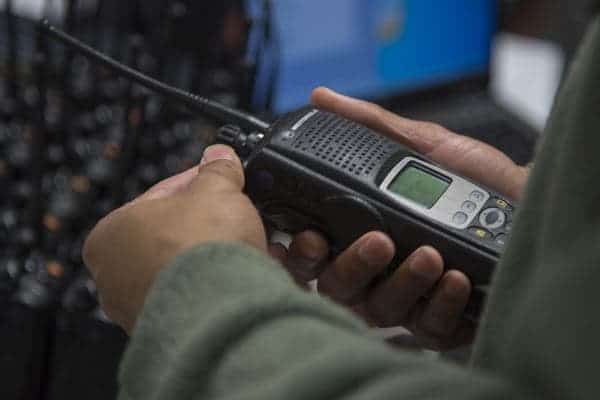
Those are theoretical maximums. Terrain, buildings, a 1.8-watt carrier and a rubber antenna inside a metal cabin all cut the real figure, so a handheld that works fine in the pattern may struggle to reach a distant center frequency.
One myth to drop: UHF does not reach further than VHF. The FAA’s Instrument Flying Handbook notes that lower frequencies bend slightly over the horizon, which is why the higher-frequency DME usually drops out before the VOR when you fly away from a station.
Is it legal to use a handheld aviation radio?
Listening is legal in the US. The FCC says the Communications Act does not forbid the mere interception of radio communications. What federal law restricts is passing on or exploiting what you hear, so do not rebroadcast or profit from routine ATC traffic.
Transmitting from your airplane is legal without a license on domestic flights. FCC rules license a domestic aircraft station “by rule,” and no operator permit is needed for VHF voice on domestic flights. You need an FCC station license and a Restricted Radiotelephone Operator Permit only to fly to another country, including Canada, Mexico and the Bahamas.

Transmitting from the ground is the catch. The FCC says you may only use a handheld aviation radio “from your aircraft, or under the authority of an FCC ground station authorization.” Those authorizations usually go to airport businesses, flight schools, manufacturers and soaring or ballooning chase crews, not to private individuals.
Drone pilots are not required to carry a radio under Part 107, and the FAA treats listening to the local traffic frequency as an optional aid. Transmitting from the ground falls under the same FCC ground-station rule, and the FAA says radio licensing is outside its jurisdiction. Our guide to the frequencies drones use covers the control link side.
On an airliner, TSA allows devices with installed lithium batteries of 100 watt-hours or less in carry-on and checked bags, with spare batteries in carry-on only. Whether you may switch a radio on is up to the airline under 14 CFR 91.21, so ask before you turn on a transmitter.
Scanners, ham radios and cheap dual-band radios
Forum threads often suggest a scanner or a cheap ham radio instead of a dedicated aviation transceiver. For listening, a scanner is a perfectly good choice. For talking to ATC, neither is.

A scanner or communications receiver, such as the Uniden BC125AT or Icom’s IC-R20, receives only. It cannot transmit at all, which is exactly what a plane spotter needs and nothing a pilot can rely on.
Ham radio handhelds, such as the Icom IC-T7H and the Yaesu VX-6R and VX-8R, are FM amateur radio handhelds built for the ham bands. Aviation voice uses AM: the FCC’s rules set the emission for aircraft VHF voice as A3E, double-sideband amplitude-modulated telephony.

Some amateur radios can receive parts of the airband, which turns them into a basic scanner. They are still not aviation transceivers, and the FCC rule on ground transmissions applies whatever radio you hold.

If you are a pilot, buy a radio built for the airband from Icom, Yaesu or Sporty’s. If you are a spotter, a scanner does the job for less money.
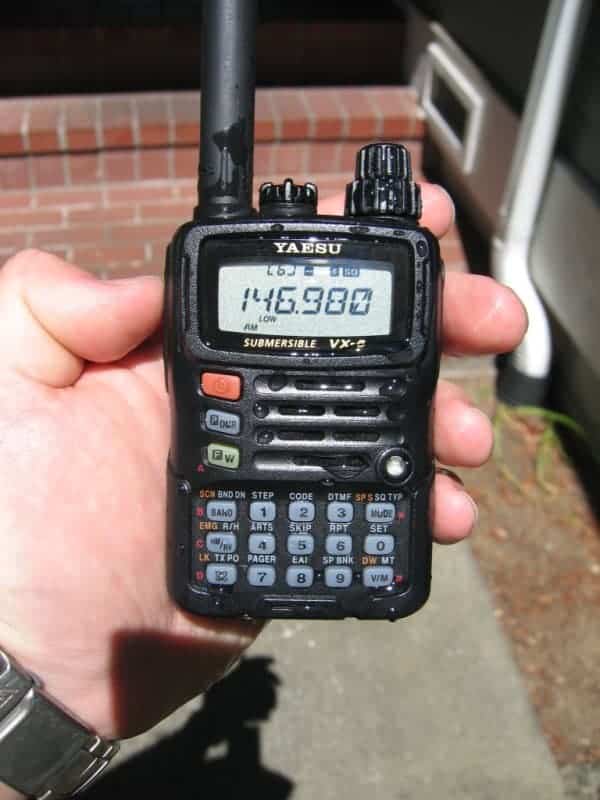
Using a handheld when your panel radio fails
This is the job most pilots buy a handheld for. The FAA’s Glider Flying Handbook describes it directly: after an electrical fire, the pilot may use a portable battery-operated aviation radio, or take landing instructions from ATC light signals.
If the panel radio fails, squawk 7600 and follow the lost-communications procedure in the AIM. A handheld lets you try to re-establish contact, including on 121.5 MHz, the emergency and distress frequency. Our guide to declaring an emergency with ATC covers what happens next.
If you have no radio at all, the tower can still talk to you with a light gun. These are the signals from the AIM:
| Light signal | Aircraft on the ground | Aircraft in flight |
|---|---|---|
| Steady green | Cleared for takeoff | Cleared to land |
| Flashing green | Cleared to taxi | Return for landing |
| Steady red | Stop | Give way to other aircraft and continue circling |
| Flashing red | Taxi clear of the runway in use | Airport unsafe, do not land |
| Flashing white | Return to starting point on airport | Not applicable |
| Alternating red and green | Exercise extreme caution | Exercise extreme caution |
Can a handheld be your only radio, in an aircraft with no electrical system? The rules for Class B, C and D airspace require an operable two-way radio and say nothing about how it is installed. FAA handbooks refer to “either panel mounted or portable radios” in gliders.
FAQ
Sources and references used for research and fact-checking.
- Icom America, IC-A25N / IC-A25C VHF Air Band Transceivers
- Icom America, IC-A16 VHF Air Band Transceiver
- Icom America, Icom aviation lineup
- Icom America, Icom America warranty
- Sporty's Pilot Shop, Icom A25N Portable NAV/COM Radio
- Sporty's Pilot Shop, Icom A25C Portable COM Radio
- Sarasota Avionics, Icom IC-A25C Sport
- Sporty's Pilot Shop, Icom A16 Radio with Bluetooth
- Sporty's Pilot Shop, Icom A16 Radio without Bluetooth
- Yaesu, Yaesu aviation portables
- Yaesu, FTA-850L
- Yaesu, FTA-850 Operating Manual
- Sporty's Pilot Shop, Yaesu FTA-850L Transceiver
- Sporty's Pilot Shop, Yaesu FTA-850AA Transceiver with GPS
- Yaesu, FTA-550 Series
- Yaesu, FTA-750/550/450 Operating Manual
- Sporty's Pilot Shop, Yaesu FTA-550L Pro-X NAV/COM
- Sporty's Pilot Shop, Yaesu FTA-550AA NAV/COM
- Sporty's Pilot Shop, Yaesu FTA-450L COM-only transceiver
- Yaesu, FTA-250L Operating Manual
- Sporty's Pilot Shop, Yaesu FTA-250L COM-only transceiver
- Sporty's Pilot Shop, PJ2 GPS Radio
- Sporty's Pilot Shop, PJ2 GPS Manual
- Sporty's Pilot Shop, PJ2+ COM Radio
- KITPLANES, Sporty's latest PJ2
- Sporty's Pilot Shop, L6 COM Radio
- Sporty's Pilot Shop, Which aviation radio should I buy?
- Uniden, Bearcat BC125AT
- RadioReference, BC125AT
- Icom America, IC-R20 communications receiver
- Icom, IC-T7H
- Yaesu, VX-6R
- Yaesu, VX-8R
- eCFR, 47 CFR 87.131, Power and emissions
- eCFR, 47 CFR 2.201, Emission designators
- eCFR, 47 CFR 87.173, Frequencies
- eCFR, 47 CFR 87.137, Types of emission
- eCFR, 47 CFR 87.18, Station license required
- eCFR, 47 CFR 87.89, Minimum operator requirements
- eCFR, 47 CFR 87.217, Frequencies
- FCC, Aircraft Stations
- FCC, Ground Stations
- FCC, Interception and Divulgence of Radio Communications
- Cornell Law School LII, 47 U.S. Code 605, Unauthorized publication or use of communications
- Federal Register, Operation and Certification of Small Unmanned Aircraft Systems (final rule)
- eCFR, 14 CFR 91.21, Portable electronic devices
- eCFR, 14 CFR 91.129, Class D airspace
- eCFR, 14 CFR 91.131, Class B airspace
- TSA, Lithium batteries with 100 watt hours or less in a device
- FAA, Pilot's Handbook of Aeronautical Knowledge (FAA-H-8083-25C)
- FAA, Instrument Flying Handbook (FAA-H-8083-15B)
- FAA, Aeronautical Information Manual, Chapter 1 Section 1
- FAA, Aeronautical Information Manual, Chapter 4 Section 2
- FAA, Aeronautical Information Manual, Chapter 4 Section 3
- FAA, Aeronautical Information Manual, Chapter 6 Section 4
- FAA, Glider Flying Handbook
- ATIS Telecom Glossary, Radio horizon range
- EUR-Lex, Commission Implementing Regulation (EU) No 1079/2012
- EUR-Lex, Commission Implementing Regulation (EU) 2023/1770
Get the Newsletter
The latest aviation news and stories sent to your inbox.
About the Author

Tim is the owner and lead editor of AeroCorner since 2019, overseeing aviation content covering aircraft, airlines, airports, and the broader aviation industry. Through years of researching, writing, editing, and publishing aviation-focused content, he has developed extensive practical knowledge of commercial aviation and air travel. Based in Asia and a frequent traveler himself, Tim also brings firsthand passenger experience to AeroCorner’s coverage. Outside of publishing, he has also explored aviation firsthand through hands-on flight training in New Zealand.