Mid Size Helicopters
Bell 214
ICAO: B214
The intermeshing-rotor helicopter built to carry loads on a hook
Updated: by Tim de Vries
The latest aviation news and stories sent to your inbox.
The Kaman K-MAX (company designation K-1200) is a single-seat synchropter built for one job: carrying external loads on a hook. Two intermeshing rotors replace the tail rotor, so all the engine power goes into lift. It has flown logging, firefighting and construction work and, in a pair of unmanned examples, Marine Corps cargo missions in Afghanistan. Kaman built 60 and ended production in 2023.
Live Fleet Activity (KMAX)
Fetching live data…




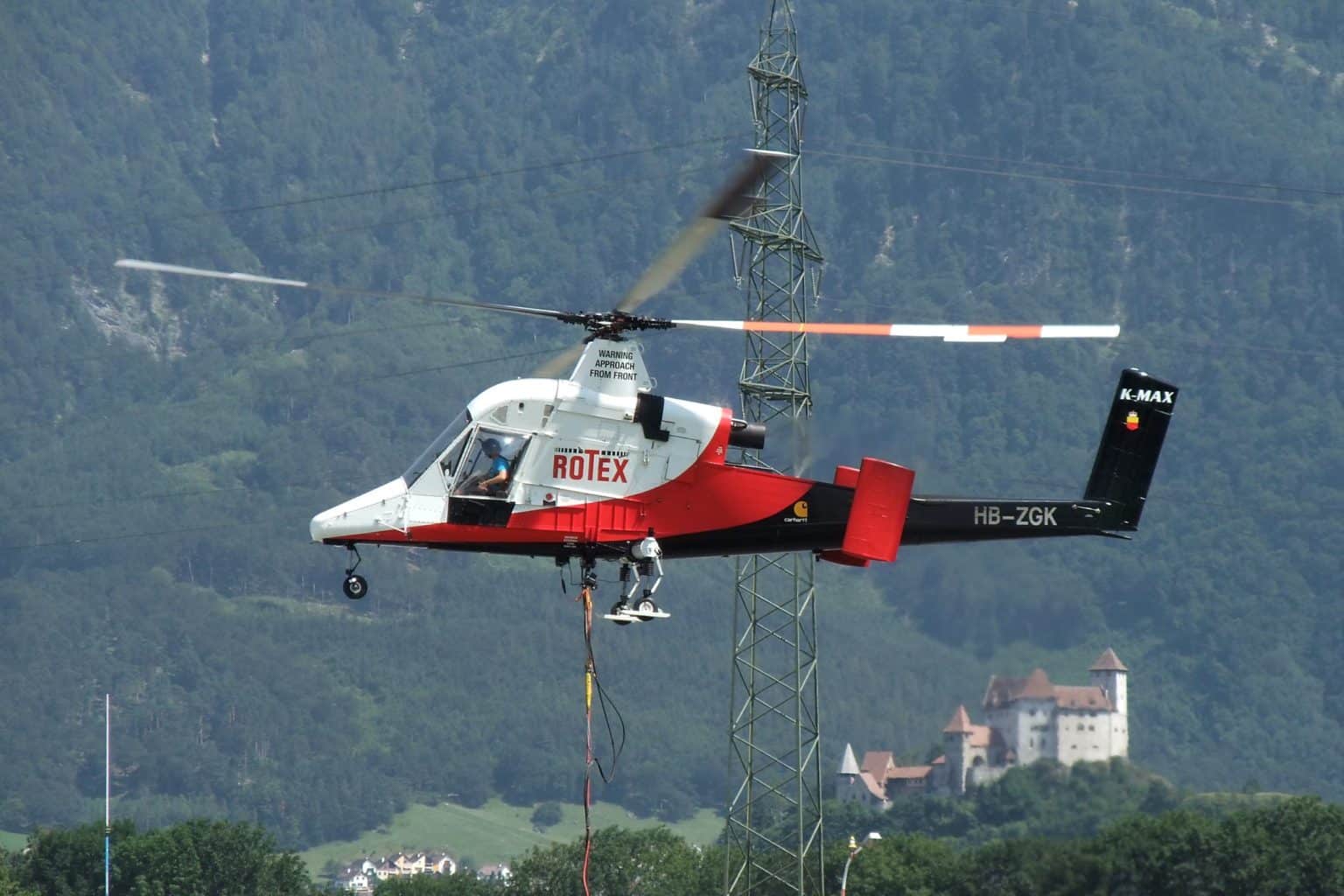
The Kaman K-MAX is a single-seat helicopter built to do one job: lift loads on a hook. Kaman’s company name for it is the K-1200.
Kaman describes it as the first helicopter designed, tested and certified specifically for repetitive external lift work. Other helicopters used for this job were adapted from passenger or utility designs.
It first flew on December 23, 1991, and the FAA certified it in August 1994. IFR certification followed in 1999.
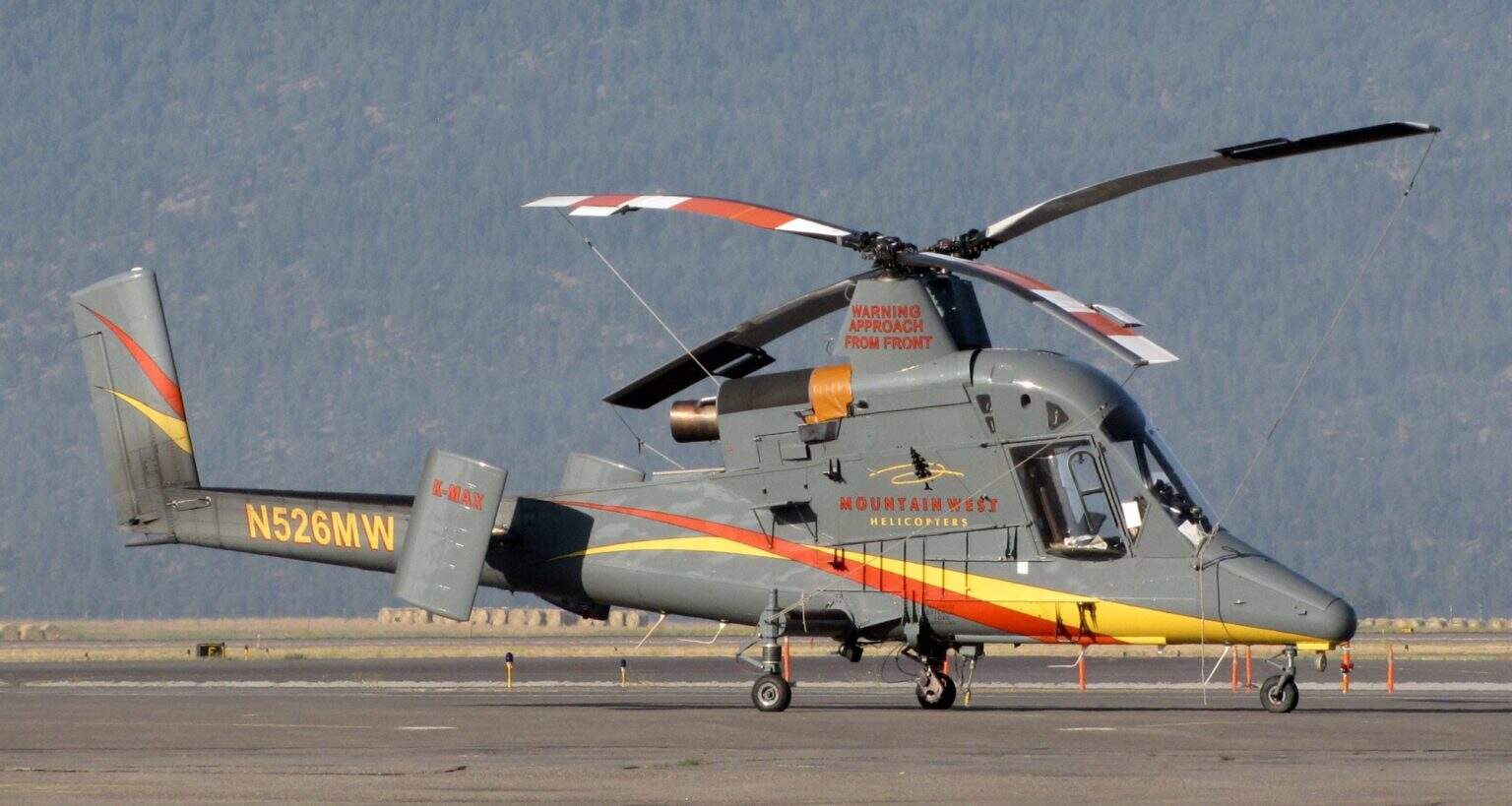
The K-MAX is a synchropter. Two main rotors sit side by side on masts angled 25 degrees apart, and their blades intermesh without touching.
The rotors turn in opposite directions, so their torque cancels out. That removes the tail rotor, and all of the engine’s power goes into lift.
Kaman had built this layout for decades, most famously in the HH-43 Huskie of the 1950s and 1960s. Pilots trained for the K-MAX in an HH-43.
The design suits sling work for three reasons:

The K-MAX lifts 6,000 lb on its hook at sea level on a standard day. That is more than the helicopter’s own empty weight.
It lifts about 5,000 lb to 8,000 ft density altitude at normal rated power. That is almost twice what a Bell 205 lifts, even though the Bell uses a different version of the same engine.
The hook is the reason for the shape of the helicopter. It slides on a curved bearing under the center of gravity, which improves load handling in flight.
Weight limits depend on how it is flown. With a jettisonable slung load the K-MAX can take off at 12,000 lb. Without an external load the limit is 6,500 lb.
The full specification table for the aircraft is on this page. A few figures need context.
The panel’s maximum payload is the useful load, meaning takeoff weight minus empty weight. The hook limit is lower at 6,000 lb, and it is the number operators plan around.
The engine is rated at 1,800 shp, but the transmission is only rated to 1,500 shp. Wikipedia gives the installed output as flat-rated to about 1,350 shp, which extends transmission life.
The speed figure on the panel is the never-exceed speed without a load, 100 kt · 115 mph · 185 km/h. With a load on the hook it drops to 80 kt. The K-MAX is a lifter, not a fast helicopter.
The row labeled wing span is the rotor diameter. Each rotor is 48 ft 4 in · 14.73 m across.
A single Honeywell T53-17A-1 turboshaft powers both rotors. The engine inlet has a particle separator.
The rotor blades have a Sitka spruce spar and a Nomex honeycomb trailing edge. Kaman chose wood for its tolerance of damage and fatigue, and for the experience it had from the HH-43 spar.
Control forces reach the blades through servo flaps, so the K-MAX needs no hydraulic flight controls. That saves weight and cost.
The K-MAX works in logging, aerial firefighting, construction and other heavy-lift jobs. Logging and construction mean picking up and setting down a load again and again, which is the work it was certified for.
Operators in Switzerland, Liechtenstein, Japan, New Zealand and Canada have flown it, as has the Colombian army.
By 2014 the fleet had flown 300,000 hours, at a reported cost of about $1,200 per flight hour.

Kaman and Lockheed Martin developed an unmanned, optionally piloted version that could deliver supplies to dangerous places. In December 2010 the Naval Air Systems Command awarded a $46 million contract for two aircraft.
The Marine Corps deployed a pair of unmanned K-MAXes to support ground forces in Afghanistan in the early 2010s. It lost the larger program to an unmanned version of the MD Helicopters MH-6 Little Bird.
Kaman flight-tested an optionally piloted K-MAX TITAN in 2021, but no production followed.

Kaman built 60 K-MAX helicopters over about 30 years. It built 38 from 1991 to 2003, then shut the line when sales fell.
In 2015 Kaman announced it would restart production to fill an order for 10 aircraft. The first new helicopter flew in May 2017 and was delivered two months later to a customer in China.
In January 2023 Kaman announced it would end K-MAX and K-MAX TITAN production that year. It cited low demand, uneven yearly deliveries, low profit and the working capital needed to build them.
Kaman said it would keep supporting the fleet with spare parts, repairs and training.
Not every K-MAX is still flying. By January 2015, 11 were no longer airworthy, some written off in accidents.
Kaman estimated the price of a new K-MAX at $7.5 million to $8.5 million when it restarted production in 2015. The panel on this page shows $8 million. Kaman no longer builds the helicopter, so there is no current list price.
It is used for external load work: logging, aerial firefighting, construction and heavy transport. An unmanned version was also tested for military resupply.
Kaman built 60 K-MAX helicopters in total, 38 of them by 2003. Some of the early aircraft have since been written off or retired, so fewer than 60 are in service.
It lifts 6,000 lb on the hook at sea level on a standard day. About 5,000 lb can be lifted to 8,000 ft density altitude at normal rated power.
It has two intermeshing main rotors that turn in opposite directions. Their torque cancels, so no tail rotor is needed and all engine power goes into lift.
No. Kaman announced in January 2023 that it would stop building the K-MAX and K-MAX TITAN that year. It continues to support the helicopters in service.
Sources and references used for research and fact-checking.