

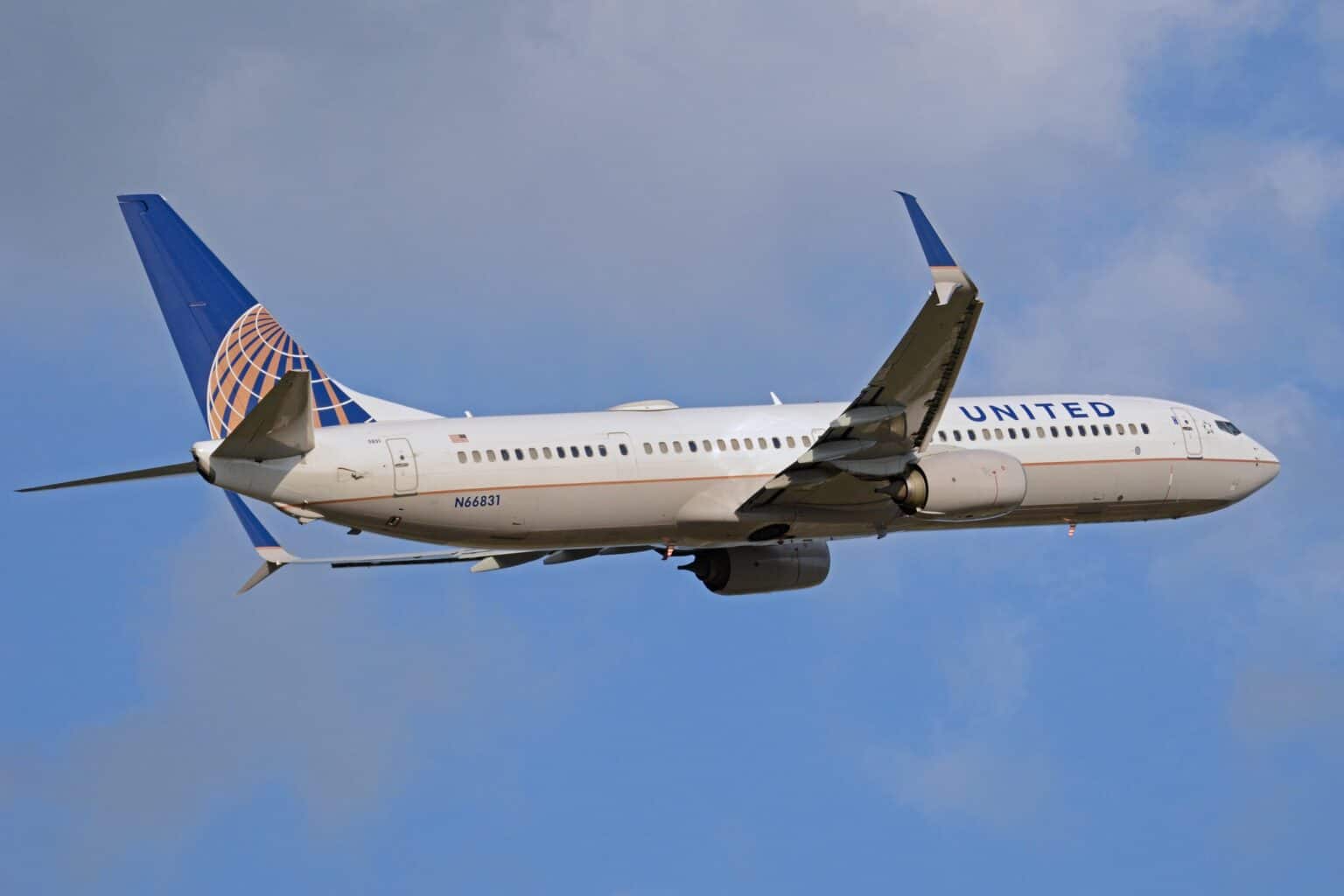
United Airlines flight UA2746, a Boeing 737-900ER bound for Washington Dulles, declared an emergency about 30 minutes after leaving Orlando on September 25, 2026, and diverted to Jacksonville. The crew reported an engine issue, AIRLIVE reported, and the jet was on the ground in Jacksonville a little over an hour after pushing back.
United has not said what went wrong or how many people were on board. At the time of writing on September 25, neither United nor the FAA had published a statement.
What happened on UA2746
The aircraft, a Boeing 737-900ER registered N66831, pushed back from gate 40 at Orlando International at 8:51 a.m. EDT, according to FlightAware. It was due at Dulles at 11:13 a.m.
About half an hour into the flight, the crew selected transponder code 7700 and stopped the climb at 22,000 feet, AIRLIVE reported. A later update said the crew had reported an engine issue, citing AIRLIVE’s own source rather than the airline.
By 9:39 a.m. EDT the flight was diverting to Jacksonville. It touched down on runway 08 at 10:03 a.m. and reached gate A1 at Jacksonville International at 10:10 a.m., according to AIRLIVE and FlightAware.
Jacksonville is about 144 miles (232 km) north of Orlando, in the direction the flight was heading. Dulles, the planned destination, is another 631 miles (1,016 km) beyond it.
N66831 was built in 2014 and is powered by CFM International CFM56-7B27E engines, according to the FAA aircraft registry. The registry lists it by its full Boeing model designation, 737-924ER.
United appears to have swapped aircraft rather than wait on N66831. Flightradar24 lists a second United 737-900ER, N78448, to fly UA2746 on from Jacksonville to Dulles, with an estimated departure of 1:11 p.m. EDT.
What is not confirmed
United Airlines has not issued a public statement on UA2746. The engine issue comes from a source cited by AIRLIVE, not from the airline, and it has not been reported whether the crew shut an engine down. The number of people on board has not been published. The timings above come from flight tracking data and AIRLIVE.
What a 7700 and an engine issue mean on a twin
Code 7700 is the general emergency signal among transponder squawk codes. The FAA’s Aeronautical Information Manual tells pilots to select it in a distress or urgency condition, and says it normally triggers an alarm or special indicator at every radar control position.
The code does not say what the problem is. It covers a medical emergency as readily as a mechanical fault, so the squawk alone does not reveal the cause.
An engine issue also covers a wide range. It can mean an engine that failed or was shut down, or an abnormal indication on an engine that kept running, and the AIRLIVE report does not say which it was.
The difference matters under FAA rules. Under 14 CFR 121.565, when an engine fails or is shut down to prevent damage, the captain must land at the nearest suitable airport in point of time.
The rule lets a captain fly on to an airport of their choosing only on aircraft with three or more engines. A two-engine 737 gets no such latitude, and a captain who lands anywhere other than the nearest suitable airport must file a written report explaining why.
Crews do shut engines down as a precaution. On July 30, a TAP Air Portugal A320neo shut down an engine on climbout after signs of low oil pressure and turned back to Lisbon.
Will the NTSB look at it?
Not necessarily. Under 49 CFR 830.5, an operator must notify the NTSB immediately after certain serious incidents, and a single engine problem on a twin does not automatically qualify.
The list includes an in-flight fire, an internal turbine engine failure that throws debris out of anywhere but the exhaust, and, on large multiengine aircraft, a sustained loss of thrust from two or more engines. If UA2746’s problem matches nothing on that list, the rule requires no immediate notification to the NTSB.
What the crew saw, and what United’s inspection of N66831 finds, will only be known if the airline or a regulator says more.
Sources and references used for research and fact-checking.
Get the Newsletter
The latest aviation news and stories sent to your inbox.
About the Author

Tim is the owner and lead editor of AeroCorner since 2019, overseeing aviation content covering aircraft, airlines, airports, and the broader aviation industry. Through years of researching, writing, editing, and publishing aviation-focused content, he has developed extensive practical knowledge of commercial aviation and air travel. Based in Asia and a frequent traveler himself, Tim also brings firsthand passenger experience to AeroCorner’s coverage. Outside of publishing, he has also explored aviation firsthand through hands-on flight training in New Zealand.