

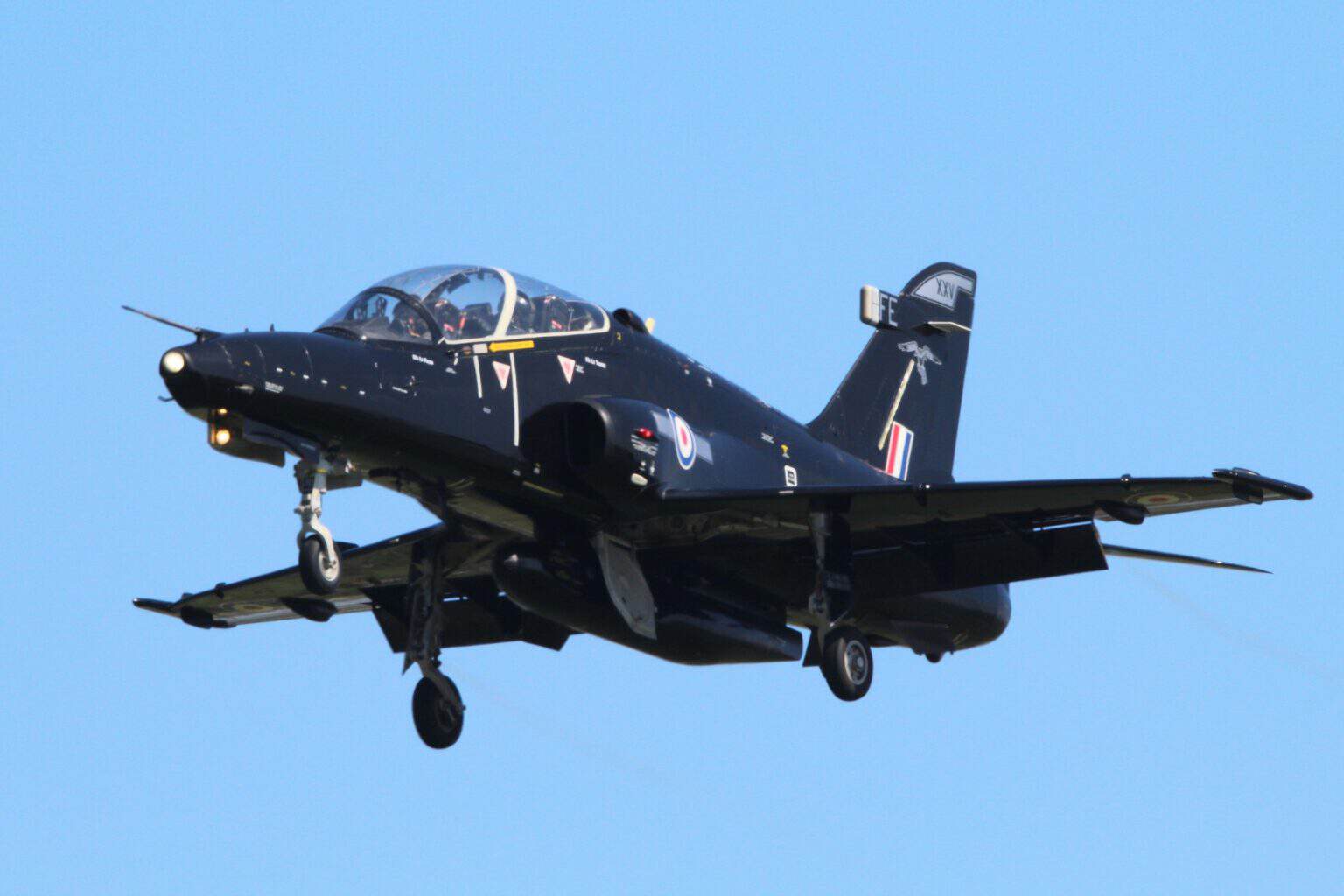
A Royal Air Force Hawk T2 advanced jet trainer crashed into farmland near Pencarnisiog, on the Welsh island of Anglesey, shortly after taking off from RAF Valley on Wednesday, September 23, 2026. Both pilots ejected and were treated for minor injuries.
That evening the RAF temporarily paused all Hawk T1 and Hawk T2 flying as a precaution while a formal investigation begins. The pause halts the UK’s advanced fast-jet training and also covers the Red Arrows, who fly the older T1.
What Happened Near RAF Valley
The jet left RAF Valley at lunchtime with a trainee and an instructor on board. Station commander Group Captain Gez Currie told the BBC it was “a trainee, with a highly experienced instructor on a routine sortie, across the Anglesey area.”
An eyewitness told North Wales Live he saw an orange flame as the jet accelerated down the runway. He said it climbed steeply, pitched sharply twice, and the crew ejected at what he estimated was about 800 feet.
The aircraft came down in a field and burned. North Wales Police said the two pilots were being treated for what were thought to be minor injuries, with no reports of wider damage or injuries.
Currie said the pilot would have pointed the jet at what they believed was open field, “in order to avoid built-up areas and anybody on the ground.” He added that it was “far too early to even suggest what has happened.”
Footage published after the crash appears to show fluid streaming from the upper fuselage and igniting as the jet departed, The Aviationist noted. The RAF has not given a cause.
On September 24 the RAF said both pilots were doing well, “in extremely good spirits” and expected to make a full recovery, Forces News reported. Martin-Baker, which makes the jet’s ejection seats, has logged the escape on its public list of ejection notices.
Why a Hawk Pause Reaches So Far
The BAE Hawk T2 is the advanced trainer that RAF and Royal Navy fast-jet students fly before moving to front-line types such as the Typhoon and F-35. It is flown by IV Squadron and XXV(F) Squadron at RAF Valley and powered by a single Rolls-Royce/Turbomeca Adour Mk.951 turbofan.
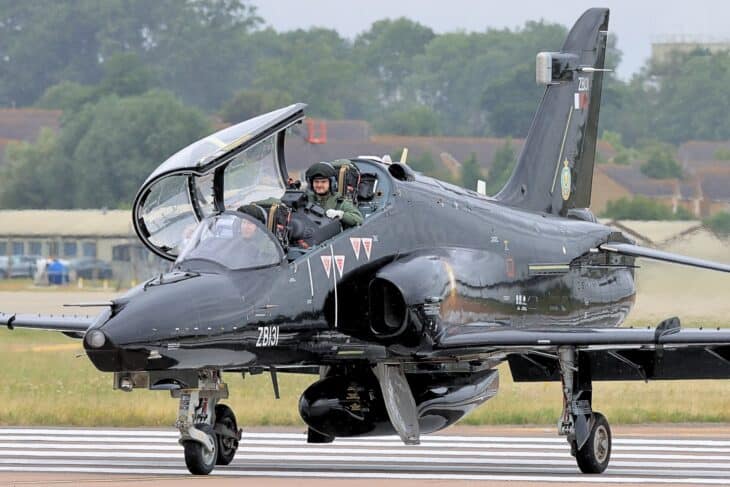
The UK ordered 28 T2s under a 2006 contract, and the type became fully operational in 2009. FlightGlobal reports this is the first T2-standard Hawk the UK has lost.
That fleet has struggled with availability before. In September 2022 the Ministry of Defence told Parliament that a fault in the engine’s Safran-made low-pressure compressor had led it to remove a number of engines from service as a precaution.
Its initial assessment was that the shortfall would affect UK fast-jet training output for the next three years. Richard Knighton, then Chief of the Air Staff, said in 2025 that the RAF got “about half of what we should get” from the jet, Breaking Defense recalled.
The Ministry of Defence asked industry for information on a replacement trainer in August 2026. Contenders include the T-7A offered by BAE Systems, Boeing and Saab, Leonardo’s M-346, Lockheed Martin’s TF-50 and Turkish Aerospace’s Hurjet.
What the Pause Covers
The RAF said it had “temporarily paused Hawk T1 and Hawk T2 flying operations” as a precautionary measure. According to the BBC, the Ministry of Defence confirmed that the Hawk squadron at RAF Leeming in Yorkshire has stopped flying too.
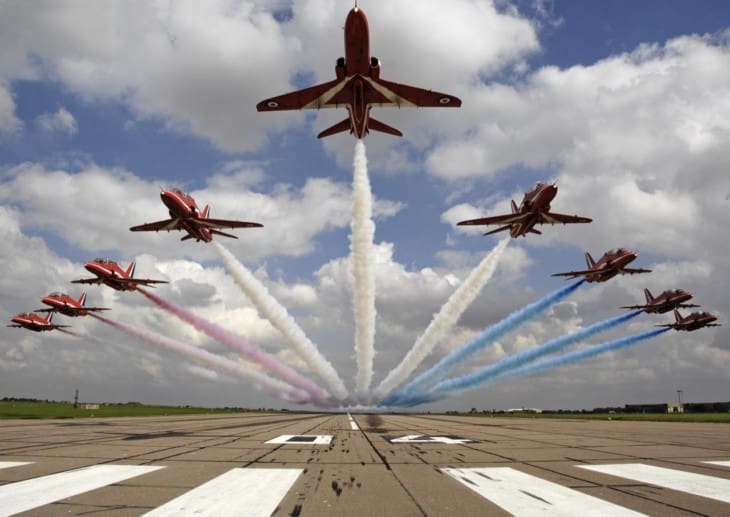
The Red Arrows, based at RAF Waddington, are included. The team was not due to fly again until the Le Touquet Airshow in France this weekend, and it is not known when the restriction will lift.
What is not known yet
The cause of the crash, how long the pause will last, and whether it affects the Red Arrows’ weekend appearance at Le Touquet. The RAF says the investigation is in its early stages. This story reflects what was public as of September 25, 2026.
Pausing a whole fleet after an unexplained loss is a standard precaution: it keeps the other jets on the ground until investigators can rule out a fault they might share. A short pause costs training sorties, while a longer one would add to the backlog in a pipeline that has been under strain since 2022.
Sources and references used for research and fact-checking.
Get the Newsletter
The latest aviation news and stories sent to your inbox.
About the Author

Tim is the owner and lead editor of AeroCorner since 2019, overseeing aviation content covering aircraft, airlines, airports, and the broader aviation industry. Through years of researching, writing, editing, and publishing aviation-focused content, he has developed extensive practical knowledge of commercial aviation and air travel. Based in Asia and a frequent traveler himself, Tim also brings firsthand passenger experience to AeroCorner’s coverage. Outside of publishing, he has also explored aviation firsthand through hands-on flight training in New Zealand.