

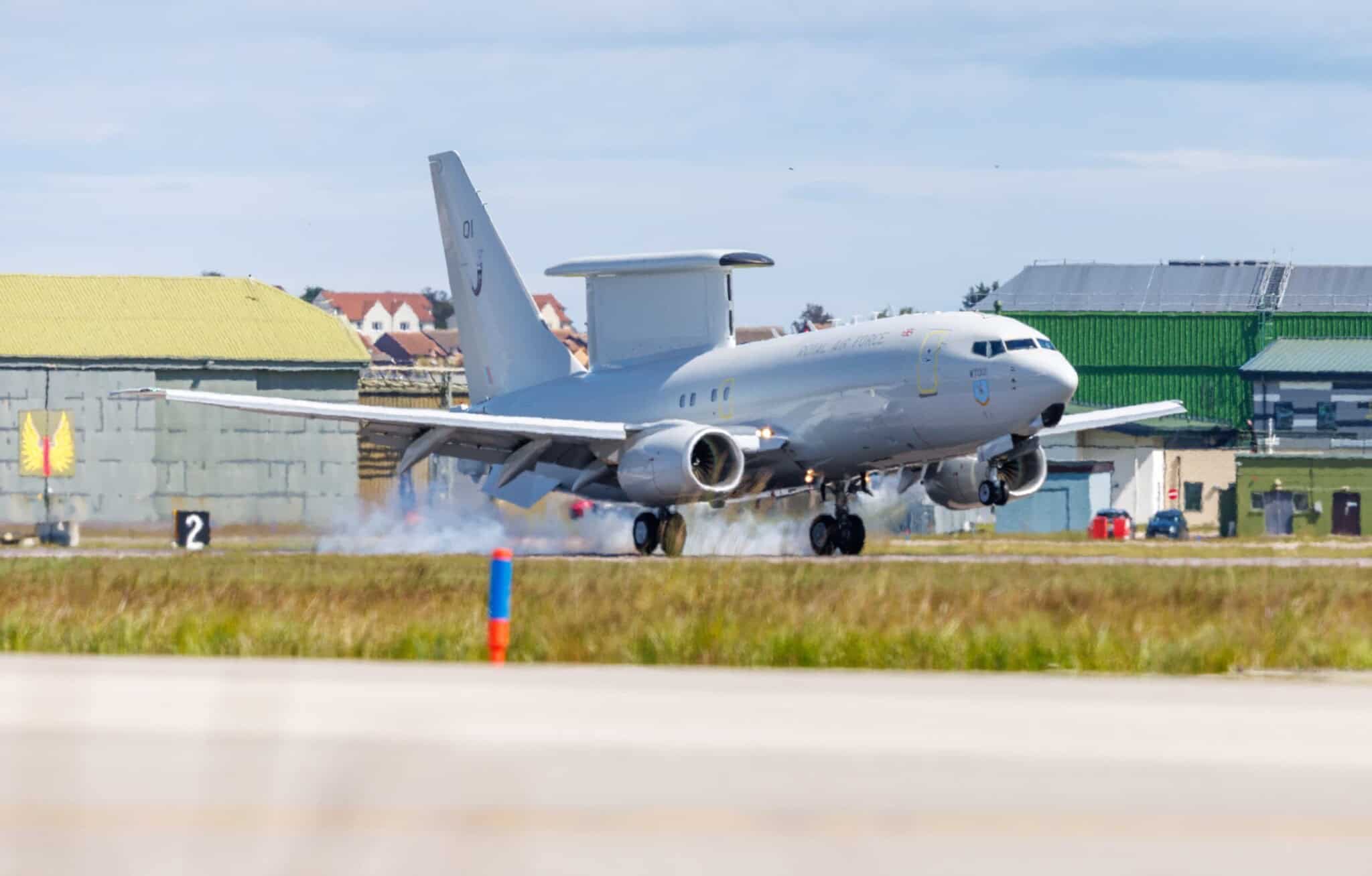
On July 15, 2026, the second of the Royal Air Force’s three Boeing E-7 Wedgetail early warning aircraft made its first flight. It lifted off from Birmingham Airport in unpainted green primer for a functional check flight of about two hours.
Boeing confirmed the flight the following day, and it was first reported by FlightGlobal and Aviation Week. The aircraft, designated WT002, is the second airframe converted from a Boeing 737 into the RAF’s new airborne surveillance platform.
What flew, and what comes next
WT002 was converted by STS Aviation Services at Birmingham Airport. There a former passenger 737 is stripped and rebuilt with the Northrop Grumman MESA radar and mission systems that define the Wedgetail. According to Boeing, the July 15 flight was the jet’s first outing since that conversion.
It flew in bare green primer because it has not yet been painted. The aircraft will next go for painting into RAF markings and the colours of No. VIII Squadron, then continue through test and evaluation ahead of delivery.
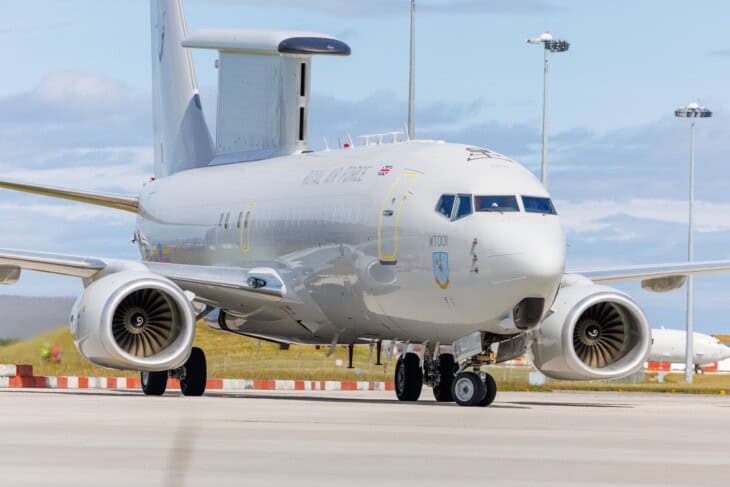
The flight came alongside a separate £127.5 million support contract awarded to Boeing Defence UK to sustain the three-aircraft fleet. Boeing said the work will support roughly 180 existing jobs in Scotland and create between 60 and 80 new roles plus four apprenticeships.
“This work not only supports critical defence capabilities but also creates high-value UK jobs,” said Thom Breckenridge, managing director of Boeing Defence UK. The fleet is based at RAF Lossiemouth in Scotland, where the first aircraft, WT001, arrived in May 2026 and is expected to enter service during 2026.
Why this program matters
The Wedgetail is an airborne early warning and control aircraft, essentially a flying radar station. It watches vast stretches of airspace and sea, tracks hostile aircraft, missiles and drones from long range, and directs friendly fighters and other assets.
It is the kind of capability that only a handful of nations operate, and it shapes how an entire air force fights. Boeing has described the MESA radar as able to detect targets from more than 300 miles away.
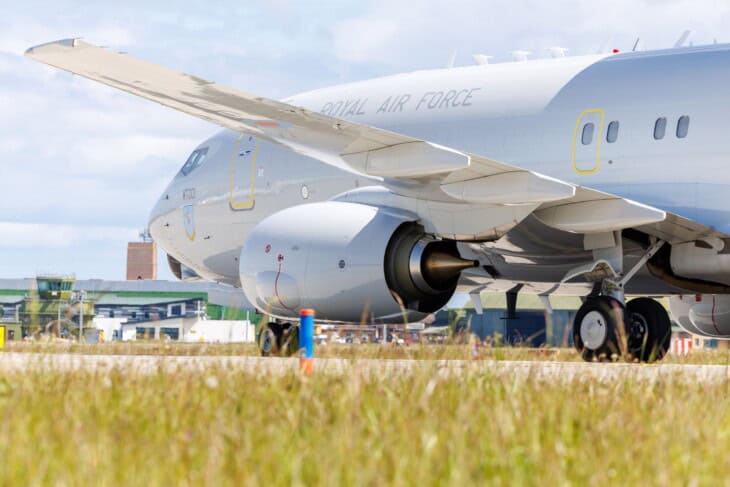
For the RAF, WT002 getting airborne matters because Britain has been without this capability for years. The UK retired its aging E-3D Sentry AWACS fleet in 2021 and scrapped the aircraft.
That left a multi-year gap in airborne early warning, forcing reliance on allied AWACS from NATO, France and the United States. Getting a second Wedgetail flying is a concrete step toward closing that gap with a home fleet.
The number everyone argues about: three
The UK originally signed for five E-7s in 2019, then cut the order to three in the 2021 defence review. A parliamentary committee later called that reduction “an absolute folly,” noting three aircraft cost roughly 90 percent of the five-jet price while leaving thin coverage for maintenance, training and deployment at once.
The program has been a case study in how complicated modern military procurement has become. Boeing sits at the center of it as one of the world’s largest military contractors.
It even survived a wobble in confidence when the US Air Force moved to cancel its own E-7 plans, a decision the UK did not follow. Britain has stayed with the aircraft, and is now set to build two rapid-prototype E-7A airframes for the United States. That would be the first time in more than 50 years the UK has assembled a military aircraft for the US Air Force.
Converting an off-the-shelf jetliner into a frontline sensor platform shows how much modern airpower leans on adapted commercial airframes rather than clean-sheet designs. It is a different route to the scale seen among the biggest military airplanes, and it is why a single 737-based aircraft in bare green primer counts as national news.
Still not in service
WT002’s first flight is an early milestone, not an operational one. The jet still needs painting, test and evaluation, and formal delivery. Even the lead aircraft, WT001, is only expected to enter RAF service during 2026.
Sources and references used for research and fact-checking.
- UK Ministry of Defence (GOV.UK), Multi-billion-pound deal for early warning radar aircraft
- Royal Air Force, RAF and Boeing UK Welcome the First Wedgetail Aircraft to RAF Lossiemouth
- UK Ministry of Defence (GOV.UK), Jobs boost as UK set to build military aircraft for United States for first time in over fifty years
Get the Newsletter
The latest aviation news and stories sent to your inbox.
About the Author

Tim is the owner and lead editor of AeroCorner since 2019, overseeing aviation content covering aircraft, airlines, airports, and the broader aviation industry. Through years of researching, writing, editing, and publishing aviation-focused content, he has developed extensive practical knowledge of commercial aviation and air travel. Based in Asia and a frequent traveler himself, Tim also brings firsthand passenger experience to AeroCorner’s coverage. Outside of publishing, he has also explored aviation firsthand through hands-on flight training in New Zealand.