

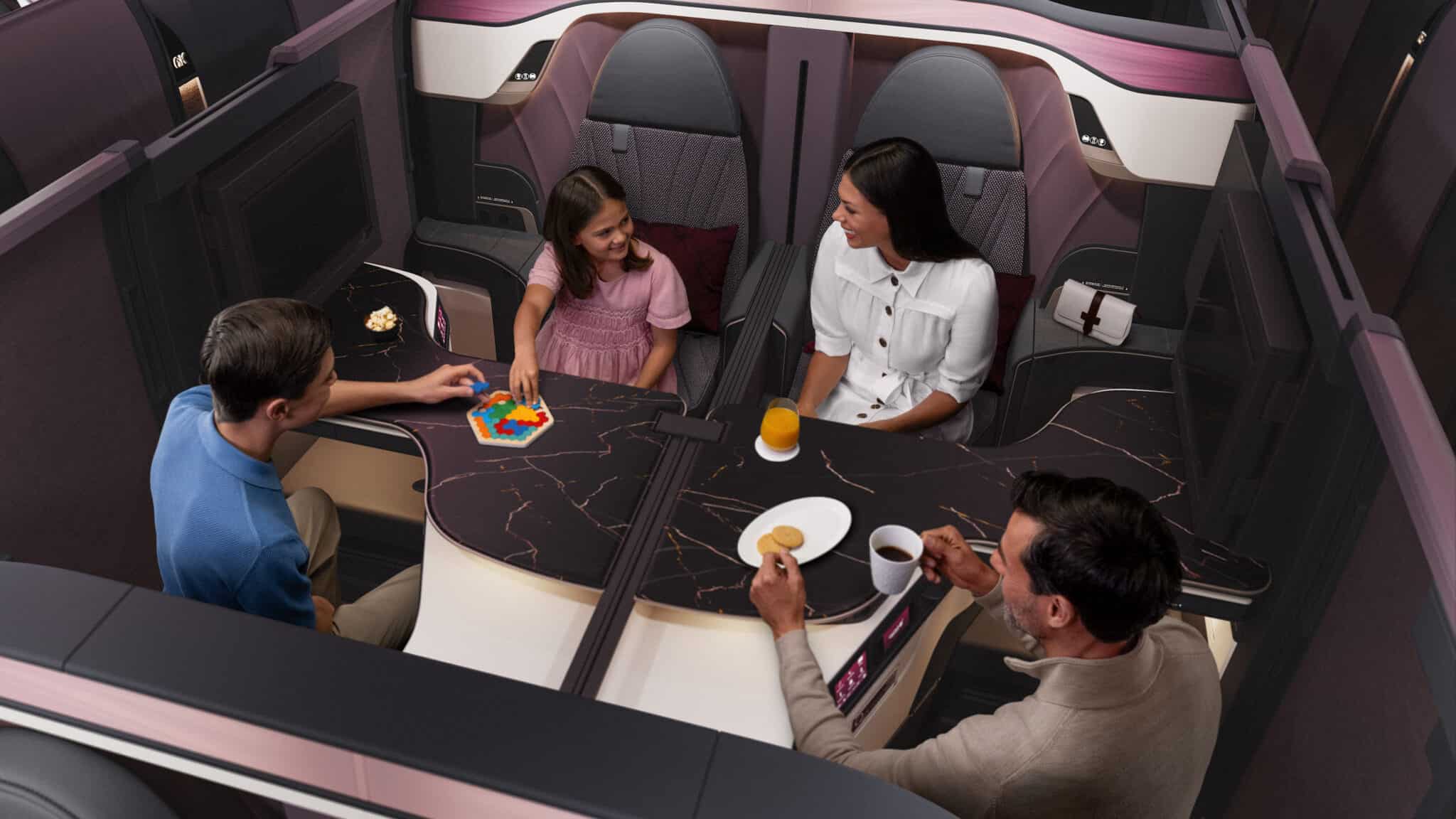
Qatar Airways will launch its Qsuite Next Gen business class on the Airbus A350-1000 in mid-2027, Group CEO Hamad Ali Al-Khater said in remarks reported by Executive Traveller this week. The seat was unveiled in July 2024 for the Boeing 777-9 and was due to fly by 2025.
The new timeline, picked up on October 24, 2026 by One Mile at a Time, puts the cabin well behind its original 2025 target, and on an Airbus rather than the Boeing it was designed to launch on.
What Qatar Airways has said
According to the Executive Traveller report as relayed by One Mile at a Time, Al-Khater said the A350-1000s Qatar still has to take delivery of will carry the new suites from mid-2027. One Mile at a Time puts those remaining deliveries at roughly a dozen aircraft.
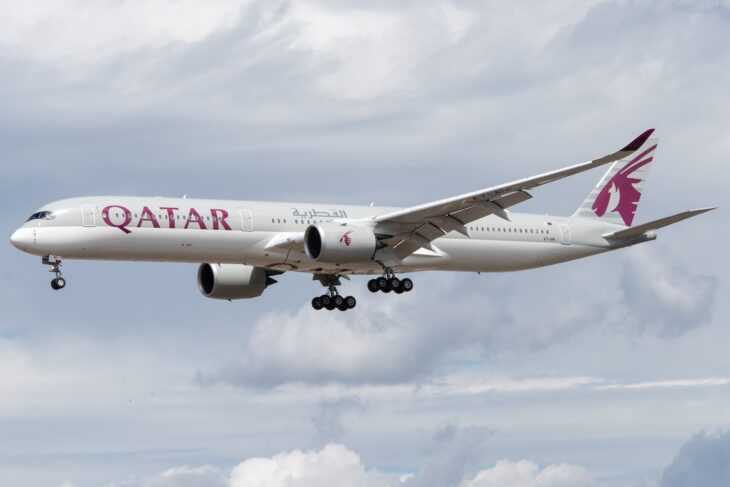
Neither report gives a launch route or a first flight date for the cabin, and Qatar Airways has not announced one.
The A350 switch itself has been coming for some time. In April 2025, Al-Khater’s predecessor, Badr Mohammed Al-Meer, told Bloomberg that the launch would now likely take place on the A350-1000 rather than the 777X, Gulf Times reported. What is new is a date from the airline’s current chief executive.
Al-Khater took over as Group CEO on December 7, 2025, ending Al-Meer’s two-year tenure, Gulf News reported.
The seat Qatar unveiled at Farnborough
Qatar Airways revealed Qsuite Next Gen on July 22, 2024, the first day of the Farnborough International Airshow. Its release said the cabin would be “featured on-board the Qatar Airways Boeing B777-9 aircraft by 2025.”
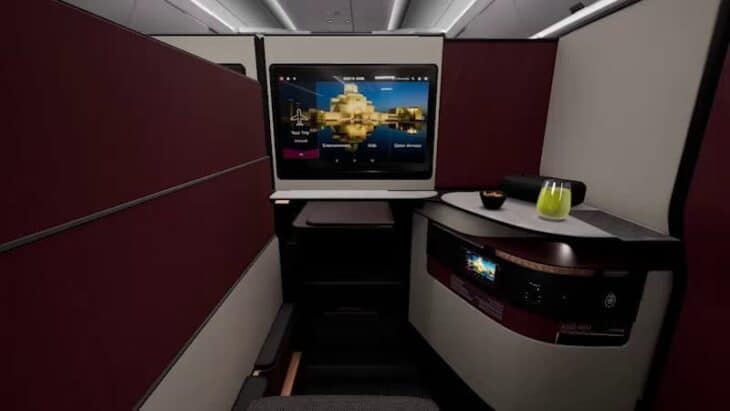
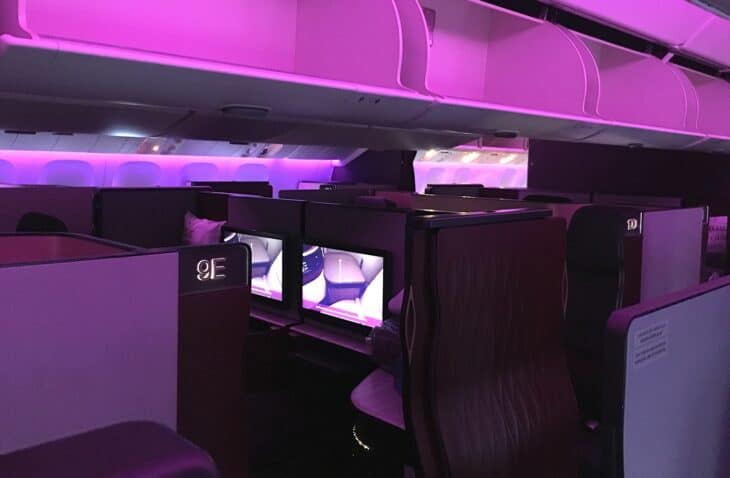
The headline feature is a movable 4K OLED Panasonic Astrova entertainment screen, which Qatar called a first for any airline. Sliding it aside opens up a shared space for up to four passengers in a Quad Suite, or two in the new Companion Suite by the windows.
The airline also listed taller, digitally controlled privacy dividers, larger lie-flat and double beds, and touchscreen controls for lighting and privacy. The layout keeps the staggered, alternating seats of today’s Qsuite.
Why the 777-9 lost the launch
The Boeing 777-9 is still not certified. Boeing took a $4.9 billion charge in its third-quarter 2025 results when it moved first delivery to 2027, and in its second-quarter 2026 results it said it continues to anticipate a 2027 first delivery.
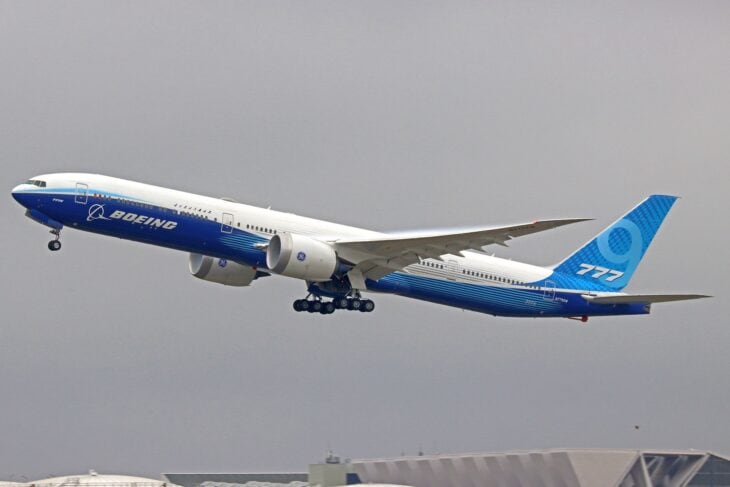
That schedule has little room left. A single seal inside the GE9X engine has already held up the 777-9’s ETOPS testing, and the type was originally meant to enter service in 2020.
Qatar has a lot riding on the jet. In May 2025 it ordered 30 more 777-9s alongside 130 787s, with options on 50 more 787s and 777Xs, in what Boeing called the largest widebody order in its history.
The Airbus A350-1000, by contrast, is in production and already flies in Qatar’s fleet. Gulf Times noted in 2025 that Qatar was the type’s launch customer, so the new seat goes onto an airframe the airline knows well.
What it means for passengers
Booking a Qatar A350-1000 in late 2027 will not guarantee the new seat. Only newly delivered jets are in the plan, and One Mile at a Time noted there do not appear to be plans to retrofit the A350-1000s already flying.
That would leave two different business class seats on one aircraft type, and today’s Qsuite already does not cover every long-haul jet in the fleet, according to One Mile at a Time. Travelers chasing the new cabin will need to check the seat map flight by flight once it launches.
For now, a mid-2027 start on the A350-1000 is the only date the airline’s chief executive has put on the cabin.

Sources and references used for research and fact-checking.
- Qatar Airways, Qatar Airways Unveils Highly Anticipated 'Qsuite Next Gen' on the First Day of the Farnborough International Airshow 2024
- Boeing, Boeing and Qatar Airways Announce Historic Order for up to 210 Widebody Airplanes
- Boeing, Boeing Reports Third Quarter Results (2025)
- Boeing, Boeing Reports Second Quarter Results (2026)
Get the Newsletter
The latest aviation news and stories sent to your inbox.
About the Author

AeroCorner News is the aviation news desk of AeroCorner.com. It covers accidents and incidents, safety rulings, airline and airport disruption, and new aircraft. It works from primary sources such as the NTSB, FAA, EASA and the manufacturers' own announcements.