

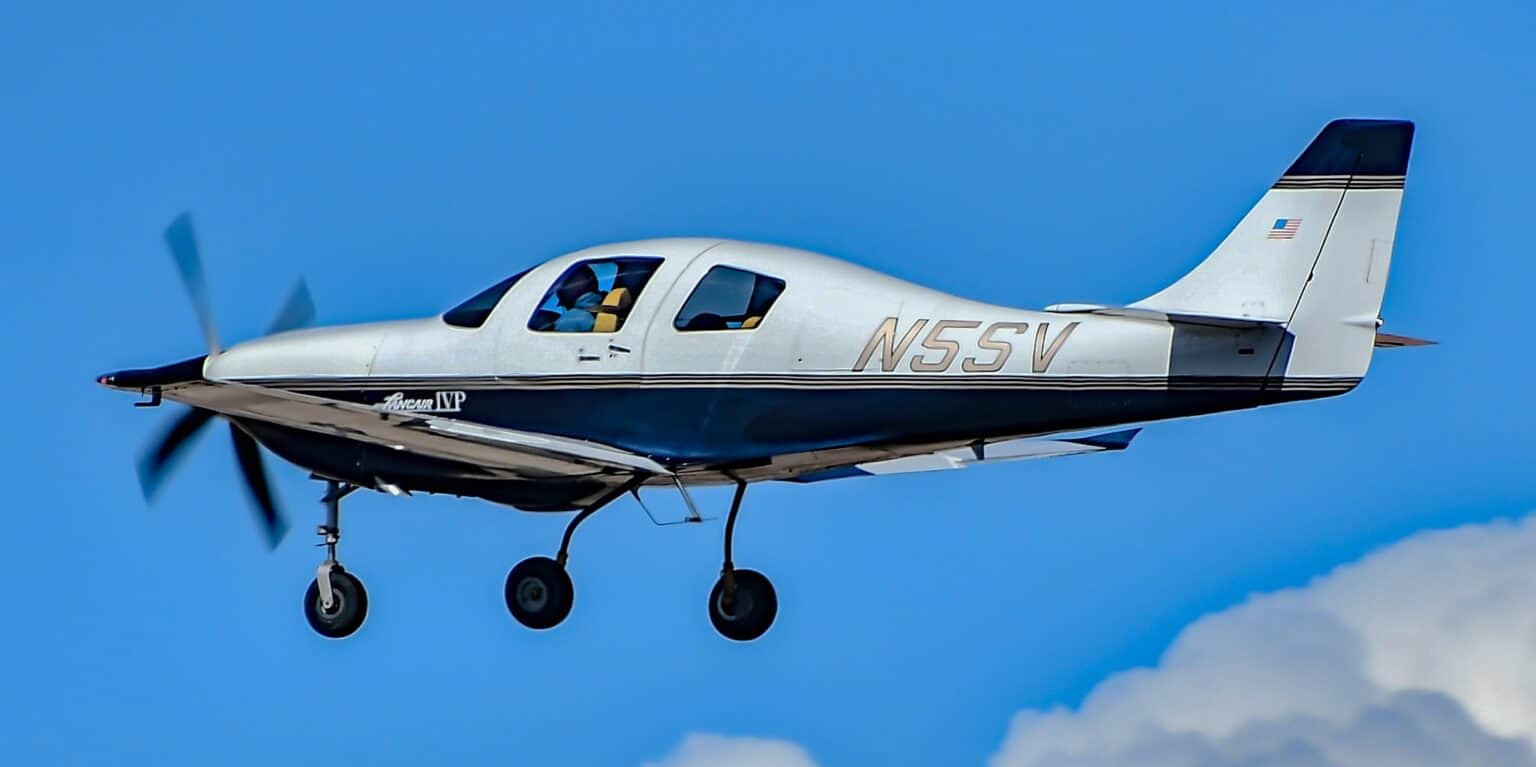
Lancair IV-P N5SV took off from Fort Worth’s Hicks Airfield at about 9:51 a.m. on October 7, 2026, and crashed into power lines and a roadside ditch near Haslet, Texas, at 9:52 a.m., according to the National Transportation Safety Board’s preliminary report. The report, case CEN27FA006, was released on Friday, October 23.
The pilot, the only person on board, was killed. The Tarrant County Medical Examiner’s Office identified him as John Unangst, 67, the Dallas Morning News reported.
What the flight track shows
Investigators reviewed commercially available ADS-B data, which shows the flight leaving Hicks Airfield (T67) at about 9:51 a.m. central daylight time. The airplane climbed to 875 feet above sea level and then entered a left turn.
It kept climbing in the turn to 1,000 feet while slowing to a ground speed of 84 knots, then descended, the NTSB wrote.
A track plot in the report labels each data point. Its ground speed reached 113 knots before falling away in the turn, and the last labeled point comes 36 seconds after the plane was rolling at 66 knots on the runway.
The report gives the altitudes above sea level, not above the ground, and does not say how high above the runway the plane climbed. It lists Haslet, Texas, as both the departure point and the destination, and no flight plan was filed.
Power lines, a ditch and a postimpact fire
The Lancair struck power lines on the south side of a road. Pieces of its composite propeller, along with fiberglass and acrylic fragments, were found beneath the lines.
A ground scar began about 3 feet from the road’s north edge and ran into a ditch, where investigators found an impact crater. The main wreckage, with the fuselage, both wings, the engine and parts of the propeller, came to rest upright on the north side of that ditch.
A postimpact fire consumed most of the main wreckage. The tail surfaces separated and came to rest against a brick privacy wall to the north, with no sign of fire damage.
Fort Worth Alliance Airport, 6 nautical miles away, recorded clear skies, 10 miles of visibility and a temperature of 75°F (24°C) one minute after the crash, the report shows.
The engine question is still open
On the day of the crash, an NTSB spokesperson told KERA that “preliminary information indicates the airplane had engine issues, and it turned back toward the airport,” as the Fort Worth Report carried it. That was the basis of our first report on the N5SV crash.
The preliminary report does not mention the engine’s condition or say whether the pilot was trying to return to the runway. It says only that the wreckage was moved to a secure location for further examination.
A preliminary report is not a finding
The NTSB marks every page of the report as preliminary and subject to change. It describes the flight path and the wreckage but assigns no cause. The probable cause comes only in the final report, after the Board approves it.
FAA registry records list N5SV as an experimental amateur-built airplane, a kit aircraft completed in 2000, registered to Plane Metrics LLC of Fort Worth. The NTSB report confirms the amateur-built status and names Plane Metrics as the operator of the personal flight.


Why a turn after an engine problem is so dangerous
If the engine did falter, the pilot had very little time, since the whole flight lasted about a minute. An FAA safety training aid says research indicates a higher chance of survival when a pilot continues straight ahead after an engine failure on takeoff.
Turning back takes more than 180 degrees of turn once the turning radius is counted, the FAA notes. A turn at low altitude and low airspeed can lead to a stall and spin.
The same guidance tells pilots to identify power lines, trees and towers before departure, since they become obstructions in an emergency. Whether any of that played a part here is for the NTSB to decide.
The same morning, a Van’s RV-7A crashed after takeoff from Petaluma, California, killing two people.
What happens next
The NTSB classed the case as a Class 3 investigation, led by investigator-in-charge Ezra Olson with the FAA’s North Texas Flight Standards District Office taking part. The agency says Class 3 investigations look for the safety issues behind an accident and end in a Board-approved final report naming the probable cause.
Unlike the more limited Class 4 cases, which the NTSB says it closes within six months, its description of Class 3 cases gives no timeline. This is the second fatal crash near Hicks Airfield in less than a year, after a King Air went down near the field in October 2025.
Sources and references used for research and fact-checking.
- NTSB, Aviation Investigation Preliminary Report CEN27FA006 (Lancair IV-P N5SV, Haslet, TX, Oct. 7, 2026)
- NTSB, Aviation Investigation Classification
- FAA Aviation Safety (FAASTeam / GAJSC), Aircraft Control After Engine Failure on Takeoff (training aid, January 2016)
- FAA Aircraft Registry, N-Number inquiry: N5SV
Get the Newsletter
The latest aviation news and stories sent to your inbox.
About the Author

AeroCorner News is the aviation news desk of AeroCorner.com. It covers accidents and incidents, safety rulings, airline and airport disruption, and new aircraft. It works from primary sources such as the NTSB, FAA, EASA and the manufacturers' own announcements.