

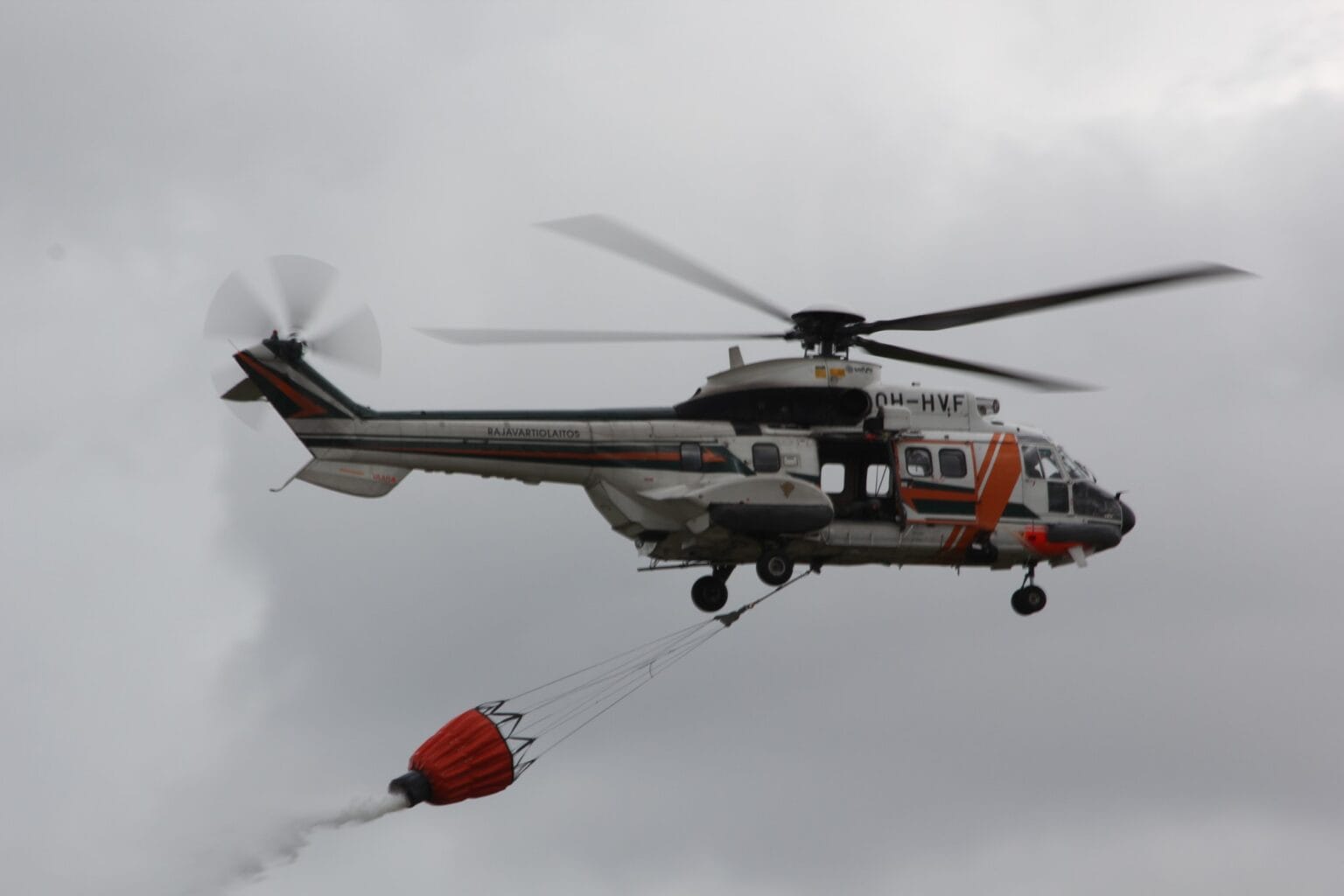
Super Puma N332N, the firefighting helicopter that crashed in Yosemite National Park on September 20, killing both pilots, had problems with its water bucket on an earlier flight that day, the NTSB says in its preliminary report. The Airbus AS332 L1 went down at about 1:56 p.m. PDT on the third water drop of its final flight.
The report, case WPR26FA346, is dated October 21 in the NTSB’s CAROL database and reached local coverage this week, including ABC30 Fresno. It follows the Dome Fire crash we reported the day it happened.
A bucket problem on an earlier flight
Earlier in the day, the pilots flew a 2.9-hour firefighting flight with an 800-gallon (3,030-liter) Nomad bucket on a 200-foot (61 m) longline. They made more than 25 drops before returning to their helibase at the end of that fuel cycle.


During that flight they had problems with the bucket, according to the NTSB. After landing, mechanics tightened the bucket’s air pressure regulator and pressure-checked the system.
Shortly afterward, the crew was asked to drop water on fires near helispot H-5, using Ostrander Lake as the dip site. The helicopter left the helibase at about 1:28 p.m. and headed first to the drop area, apparently to assess it.
Three drops, the last one fatal
Investigators rebuilt the flight from ADS-B and Spidertracks data and firefighters’ cell phone videos. The helicopter made three dips at the lake, sharing the site with two other helicopters, and the drop area lay about 2.25 nautical miles away.
The first load was less than full and went down as a trailing drop at about 1:45 p.m. On the second run, at about 1:50 p.m., the pilots made a spot drop on a dead tree that a ground crew marked with a strobe light, with the bucket just above a canopy the NTSB put at roughly 80 to 125 feet.
The third drop began at about 1:56:28 p.m., on the spot the ground crew wanted. The bucket was empty about three seconds later, and about one second after that the helicopter yawed to the left.
At 1:56:37 p.m., ADS-B showed a ground speed of 4 knots and a descent rate of about 1,344 feet per minute. The bucket appeared to fall almost vertically and touched the ground at about 1:56:38 p.m.
The cargo hook released about a second later, letting the longline fall, and the helicopter appeared to move forward. It struck trees at about 1:56:43 p.m., and the sound of impact followed about a second later.
What the audio and the wreckage show
Sound analysis of the videos put main rotor speed at about 101% near the drop, falling to about 96% near the end of the sequence. Engine gas-generator speed rose from about 90% before the drop to 96.9% shortly afterward, then to about 101.2%.
The main wreckage lay at about 8,150 feet (2,480 m), roughly 500 feet (150 m) downslope from the flat ground of helispot H-5, among fir trees with a canopy 100 to 150 feet above the ground. It came to rest on its left side with the nose upslope, and a post-impact fire consumed most of the helicopter.
Most cockpit gauges were too badly burned to yield data, but the cockpit voice recorder was recovered and downloaded.
The bucket lay about 90 feet (27 m) west-northwest of the main wreckage, beside dirt that looked disturbed by a water drop. The cargo hook was found locked, which the NTSB says is consistent with a normal electronic release rather than use of the manual release.
The NTSB lists visual conditions, with clear skies and wind gusting to 16 knots at Mammoth Yosemite Airport, 35 nautical miles away.
Preliminary, not a cause
The report sets out the facts gathered so far and is subject to change. It does not link the earlier bucket problem to the crash or say why the helicopter went down. The wreckage is still being recovered, pending fire danger, and will be examined later; the probable cause comes in the final report.
What is new since the first reports
The NTSB’s time of 1:56 p.m. is about an hour earlier than the roughly 2:55 p.m. the FAA gave on the day, as AeroTime reported at the time. The report also confirms the registration, N332N, and the exact variant, the AS332 L1.
Both pilots worked for Precision, which named them after the crash and is a party to the investigation with the FAA, Airbus Helicopters, Safran and the US Forest Service. Greg King lived in Palmer, Alaska, ABC30 reported, and Ryan Cutter, 46, lived in Park City, Utah, according to KSL.
Why a bucket drop is a demanding moment
Water weighs about 8.3 pounds per gallon, so a full 800-gallon bucket carries roughly 6,700 pounds (3,000 kg). Emptying it in a few seconds changes the load on the helicopter almost at once, and in a spot drop like this one that happens at low speed over the trees.
This drop was made on the same spot as the second, over a canopy of roughly 80 to 125 feet, with the bucket hanging 200 feet below the helicopter. The report does not say how full the third load was, and it draws no conclusion about the descent, the yaw or the hook release.
Bucket work like this has a long lineage, covered in our history of aerial firefighting. The probable cause will come in the NTSB’s final report.
Sources and references used for research and fact-checking.
Get the Newsletter
The latest aviation news and stories sent to your inbox.
About the Author

AeroCorner News is the aviation news desk of AeroCorner.com. It covers accidents and incidents, safety rulings, airline and airport disruption, and new aircraft. It works from primary sources such as the NTSB, FAA, EASA and the manufacturers' own announcements.