

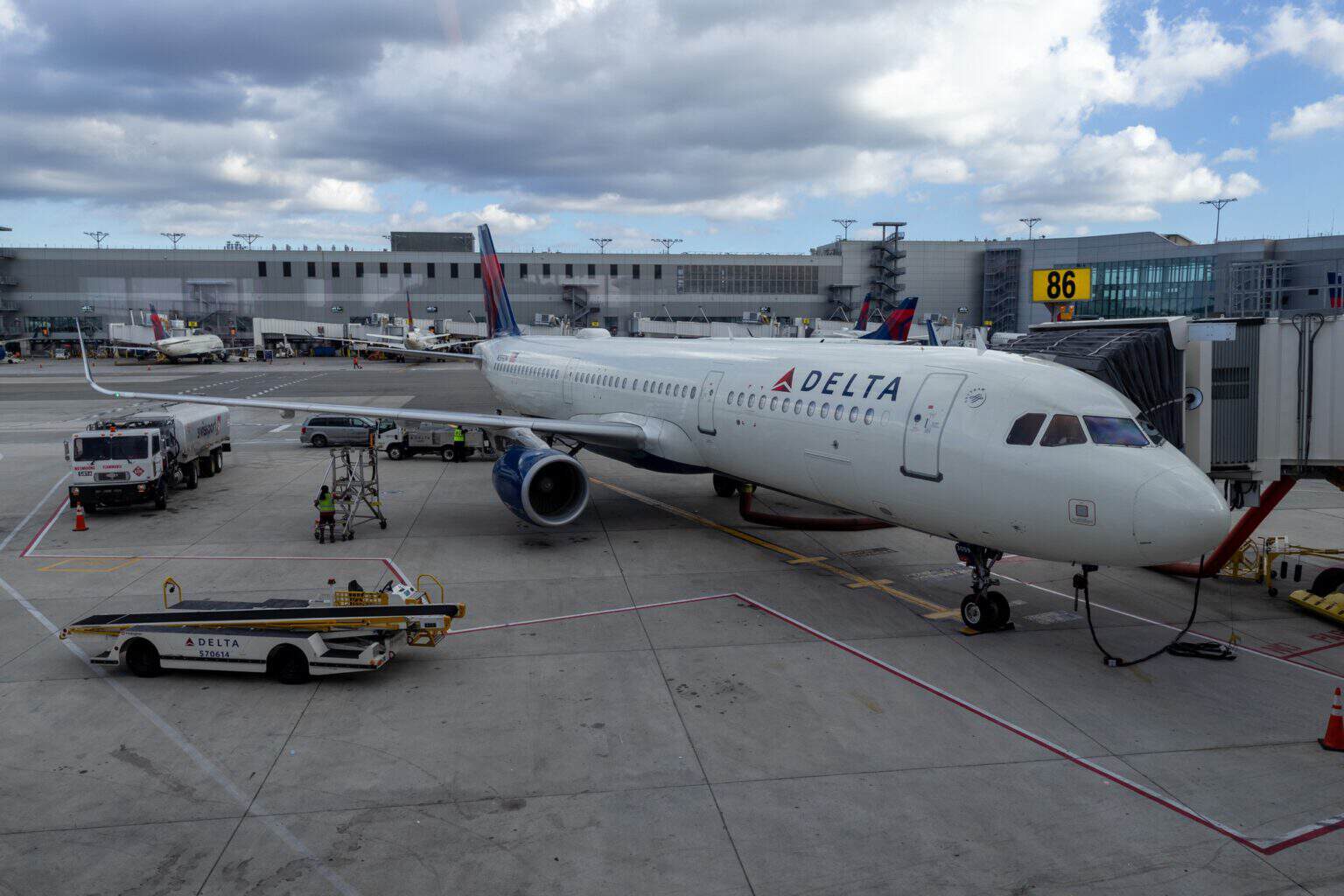
The FAA held some flights bound for New York LaGuardia, Newark Liberty and Houston Hobby on the morning of November 22, 2026, the Sunday before Thanksgiving, as low visibility cut into arrivals at all three airports. LaGuardia was hit twice in less than two hours.
All four low-visibility ground stops had been canceled by 9 a.m. ET, but the delays outlasted them. An FAA update at 9:05 a.m. listed departure delays of 76 to 90 minutes at Newark, and increasing.
Which flights the FAA held
The first LaGuardia stop went out at 6:46 a.m. ET and covered departures from airports under the Washington, New York, Cleveland and Boston en route centers. The FAA canceled it at 8:13 a.m., noting that the weather had improved to Category II minimums.
The relief was brief. At 8:21 a.m., with aircraft in holding stacks, the agency issued a second LaGuardia stop for departures from the Washington, Cleveland and Boston center areas.
Newark’s ground stop was narrower, taking in only the Washington center area. Hobby’s ground stop applied to departures from the Houston and Fort Worth center areas.

| Airport | Issued | Canceled | Average delay | Maximum delay |
|---|---|---|---|---|
| LaGuardia, first stop | 6:46 a.m. ET | 8:13 a.m. ET | 65 minutes | 95 minutes |
| LaGuardia, second stop | 8:21 a.m. ET | 9:00 a.m. ET | 77 minutes | 138 minutes |
| Newark | 8:18 a.m. ET | 8:43 a.m. ET | 26 minutes | 49 minutes |
| Houston Hobby | 6:35 a.m. CT | 7:37 a.m. CT | 29 minutes | 101 minutes |
The trouble was wider than those three airports. At 7:51 a.m. ET, the FAA warned of airborne holding and arrival delays of up to 30 minutes across the Northeast, including Boston, JFK, Philadelphia and the Washington-area airports.
It also switched on diversion recovery, its tool for handling diverted flights, for Hobby and the Northeast. The advisories warn that those flights are not automatically exempt from a ground stop or delay program.
Atlanta’s Delta-only ground stop and delay program on Sunday was a separate event, requested by the airline.
How thick the fog was
LaGuardia’s official weather report at 6:51 a.m. put prevailing visibility at zero, with an eighth of a mile (200 m) at the surface. Runway visual range on Runway 4, a measure of how far pilots can see along the runway, was 1,200 to 1,400 feet (370 to 430 m).
Newark reported mist and visibility of half a mile (800 m) at the same time. Hobby was down to an eighth of a mile in fog from 4:53 to 6:53 a.m. CT, and the FAA said it was below most operators’ minimums.

Why fog slows LaGuardia
Category II is a more precise version of the standard instrument landing system approach. The FAA’s pilot manual puts its usual limits at a 100-foot decision height and 1,200 feet (370 m) of runway visual range, against 200 feet and as little as 1,800 feet (550 m) for Category I.
LaGuardia does not offer that on every runway. Its Category II procedure is a special authorization approach to Runway 22, and it requires an approved operator plus either autoland or a head-up display used to touchdown.
Come in from the other end, on Runway 4, and the FAA’s chart calls for 4,000 feet (1,220 m) of runway visual range, or 2,400 feet (730 m) with a flight director or head-up display. Sunday’s readings at 6:51 and 7:51 a.m. were below both figures.
The wind at those times came from the northeast, which favors landing on Runway 4 and puts a tailwind behind anyone using Runway 22. The FAA’s advisories did not say which runway arrivals were using.
With limited exceptions, federal rules bar airline pilots from continuing past the final approach fix when reported visibility is below the procedure’s minimum. Those who cannot start the approach must wait for an improvement or go elsewhere.
Controllers also have less flexibility. When the ceiling is under 200 feet or runway visual range is under 2,000 feet, they must keep preceding landing and departing aircraft out of the localizer’s critical area as a plane nears touchdown, protecting the signal that guides it to the runway.
When arrivals back up this way, holding departures at their origin keeps more aircraft from joining the stack. The FAA’s traffic management order lists an airport below most arrival minimums as a reason for a ground stop.
What travelers should watch
The FAA’s 8 a.m. operations plan said further ground stops or delay programs were possible at LaGuardia until 7 p.m. ET, and at Newark, Teterboro and JFK after 2 p.m. Check FAA NAS Status and your airline before leaving for the airport.
National Weather Service forecasts updated at 9:18 a.m. ET called for better visibility at LaGuardia and Newark by noon, then rain and lower clouds again by about 5 p.m. A canceled ground stop can leave a backlog, so aircraft and crews may still run late after the sky clears.
Federal rules make no weather exception to your right to a refund. You qualify if your flight is canceled, or is now due to arrive at least three hours late on a domestic itinerary or six hours late on an international one, and you turn down the delayed flight, rebooking and any credit.
Sources and references used for research and fact-checking.
- FAA ATCSCC, Advisory 030: LGA ground stop, November 22, 2026
- FAA ATCSCC, Advisory 039: LGA ground stop extension
- FAA ATCSCC, Advisory 045: LGA ground stop canceled
- FAA ATCSCC, Advisory 048: second LGA ground stop
- FAA ATCSCC, Advisory 058: second LGA ground stop canceled
- FAA ATCSCC, Advisory 047: EWR ground stop
- FAA ATCSCC, Advisory 054: EWR ground stop canceled
- FAA ATCSCC, Advisory 031: HOU below most user minimums
- FAA ATCSCC, Advisory 035: HOU ground stop
- FAA ATCSCC, Advisory 037: HOU diversion recovery
- FAA ATCSCC, Advisory 049: HOU ground stop extension
- FAA ATCSCC, Advisory 053: HOU ground stop canceled
- FAA ATCSCC, Advisory 040: Northeast arrival delays
- FAA ATCSCC, Advisory 043: Northeast diversion recovery
- FAA ATCSCC, Advisory 041: operations plan
- FAA, National Airspace System Status
- National Weather Service, METARs and TAFs for LGA, EWR and HOU
- FAA, Aeronautical Information Manual, 1-1-9: Instrument Landing System
- FAA, LaGuardia ILS RWY 22 (SA CAT I and II) approach chart
- FAA, LaGuardia ILS or LOC RWY 4 approach chart
- FAA, Order JO 7210.3, Section 18-13: Ground Stops
- eCFR, 14 CFR 121.651: Takeoff and landing weather minimums
- eCFR, 14 CFR 260.6: Refunds
- eCFR, 14 CFR 260.2: Definitions
Get the Newsletter
The latest aviation news and stories sent to your inbox.
About the Author

AeroCorner News is the aviation news desk of AeroCorner.com. It covers accidents and incidents, safety rulings, airline and airport disruption, and new aircraft. It works from primary sources such as the NTSB, FAA, EASA and the manufacturers' own announcements.