

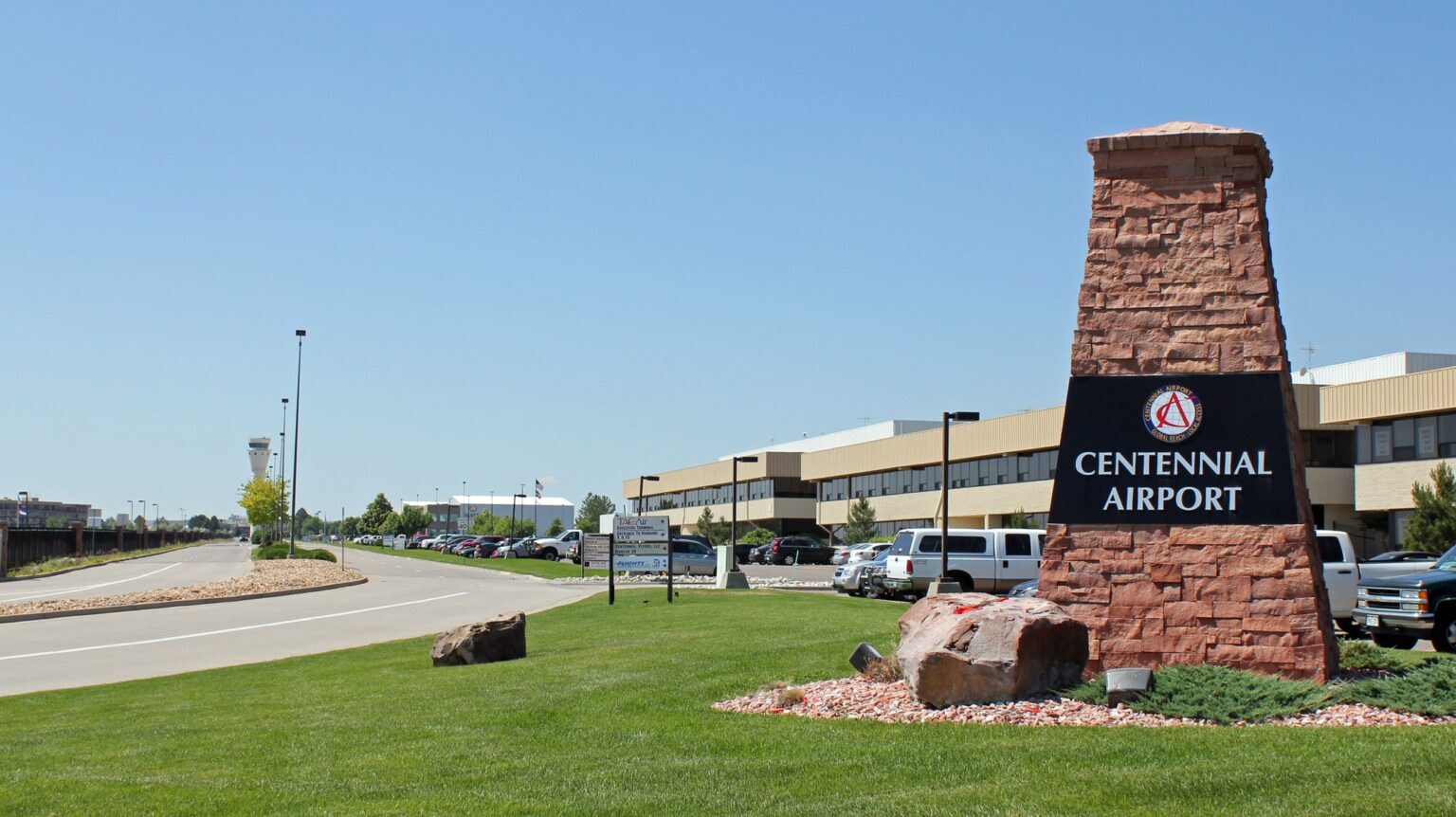
The FAA approved a fix that allows simultaneous parallel departures to resume at Centennial Airport (APA) near Denver from Friday, November 20, 2026, seven weeks after it halted them over aircraft drifting toward each other. Regular touch-and-goes, which the tower also stopped accommodating on October 1, may return more gradually, as controller workload allows.
The Arapahoe County Public Airport Authority, which runs the airport, announced the approval on November 19. Its notice says the FAA intended to begin permitting parallel departures the next day, and makes no promise about touch-and-goes.
The Aircraft Owners and Pilots Association (AOPA) welcomed the decision on November 20 as a return of both. It added that the airport plans to phase in the procedure, allowing more traffic in the pattern over time.
How the 10-degree turn works
Controllers will tell aircraft departing the two parallel runways, 17L/35R and 17R/35L, to turn 10 degrees away from their runway centerlines. That puts 20 degrees of divergence between the two departure paths.

The margin is thin without it, because the centerlines are only about 700 feet (210 m) apart, based on published runway coordinates. Two aircraft climbing straight ahead side by side have little room if wind or a wrong turn moves one of them toward the other.
With diverging paths, the gap grows the farther they fly. By simple geometry, two aircraft holding those tracks would gain roughly 1,800 feet (550 m) of lateral spacing for each mile (1.6 km) both fly after the turn, although real tracks will vary with wind, speed and pilot technique.
The airport authority is telling pilots to listen carefully to air traffic control instructions and follow them as the procedure comes in. It also says the FAA is responsible for implementing and monitoring the change.
What the FAA found at Centennial
The halt came in a September 30 memo from the head of the FAA’s Air Traffic Organization, which the airport has published with its attachments. It ordered simultaneous parallel departures to cease until mitigations were approved.
An attached risk assessment covered May 2025 through April 2026, when the affected runways logged 35,551 departures. An initial review of 115 event notifications produced 60 verified cases of aircraft drifting off course due to wind during simultaneous departures.
Two of those were verified near midair collisions, rated hazardous, and nine were rated major. The other 49 were scored minor or minimal.
Besides wind, the FAA listed incorrect pilot turns and late controller recognition or missed alerts as possible contributors. It compared nine airports that use the operation, including Chicago O’Hare, San Francisco and DeKalb-Peachtree, and rated Centennial’s initial risk high and the other eight medium.
Departures from neighboring runways have caused trouble at much bigger airports, too. In a separate case at Los Angeles, Air France AF28 turned toward an American Airlines A321 climbing off the next runway.
Why touch-and-goes stopped, and what is back now
The September 30 memo does not mention touch-and-goes or pattern work. According to the airport’s October 16 timeline, the tower manager received the memo on October 1 and told the airport later that day that the tower would initially be unable to accommodate them.
AOPA objected publicly on October 8 that, after nearly a week, the FAA had neither issued a NOTAM nor updated the recorded airport information broadcast. The airport said neither it nor the tower had advance notice of the FAA directive.
In a touch-and-go landing, the pilot lands and takes off again without leaving the runway. Students repeat the exercise many times, so losing it at their home field means paying for flight time to and from another airport.
Students went to Limon, Boulder and Broomfield, among other places, 9NEWS reported. Jan Aleman, chief pilot at Centennial flight school Fly Accelerated, told the station that students were spending much more money, but said the FAA “shut us down for the correct reasons.”
Zach Gabehart, the airport’s assistant director and chief operating officer, told 9NEWS that touch-and-goes may resume subject to controller workload and other operational considerations. Air traffic control will decide when and how often they happen.
Not back to full capacity
Approval of the turn does not restore Centennial’s old traffic levels overnight. Gabehart told 9NEWS there is “no established timeline for a full return to previous operational levels,” so pilots planning pattern work should check with the tower or their flight school first.
A busy airport running well below normal
Centennial averaged 999 aircraft operations a day from July through September, according to its quarterly update. Gabehart told 9NEWS that operations have fallen about 35% since parallel departures were suspended.
He expects traffic to recover gradually as controllers are trained on the revised procedure and become familiar with it. Anyone choosing a flight school there should ask how much pattern work it can currently do on the field.
The fix came out of an FAA safety risk management panel on October 27, where local FAA representatives proposed it. AOPA Vice President of Regulatory Affairs David Boulter took part, along with airport and community representatives.
The FAA will decide whether further changes are needed as it monitors the results, according to Gabehart. He said the turn may shift some flight paths and that the airport cannot yet predict any effect on noise for its neighbors.
Sources and references used for research and fact-checking.
- Centennial Airport (Arapahoe County Public Airport Authority), Update on FAA Operational Restrictions at Centennial Airport: Approved Safety Mitigations
- Centennial Airport (Arapahoe County Public Airport Authority), Centennial Airport Statement Regarding FAA Operational Restrictions
- FAA, Cease Simultaneous Parallel Departure Operations at APA: Memorandums and Preliminary Safety Risk Assessment
- AOPA, AOPA Welcomes Return of Touch-and-Goes, Parallel Departures at Centennial Airport
- AOPA, AOPA Expresses Concern Over Centennial Airport GA Limitations
- Centennial Airport (Arapahoe County Public Airport Authority), Quarterly Airport Update, July-September 2026
Get the Newsletter
The latest aviation news and stories sent to your inbox.
About the Author

AeroCorner News is the aviation news desk of AeroCorner.com. It covers accidents and incidents, safety rulings, airline and airport disruption, and new aircraft. It works from primary sources such as the NTSB, FAA, EASA and the manufacturers' own announcements.