

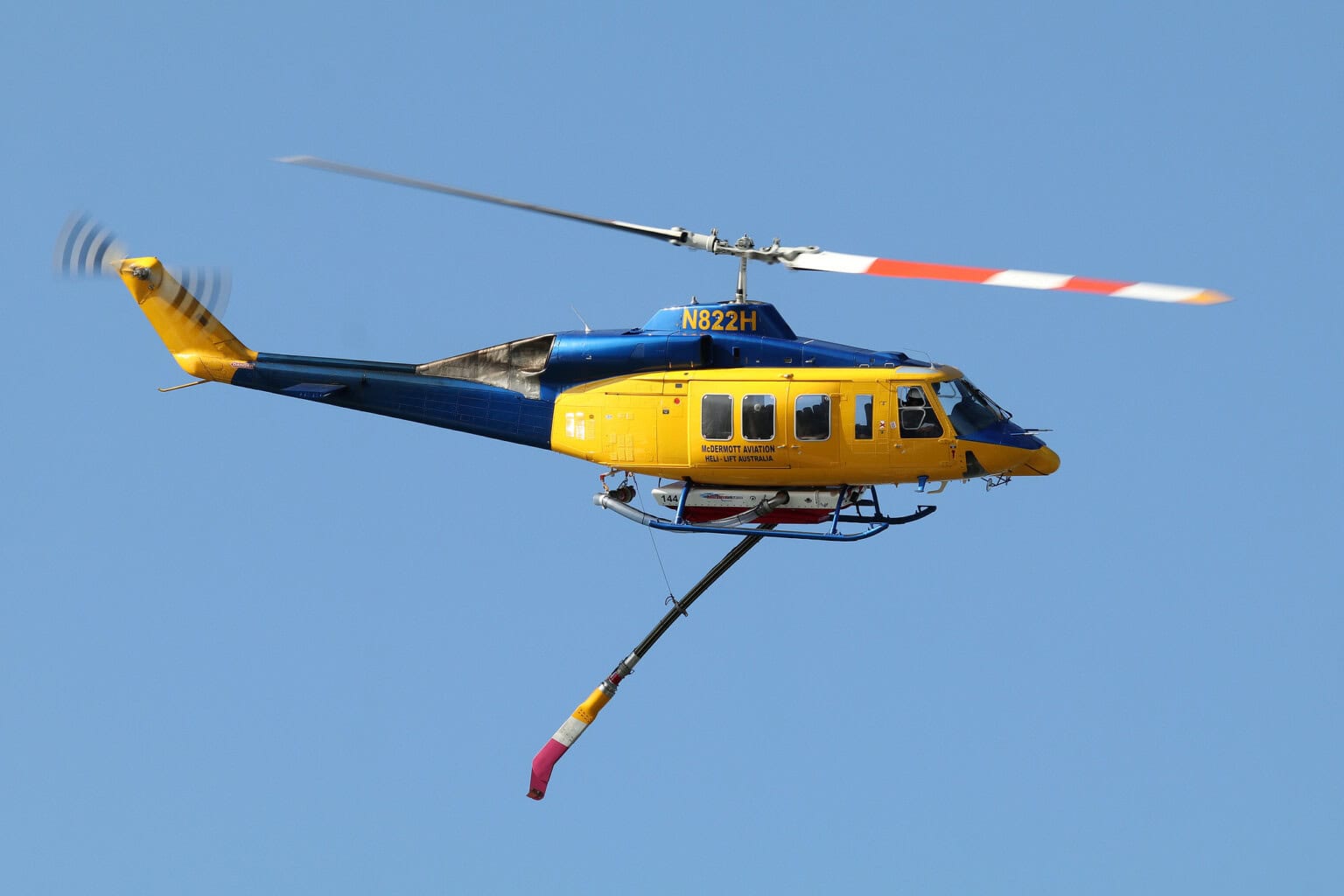
On Sunday, August 2, 2026, two Bell 214ST helicopters working a wildfire at Psatha, west of Athens, collided in mid-air. Two of the four crew members on board were killed and the other two were rescued with injuries, the Hellenic Fire Service said.
Both aircraft were leased to the fire service from McDermott Aviation, an Australian operator, and had launched from Elefsina air base in western Attica. Both were flying with underslung water buckets when they came together.
The dead were the Danish pilot of one helicopter and the Greek fire service crew member flying alongside him. The pilot of the second aircraft, a British national, and his Greek colleague survived and were recovered from a ravine after a search operation.
Awful tragedy. Two Bell 214ST firefighting helicopters (N746H and N511EV) collide during a wildfire operation in the Psathas area of Greece.
— Andy Scollick (@andyscollick.bsky.social) August 2, 2026 at 9:30 PM
[image or embed]
What Is Not Yet Known
Greek authorities have not said how the two helicopters came into contact, and no official cause has been offered. ProtoThema, quoting aeronautical engineer Faidon Karaiosifidis, reported that the skids of one aircraft struck the rotor of the other, but that is an outside reading of the available footage rather than a finding.
No cause has been established
Reports attributing the collision to human error, visibility or airspace coordination are early speculation. Nothing has been confirmed by investigators, and preliminary accounts of mid-air collisions are frequently revised.
The fire service grounded every Bell-type firefighting helicopter working the Attica and Boeotia front as a precaution immediately afterward, pending further notice. It said the causes and circumstances of the collision are being investigated by the competent authorities.
All four crew members were recovered and taken to the 251 General Air Force Hospital in Athens. Fire Service Chief of Staff Lieutenant General Theodoros Vagias coordinated the response from the scene.
The conditions were severe. Gale-force winds had pushed the fire through dry forest since Friday and at times stopped aircraft from reaching the sea to reload their buckets.
Nearly 500 firefighters and 23 aircraft were committed to the blaze, which had spread from near Agios Vasileios toward Porto Germeno and threatened communities in western Attica and Boeotia. Prime Minister Kyriakos Mitsotakis was briefed on the operation.
Why the Airspace Over a Fire Is So Unforgiving
A wildfire is one of the very few places in aviation where multiple aircraft deliberately converge on the same small patch of ground, at low altitude, with no radar coverage and no control tower anywhere near. Everything that keeps them apart is procedural.
Crews are separated by assigned altitude blocks and by a fixed circuit direction over the drop zone, and normally only one aircraft is cleared into the drop at a time. Fixed-wing tankers and helicopters are usually kept at different heights entirely.
Above it all, an air attack supervisor orbits in a spotter aircraft and sequences the traffic on a common radio frequency. Putting a fire service coordinator in the cabin of each helicopter, as Greece does, serves the same function from inside the aircraft.
Smoke is what erodes all of it. Visibility can collapse in seconds, the surface wind shifts as the fire builds its own convection column, and the aircraft are heavy, slow and low with a full bucket swinging beneath them on a long line.
A mid-air collision between airliners triggers an enormous formal machinery, as the NTSB’s recommendations after the DCA collision showed. Aerial firefighting, flown largely by contractors under national civil protection agencies, has nothing comparable in most countries.
A Leased, Migrating Fleet
The 214ST is a stretched, twin-engine member of Bell’s 214 family, originally built as a military and offshore transport. It has found a long second career in firefighting for the simple reason that it can lift a great deal of water.
Greece, like most Mediterranean countries, does not own most of the helicopters it fights fires with. It leases them each summer from specialist contractors, many of them Australian, who follow the northern hemisphere fire season and then return home for their own.
That arrangement is why the crew of two Greek helicopters included a Danish pilot and a British one. It is also a reminder of how thin the pool of people who do this work actually is, a century into the history of aerial firefighting.
Get the Newsletter
The latest aviation news and stories sent to your inbox.
About the Author

Tim is the owner and lead editor of AeroCorner since 2019, overseeing aviation content covering aircraft, airlines, airports, and the broader aviation industry. Through years of researching, writing, editing, and publishing aviation-focused content, he has developed extensive practical knowledge of commercial aviation and air travel. Based in Asia and a frequent traveler himself, Tim also brings firsthand passenger experience to AeroCorner’s coverage. Outside of publishing, he has also explored aviation firsthand through hands-on flight training in New Zealand.