

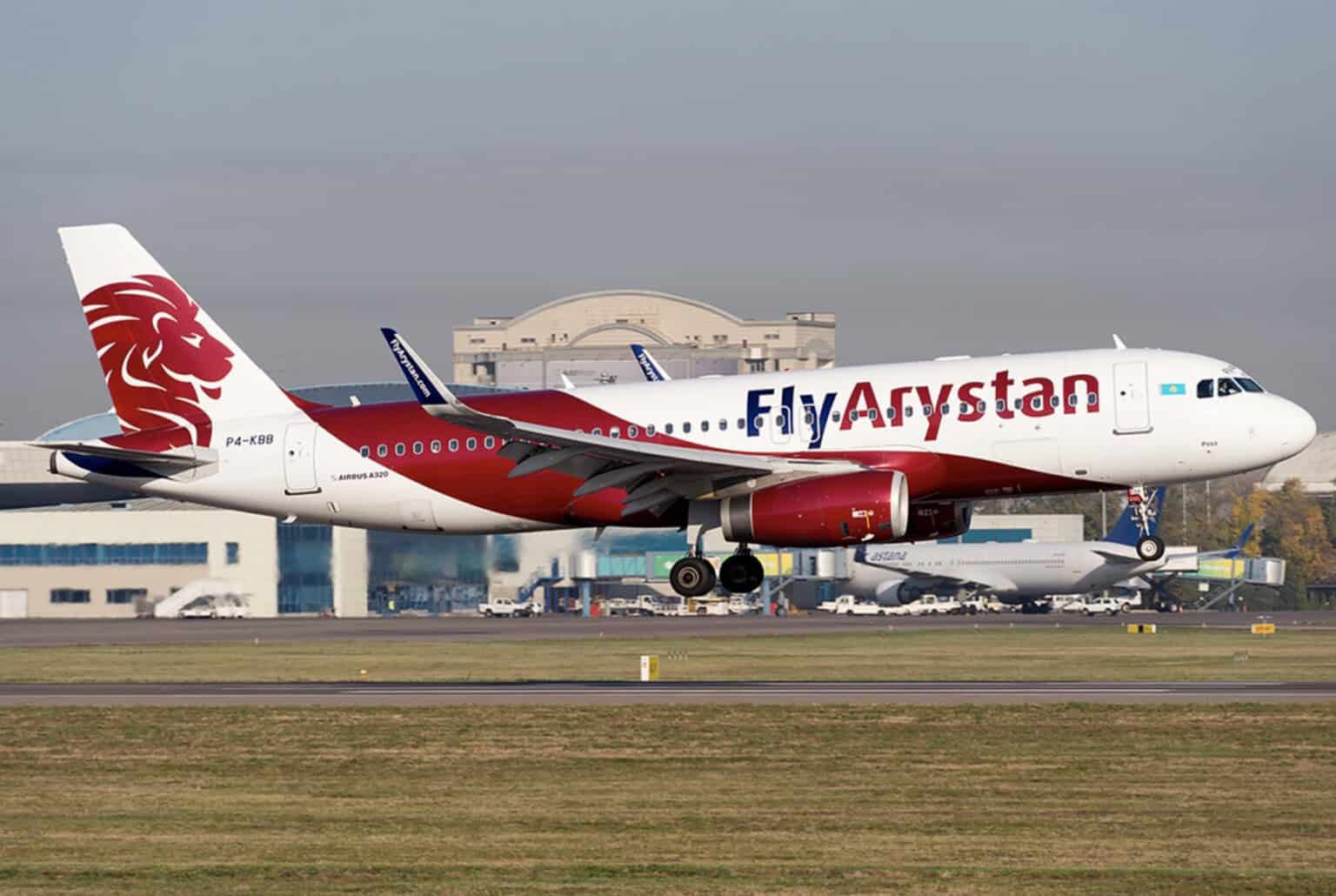
On August 28, 2026, an Airbus A320 operated by FlyArystan, the low-cost arm of Kazakhstan’s Air Astana Group, caught fire while undergoing scheduled maintenance at Almaty International Airport. One Air Astana Group employee was injured and taken to hospital, then discharged the same day. No passengers or flight crew were on board.
What happened at Almaty
The aircraft, registration EI-KBN, was parked and under routine maintenance when a fire broke out in an area of the fuselage, according to Air Astana Group. Video shared online showed flames and a glow near the nose, close to the nose landing gear bay beneath the cockpit. Airport emergency services reached the aircraft quickly and put the fire out while it was still confined to a small area.
Air Astana Group described the event as an operational incident during routine maintenance and said the fire was contained and tackled immediately. The group told FlightGlobal that the jet has been withdrawn from service while engineers assess the damage and draw up a repair plan. The company and Almaty airport have opened a joint internal investigation into how the fire started.
The 11.9-year-old aircraft first flew in 2014 and joined FlyArystan in March 2021 after roughly six years with India’s Vistara, Simple Flying reported, adding that Kazakhstan’s aviation regulator had not released any findings as of this week. FlyArystan operates a fleet of around 28 Airbus narrowbodies, a mix of the older A320ceo and the newer A320neo.
Why maintenance is a risky time for a parked jet
An empty aircraft on the ground sounds like the safest possible place for a fire, and in terms of human risk it usually is. But a jet in maintenance is in an unusual state. Access panels are open, insulation blankets and wiring bundles are exposed, and systems that normally sit sealed inside the airframe are laid bare for inspection.
Ground power or the aircraft battery is often connected so technicians can test electrical systems, which means live current runs through circuits that may be partly disassembled. Maintenance also involves heat: drilling, grinding, and other hot work near hydraulic fluid, cleaning solvents, and residual fuel vapor. Any of those can turn a small fault into a fire. The work carries risk for the people doing it too, as a maintenance accident that killed a Virgin Atlantic engineer on a parked Boeing 787 at Heathrow showed earlier this year.
The nose area draws particular attention because the forward equipment bay and the space beneath the cockpit hold avionics and, on many airliners, the crew oxygen cylinder. Oxygen does not burn, but it makes everything around it burn faster and hotter, so investigators will want to rule that system in or out early.
A ground fire is not an in-flight fire
With the cabin empty and airport fire crews minutes away, a maintenance fire is far more survivable than the same fire at altitude. The bigger cost is often the aircraft itself: smoke can contaminate wiring and avionics well beyond the area that actually burned, and that damage can take longer to repair than the fire damage.
The cause has not been determined
Air Astana Group and Almaty airport have not said what started the fire, and Kazakhstan’s regulator has not released a report. Any explanation before then is speculation.
Get the Newsletter
The latest aviation news and stories sent to your inbox.
About the Author

Tim is the owner and lead editor of AeroCorner since 2019, overseeing aviation content covering aircraft, airlines, airports, and the broader aviation industry. Through years of researching, writing, editing, and publishing aviation-focused content, he has developed extensive practical knowledge of commercial aviation and air travel. Based in Asia and a frequent traveler himself, Tim also brings firsthand passenger experience to AeroCorner’s coverage. Outside of publishing, he has also explored aviation firsthand through hands-on flight training in New Zealand.