

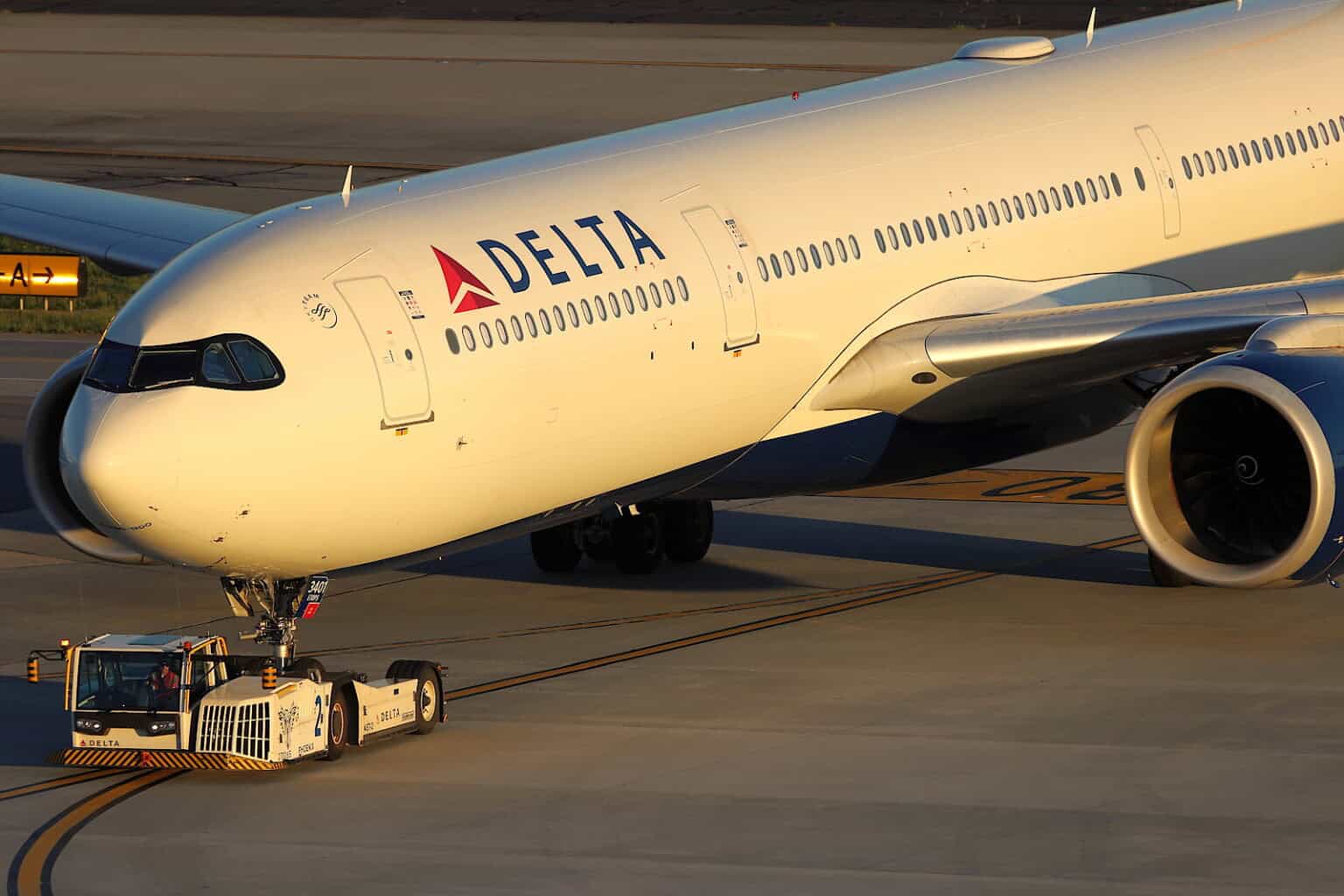
On August 7, 2026, Delta Air Lines said it will launch daily nonstop service between Seattle and Tokyo Narita starting March 27, 2027. The route puts Delta in direct competition with Alaska Airlines on a flight Alaska has flown as its flagship long-haul route since 2025.
The new flight will use an Airbus A330-900neo configured with 281 seats: 29 Delta One suites, 28 Premium Select seats, and 224 main cabin seats, 56 of them Delta Comfort.
Delta departs Seattle at 1:35 p.m. and lands at Narita the next afternoon. The return leaves Narita at 6:30 p.m. and arrives back in Seattle by noon the same day, according to Delta and the Port of Seattle.
“Japan continues to be one of the most important and beloved destinations in Delta’s global network,” said Jeff Arinder, Delta’s vice president of international network planning, in the airline’s announcement.
Delta already flies Seattle to Tokyo Haneda daily on an Airbus A350-900, so the new route makes Seattle the only US city where Delta will serve both of Tokyo’s airports nonstop.
Alaska’s route to defend
Alaska opened Seattle-Narita in May 2025, its first intercontinental route and the start of a wider push to build Seattle into a long-haul hub following its 2024 merger with Hawaiian Airlines. The route was initially flown with a Hawaiian-branded Airbus A330-200 before Alaska switched it to its own Boeing 787-9s in January 2026.
Seattle-Narita becomes the fourth long-haul route out of Seattle where Delta and Alaska will fly head to head, joining existing overlaps to London, Seoul, and Rome. Delta has not described the new flight as a response to Alaska, but the two carriers have been building competing widebody networks from the same airport for several years.
Alaska still runs the airport
Alaska carries roughly half of all passenger traffic at Seattle-Tacoma International, making it by far the airport’s largest airline. Delta’s Seattle operation is about half that size, even after years of adding widebody routes there.
Why Delta is going back to the airport it quit
The choice of Narita over another Haneda frequency is itself part of the story. Haneda sits close to central Tokyo and has drawn business travel away from Narita, which now leans more toward leisure and connecting traffic despite handling more total flights.
2018
Delta begins routing much of its Asia connecting traffic through Seoul Incheon via its Korean Air joint venture, in lieu of a Narita hub.
March 2020
Delta ends Tokyo Narita service entirely as Haneda gains more transpacific landing slots and pulls business travel away from Narita.
May 2025
Alaska Airlines launches Seattle-Narita, its first intercontinental route, flown by a Hawaiian-branded Airbus A330-200.
January 2026
Alaska moves Seattle-Narita onto its own Boeing 787-9 fleet.
August 7, 2026
Delta announces it will return to Narita, this time nonstop from Seattle, starting March 27, 2027.
Delta left Narita in part because it had no Japanese partner airline to feed passengers onward, unlike United’s tie-up with ANA or American’s with Japan Airlines. That gap has not closed.
As the aviation blog View From the Wing put it, the return looks aimed squarely at Seattle passengers headed to Tokyo, not at rebuilding Narita as a connecting hub.
A defensive move, not a hub rebuild
Delta is not restoring the Asia connections it once ran through Narita. Those still route through Seoul, where the airline says more than 2,000 passengers a day connect in each direction via Korean Air. This flight exists to give Seattle travelers a second nonstop path to Tokyo before Alaska has the market to itself.
Alaska has not publicly responded to Delta’s announcement. Reporting by Simple Flying notes Alaska could answer with pricing, loyalty perks, or scheduling rather than pulling back, since Seattle-Tokyo is central to the strategy it built around the Hawaiian merger.
With both airlines now flying the same four long-haul routes out of one airport, how they compete on Seattle-Narita will say a lot about whether both flights stay profitable.
Sources and references used for research and fact-checking.
Get the Newsletter
The latest aviation news and stories sent to your inbox.
About the Author

Tim is the owner and lead editor of AeroCorner since 2019, overseeing aviation content covering aircraft, airlines, airports, and the broader aviation industry. Through years of researching, writing, editing, and publishing aviation-focused content, he has developed extensive practical knowledge of commercial aviation and air travel. Based in Asia and a frequent traveler himself, Tim also brings firsthand passenger experience to AeroCorner’s coverage. Outside of publishing, he has also explored aviation firsthand through hands-on flight training in New Zealand.