

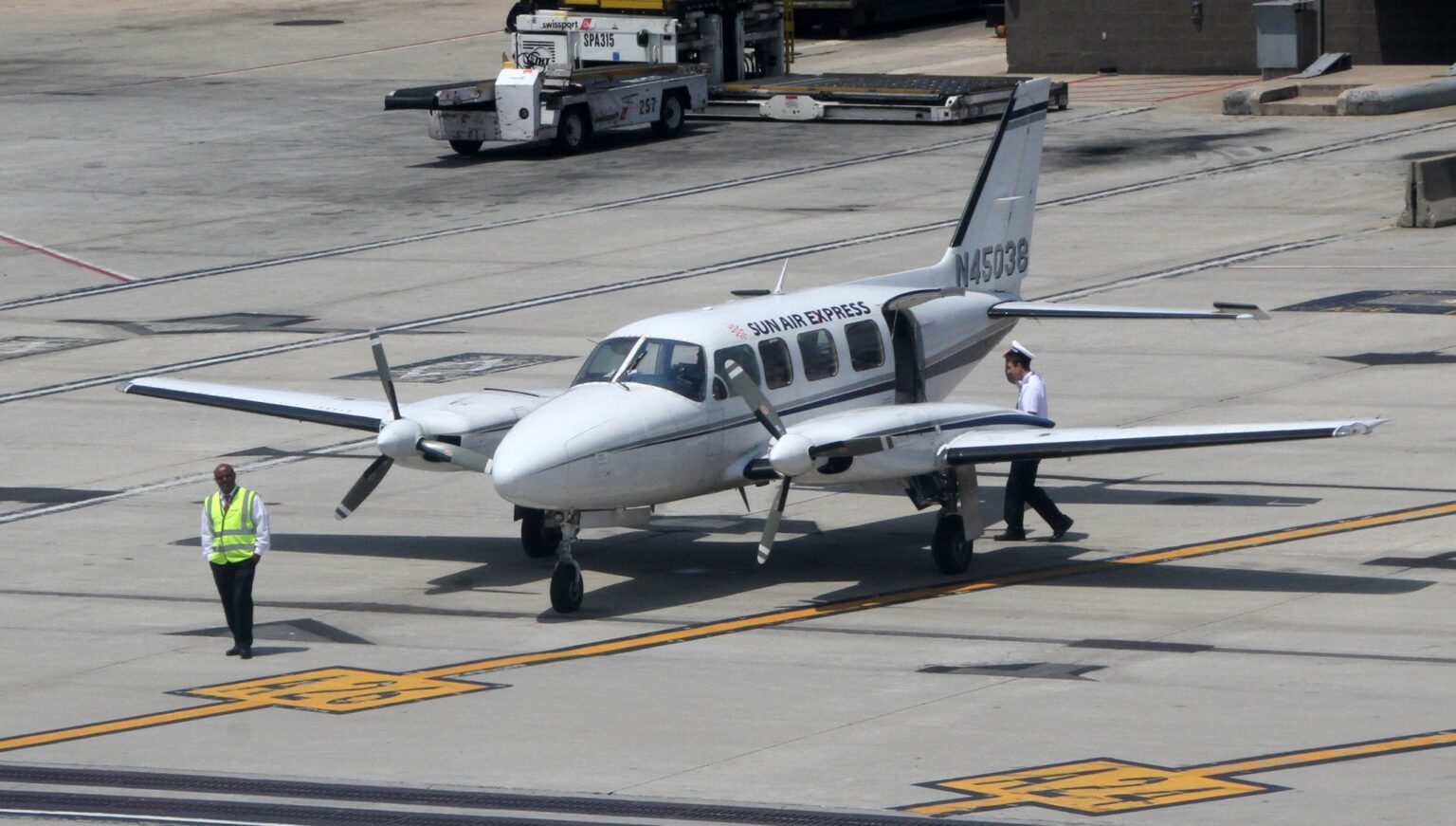
The NTSB has closed its investigation into the June 17, 2024 crash of Piper PA-31 Navajo C-GKSI, which went down about a mile past the end of runway 19 at Albany International Airport, killing its pilot. In a final report dated November 19, 2026, the board puts the cause on pitch oscillations “due to a pitch trim anomaly that could not be identified.”
The Canadian-registered twin, owned and operated by Kasi Aviation Services, was destroyed in Loudonville, in the town of Colonie, New York. The 34-year-old pilot, identified at the time by Spectrum News as Natalie Gillis, was alone on board, and one person on the ground suffered a minor injury.
Two minutes from takeoff to impact
The flight was a positioning leg to Montreal under an instrument flight plan, after the aircraft had arrived from Fayetteville, North Carolina, with the same cargo, weight and balance. It was a 1978 PA-31 Navajo modified for aerial survey work, with survey equipment mounted in the cabin.


According to the NTSB’s performance study of ADS-B data, the airplane rotated at 110 knots at 8:15:34 a.m. and lifted off four seconds later. Airport security video and witnesses showed it porpoising up and down for about eight seconds while still over the runway, less than 200 feet above the ground.
Past the departure end, it climbed from about 675 feet to 1,050 feet above sea level in roughly seven seconds, an average of about 3,200 feet per minute, as its airspeed bled from about 130 knots to 90. Investigators said that rate was likely unintentional and far beyond what the loaded Navajo could achieve with its gear and flaps up.
The airplane then rolled left in what some witnesses called a barrel roll and descended at about 2,800 feet per minute. It pitched up again in a climbing left turn, oscillated once more, and dove into trees about a mile southeast of the runway, where a post-impact fire consumed most of the fuselage.
What investigators could and could not rule out
Examination of the flight controls, both Lycoming engines, the propellers and their governors found no sign of a failure before impact. A sound study of a video taken near the crash site indicated both engines were likely running at about 2,500 rpm just before impact.
The elevator trim actuator was found at full nose-up, but the NTSB notes it could have moved during the crash, so the trim setting at takeoff is unknown. Fire damage to the Garmin GFC 600 autopilot’s mode controller, pitch servo and pitch trim servo prevented any testing, and no stored data could be recovered.
The board also ruled out the autopilot and center of gravity as the trigger for the first oscillations. The flight manual supplement barred autopilot use on takeoff, and the previous takeoff at the same weight and balance had reportedly been normal.
That GFC 600 had replaced the Navajo’s old autopilot in May 2023, about 263 flight hours before the crash. The operator’s president told investigators no autopilot issues had come up since, and its daily operations log backed that up.
Why a trim problem can overwhelm a pilot
Pitch trim sets the elevator’s resting position so the pilot does not have to hold constant pressure on the yoke. A badly mis-set or moving trim forces the pilot to push or pull hard just to hold attitude, which is why the FAA recently ordered repeat pitch trim actuator checks on Metroliner and Merlin turboprops after in-flight failures.
The NTSB said the oscillations and the steep pitch-up were consistent with a trim anomaly, and that the pilot could have corrected it easily with the autopilot’s manual electric trim, if it was available. She had trained on the system, including a refresher flight the month before.
That electric trim depends on Garmin’s pre-flight test being completed, and the investigation could not establish whether it was. Above 200 feet, the autopilot system’s electronic stability and protection feature would also have started nudging the controls back toward a normal attitude, which the pilot can overpower or switch off.
ADS-B gave investigators the flight path, but not the control inputs. With no stored data recoverable from the burned autopilot controller or the Aspen display, the NTSB could not tell what the pilot or the protection system did during the final maneuvers.
Toxicology found mefloquine, an antimalarial the pilot had stopped taking about three months earlier, and which can linger because of its long half-life. The board said the medical evidence gave no particular reason to believe she was affected by it.
The report also notes that the operator’s log for June 16 listed an inoperative left oil temperature gauge, a cowl flap indicator fault and an unserviceable co-pilot attitude indicator, with no record they were addressed before the flight. The NTSB did not tie them to the cause.
Sources and references used for research and fact-checking.
Get the Newsletter
The latest aviation news and stories sent to your inbox.
About the Author

AeroCorner News is the aviation news desk of AeroCorner.com. It covers accidents and incidents, safety rulings, airline and airport disruption, and new aircraft. It works from primary sources such as the NTSB, FAA, EASA and the manufacturers' own announcements.