

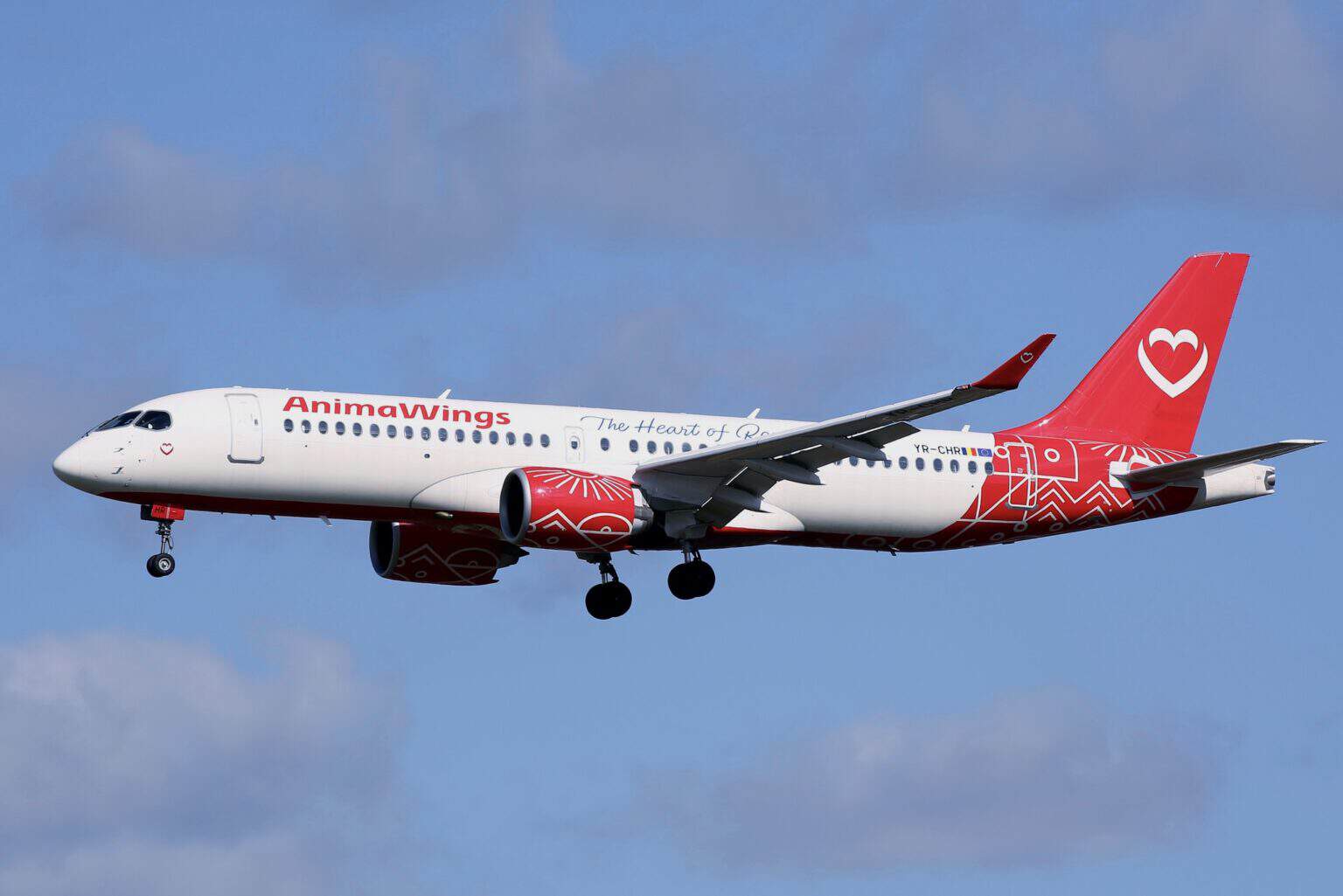
Romanian carrier AnimaWings grounded all six of its Airbus A220-300s and filed for court-protected insolvency on September 30, 2026, leaving the airline flying only its two A320s for the rest of the month.
The filing was registered with the Bucharest Tribunal’s Seventh Civil Section as case number 40903/3/2026, according to BoardingPass.ro, which first reported it; no hearing date had been set as of publication. AnimaWings told customers it was “undergoing a judicial reorganisation process, initiated by the company to protect business continuity and stabilise its operations,” as Romania Insider reported.
The company’s own notice cited “technical situations affecting the availability” of its A220-300s. None of the six aircraft flew on September 30, according to BoardingPass.ro.
AnimaWings is part of Memento Group Holding, founded by Cristian and Marius Pandel. CEO Marius Pandel called the filing “a difficult but necessary step to protect” the airline, citing “recurring fleet problems” on top of rising costs, per Aviation24.be.
Flights are suspended through October 24, affecting AnimaWings service at Bucharest, Cluj and Timișoara. AnimaWings said it would resume under “a simplified scheme” starting October 25, according to Romania Insider.
A familiar culprit: the A220’s engines
Every A220 flies on the Pratt & Whitney PW1500G geared turbofan, an engine family whose powder-metal manufacturing defect has kept aircraft grounded worldwide for inspection and repair since 2023. Romanian media have linked AnimaWings’ problem to that engine family, according to Migflug, though AnimaWings itself has not named a specific defect.
The crisis has already reshaped other A220 operators AeroCorner has covered: airBaltic cut its A220 fleet by a third and later filed its own Chapter 11 case, while the FAA ordered repeat borescope checks on PW1500G engines in September after six reports of compressor rotors clashing with stator vanes.
As of late 2025, an RTX spokesperson told Simple Flying that roughly 7% of the global A220 fleet was grounded for GTF-related inspections at any given time, though AeroCorner has not seen a more recent figure.
Eight jets, not sixty
AnimaWings is a small operator: six A220-300s and two A320s. A six-aircraft grounding is a bigger share of its capacity than the same engine problem has been for a major flag carrier.
The money problem behind the technical one
BoardingPass.ro, citing people familiar with the airline’s finances, reported that AnimaWings’ trouble runs deeper than engine availability. The airport at Iași and Fraport Greece, which manages several Greek airports, have both sued the carrier over unpaid fees in recent months, and AnimaWings owed Romania’s tax authority roughly 11.5 million lei (around $2.4 million) as of June 2026, according to ANAF data cited by BoardingPass.ro.
A planned investment that would have handed 50% of AnimaWings to BT Asset Management, Winners Holding Investments and Evergent Investments, announced last spring, appears not to have closed, BoardingPass.ro reported. AnimaWings denied having financial problems to the outlet G4Media the evening before the insolvency filing.
Two explanations, one outlet
AnimaWings’ public statements describe only a technical and operational issue. The financial detail here comes from BoardingPass.ro’s unnamed sources and public ANAF debt data, not from an AnimaWings statement, and has not been independently confirmed by AeroCorner.
Nearly 12,000 court cases involving AnimaWings are on file with Romania’s justice ministry, BoardingPass.ro reported, most filed by passengers seeking refunds or compensation for cancelled and delayed flights. It is not yet clear how the insolvency filing will affect AnimaWings’ routes once the two A320s resume a fuller schedule on October 25.
Get the Newsletter
The latest aviation news and stories sent to your inbox.
About the Author

Tim is the owner and lead editor of AeroCorner since 2019, overseeing aviation content covering aircraft, airlines, airports, and the broader aviation industry. Through years of researching, writing, editing, and publishing aviation-focused content, he has developed extensive practical knowledge of commercial aviation and air travel. Based in Asia and a frequent traveler himself, Tim also brings firsthand passenger experience to AeroCorner’s coverage. Outside of publishing, he has also explored aviation firsthand through hands-on flight training in New Zealand.