


On Sunday, September 6, 2026, Mount Anak Krakatau erupted in the Sunda Strait between Java and Sumatra, pushing volcanic ash over western Indonesia and forcing eight airports to close. Indonesia’s Transportation Ministry said that by early Sunday evening the closures had disrupted about 1,558 flights and 170,000 passengers.
Jakarta’s Soekarno-Hatta International Airport, Southeast Asia’s second-busiest, accounted for more than 960 of those disrupted flights on its own. The closures ran into Monday, September 7, as ash kept drifting across the region.
What happened on the ground
The main eruption came at about 3:53 a.m. local time and lasted roughly 30 seconds, followed by a shorter burst near 6:53 a.m. Lana Saria, who heads Indonesia’s Geological Agency, said activity had been building since July and that Sunday’s eruption was the strongest of the current unrest.
Anak Krakatau has sat at alert Level 3 of Indonesia’s four-level scale since July 2, and authorities kept a 3-kilometer (2-mile) exclusion zone around the crater. One ash plume rose to roughly 20,000 feet (6,100 m) and drifted northeast toward Jakarta, while a second reached about 50,000 feet (15,200 m) over Lampung, Bengkulu and Banten provinces.
AirNav Indonesia, the country’s air navigation provider, issued a notice to airmen closing Soekarno-Hatta’s airspace, first until 9:30 a.m., then through 11:59 p.m., then into Monday. Five airports had their closures extended to 6 p.m. Monday, and one South Sumatra field, Atung Bungsu, reopened earlier in the day.
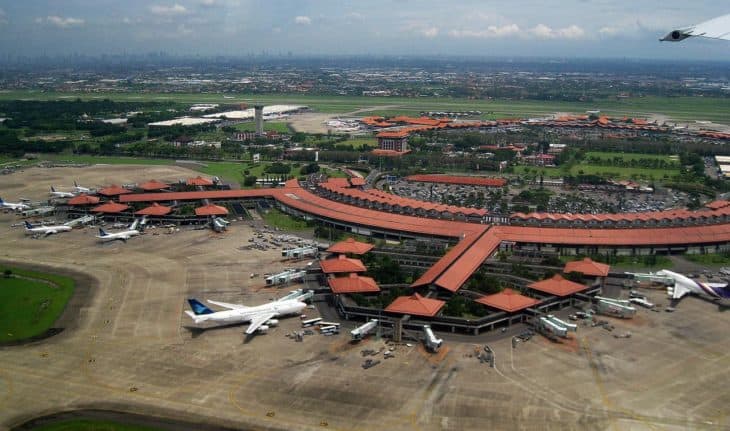
Alongside Soekarno-Hatta, the closed airports included Halim Perdanakusuma in Jakarta, Radin Inten II in Lampung, Husein Sastranegara in Bandung and several smaller fields. Bali and Medan also saw cancellations. Reporting by ABC News said Singapore Airlines and Qantas dropped flights to and from Jakarta, while other carriers rerouted or delayed services.
Lukman F. Laisa, the Transportation Ministry’s director general of civil aviation, said in remarks carried by the Associated Press that safety remained the priority in every operational decision. The ministry said Semarang and Surabaya were prepared as alternate landing sites.
Who decides the airspace is closed
Nine Volcanic Ash Advisory Centres track eruptions worldwide because ash does not show on weather radar. The Darwin centre in Australia covers Indonesia, and its advisories are what AirNav Indonesia used to draw the closed sectors over Jakarta.
Why an eruption here hits so many flights
The Sunda Strait sits directly between Indonesia’s two most heavily flown islands, so ash drifting northeast from Anak Krakatau lands squarely on Jakarta’s approach corridors. That is the same pattern that shut Catania airport on and off for a week in August, scaled up to a far busier hub.
Volcanic ash is abrasive rock and glass that melts inside a running jet engine and can resolidify on the turbine, choking off thrust. The definitive case happened nearby: in 1982, a British Airways 747 flew into ash from Java’s Mount Galunggung and lost all four engines before the crew restarted them during the glide.
Because the hazard is invisible to radar and unforgiving, airlines treat an active ash cloud as a hard no-fly zone rather than something to steer around. That is why regulators close whole blocks of airspace at once, and why a single eruption can strand tens of thousands of passengers within hours.
Still developing
Anak Krakatau remained at Level 3 with continued ash emissions as of September 7. Closure times have been extended more than once, so treat any reopening target as provisional until the airport confirms flights have resumed.
Sources and references used for research and fact-checking.
Get the Newsletter
The latest aviation news and stories sent to your inbox.
About the Author

Tim is the owner and lead editor of AeroCorner since 2019, overseeing aviation content covering aircraft, airlines, airports, and the broader aviation industry. Through years of researching, writing, editing, and publishing aviation-focused content, he has developed extensive practical knowledge of commercial aviation and air travel. Based in Asia and a frequent traveler himself, Tim also brings firsthand passenger experience to AeroCorner’s coverage. Outside of publishing, he has also explored aviation firsthand through hands-on flight training in New Zealand.