

Table of Contents
Published figures put crop duster pilots at about $50,000 to $150,000 a year, though none of them comes from a pay survey. New pilots sit toward the low end, and experienced pilots can clear $100,000.
One reason the range is so wide is that ag pilot pay can be a share of what the airplane earns rather than a fixed salary. On that kind of deal, the number depends on acres flown and how long the season runs.
The Bureau of Labor Statistics (BLS) publishes no figure for this job alone. It counts crop dusters as commercial pilots, so every number needs reading for what it actually measures.
| Source | What it measures | Annual figure |
|---|---|---|
| North Central Texas Council of Governments careers site | Agricultural pilot average and range | $44,570, range $29,330 to $68,370 |
| Delta State University | First-year ag pilot | Up to $75,000+ |
| Vault career guide | Ag pilot salary range | $50,000 to $100,000+ |
| General Aviation News, 2014 | Experienced ag pilot | “Not uncommon” to top $100,000 |
| AgAir Update model, 2017 | Turbine pilot, 500 hours, 20% of gross | $150,000 (our math: $300 an hour x 500 hours) |
| BLS, May 2025 | All commercial pilots, median | $123,220 |
| BLS, May 2025 | All commercial pilots, lowest and highest 10% | Under $58,850 / over $266,620 |
The $20,000 figure needs retiring
Older versions of this page repeated a range of $20,000 to $100,000 from a JobMonkey career page that shows no date or data behind it. Delta State, which trains ag pilots, says first-year pilots can earn up to $75,000 or more. That is a school promoting its own program, so read it as a best case. A Texas workforce site lists a low of $29,330, also unsourced. No published survey settles the floor, so we no longer repeat $20,000.
How crop duster pilots actually get paid
“Ag pilots work in acres, not hours,” Tracy Thurman wrote in General Aviation News in 2014, describing a job with no fixed schedule. Pay can follow the same logic, as a percentage of what each flying hour bills.
AgAir Update, an ag aviation trade publication, models pilot’s pay at 20 percent of gross. Its author, a former operator, also recalls “pilot’s pay” being 25 percent when he sold his flying service in 1985.
Its example is a turbine airplane treating 200 acres an hour at $7 an acre, which bills $1,400 an hour. Those figures come from a 2017 article and one illustrative operation. Arrangements vary by operator, and no survey we found says how common each one is.

What a season pays: the math
Pay on a percentage deal comes down to one sum: hours flown, times gross per hour, times the pilot’s share. We ran it at AgAir Update’s $1,400 an hour for three season lengths.
The middle row uses a real number. Pilots who answered the National Agricultural Aviation Association’s (NAAA) industry survey averaged 412 agricultural hours in the 2017 season. The other two rows are illustrative.
| Season | Hours flown | At 20% of gross | At 25% of gross |
|---|---|---|---|
| Light season | 250 | $70,000 | $87,500 |
| NAAA survey average | 412 | $115,360 | $144,200 |
| AgAir’s example season | 500 | $140,000 | $175,000 |
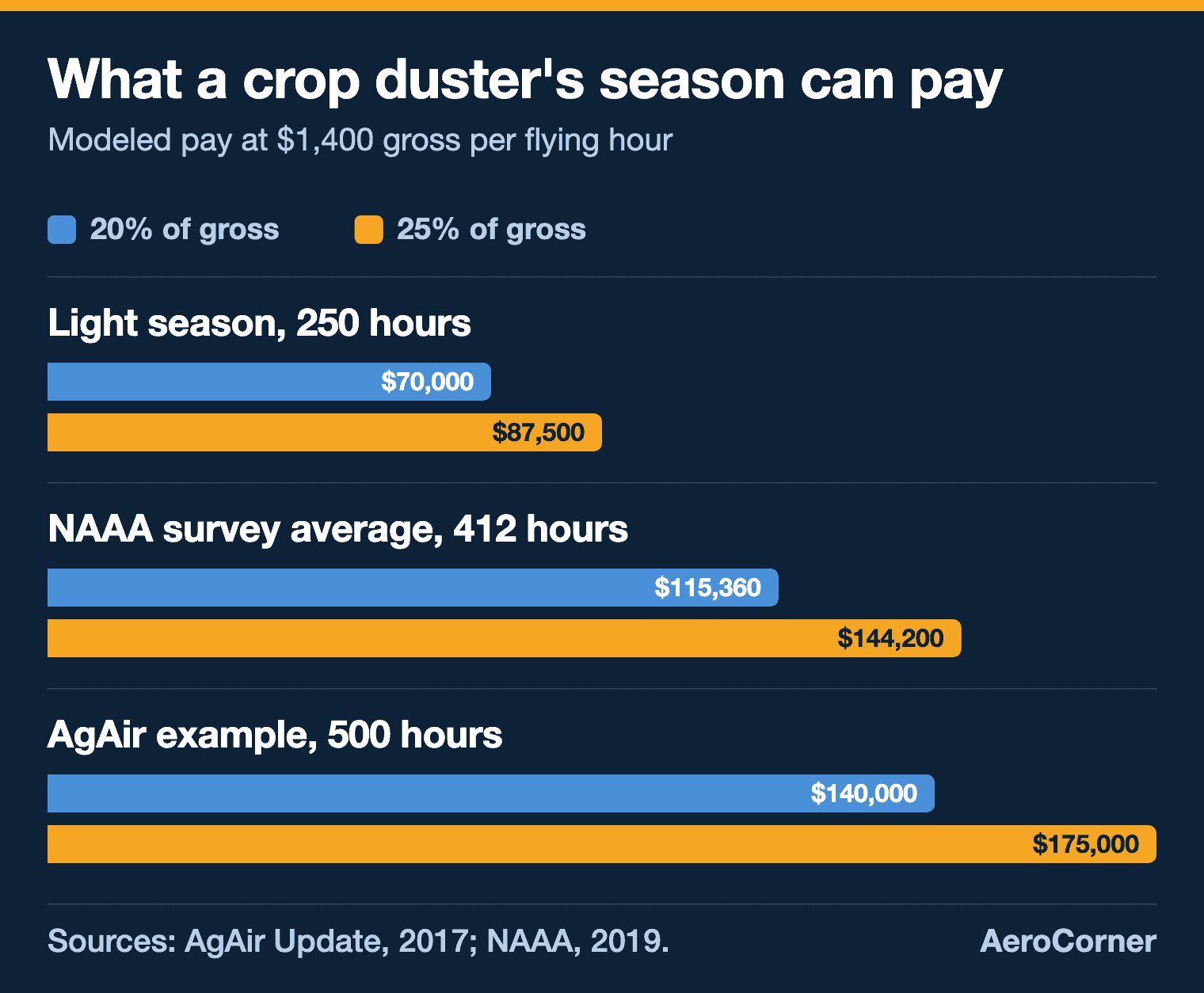
Treat these as optimistic for those hours. AgAir Update warns that “an ag-plane is not productive 100% of the hours logged in a season,” and that consistently spraying 200 acres an hour can be a challenge with a 500-gallon aircraft.
AgAir’s own pay line runs slightly higher than our table: 20 percent of a $1,500 hourly gross is $300 an hour, or $150,000 over 500 hours. We used the lower $1,400 its acre math supports.
The pilot can out-earn the owner
In AgAir Update’s example, the owner of a single turbine airplane clears $262 an hour by the author’s count, about $131,000 over 500 hours, before hidden costs. The pilot’s line, figured on a slightly higher $1,500 gross, comes to $150,000. As the author puts it, the pilot made almost $20,000 more without the financial risks. It is one illustrative budget, but owning the airplane is not automatically the better deal.
Why two ag pilots can earn very different money
Season length. In the NAAA survey, 43 percent of operators flew 100 to 200 days in 2017, while 25 percent flew more than 200 and 7 percent flew fewer than 50. On a percentage deal, those are very different years.

The airplane. The NAAA puts 81 percent of the fleet at turbine power, and new pilots face a barrier getting into those seats. Thurman wrote in 2014 that it is very difficult to get a new pilot insured in a turbine and expensive in a piston airplane, though it can be done.
The piston end of the market includes older types such as the Cessna 188 AgWagon and Piper PA-25 Pawnee, both on Iowa’s schedule of common aerial application aircraft.
Region. Operators who answered the survey were based mainly in the Midwest (41 percent) and South (38 percent), led by Texas, Minnesota, Arkansas and Louisiana. We found no reliable state-by-state pay data for ag pilots, so treat any such table with suspicion.

Experience. This is a veteran’s trade. Hired pilots in the survey averaged 47.4 years old with 7,450 hours of agricultural flying, and the $100,000-plus seasons Thurman describes belong to experienced pilots.
Do crop dusters make more than airline pilots?
Published medians cannot settle it, because none exists for ag pilots. The BLS puts airline pilots, copilots and flight engineers at $232,140 in May 2025, against $123,220 for commercial pilots, the category that includes crop dusters. See which airlines pay pilots the most for that side of the comparison.
Thurman claimed in 2014 that a first-year ag pilot would likely out-earn a five-year airline pilot. That is one writer’s claim from over a decade ago, and we found nothing current to back it.
That median says little about ag pilots specifically. BLS counts about 50,400 commercial pilot jobs in 2025, while the NAAA’s estimate, tied to its 2019 survey, is just 3,400 ag pilots in the U.S.: about 2,000 hired pilots and 1,400 owner-operators.

What you give up for the money
The hours are long. In the NAAA survey, 55 percent of operators worked 8 to 12 hours a day in season and another 35 percent worked 13 to 16, and pilots’ answers were almost identical.
The flying is also only part of the job. Thurman puts flying at about 20 percent of it, with the rest going to chemicals, crops, fields and application timing. That is one writer’s estimate, not a measured figure.

Then there is the risk. AgAir Update’s review of NTSB reports counted 54 ag accidents in 2020, 12 of them fatal, with July the worst month. That is the latest full-year review we found. We cover why in how dangerous crop dusting is, and the working heights in how low crop dusters fly.
What it takes to get the job
The legal minimum. Commercial work under FAA Part 137 requires a commercial or airline transport pilot certificate. The pilot in command must also demonstrate to the operator the knowledge and skills set out in 14 CFR 137.19(e), including chemical handling, swath runs and pull-ups.
The FAA’s standard for a commercial airplane certificate is generally 250 hours of flight time, or fewer through certain approved courses, which is where the often-quoted “250 hours” comes from. It is a licensing floor, not what gets someone hired.
The real gate. Thurman says the door is hard to open even with formal training, and that operators usually want a new pilot on the ground for a year or two, loading airplanes and turning wrenches, before offering a seat.

Tailwheel time and training. Delta State’s certificate program asks for a private pilot certificate and 50 hours of tailwheel time. It is one of several flight training routes, and the NAAA’s site lists its member ag schools.
The NAAA says neither a college degree nor an ag school certificate is required, and it stresses mentorship from an experienced pilot. Many states also use a national exam to certify aerial pesticide applicators, so check with your state’s agriculture department.
Starting your own operation is a far bigger step. The NAAA prices ag aircraft from $100,000 to nearly $2 million, and Iowa’s registration schedule lists a 2026 Air Tractor AT-802 at $2,445,300.
FAQ
Sources and references used for research and fact-checking.
- U.S. Bureau of Labor Statistics, Occupational Outlook Handbook: Airline and Commercial Pilots
- AgAir Update, How much does it cost?
- National Agricultural Aviation Association, NAAA Releases 2019 Aerial Application Industry Survey Results
- National Agricultural Aviation Association, Industry Facts, Environmental Benefits and FAQs
- Rice Farming, Aerial application industry continues to grow, says NAAA survey
- General Aviation News, Making a living as an ag pilot
- Delta State University, Aerial Applicator Pilot Training Certificate
- Vault, Agricultural Pilots
- JobMonkey, Crop Dusting Jobs
- Cornell Legal Information Institute, 14 CFR 137.19, Certification requirements
- Cornell Legal Information Institute, 14 CFR 137.41, Personnel
- Cornell Legal Information Institute, 14 CFR 61.129, Aeronautical experience
- National Agricultural Aviation Association, Career
- AgAir Update, NTSB Final Report 2020
- North Central Texas Council of Governments, Agricultural Pilot
- Vault, Agricultural Pilots: Earnings
- National Agricultural Aviation Association, Flight School Information
- USDA Agricultural Research Service, Image K7803-2
- Iowa Department of Transportation, 2026 Common Aerial Application Aircraft (Airplane/Helicopter/UAS)
Get the Newsletter
The latest aviation news and stories sent to your inbox.
About the Author

Tim is the owner and lead editor of AeroCorner since 2019, overseeing aviation content covering aircraft, airlines, airports, and the broader aviation industry. Through years of researching, writing, editing, and publishing aviation-focused content, he has developed extensive practical knowledge of commercial aviation and air travel. Based in Asia and a frequent traveler himself, Tim also brings firsthand passenger experience to AeroCorner’s coverage. Outside of publishing, he has also explored aviation firsthand through hands-on flight training in New Zealand.