

Table of Contents
Two pilots hold the same FAA commercial helicopter certificate. One flies sightseeing laps over red rock in Arizona, six or seven a day, always in good weather. The other launches at two in the morning into low cloud to reach a car wreck on a rural highway.
The second one earns roughly twice as much. Not because the machine is better, and not because the logbook is thicker, but because of what the job asks and how few people are willing to do it.
That is what makes helicopter pay so strange to anyone who understands airline pay. There is no seniority ladder. The money is attached to the mission, and the missions that pay best are the ones with the worst weather, the worst hours, or the worst places to put a helicopter down.
How Much Do Helicopter Pilots Make?
There is no official figure, and that is the first surprise. The US Bureau of Labor Statistics does not track helicopter pilots as a separate occupation at all. They are folded into a category called commercial pilots, sharing it with charter, cargo and air tour crews who fly airplanes.
That combined group had a median wage of $122,670 in May 2024, with the bottom 10 percent under $59,330 and the top 10 percent above $239,200. Do not read the median as a helicopter number. Corporate jet captains sit in the same bucket and pull it upward.
The spread is the part worth keeping. A working American helicopter pilot realistically earns somewhere between about $45,000 and $175,000 a year, and where they land inside that range is decided almost entirely by which sector will have them.
The short version
Helicopter pay is set by mission, not by seniority. Flight instruction and sightseeing sit at the bottom, roughly $45,000 to $70,000. Air medical, offshore oil and gas, and utility work sit at the top, from roughly $100,000 to $175,000. The gap is what operators pay for night flying, bad weather, remote rotations and risk.
The Ladder Is Built From Missions, Not Years
In airline flying, pay is mostly a function of tenure at one company. A pilot joins the bottom of a seniority list, moves up it, and the contract raises their hourly rate on a published schedule. That structure is the whole reason airline pilot pay climbs so steeply with time.
Helicopter work has almost none of that. A pilot raises their income by changing sector, and the currency is not years served. It is what the logbook proves: turbine time as pilot in command, instrument hours, night hours, hours in a specific type.
The result is a ladder of jobs rather than a ladder of years, and the rungs are unusually far apart. The gap between the bottom and the top of the main helicopter flying jobs is wider than the gap between a regional first officer and a wide-body captain.
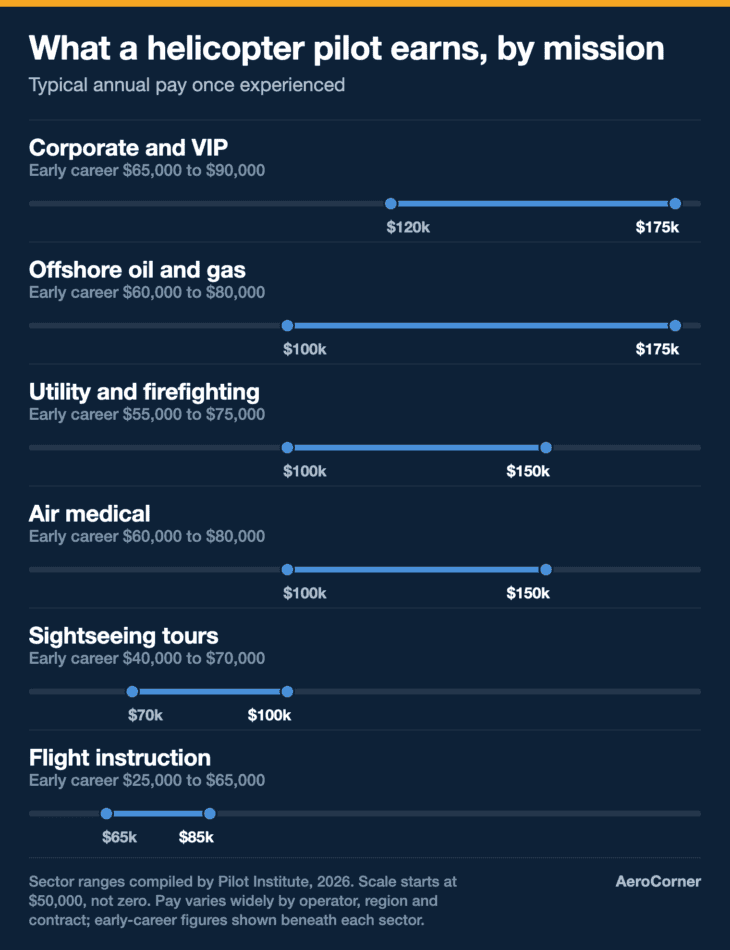
| Sector | Typical early pay | Typical experienced pay | What gates entry |
|---|---|---|---|
| Flight instruction | $25,000 to $65,000 | $65,000 to $85,000 | About 200 hours, plus type-specific hours |
| Sightseeing tours | $40,000 to $70,000 | $70,000 to $100,000 | Around 1,000 hours, some turbine time |
| Utility and firefighting | $55,000 to $75,000 | $100,000 to $150,000 | Long-line and external load skill |
| Offshore oil and gas | $60,000 to $80,000 | $100,000 to $175,000 | Instrument rating, overwater experience |
| Air medical | $60,000 to $80,000 | $100,000 to $150,000 | Roughly 2,000 hours, night and weather |
| Corporate and VIP | $65,000 to $90,000 | $120,000 to $175,000 | Turbine command time, discretion |
The Hour-Building Trap That Keeps Early Pay Low
Getting to the bottom rung is expensive. Training from zero through private, instrument, commercial and instructor ratings typically runs $85,000 to $100,000, with dual instruction in a Robinson R22 charged at around $400 to $500 an hour.
At the end of that, a new commercial pilot has roughly 150 to 200 flight hours. Almost no operator will hire them, and the reason is not skill. It is that most underwriters will not insure a pilot in command below about 1,000 hours, so the operator’s insurance simply forbids the hire.
That leaves one realistic route to the missing 800 hours: teach. Almost every civilian helicopter career passes through a year or so of full-time instructing, which is exactly why the instruction rung pays the least and is also the most crowded.
Why nobody buys their way past it
A fresh commercial helicopter pilot is around 800 hours short of what an insurance underwriter will accept. Renting a light piston helicopter for those 800 hours would cost more than the entire training course that produced the certificate, which is why almost everyone instructs through the gap instead of paying through it.
There is a second gate right behind the first. Training happens in piston helicopters, but nearly every job that pays well flies turbines, and insurers want time in type there too. Tour flying is popular precisely because it converts a piston logbook into turbine hours while paying something.
Why the Best Money Sits With the Worst Risk
Flying for a living is genuinely dangerous work by American standards. The Bureau of Labor Statistics counted 73 fatal work injuries among aircraft pilots and flight engineers in 2024, a rate of 36.7 per 100,000 full-time equivalent workers against 3.3 for all US workers.
That figure covers every kind of pilot, not only helicopter crews. But helicopter work concentrates the hazards the number is measuring: low altitude, unprepared landing sites, single engines, darkness, and weather that a scheduled flight would simply refuse.
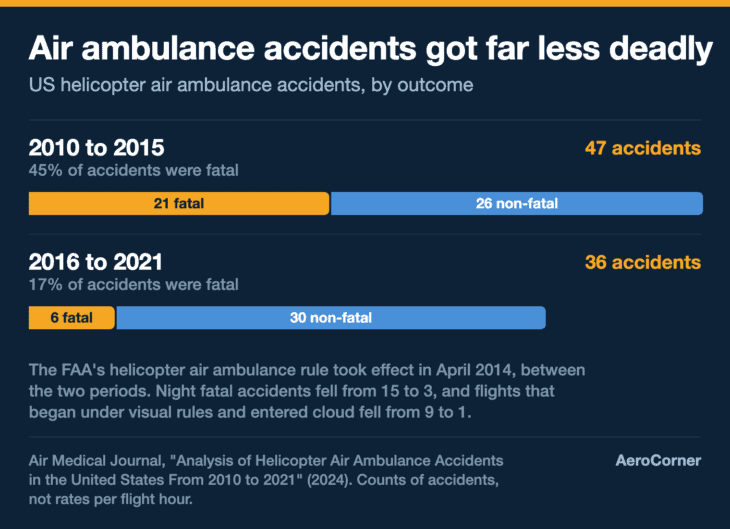
Air medical is the clearest case, and its history is well documented. A 2024 study in the Air Medical Journal counted 83 helicopter air ambulance accidents in the United States between 2010 and 2021.
The trend inside that number is the encouraging part. Of the 47 accidents in 2010 to 2015, 21 were fatal, or 45 percent. Of the 36 accidents in 2016 to 2021, only 6 were fatal, or 17 percent.
Something changed in the middle of that window. The FAA published its helicopter air ambulance final rule in February 2014, effective that April, creating a dedicated set of requirements now sitting in Part 135 Subpart L of the federal aviation regulations.
It required radio altimeters across Part 135 helicopters, terrain awareness equipment within three years, flight data monitoring within four, and an operations control center for any air ambulance operator running ten or more helicopters. The two accident categories that used to kill air ambulance crews collapsed afterwards.
Night fatal accidents fell from 15 in the first period to 3 in the second. Flights that began under visual rules and blundered into cloud fell from 9 to 1. The job still pays a premium, and it is meaningfully safer than the reputation it earned in the 2000s.
Offshore flying buys a different kind of discomfort. Gulf of Mexico operators typically run 14 days on and 14 days off, which means living at a coastal base for half of every month, flying long overwater legs to platforms in a survival suit.
Utility work pays for precision instead. Powerline patrol, external load and aerial firefighting put a pilot within feet of wires, ridgelines and trees, often on seasonal contracts that pay a daily rate plus a flight-hour rate. It is the same trade that makes agricultural flying pay far more than its hours suggest.
The Myth: That Helicopter Pay Works Like Airline Pay
The assumption to drop
That a helicopter pilot who stays put and puts in the years will end up well paid, the way an airline pilot does. In most of this industry there is no seniority list to climb, and staying put is often what keeps the salary flat.
Outside a handful of unionised operators, there is no industry seniority list, no published pay scale, and no automatic step increase for another year in the seat. Loyalty is not a financial instrument here.
That cuts both ways, and mostly in the pilot’s favour once they have hours. An airline pilot who resigns forfeits everything their seniority number was worth. A helicopter pilot who resigns carries their entire asset with them, because the asset is the logbook.
So experienced helicopter pilots move deliberately, and operators compete on base location and schedule as hard as they compete on salary. A predictable roster near a pilot’s family is a real part of the offer, not a perk.
Demand supports that leverage, but only at the experienced end. A 2018 study by the University of North Dakota for what was then Helicopter Association International projected a shortfall of roughly 7,600 US helicopter pilots by 2036, and a far larger one of mechanics.
None of that helps a 200-hour pilot. The shortage is of people with turbine command time and an instrument rating, and the only way to become one of those is to spend a year or two at the bottom, earning very little.
So the next time a helicopter goes over low and you wonder what the person flying it earns, the honest answer is that the aircraft tells you almost nothing. What it is doing tells you everything.
A sightseeing pilot on a clear afternoon and a night air ambulance captain in bad weather can hold identical certificates and fly similar machines. One of them is being paid for the view, and the other is being paid for the risk.
Sources and references used for research and fact-checking.
- U.S. Bureau of Labor Statistics, Airline and Commercial Pilots: Occupational Outlook Handbook
- O*NET OnLine, 53-2012.00 Commercial Pilots
- U.S. Bureau of Labor Statistics, National Census of Fatal Occupational Injuries in 2024
- Air Medical Journal, Analysis of Helicopter Air Ambulance Accidents in the United States From 2010 to 2021
- Federal Register, Federal Aviation Administration, Helicopter Air Ambulance, Commercial Helicopter, and Part 91 Helicopter Operations (Final Rule)
- Pilot Institute, Helicopter Pilot Salary Guide (EMS, Utility, Tours, Offshore)
Get the Newsletter
The latest aviation news and stories sent to your inbox.
About the Author

Tim is the owner and lead editor of AeroCorner since 2019, overseeing aviation content covering aircraft, airlines, airports, and the broader aviation industry. Through years of researching, writing, editing, and publishing aviation-focused content, he has developed extensive practical knowledge of commercial aviation and air travel. Based in Asia and a frequent traveler himself, Tim also brings firsthand passenger experience to AeroCorner’s coverage. Outside of publishing, he has also explored aviation firsthand through hands-on flight training in New Zealand.