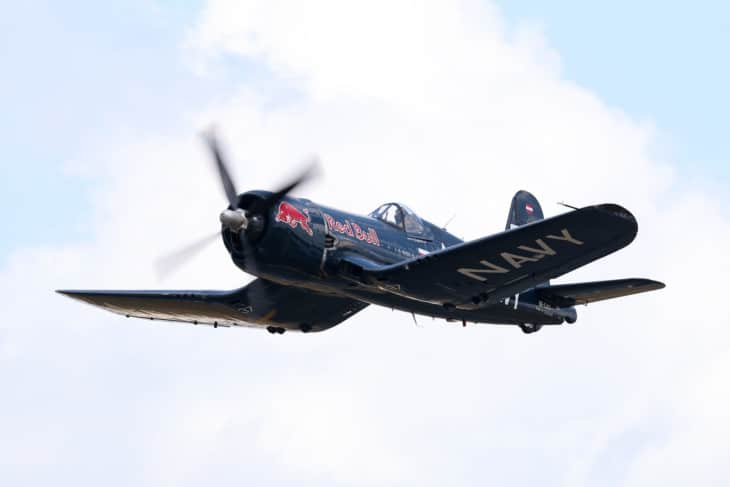
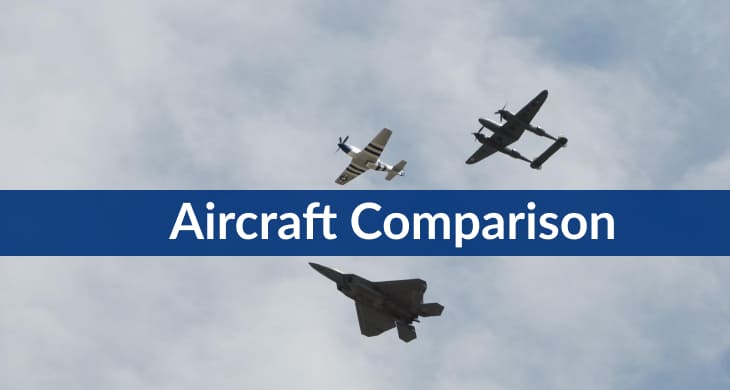
Which one is the better aircraft? It’s a question that many people have asked, and there are valid arguments for both sides. The P-38 was faster and could climb higher, while the F4U Corsair had more firepower and could take more punishment. So which one was the better aircraft? Let’s take a closer look at each one to find out.
The Lockheed P-38 Lightning
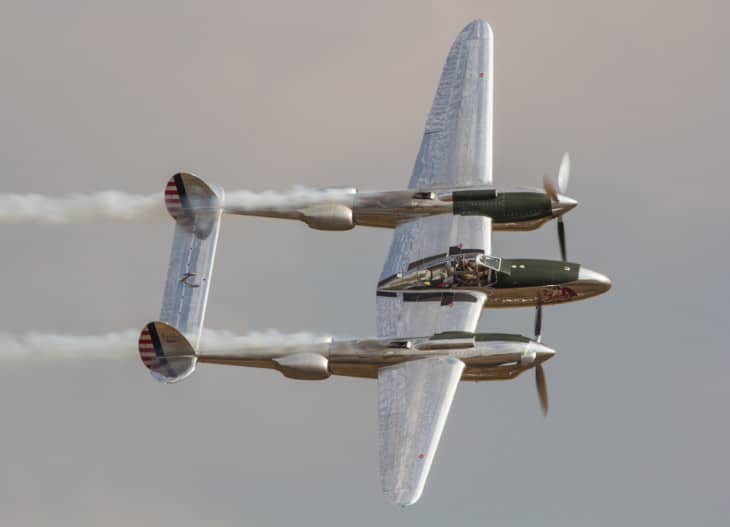
The P-38 Lightning quickly gained a reputation for being a “flight epileptic” due to its characteristic shaking and vibrating. Still, its unique design allowed it to excel at high altitudes where other planes struggled. Its unique twin-boom structure also gave it more stability in turns and greater control during dives compared to the traditional single-fuselage design.
While it was initially not well-received by pilots, advances in pilot training helped them learn how to handle the P-38 properly. It soon became one of the most successful fighters in WWII, known for its role in shooting down Japanese admiral Isoroku Yamamoto’s plane over Bougainville in 1943.
Its versatility and performance also earned it a spot as a favorite among pilots like Chuck Yeager, who flew the P-38 on his record-breaking supersonic flight in 1947. Despite its shaky start, the P-38 proved a formidable and versatile aircraft that played a crucial role in WWII and beyond.
With its unique twin-boom design and powerful arsenal of four 50-caliber machine guns and one 20 mm cannon, the P-38 was ahead of its time. It had a reputation for being difficult to fly due to excessive vibrations. Still, pilots who learned how to handle it correctly found that the twin-boom design provided increased stability during turns and dives.
The P-38 proved itself as a deadly fighter during WWII, including playing a role in shooting down Japanese Admiral Isoroku Yamamoto’s plane over Bougainville in 1943. Even after the war, test pilot Chuck Yeager chose a P-38 for his record-breaking supersonic flight in 1947. The innovative design and impressive performance of the P-38 made it an invaluable asset throughout WWII and beyond.
Why was the P-38 developed and built?
In response to the 1937 US Army Air Corps request for a high-altitude interceptor, Lockheed designed the P-38, also known as the Lightning.
The plane, which has a cockpit and armament in its central nacelle between its two booms, flew for the first time in January 1939.
Production of the P-38 continued until 1945, totaling over 10,000 aircraft. In addition to its role as an interceptor, the P-38 proved highly versatile, with a long-range and the ability to carry heavy payloads.
It was used in reconnaissance missions, as a bomber escort, and even as a ground attack aircraft in Europe and the Pacific Theatre. The P-38’s role in World War II included missions against Japanese shipping in the Aleutian Islands Campaign and well-known battles such as Operation Torch and Operation Vengeance (the shooting down of Admiral Yamamoto).
Its success led to several variants being produced during its lifetime, including ones equipped explicitly for photo reconnaissance or dive-bombing.
What purpose did the P-38 serve?
It served as an interceptor, a bomber escort, and a ground attack aircraft.
Also, Its success led to several variants being produced during its lifetime, including ones equipped explicitly for photo reconnaissance or dive-bombing.
The Vought F4U Corsair
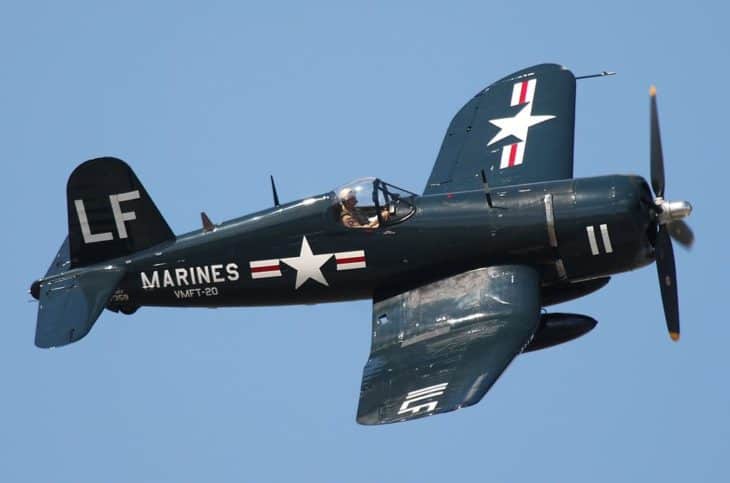
The F4U Corsair entered combat in 1943, quickly proving itself as a formidable opponent for the Axis powers. With a top speed of over 710 kilometers per hour and a wingspan of 12 meters, the aircraft could outmaneuver its enemies and unleash its impressive firepower.
The Corsair was also known for its ruggedness and durability, allowing it to survive punctures and battle damage that would have crippled other fighter planes.
These traits made the Corsair a favorite among Allied naval aviators, giving them the edge they needed in aerial battles. The F4U served in conflicts beyond World War II, including the Korean War, before it was phased out in the 1960s.
Why was the F4U Corsair developed and built?
The F4U Corsair was first designed to solve the Navy’s need for a carrier-based, high-performance fighter. Its unique inverted gull wing design allowed for larger propeller diameter and better ground clearance on aircraft carriers. At the same time, its Pratt & Whitney R-2800 engine provided excellent performance at low and high altitudes.
The Corsair also incorporated advanced features such as hydraulic landing gear, a gyroscopic gunsight, and optional rocket launchers.
Because of its power and versatility soon became a much sought-after aircraft by the Navy and Marine Corps, with nearly 12,500 produced between 1942 and 1953.
The Corsair saw much success during World War II, particularly in the Pacific Theater, where its abilities proved invaluable in missions such as close air support, fleet defense, and reconnaissance.
It was also used extensively by the British Royal Navy Fleet Air Arm, with over 1,000 acquired through lend-lease programs. Post-war, the Corsair continued to serve in both Korea and Vietnam before ultimately being phased out in the 1970s with the introduction of jet fighters.
What purpose did the F4U Corsair serve?
This plane had several purposes. Its original purpose was to be a high-performance fighter for the Navy that could take off from carriers.
It was also used extensively by the British Royal Navy Fleet Air Arm and saw much success during World War II in the Pacific Theater.
Post-war, the Corsair continued to serve in both Korea and Vietnam before ultimately being phased out in the 1970s with the introduction of jet fighters.
How are the P-38 and F4U Corsair different?
The P-38 and F-4u Corsair may be iconic World War II planes, but they had distinct differences in design and purpose. The P38 was designed as a high-altitude interceptor, while the F-4U was intended for use as a fighter bomber.
In terms of size, the P-38 was more extensive and heavier, with a wingspan of 52 feet compared to the Corsair’s 41 feet. It also had a higher service ceiling at 43,000 feet versus the F4U’s 32,000 feet.
Additionally, the P-38 had two engines compared to Corsair’s single-engine design. This difference impacted their performance – the P-38 had a top speed of 437 miles per hour versus 405 for the F4U.
However, the F4U could carry almost twice the payload of bombs and ammunition, making it more effective than a fighter bomber.
How are the P-38 and F4U Corsair similar?
The P-38 Lightning and the F-4U Corsair were American fighter planes during World War II. Both aircraft were also designed with distinct twin boom structures, which helped to balance the weight of their engines and fuel tanks.
Both planes were highly maneuverable and had a high diving speed, making them formidable adversaries in battle. Additionally, both aircraft were used in multiple roles in combat, including bomber escort, reconnaissance, and ground attack missions.
What’s better about the P-38?
Several better things on this fighter plane include:
Speed:
The speed of this fighter is one of the best things about it. It can go from 0 to 400 miles per hour in 12 seconds.
Maneuverability:
This fighter is also highly maneuverable. It can make a 180-degree turn in just 9 seconds at a low altitude.
Range:
The P-38 has an impressive range of 1,300 miles. This allows it to take on more extended missions and cover greater distances without refueling.
Twin-engine design:
The P-38’s twin-engine design is another one of its defining features. This provides backup in case of engine failure and also results in a more comfortable cockpit for the pilot.
What’s better about the F4U Corsair?
The F4U Corsair was a standout aircraft during World War II. One of its most significant advantages was:
Design:
The F-4U Corsair had a unique design that included long wings and an engine placed behind the pilot. This gave the aircraft better aerodynamics and increased speed. The distinctive bent wings also allowed for a larger turning radius, giving the Corsair increased maneuverability in dogfights. Additionally, it had one of the largest wing areas in its body size, resulting in improved stability and control during takeoffs and landings.
Performance:
The F-4U Corsair was an outstanding aircraft during World War II. One of its most impressive features was its speed. It could fly faster than any other American plane at the time, reaching up to 430 miles per hour. Additionally, the Corsair had an impressive range, staying in the air for up to eight hours. It was also one of the most maneuverable planes due to its unique design. The F-4U Corsair could make tight turns and perform acrobatic feats that other planes couldn’t match.
Armament:
The F-4U Corsair was equipped with six .50-caliber machine guns. It could also carry up to four thousand pounds of bombs, making it a formidable opponent in combat.
Conclusion
The P-38 Lightning and the F4U Corsair were exceptional aircraft during World War II. They both had unique designs, capabilities, and advantages, making them formidable in battle. However, each plane had its strengths and weaknesses.