

Table of Contents
I guess there’s one question on many a war historian mind regarding fighter aircraft: P-51s or Bf 109s? Sure, the Mustang is a classic – but the Messerschmitt has that specific something, you know? It’s tough to decide, but luckily we’re here to help. In this article, I’ll compare the P-51 and the Bf 109 side-by-side, so you can decide which was the better World War II fighter.
The North American P-51 Mustang
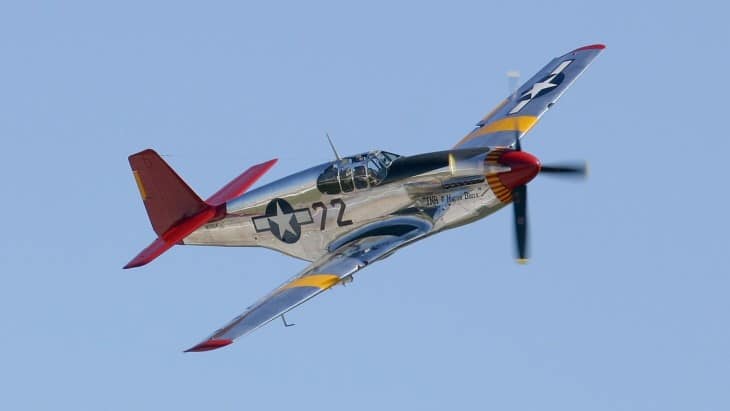
The P51 Mustang is one of the most legendary fighter planes in history. Its sleek design and formidable firepower helped turn the tide of World War II in favor of the Allies.
But did you know that this powerhouse almost didn’t exist? Initially, the British government approached American aircraft manufacturers with a request for a fighter plane. The American companies declined, feeling that their focus should be on bombers instead.
Fortunately, engineers at North American Aviation still believed in the project and convinced executives to pursue it. The rest is history, as they say – the P51 proved faster and more maneuverable than its rivals and became a beloved symbol of American ingenuity and strength.
The P51 has impressive specs – it can reach speeds of 437 mph and soar to altitudes of 40,000 feet. But what sets it apart is its distinctive design, sleek curves, and that signature shark mouth painted on the nose.
Why was the P-51 Mustang developed and built?
The P-51 Mustang was developed and built to respond to the desperate need for an effective bomber escort during World War II.
The Allies needed a fighter that could accompany bombers on their long journeys over enemy territory, and the Mustang proved the perfect solution. It utilized a standard, dependable engine and had enough internal space for an oversized fuel load, allowing it to fly longer distances.
Plus, its external fuel tanks allowed it to accompany bombers from England to Germany and back. The P-51 Mustang was a crucial component in the Allies’ ability to conduct successful bombing missions.
What purpose did the P-51 serve
There are several benefits of this fighter aircraft:
- The P51 Mustang served as an effective bomber escort during World War II, helping the Allies to conduct successful bombing missions.
- It is a sleek and stylish aircraft that can turn heads when flying.
- The P51 is fast and maneuverable, making it an excellent choice for those who want a powerful fighter plane.
- Its external fuel tanks allow it to fly long distances, making it perfect for those who need an aircraft that can cover much ground.
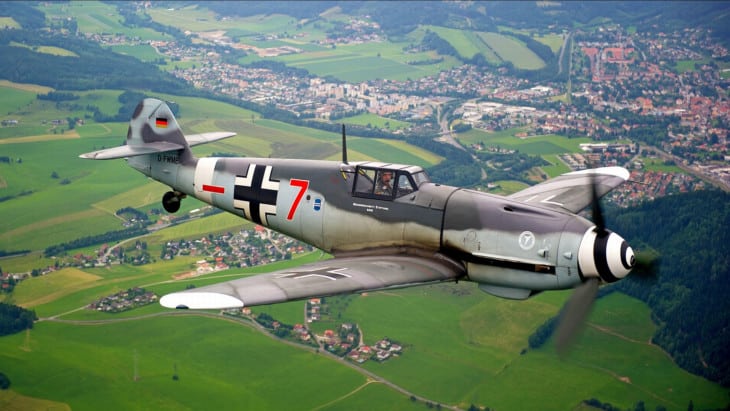
The Messerschmitt Bf 109

As one of the most produced fighter aircraft in history, with over 33,000 units built, the Messerschmitt Bf 109 was a formidable opponent for allied forces during World War II. The Bf 109 saw its first combat in the skies over Spain during the Spanish Civil War and continued to prove itself a versatile and capable fighter throughout the conflict.
With an advanced all-metal construction and a top speed of almost 400 miles per hour, the Bf 109 could outclass many of its contemporaries.
Though it had shortcomings, such as limited ammunition capacity and narrow landing gear that made takeoff and landing challenging, it proved a reliable and effective weapon in the hands of skilled pilots.
Renowned pilots who flew the Bf 109 included Erich Hartmann, who holds the record for most air combat victories, and Hans-Joachim Marseille, known as the “Star of Africa” for his prowess in North Africa.
As WWII came to a close, production of the Bf 109 ceased, but it continued to see service with other nations until as late as 1958. The legacy of the Bf 109 lives on today through restored models and appearances in popular media.
Also Read: Messerschmitt BF 108 Taifun
Why was the Bf 109 developed and built
The German government saw the need for a modern fighter plane and tasked Messerschmitt with creating one that could compete with other leading nations’ aircraft. The Bf 109 became the most-produced fighter aircraft in history due to its success during World War II.
It was initially used as an interceptor, able to take out enemy bombers, but it also proved adept at dogfighting and ground attack missions.
While the Bf 109 ultimately lost favor towards the war’s end with newer fighter planes entering the fray, it was an integral part of Germany’s air force during its reign of terror across Europe.
What purpose did the Bf 109 serve?
Firstly, the German Luftwaffe used it extensively throughout World War II.
It saw action in several other conflicts, including the Spanish Civil War and the Arab-Israeli War.
Thirdly, some countries even used it as a trainer aircraft after the war. The Bf 109 was known for its high maneuverability and speed, making it a formidable opponent in aerial combat.
However, due to its popularity and widespread use, it also became one of the most-produced planes in history, with over 33,000 units built during its service. Various countries produced variants and copies of the Bf 109 until 1958.
How are the P-51 and Bf 109 different
The P51 and Bf 109 are both iconic World War II-era fighter planes, but they have distinct characteristics that set them apart.
The P51, also known as the Mustang, was an American aircraft with a sleek design and long-range capabilities thanks to its use of drop tanks.
It was also highly maneuverable and could hold its own in dogfights. On the other hand, the Bf 109 was a German plane known for its high speed and armament capabilities.
It lacked the P51’s range and agility but made up for it with powerful engines and heavy firepower. The Bf 109 had an enclosed cockpit, while the P51 had an open cockpit design.
How are the P-51 and Bf 109 similar
Despite their differences, they share some commonalities.
Both aircraft were designed and built during World War II and extensively used throughout the conflict.
Both planes were highly advanced and featured impressive speed and maneuverability.
Both were also equipped with machine guns for air-to-air combat, although the Bf 109 had greater overall armament with its ability to mount cannons. In terms of design, both planes featured sleek, elegant lines and a single-seat cockpit.
What’s better about the P-51?
A few factors put the P-51 ahead of the Bf 109.
Engine:
The P51 was equipped with a more powerful engine with a top speed of around 437 mph.
This made it one of the fastest planes of its time and allowed it to outrun most opponents.
Range:
The P51 also had a more extended range thanks to its use of drop tanks. This allowed it to stay in the air for extended periods and made it ideal for escort missions.
Maneuverability:
The P51 was more agile than the Bf 109, making it better suited for fights that involved lots of turns and twists.
What’s better about the Bf 109?
On this front, the Bf 109 has a few advantages.
Speed:
The Bf 109 had a top speed of around 391 mph, making it one of the fastest fighters of its time. This allowed it to outrun most opponents and get behind them for a quick kill.
Armament:
The Bf 109 was also better equipped for air-to-air combat, thanks to its use of cannons. These were more effective than machine guns and gave the Bf 109 an edge in dogfights.
Enclosed Cockpit:
The Bf 109 also featured an enclosed cockpit, which provided better protection for the pilot and made it easier to stay focused on the fight.
Conclusion
So, which plane is better? The P-51 or the Bf 109? It depends on what you’re looking for. If you want a fast, agile plane that can outrun most opponents, then the P51 is the better choice.
However, if you want a plane that’s better equipped for air-to-air combat, then the Bf 109 is the way to go. Ultimately, it’s up to you to decide which is better suited for your needs.
About the Author

With a passion for aviation, as well as surfing and scanning the web, Rocco is in his element analyzing aircraft data and the differences and similarities between aircraft.