


Table of Contents
| Question | MiG-25 Foxbat | MiG-31 Foxhound |
|---|---|---|
| Job | Interceptor and reconnaissance aircraft | Interceptor built to catch low-flying cruise missiles and bombers |
| First flight | September 9, 1964 (interceptor prototype) | September 16, 1975 |
| Radar | Smerch-A, vacuum-tube electronics | Zaslon phased array, tracks 10 targets |
| Gun | None | 23 mm GSh-6-23 with 260 rounds |
| Main missiles | Four R-40 (MiG-25P) | Four R-33, R-37M on the MiG-31BM |
| Speed near the ground | About 746 to 808 mph (1,200 to 1,300 km/h) | About Mach 1.23 |
| G limit | 4.5 g, only 2.2 g with full fuel | 5 g at supersonic speed |
| Built | 1,186 | Roughly 500 |
| Status | Retired by Russia, a few reported in Algeria | In Russian service, expected to 2030 |
Is the MiG-31 just a MiG-25 with a second seat?
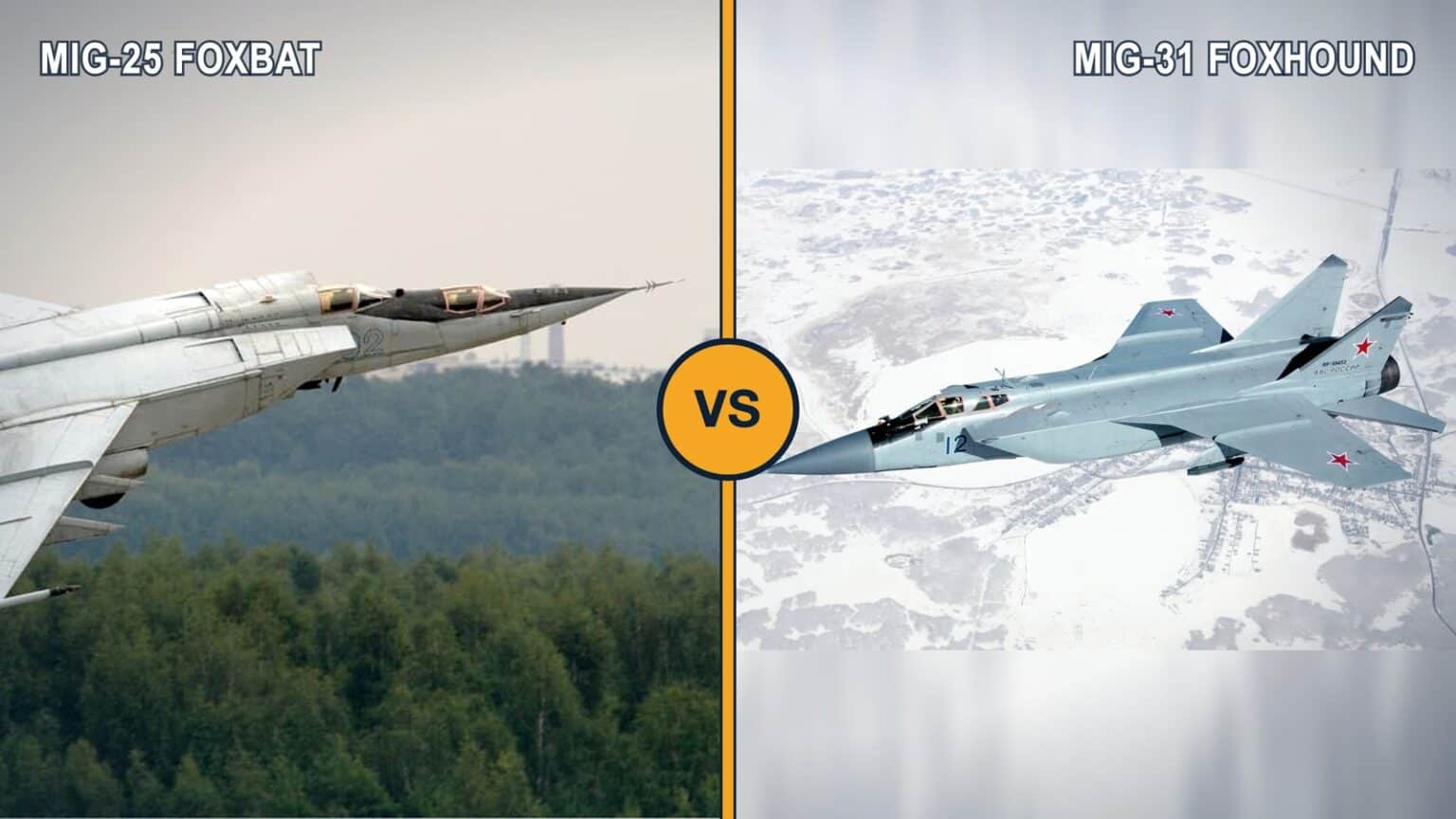
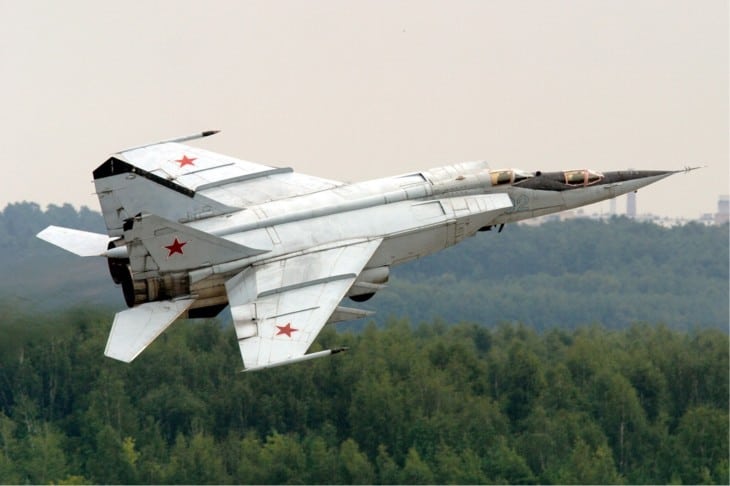
No, though it is easy to see why people think so. The MiG-25 Foxbat was the Soviet answer to American spy planes and the Mach 3 bomber the US was developing. The MiG-31 Foxhound was built to fix what the Foxbat could not do.
The MiG-25 handled poorly at interception speeds and was hard to fly low. The MiG-31 got a stronger airframe for supersonic flight at low altitude, a second crewman to run the radar, and a rotary cannon the Foxbat never had. Production at Gorky moved from the MiG-25PD to the MiG-31.
The MiG-31 prototype flew on September 16, 1975. A year later, defector Viktor Belenko told Western debriefers about a coming “Super Foxbat” with two seats.
This page uses the MiG-25P and MiG-25PD for the Foxbat. Our MiG-31 page is titled MiG-31E, an export version that never entered serial production, but its figures describe the baseline jet.


Myth check: neither jet is a Mach 3 fighter
Both are listed at Mach 2.83, about 1,864 mph (3,000 km/h). A MiG-25 was tracked at Mach 3.2 over Sinai in the early 1970s, but the flight wrecked its engines. The MiG-31’s thrust would allow more than Mach 3, but heat would damage the airframe and engines.
Edge: MiG-31, because it fixed the Foxbat’s weaknesses
Speed: the same at altitude, very different near the ground
AeroCorner’s spec panel lists both at 1,864 mph (3,000 km/h). Both limits come from heat, not thrust.
The MiG-25 was allowed Mach 2.83 for no more than five minutes. A warning light came on when the airframe reached 554°F (290°C), and the pilot had to slow down.
The gap opens low down. The MiG-25 was never stressed for fast flight in dense air and managed about 746 to 808 mph (1,200 to 1,300 km/h) near sea level. Russian sources quote Mach 1.23 near the ground for the MiG-31, which was designed to hunt low-flying targets.
For where both sit in the wider field, see our ranking of the fastest fighter jets.


Edge: even at altitude, MiG-31 near the ground
Climb, ceiling and thrust: the MiG-31 is stronger on paper
The MiG-31’s two Soloviev D-30F6 turbofans give 2 × 34,172 lbf (152 kN). The MiG-25’s two Tumansky R-15B-300 turbojets give 2 × 22,500 lbf (100 kN).
That shows in the climb. The panel lists 56,700 ft/min (288 m/s) for the MiG-31 and 40,945 ft/min (208 m/s) for the MiG-25.
The service ceiling is 82,000 feet (25,000 m) against 67,900 feet (20,700 m). The MiG-25 figure applies with four missiles. With two it rose to about 78,700 feet (24,000 m).
The MiG-25 still holds a record the MiG-31 never took. On August 31, 1977, Alexander Fedotov zoom-climbed a stripped MiG-25RB to 123,524 feet (37,650 m), the absolute altitude record for a jet taking off under its own power. A zoom climb is a ballistic arc, not sustained flight.


Edge: MiG-31, though the MiG-25 owns the altitude record
Radar and weapons: where the MiG-31 pulls away
The MiG-25P’s Smerch-A radar used vacuum tubes, which tolerated heat without cooling. It ran at about 600 kilowatts, giving long range and strong resistance to jamming. After Belenko’s defection compromised it, the MiG-25PD got the Saphir-25 radar with limited look-down ability and an infrared sensor.
The MiG-31’s Zaslon is a passive phased-array radar. It can detect a fighter-sized target at roughly 124 miles (200 km) and track up to 10 targets while attacking four. It can look down and shoot down, which matters against cruise missiles hugging the ground.
A flight of four MiG-31s can share radar data over a digital datalink. One jet can also direct other fighters onto targets it has found. Wikipedia says no other fighter in service had a phased-array radar until 2000.
The MiG-25P carried four R-40 missiles and no gun. The MiG-31 carries four R-33 missiles with a published range of about 75 miles (120 km), plus a 23 mm GSh-6-23 rotary cannon. The upgraded MiG-31BM can fire the R-37M, with estimates of about 174 to 249 miles (280 to 400 km).
Fast, but not agile
Belenko’s MiG-25P showed a steel airframe with a 4.5 g limit, and only 2.2 g with full tanks. The MiG-31 is limited to 5 g at supersonic speed. Both are built to shoot from long range, not to dogfight.

Edge: MiG-31, clearly
Range and fuel: the Foxhound flies much farther
The panel gives the MiG-31 a range of 1,860 miles (3,000 km) and the MiG-25 1,160 miles (1,860 km). The MiG-31 also carries more fuel: 5,300 gallons against 4,650 gallons.
The MiG-25’s figure is a subsonic one. At supersonic cruise it fell only modestly, to about 1,013 miles (1,630 km), but a real intercept was far shorter. The analysis of Belenko’s aircraft put its combat radius at 186 miles (300 km).

Edge: MiG-31
Combat record: the Foxbat fought, the Foxhound is still fighting
The MiG-25 saw most of its action in the Middle East. In 1971 and 1972 a Soviet detachment flew roughly 20 reconnaissance sorties over Israeli-held Sinai at maximum speed. Israeli F-4E Phantoms fired on one without success.
Iraq used it most. All confirmed air-to-air kills by the MiG-25 were scored by Iraqi pilots, including the F/A-18 flown by Lieutenant Commander Scott Speicher on January 17, 1991. On December 23, 2002, an Iraqi MiG-25 shot down an armed MQ-1 Predator.
Against Western fighters the record was poor. Israeli F-15s shot down Syrian MiG-25s in February 1981, July 1981 and August 1982, and US F-15s downed two Iraqi MiG-25s on January 19, 1991.
The MiG-31K carries one Kh-47M2 Kinzhal air-launched ballistic missile, listed at Mach 10 and about 1,240 miles (2,000 km). Ukraine says it has intercepted Kinzhals fired from MiG-31Ks, though Russia’s claims differ.
Russian MiG-31s have also fired R-37M missiles at Ukrainian aircraft from long range since 2022. On September 19, 2025, three entered Estonian airspace for about 12 minutes with their transponders off.
Edge: MiG-25 for air-to-air history, MiG-31 for current relevance
Numbers built and who still flies them
A total of 1,186 MiG-25s were built before production ended in 1984, including 460 MiG-25P and 104 MiG-25PD interceptors. The MiG-31 total is given as roughly 500, with sources ranging from 500 to 519.
Russia and the other Soviet successor states have retired their MiG-25s, and India retired its reconnaissance fleet in 2006. Algeria retired its last frontline MiG-25s in July 2022, though a June 2026 report said some are still kept in flying condition.
The MiG-31 is still a front-line Russian type. The Defense Ministry expects it to serve until at least 2030, after extending airframe life from 2,500 to 3,500 hours in 2020. Kazakhstan retired its jets in 2023.


Edge: MiG-31
Verdict: which is better, the MiG-25 or the MiG-31?
The MiG-31 is the better aircraft in nearly every way that matters in a fight. It has a far better radar, a gun, a second crewman, more thrust, more range and a higher ceiling.
The MiG-25 is the more famous one. It was the faster surprise of the 1960s, set the altitude record and gave the West its biggest intelligence haul when Belenko landed in Japan in 1976.
To see how the Foxbat compares with a Western jet, read our F-35 vs MiG-25 comparison.
Verdict: the Foxhound wins
MiG-25 Foxbat: record speed and altitude flights, a steel airframe built for Mach 2.83. MiG-31 Foxhound: phased-array radar, a gun, two crew, more range and still in service. Edge: MiG-31.
FAQ
Sources and references used for research and fact-checking.
- Wikipedia, Mikoyan-Gurevich MiG-25
- Wikipedia, Mikoyan MiG-31
- National Museum of the United States Air Force, Mikoyan-Gurevich MiG-25
- Air Vectors, MiG-25 Foxbat & MiG-31 Foxhound
- Airforce Technology, MiG-31 Foxhound Interceptor Aircraft
- AeroCorner, Mikoyan MiG-25 Foxbat
- AeroCorner, Mikoyan MiG-31E Foxhound
About the Author

Tim is the owner and lead editor of AeroCorner since 2019, overseeing aviation content covering aircraft, airlines, airports, and the broader aviation industry. Through years of researching, writing, editing, and publishing aviation-focused content, he has developed extensive practical knowledge of commercial aviation and air travel. Based in Asia and a frequent traveler himself, Tim also brings firsthand passenger experience to AeroCorner’s coverage. Outside of publishing, he has also explored aviation firsthand through hands-on flight training in New Zealand.