The Eurofighter Typhoon and the Sukhoi Su-57 Felon are two of the most advanced fighter jets in the world. They both have state-of-the-art technology and are capable of carrying out a wide range of combat missions. So which jet is better? This article will compare the Eurofighter Typhoon with the Sukhoi Su-57 and see which one comes out on top!
The Eurofighter Typhoon
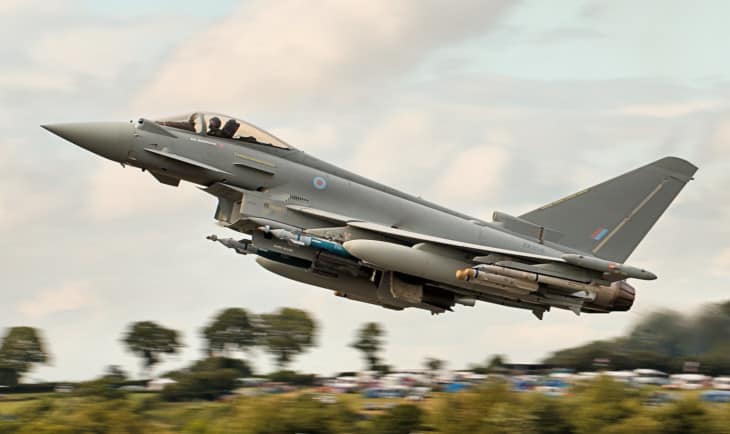
The Eurofighter Typhoon is a world-class fighter aircraft designed to outperform anything else in the sky. Eurofighter Typhoon pilots have the advantage in any engagement thanks to the aircraft’s sophisticated radar, avionics, and weapons systems. It is this combination of attributes that makes the Eurofighter Typhoon unrivaled in the air-to-air domain.
In air-to-ground missions, Eurofighter Typhoon can carry a wide range of weapons and is compatible with the latest precision-guided munitions.
The Eurofighter Typhoon has been designed from the outset to evolve and be upgradeable, ensuring that it remains at the forefront of combat capability.
Why Was The Eurofighter Typhoon Developed?
The Eurofighter Typhoon was originally developed by a consortium of three companies: EADS, BAE Systems, and Alenia Aeronautica. However, the project ran into problems from the outset, with each company having different ideas about how the aircraft should be designed.
As a result, the Eurofighter consortium was formed in 1986 to bring together the different design concepts and create a single unified aircraft. Despite the challenges, the Eurofighter Typhoon has been highly successful and is currently in service with six nations: the UK, Germany, Italy, Spain, Austria, and Saudi Arabia.
What Was The Purpose Of Developing The Eurofighter Typhoon?
The primary purpose of developing the Eurofighter Typhoon was to provide air forces with a highly effective multi-role combat aircraft that could be used for air-to-air and air-to-ground missions as well as providing reconnaissance capabilities if required.
Eurofighter Typhoons are currently being used in various roles including those of interceptor aircraft, fighter bombers, and close air support platforms. The advanced avionics systems fitted to Eurofighter Typhoons allow them to perform their roles to a very high standard despite being involved in intensely hostile environments.
Sukhoi Su-57 Felon

The Su 57 is a twin-engine jet fighter designed for air superiority and multi-role missions. The aircraft is equipped with a variety of sophisticated sensors and weapons, making it one of the most advanced fighters in the world. The Su 57 has a top speed of Mach 2.25 and a range of over 3,500 kilometers. It is also stealthy, making it difficult for enemy radar to detect.
The aircraft first entered service with the Russian Air Force in 2018. Since then, it has seen action in Syria and conducted several test sorties.
Why Was The Su 57 Developed?
The Su-57 was developed to replace the MiG-29 and Su-27 in Russian military service. The aircraft is armed with a 30mm autocannon and can carry a variety of air-to-air and air-to-surface missiles. It is powered by two Saturn AL-41F1 engines, which provide a maximum speed of Mach 2.25.
The Su-57 has a crew of one or two, and it can carry up to 12 missiles.
What Was The Purpose Of Developing The Su 57?
The Su 57 is a Russian fighter jet that was designed for both air-to-air and air-to-ground combat. The Su 57 is the first Russian jet to be equipped with stealth technology, making it difficult for enemy radar to detect. The Su 57 is also outfitted with a variety of sophisticated sensors and weapons, making it a fearsome opponent in battle.
Despite its many capabilities, the Su 57 has not yet been deployed in combat. The Russian military is currently evaluating the Su 57 in various exercises and tests, and it is expected to enter service in the next few years. Ultimately, the Su 57 represents a new generation of Russian military hardware, and it will play a vital role in protecting Russian airspace for years to come.
How Is The Su-57 Different From The Eurofighter Typhoon?
The Russian Su-57 is a 5th-generation fighter aircraft designed for air superiority and various other roles. The Eurofighter Typhoon is a twin-engine, canard-delta wing multirole fighter. In terms of size, the Su-57 is larger and heavier than the Eurofighter Typhoon. The Su-57 has a longer fuselage and wingspan and is taller as well.
The Eurofighter Typhoon has a top speed of Mach 1.5, while the Su-57 has a top speed of Mach 2.0. The Su-57 also has a greater range, as well as more powerful engines. In terms of armament, the Su-57 has 12 hardpoints for carrying missiles, while the Eurofighter Typhoon only has 9 hardpoints.
The Su-57 can also carry more missiles than the Eurofighter Typhoon. In terms of sensors, the Su-57 is equipped with an Active Electronically Scanned Array radar, while the Eurofighter Typhoon is equipped with a Passive Electronically Scanned Array radar. The Su-57 also has infrared search and track, laser warning receivers, and jamming pods.
Overall, the Su-57 is a more advanced and capable fighter jet than the Eurofighter Typhoon.
How Is The Su-57 Similar To The Eurofighter Typhoon?
Though both the Eurofighter Typhoon and the Sukhoi Su-57 are top-of-the-line fighter jets, they have several key differences. The Typhoon, developed by a consortium of European countries, first took flight in 2003. It is a twin-engine jet with canards and a delta wing design and is considered to be highly maneuverable. It is also outfitted with state-of-the-art avionics, making it an incredibly effective air-to-air fighter.
The Su-57, on the other hand, is a single-engine jet developed by Russia. It made its maiden flight in 2010 and is considered to be one of the most advanced fighters in operation today. Unlike the Typhoon, the Su-57 has a ‘stealth’ design, meaning it is difficult to detect on radar. It is also outfitted with sophisticated air-to-air and air-to-ground missiles, making it a formidable opponent in combat.
Eurofighter Typhoon: What’s Better
Eurofighter Typhoon is a twin-engine, canard-delta wing, multirole fighter. The aircraft is designed to perform air-to-air, air-to-ground, and tactical reconnaissance missions. Eurofighter Typhoon has a top speed of Mach 2 and a range of 3,200 kilometers. The aircraft is armed with an internal 30mm cannon and can carry a payload of 15,000lbs. Eurofighter Typhoon has a crew of two and is powered by two Eurojet EJ200 engines.
Su-57: What’s Better
Su-57 is a better aircraft than Eurofighter Typhoon for multiple reasons. The Su-57 is a 5th generation fighter, whereas the Typhoon is only 4th generation. The Su-57 has a much longer range than the Typhoon – over 6,000km compared to the Typhoon’s 1,550km. The Su-57 can carry more weapons than the Typhoon – up to 12 internal and 6 external hardpoints compared to the Typhoon’s 9 internal and 4 external hardpoints. The Su-57 is also stealthier than the Typhoon, with a radar cross-section of 0.1m2 compared to the Typhoon’s 1m2.
Conclusion: Eurofighter Typhoon vs Su 57
The Eurofighter Typhoon and the Su-57 are both cutting-edge fighter jets with a variety of capabilities. The Typhoon is a twin-engine jet with canards and a delta wing design, while the Su-57 is a single-engine jet with a ‘stealth’ design.
The Typhoon is outfitted with state-of-the-art avionics, making it an effective air-to-air fighter, while the Su-57 is outfitted with sophisticated air-to-air and air-to-ground missiles, making it a formidable opponent in combat. Ultimately, both jets are sure to play a major role in conflicts around the world for years to come.