

Table of Contents
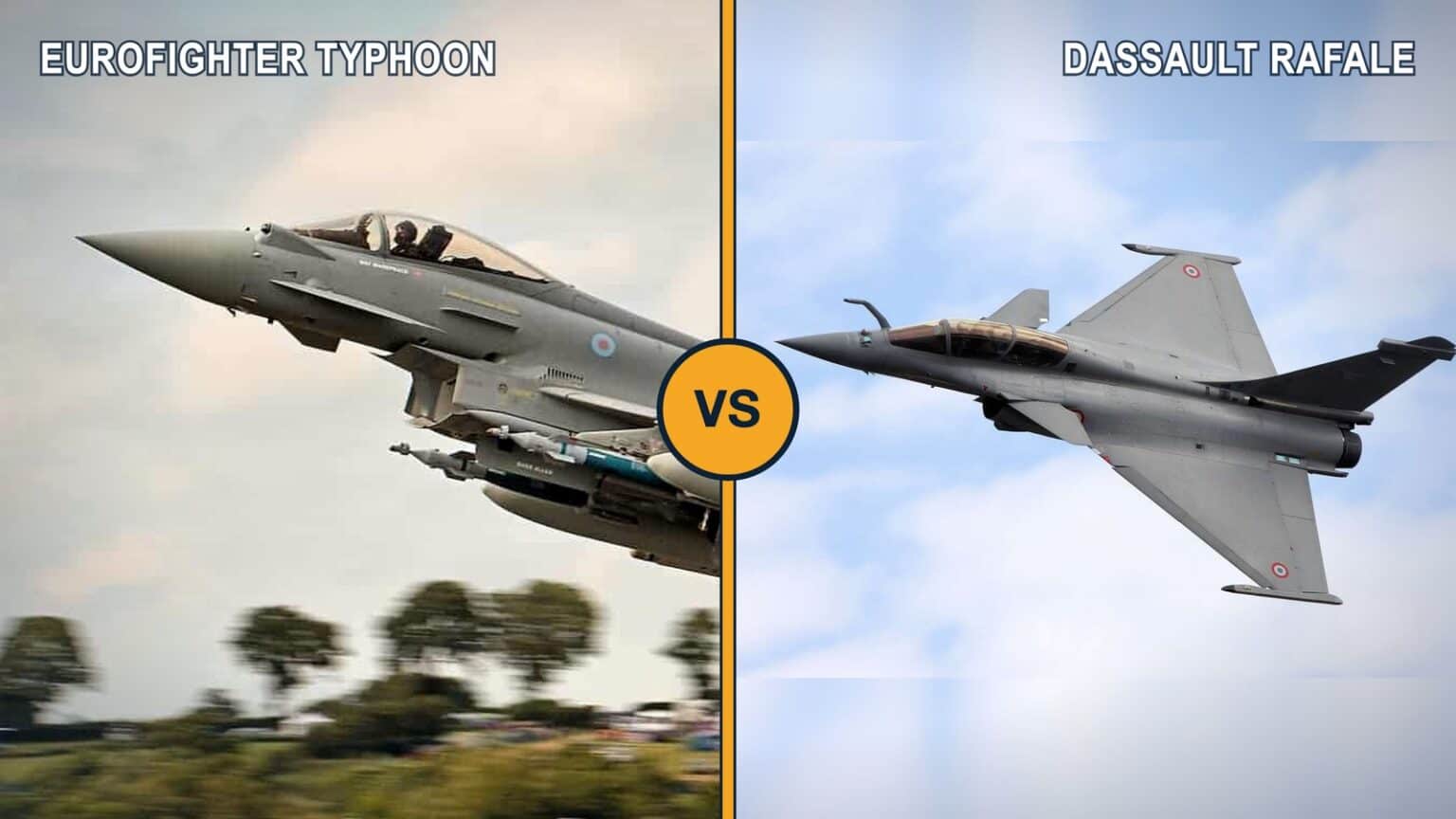
The Eurofighter Typhoon and the Dassault Rafale are the two big European fighters of their generation. Both are twin-engine, canard-delta multirole jets, and both came out of the same failed five-nation program.
The Typhoon is faster and climbs higher. The Rafale lands on carriers, carries more and beat the Typhoon in India’s fighter competition.
The spec widget above compares the numbers. This table covers what the widget does not.
| Fact | Eurofighter Typhoon | Dassault Rafale |
|---|---|---|
| Built by | Airbus, BAE Systems and Leonardo | Dassault Aviation, with Thales and Safran |
| First flight, production-standard prototype | 27 March 1994 | 19 May 1991 (technology demonstrator: 4 July 1986) |
| Entered service | 4 August 2003, Germany | 2001, French Navy |
| Carrier capable | No | Yes, as the Rafale M |
| Cannon | 27 mm Mauser BK-27, 150 rounds | 30 mm, 125 rounds |
| External hardpoints | 13 | 14 (air force), 13 (navy) |
| Design g limits | +9 g, -3 g | +9 g, -3.6 g |
| First combat | Libya, March 2011 | Libya, March 2011 |
| Fleet | 769 ordered, 618 delivered, 611 in operation (30 June 2026) | About 165 in French service, 225 planned by 2035 |
| Customers | 10 nations, with Turkey the tenth | France plus 8 export customers |
Two fighters from one failed program
The program began in 1983 as a five-nation project between the UK, West Germany, France, Italy and Spain. France wanted a carrier-capable fighter and a leading role, and the partners could not agree.
France withdrew in July 1985. On 2 August 1985 in Turin, West Germany, the UK and Italy agreed to go ahead without it, and Spain rejoined in early September. The result was the Typhoon.
France built the Rafale alone, with Dassault on the airframe, Thales on the radar and electronic warfare system and Safran on the engines. The Typhoon has four partner nations and three companies behind it, so it is the more political aircraft.
Our guides to the Eurofighter Typhoon and the Dassault Rafale cover each jet in full.
Same layout, different priorities
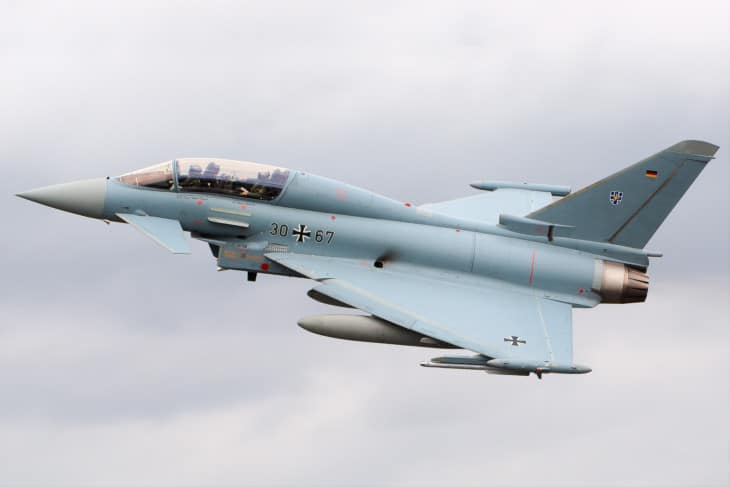
Both jets use a delta wing with canards. That layout is deliberately unstable, so digital fly-by-wire controls keep the aircraft flyable, and it is where the agility comes from.
Neither is a stealth fighter. The Typhoon’s designers reduced its frontal radar signature, for example with intakes that hide the engine faces, and the Rafale uses radar-absorbent materials and a reduced-signature layout. Both still hang their weapons outside the airframe.
The difference is in what each was built to do. The Typhoon was designed first as an air-superiority fighter, with strike added later. Dassault calls the Rafale an omnirole fighter that can fly air defense, strike, reconnaissance, anti-ship and nuclear missions in a single sortie.
Where the Typhoon wins: speed and climb
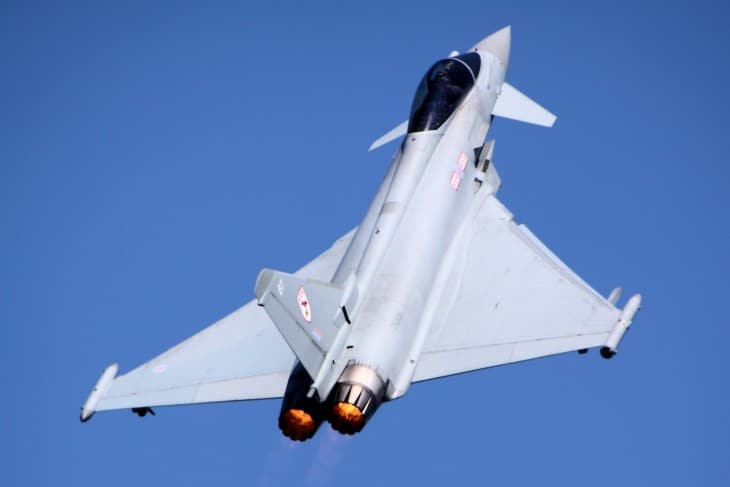
The Typhoon tops out at 1,550 mph (2,495 km/h), against 1,188 mph (1,911 km/h) for the Rafale. The Typhoon’s figure is Mach 2.35 at altitude, per Austrian and German air force data, while the Rafale’s is Mach 1.8.
It also climbs faster, at 62,000 ft/min (315 m/s) against 60,000 ft/min (305 m/s), and its service ceiling is higher at 55,000 ft (16,800 m) against 51,950 ft (15,800 m).
Both can supercruise, meaning fly supersonic without afterburner. Eurofighter says the Typhoon can do Mach 1.5, though Air Forces Monthly gives Mach 1.1 for the RAF’s FGR4. The Rafale can do it only with a light load of four missiles and one belly tank.
Where the Rafale wins: carriers, payload and the nuclear role
The Rafale M is the carrier version, with a strengthened airframe, a longer nose gear leg and a tailhook. It is the only non-US fighter type cleared to operate from the decks of US carriers.
The Typhoon has no carrier version. France wanted one when the program split, and that disagreement is part of why the two jets exist.
The Rafale also carries more, at 20,900 lb (9,500 kg) of payload against 19,800 lb (9,000 kg), and its maximum takeoff weight is 54,000 lb (24,500 kg) against 52,000 lb (23,500 kg). Two French squadrons based at Saint-Dizier fly the Rafale in the air-launched nuclear deterrence role.

Radar and sensors
The Rafale entered service with a more modern sensor suite. Its Thales RBE2 AA radar is an active electronically scanned array, and an infrared search-and-track sensor is built into the front of the aircraft.
The Typhoon entered service with the Euroradar Captor-M, a mechanically scanned radar. Its successor, the Captor-E, is an AESA family fitted to new jets, and the RAF’s version is still in development, with a contract for 38 radars signed in January 2026.
The Captor-E arrives with Tranche 4 jets. The Typhoon also has the PIRATE infrared search-and-track sensor ahead of the windscreen.
Weapons
Both fire the MBDA Meteor long-range air-to-air missile and the Storm Shadow (SCALP-EG) cruise missile. The Rafale adds the MICA missile, the AASM Hammer precision bomb and the Exocet anti-ship missile.
The Typhoon also carries the AIM-120 AMRAAM, IRIS-T, ASRAAM and Sidewinder for air combat, plus Brimstone, Taurus KEPD 350 and Paveway IV for strike. In 2026 the RAF began flying Typhoons with pods of APKWS laser-guided rockets as a cheap counter-drone weapon.
Combat record
Both made their combat debuts over Libya in March 2011. RAF Typhoons flew their first combat mission on 21 March, and Rafales flew strike and reconnaissance missions there.
RAF Typhoons later flew over Iraq and Syria, bombed Houthi sites in Yemen on 12 January 2024 and shot down Iranian drones in April 2024. French Rafales struck targets in Mali in January 2013, flew over Iraq from September 2014 and took part in the April 2018 strikes on Syria.
The Rafale’s most contested record came in May 2025. India reportedly used Rafales in strikes inside Pakistan, and Pakistan claimed it shot several down. France’s air force chief said he had seen evidence confirming the loss of one, and the wider claims remain disputed.
Neither jet has fought the other, so there is no combat record to settle the question.

How much do they cost?
Both are priced in ways that make a clean comparison hard. Governments publish program and system costs, not a single flyaway price.
The Rafale’s unit flyaway price was about 101.1 million euros in 2010 for the F3+ standard, and its unit program cost was about 160.5 million euros as of fiscal 2013.
For the Typhoon, Germany’s 2009 order for 31 Tranche 3A jets cost 2.8 billion euros, about 90 million euros per aircraft including training and spares. Spain’s program cost through 2010 worked out at about 160 million euros for each of 73 aircraft.
Who buys them
India’s choice is the best-known head-to-head. In April 2011 the Indian Air Force shortlisted the Rafale and the Typhoon for a 126-fighter contract, and on 31 January 2012 it named the Rafale the preferred bidder.
India withdrew that tender in 2015 and signed a 7.8 billion euro deal for 36 Rafales in 2016. The Typhoon has since been formally eliminated from India’s fighter programs.
The Typhoon has still sold well in the Gulf. Saudi Arabia, Kuwait, Qatar and Oman fly it, and Kuwait weighed up to 28 Rafales before agreeing to buy 28 Typhoons in 2015. Turkey signed for 20 new-build Typhoons on 27 October 2025.
The Rafale has won in Egypt, Qatar, Greece, Croatia and India, and Indonesia, Serbia and the UAE have orders. See our guides to the UAE Air Force and the French Air Force for the fleets behind them.
Which one is better?
Pick the Typhoon for pure air defense, where its speed, climb and ceiling count. Its range of Tranche upgrades, including the new Captor-E radar, keeps it current.
Pick the Rafale for a navy, a nuclear role or a single aircraft that has to do everything. It carries more, lands on carriers and has an AESA radar and an infrared search-and-track sensor built in.
A fair summary: the Typhoon is the better interceptor and the Rafale is the better all-rounder. In practice, the choice has often come down to budget and politics as much as performance.
FAQ
Sources and references used for research and fact-checking.
About the Author

Tim is the owner and lead editor of AeroCorner since 2019, overseeing aviation content covering aircraft, airlines, airports, and the broader aviation industry. Through years of researching, writing, editing, and publishing aviation-focused content, he has developed extensive practical knowledge of commercial aviation and air travel. Based in Asia and a frequent traveler himself, Tim also brings firsthand passenger experience to AeroCorner’s coverage. Outside of publishing, he has also explored aviation firsthand through hands-on flight training in New Zealand.