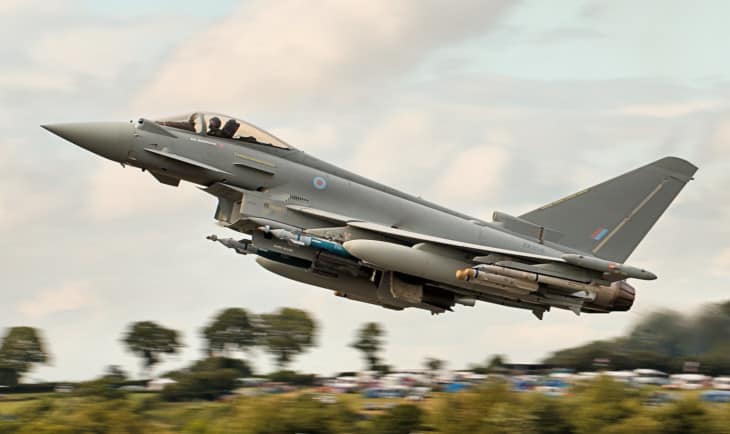

If you’re looking for an American fighter jet that can stand side by side with a European fighter jet, look no further than the Boeing F/A-18 Super Hornet and the Eurofighter Typhoon. These two beauties are products of the late 20th century and are renowned for their powerful engines and speed, among other features.
We have more variants of each aircraft in our database. On the compare aircraft page you can compare any two aircraft yourself.
The Eurofighter Typhoon
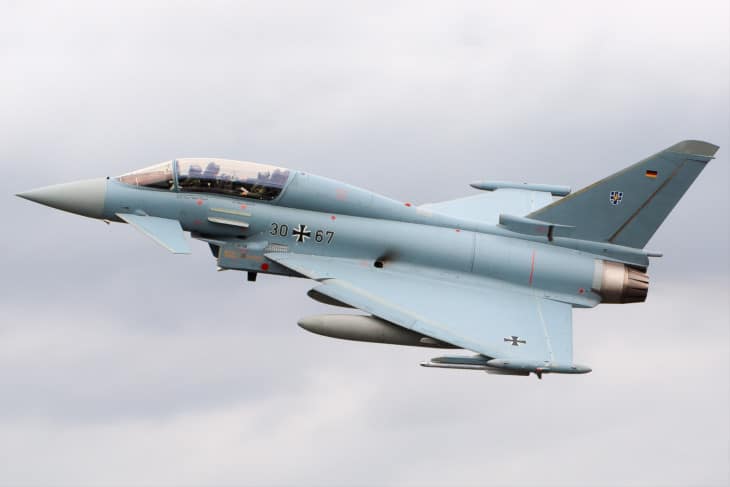
Designed originally as a fighter, the Eurofighter Typhoon is a multi-national, multi-role, twin-engine aircraft manufactured by Eurofighter Jagdflugzeug GmbH. Although its development began in 1983, the plane didn’t fly until 27th March 1994 due to disagreements between the shareholders Germany, France, Italy, Spain, and the UK.
The Eurofighter Typhoon earned its multi-role or swing-role name thanks to its dynamic abilities and employment in air policing, high-intensity conflict, and peace support.
It also possesses a high missile storage capacity – it can carry up to six bombs, six missiles, a cannon, and a targeting pod, while still providing bomb in-flight targeting and missile in-flight support. Arguably the best feature of the Typhoon is its ability to be upgraded and extended easily.
These upgrades include the control infrastructure, navigation technologies, and weapon systems, making this beast a worthwhile investment. Weighing slightly over 11 tonnes, the Eurofighter Typhoon is constructed with strong, lightweight, composite materials such as carbon fiber, different metals, and plastics.
These lightweight materials provide the aircraft with a low radar profile and strong airframe. With metals taking up only 15% of the surface materials used, the Eurofighter Typhoon can perform impressive maneuvers at subsonic speeds while supporting various combat scenarios.
The Boeing F/A-18 Super Hornet
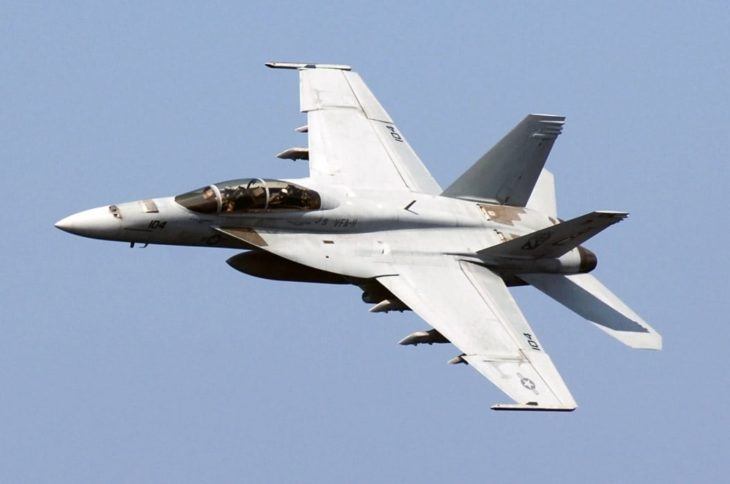
Although the F/A-18 Super Hornet made its first debut in November 1995, its predecessor (Hornet) had set the precedence in air-to-air combats and air-to-ground combats, as proven in the 1991 Persian Gulf War. Similar to the Eurofighter Typhoon, this American beast is also a multi-role fighter with a twin-engine aircraft.
The aircraft has two different seating capacities depending on the variation, i.e., F/A – 18E (single-seat) and F/A – 18F (tandem-seat). The initials ‘F/A’ stand for fighter and attacker. Over 600 Super Hornets have been built to date, and they continue to serve alongside their resilient Hornet sibling.
Weighing about 14.5 tonnes, the Super Hornet can carry air-to-air missiles and air-to-surface weapons. It can also carry up to five external fuel tanks and can be configured to become an airborne tanker.
The F-18 Super Hornet is still operational to date and forms the US Navy carrier air wing’s backbone. It can perform all missions set to it, such as day and night strikes, maritime strikes, reconnaissance, forward air control, and tanker missions.
These remarkable features of the Super Hornet are a clear upgrade from World War II’s previous fighter aircraft. Several countries like Australia and Canada have acknowledged its superb performance and are now upgrading to this aircraft.
Differences Between the Eurofighter Typhoon and F-18 Super Hornet
Super Hornets are carrier-based, multi-role fighters, with a seating capacity of 1 or 2 depending on the aircraft model, i.e., F/A – 18E and F/A – 18F. On the other hand, Eurofighter Typhoons are multi-role fighter aircraft that can only accommodate one crew member at a time.
Over 600 Super Hornet units have been manufactured to date, while their nemesis falls slightly short at about 565 units. The Eurofighter fetches a pretty sum of $95 million, while Super Hornets cost approximately $60.9 million per unit.
Dimensions
When it comes to their physical characteristics, Super Hornets are more prolonged and broader than Eurofighter Typhoons. The former measures 18.31 m long and 13.62 m wide, while their nemesis stands at 15.96 m long and 10.95 m wide.
Weight
Since they are larger in comparison, Super Hornets have an empty weight of about 14.5 tonnes, while the Eurofighter Typhoon weighs slightly over 11 tonnes.
Power
Although they both have two engine sets, the Super Hornet’s engines (General Electric F414-GE-400) can develop 9979 kg (22,000 lb) of thrust. On the other hand, each of the Eurofighter Typhoon’s engines (Eurojet EJ200) provide a 9185 kg (20,250 lb) thrust.
Performance
When it comes to speed, Eurofighter Typhoons trump Super Hornets, flying at 2,124 km/h while the latter falls short at 1,915 km/h. The Typhoon’s service ceiling is also much better than the Super Hornet’s – 65,000 feet versus 50,000 feet.
However, when it comes to weapon-launching, Super Hornets thwart Eurofighters with an incomparable 6000 rounds per minute versus 1700 rpm, respectively.
Similarities Between Eurofighter Typhoons and Super Hornets
There are several features that these two aircraft have in common. Some of them include:
- According to research, they both have an excellent performance when it comes to the overall radar rating.
- They are both multi-role fighter planes.
- They are also incredibly loud, producing noise decibels as high as a rock concert.
- At a flight altitude of 150, they share a similar climbing rate of 30,000 feet per minute.
- Their thrust to weight ratios are not too far from each other – 1.15 for Eurofighters and 1.03 for Super Hornets.
What Makes Eurofighter Typhoons So Popular?
In every industry, people will often have varied interests and preferences. Below are some of the reasons why the Eurofighter Typhoon is so popular:
- Despite their small size, Eurofighters can work up a storm with their incredible speeds and extensive weapon inventory.
- Unlike most planes, Eurofighters can fly at supersonic speeds without the help of afterburners.
- They are also designed to make upgrades and extensions much more manageable, thus, possessing a tremendously high shelf life.
- They can switch between air-to-air and air-to-surface operations within the same mission, making them fit for numerous functions.
- Compared to most military aircraft, Eurofighter Typhoons have an excellent safety record – they are designed to keep their pilots safe.
- Last but not least, Eurofighters are agile planes with enhanced maneuverability.
What Makes Super Hornets So Popular?
Super Hornet enthusiasts cannot be convinced otherwise about their beloved aircraft. Here’s why:
- Compared to the Eurofighter, Super Hornets are significantly cheaper to purchase and maintain.
- Super hornets excel at both day and night operations.
- They can perform numerous operations, such as reconnaissance, tanker missions, and maritime strikes.
- Super Hornets can carry up to five extra fuel tanks, thus increasing the mission range.
- They are also loved for their fighting and attacking capabilities.
Conclusion
When it comes to speed and overall performance, the Eurofighter Typhoon and F-18 are almost neck-a-neck. Where one fails, the other prevails. The two planes’ winner is subject to individual interpretations based on the mission, financial constraints, and personal preferences.