


Table of Contents
| Measure | CH-46E Sea Knight | CH-47F Chinook |
|---|---|---|
| Role | Medium assault transport, search and rescue, ship resupply | Heavy-lift cargo and troop transport, special operations, relief |
| First flight | 22 April 1958 (V-107 prototype) | 21 September 1961 (YHC-1B) |
| Service entry | November 1964 (CH-46A) | 1962 (CH-47A deliveries) |
| Number built | 524 (H-46 total) | Over 1,200 (as of 2012) |
| Status | Retired by the Navy in 2004 and the Marines in 2014-15 | In production; U.S. Army and 20 other countries |
| Rotors | Two three-blade, counter-rotating | Two three-blade, counter-rotating |
How to read this comparison
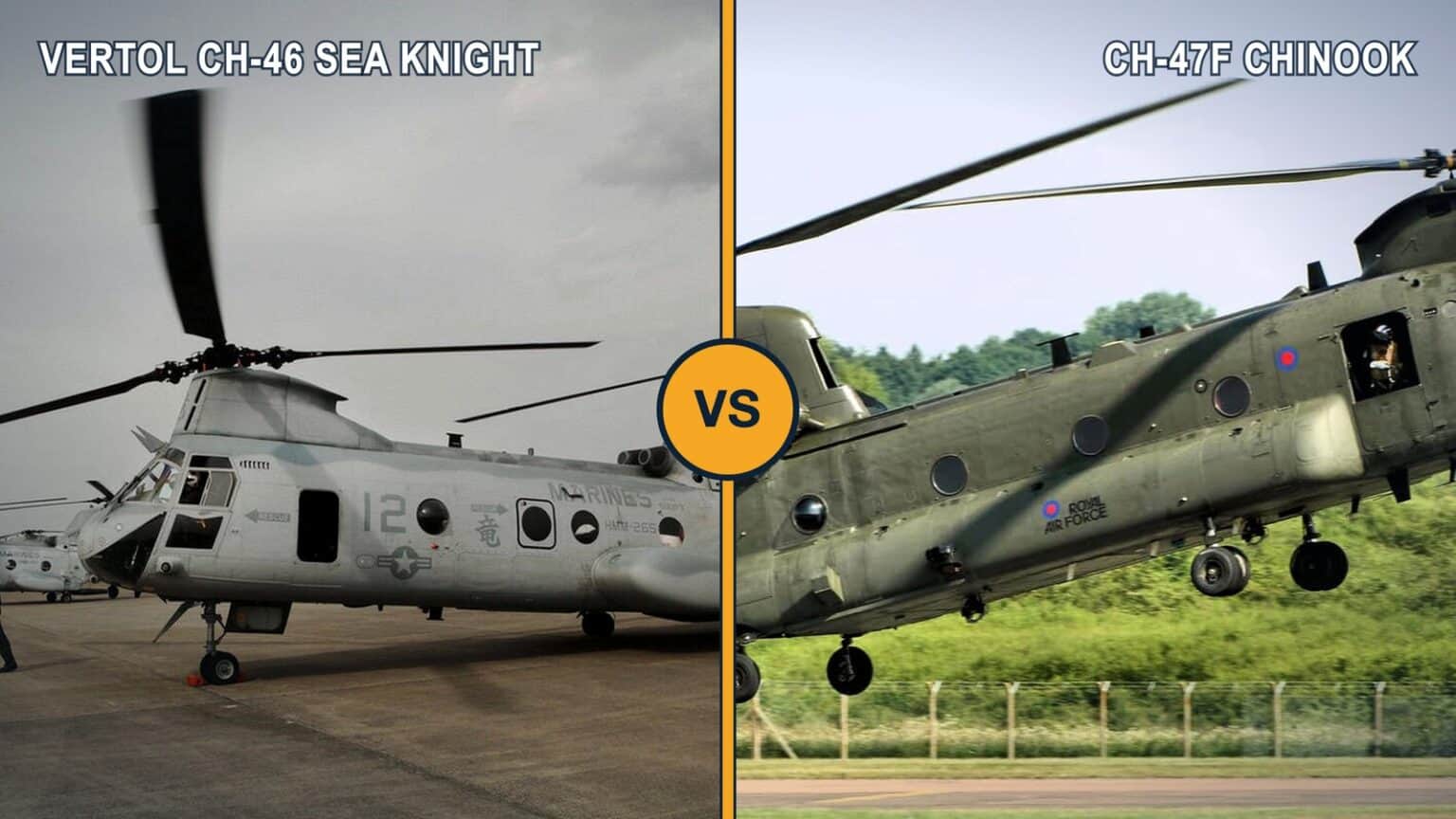
The spec panel above compares the CH-46E, the upgraded Marine version with 1,870 shp engines, against the CH-47F, the current Army version. Earlier CH-46A and CH-46D models had weaker engines. The Chinook figures are for the F model, not the older D or the special operations MH-47.
What each helicopter is
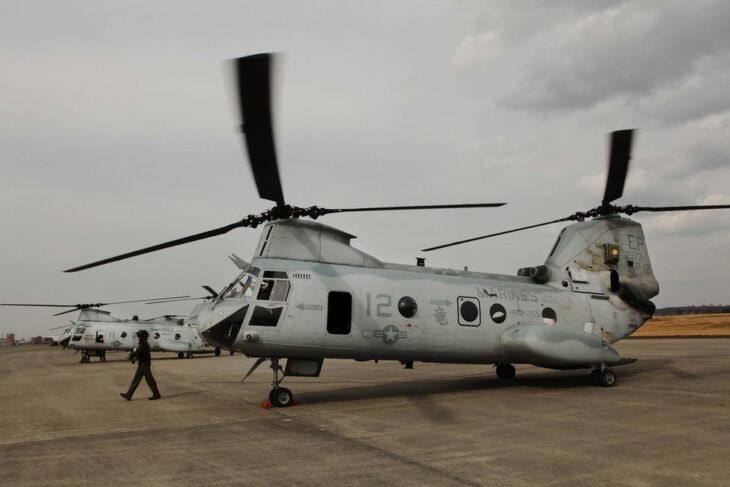
The CH-46 Sea Knight was the Marine Corps’ medium assault helicopter. Its prototype flew on 22 April 1958, and the Marines and Navy began flying it in November 1964.
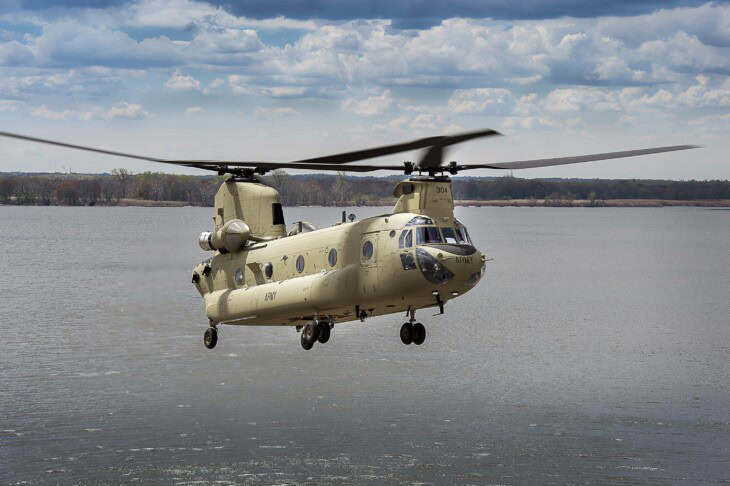
The CH-47F Chinook is the Army’s heavy-lift helicopter. The first Chinooks reached the Army in 1962, and the F model’s first production aircraft flew on 23 October 2006.
Both have two three-blade rotors, one at each end of the fuselage, turning in opposite directions. Both have a rear loading ramp.
They are related. The Vertol YHC-1A was judged too heavy for assault and too light for transport, so the Marines took it as the CH-46 and the Army ordered an enlarged version that became the Chinook.
Size and weight
The Chinook is roughly twice the Sea Knight in length. The CH-47F measures 98 ft 9 in (30.10 m) and stands 18 ft 8 in (5.69 m) tall, against 45 ft 8 in (13.92 m) and 16 ft 8 in (5.08 m) for the CH-46E.
Maximum takeoff weight shows the gap better: 50,000 lb (22,700 kg) for the Chinook and 24,300 lb (11,000 kg) for the Sea Knight.
The Chinook’s two Honeywell T55 engines make 4,733 shp each. The Sea Knight’s two General Electric T58 engines make 1,870 shp each.
Edge: CH-47, by a wide margin.
Payload and cargo
The CH-47F’s maximum payload is 24,000 lb (10,900 kg). The CH-46E’s is 7,000 lb (3,200 kg).
The Chinook carries loads under its belly on three external hooks, and it has hauled artillery pieces into mountain positions. Its cabin is 30 ft 6 in (9.30 m) long, against 24 ft 0 in (7.32 m) for the Sea Knight.
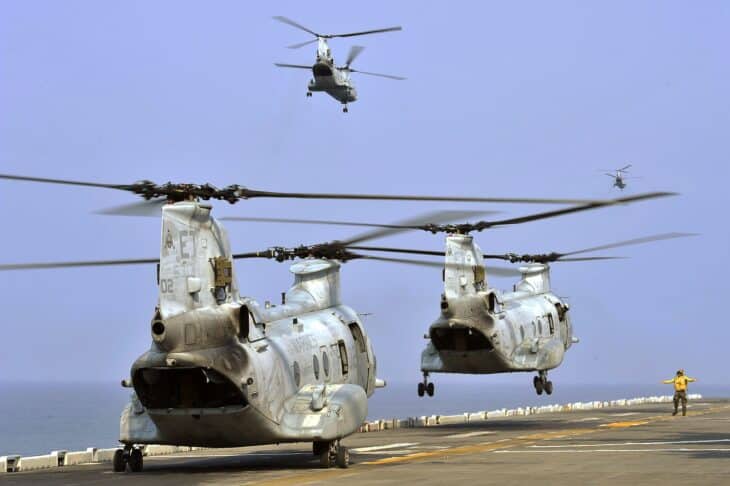
The Sea Knight is the smaller cargo hauler. It flew from ships, including amphibious assault ships, to move cargo and Marines, and the Navy’s version was used for vertical replenishment.
Edge: CH-47, for lifting more than three times the payload.
Crew and cabin
The CH-46E flies with a crew of four and seats 24. The CH-47F flies with a crew of three and seats 55.
The Chinook’s cabin is also wider and taller, at 7 ft 6 in (2.29 m) wide and 6 ft 6 in (1.98 m) high. The Sea Knight’s is 6 ft 6 in (1.98 m) wide and 6 ft 0 in (1.83 m) high.
That extra room is why the Chinook handles bulky loads and large troop lifts. The Sea Knight was built for smaller assault groups landing from ships or clearings.
Edge: CH-47, for the larger cabin and seat count.
Speed, range and ceiling
The Chinook is the faster helicopter, at a maximum of 196 mph (315 km/h) against 167 mph (269 km/h). It also cruises at 181 mph (291 km/h), and it flies higher, to 20,000 ft (6,100 m) against 17,000 ft (5,200 m).
The Sea Knight has the longer range on the panel, at 630 mi (1,020 km) against 460 mi (740 km). The Chinook climbs at 1,522 ft/min, a little slower than the Sea Knight’s 1,715 ft/min.
So the answer to “is a Chinook fast?” is yes, for a helicopter of its size, though it is not far ahead of the Sea Knight in raw speed.
Edge: CH-47 on speed and ceiling, CH-46 on range and climb.
Are they armed?
Neither is a gunship, but both carry defensive door guns. Vietnam-era Chinooks usually flew with a 7.62 mm M60 on each side, and the special operations MH-47G carries two M134 miniguns and two M240 machine guns.
The Sea Knight carried a pintle-mounted .50 caliber M2 Browning on each side, with armor added in Southeast Asia, according to Wikipedia’s account.
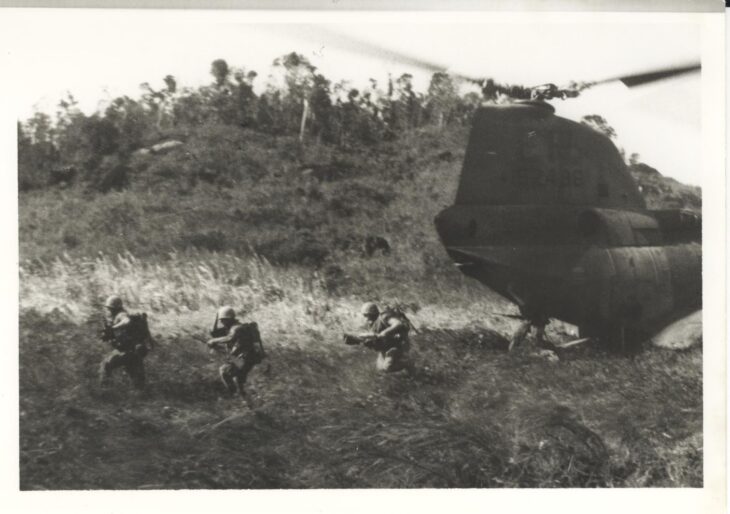
Edge: even, since both are transports with door guns.
Myth: the Sea Knight is just a small Chinook
They share a tandem-rotor layout and a common ancestor, but the Chinook was an enlarged Army design, not a scaled-up Sea Knight. The CH-46 prototype flew in 1958 and the Chinook’s in 1961. The Chinook also keeps both rotors turning on one engine, while the Sea Knight is the lighter design the Marines adopted.
Service record and status today
The Sea Knight’s career was hard in Vietnam. Engine problems grounded it in July 1966, and a run of crashes in 1967 was traced to transmission and rear pylon failures, which grounded it again.
The Navy retired its version on 24 September 2004, replaced by the MH-60S. The Marine Corps flew its last service flight on 5 October 2014 and retired the type formally in 2015, with the MV-22 Osprey taking over.
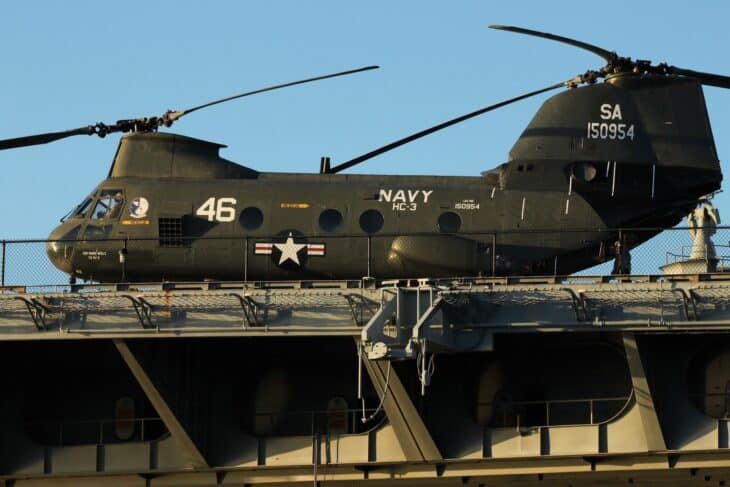
Is the CH-46 still in use? Not by the U.S. military. Civil versions of the design still fly, and Columbia Helicopters, which holds the commercial 107-II type certificate, began refurbishing older 107-II and CH-46E airframes in 2023.
The Chinook has over 1,200 built, and Boeing says it serves the U.S. Army and 20 other countries. Wikipedia notes it is planned to stay in service beyond 2060, which would be over a century after the first one entered service.
Vietnam was costly for the Chinook too, with about 200 of nearly 750 U.S. and South Vietnamese Chinooks lost in combat or wartime accidents.
Edge: CH-47, because it is still flying and still being built.
The verdict: Chinook wins, but the Sea Knight earned its place
The CH-47F is the better helicopter today. It lifts more, flies faster and higher, and has a production line and a future. The CH-46E is the smaller design that carried the Marines for half a century and went out of service in the 2010s.
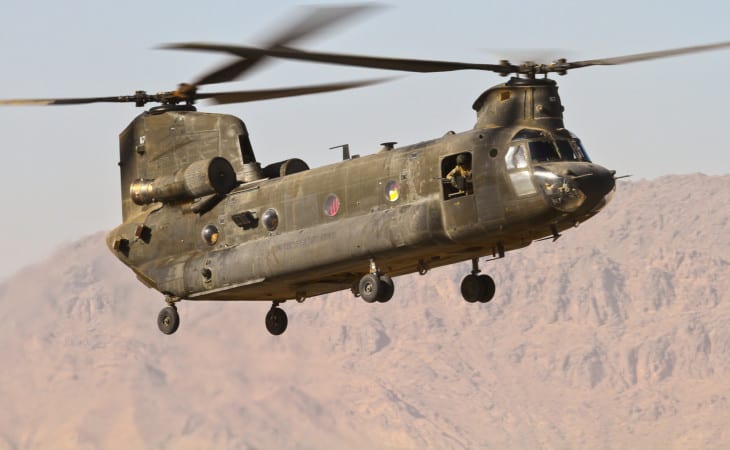
Pick the Chinook for weight, altitude and longevity. Pick the Sea Knight for what it did for the Marines from 1964 to 2014.
FAQ
Sources and references used for research and fact-checking.
About the Author

Tim is the owner and lead editor of AeroCorner since 2019, overseeing aviation content covering aircraft, airlines, airports, and the broader aviation industry. Through years of researching, writing, editing, and publishing aviation-focused content, he has developed extensive practical knowledge of commercial aviation and air travel. Based in Asia and a frequent traveler himself, Tim also brings firsthand passenger experience to AeroCorner’s coverage. Outside of publishing, he has also explored aviation firsthand through hands-on flight training in New Zealand.