

Table of Contents
| Bf 109G-6 | Fw 190A-8 | |
|---|---|---|
| Designer | Willy Messerschmitt and Robert Lusser at Bayerische Flugzeugwerke | Kurt Tank at Focke-Wulf |
| Prototype | First prototype completed by May 1935 | First flight June 1, 1939 |
| Combat debut | E series with the Condor Legion in Spain | Fw 190A over France, August 1941 |
| Built | Over 12,000 G-6s, out of about 34,000 Bf 109s | 13,291 Fw 190A-series aircraft of all subtypes |
| Armament as built | Two 13 mm MG 131 machine guns and one 20 mm hub cannon | Two 13 mm MG 131 machine guns and four 20 mm MG 151/20 cannon |
| Landing gear | Narrow track, hinged at the wing root | Wide track |
| Strongest at | Medium and high altitude | Low and medium altitude |
Which versions this page compares
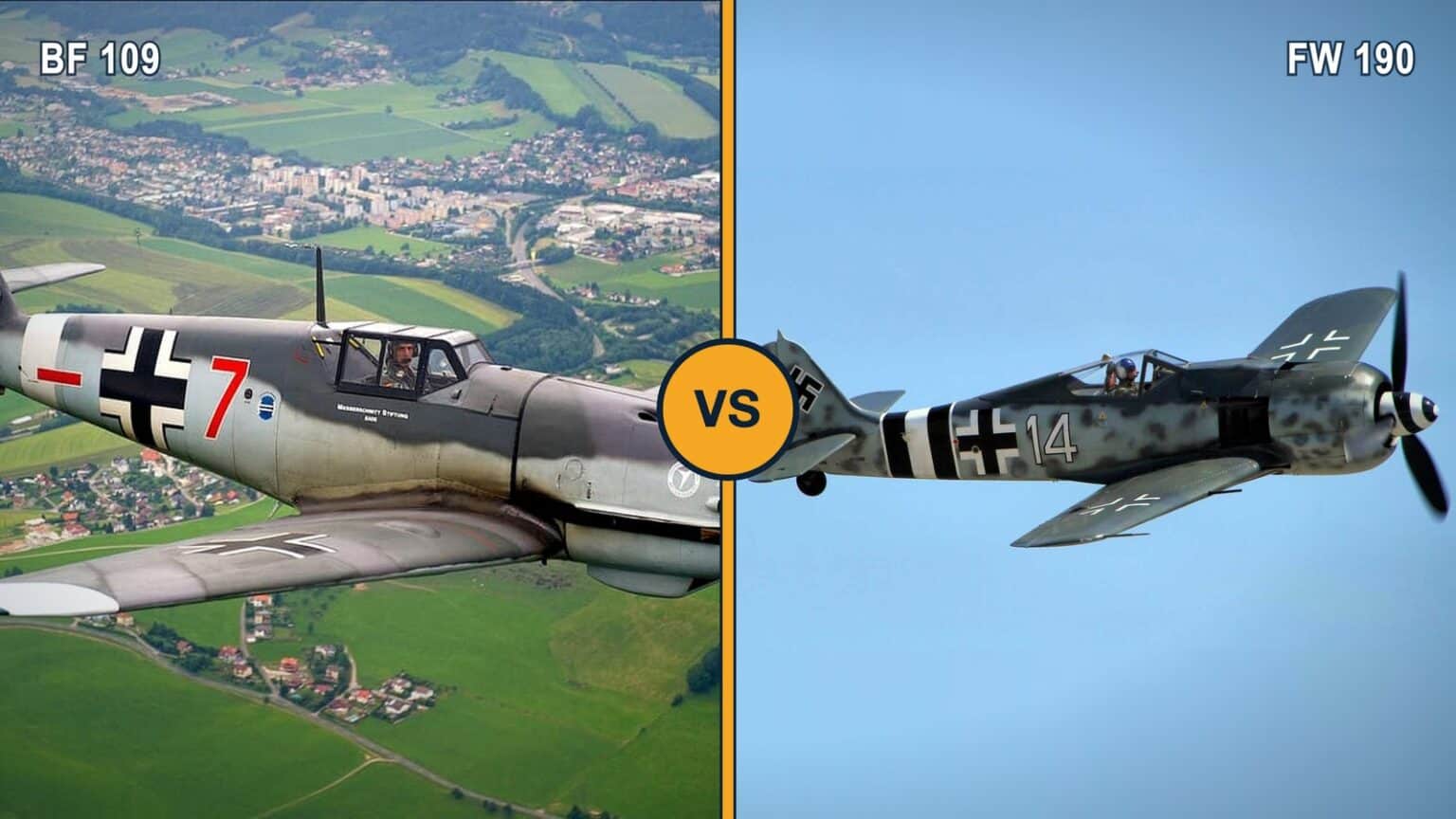
Both fighters changed a lot over the war, so “Bf 109 vs Fw 190” means little without a version. The specification panel above compares the Bf 109G-6 (Gustav) with the Fw 190A-8. The G-6 was the best-known Bf 109, with more than 12,000 built, and the A series was the Fw 190 workhorse. Where an earlier or later version changes the answer, this page names it.
Bf 109 vs Fw 190: the short answer
The Fw 190 was the stronger all-round fighter at low and medium altitude. German pilots who flew both considered it more maneuverable there, and it carried heavier firepower.
The Bf 109 was the better high-altitude fighter. The Fw 190A’s performance dropped at about 20,000 feet (6,000 m) and above, according to Wikipedia.
That split is why the Luftwaffe never replaced one with the other. The Bf 109 stayed in production to the end of the war alongside the Fw 190.
Design philosophy: racehorse against cavalry horse
The two fighters came from opposite ideas. The Bf 109 was designed in 1934 as a high-speed, short-range interceptor, built around a liquid-cooled inverted V-12 in the smallest practical airframe.
Kurt Tank described the Bf 109 and the Spitfire as racehorses, fighters that needed pampering to give their best. He wanted a Dienstpferd, a cavalry horse, that could take rough handling at the front.
His answer used a twin-row BMW 801 radial. A radial also did not compete with the Bf 109 for Daimler-Benz inline engines, which were already scarce.

Firepower: the Fw 190 hits harder
The Fw 190A-8 carries two 13 mm MG 131 machine guns above the engine and four 20 mm MG 151/20 cannon, two in the wing roots and two in mid-wing mounts. That is a heavy punch for a single-seat fighter.
The Bf 109G-6 typically has the same two MG 131 machine guns plus one 20 mm MG 151/20 cannon firing through the propeller hub. Some carried a 30 mm MK 108 hub cannon instead, in the G-6/U4 variant.
A field kit added two underwing 20 mm cannon pods to the Bf 109, which gave it bomber-killing firepower. The pods cost it speed and handling, so they suited it to attacking bombers more than to fighting other fighters.
The Fw 190 could also take bigger loads. Wikipedia says the BMW 801 let it lift larger loads than the Bf 109, which is why it became a fighter-bomber and ground-attack aircraft as well. Some A-6 and A-7 versions carried 21 cm rockets or 30 mm cannon for attacking bomber formations.
Speed, climb and altitude: the Bf 109 keeps its edge up high
On paper the two are close in level speed. The Bf 109G-6 reaches 399 mph (643 km/h) at 20,700 ft (6,300 m), and the Fw 190A-8 reaches 405 mph (652 km/h) at 19,420 ft (5,920 m).
The difference shows in climb and ceiling. The G-6 climbs at 4,470 ft/min (23 m/s) against 3,000 ft/min (15 m/s) for the A-8, and its service ceiling is 39,000 ft (11,900 m) against 33,960 ft (10,400 m).
The Fw 190 was strongest below that. A pilot assessment quoted on Wikipedia sums it up as strong at low altitude and inferior to the Bf 109 at height.
High-altitude Fw 190 versions did arrive. Turbocharger problems with the B and C models meant only the long-nosed D model entered service, in September 1944. The Ta 152 derivative reached 469 mph (755 km/h) at 44,300 ft, but too late to change the war.
Handling and ground safety
Tank’s team replaced control cables with rigid pushrods and limited aileron resistance to about 8 lb (3.5 kg), so the Fw 190 was light and crisp to fly. German pilots who flew both rated it more maneuverable at low to medium altitude.
The Bf 109 had the harder job on the ground. Its narrow, wing-root landing gear, steep ground angle and sideways-opening canopy made takeoff and taxiing awkward, and at least 10 percent of all Bf 109s were lost in takeoff and landing accidents.

The Fw 190’s wide-track gear suffered fewer ground accidents, which mattered as training shrank late in the war. The Fw 190 had its own risk, a tendency to turn over if braked hard on soft ground.
Where the Spitfire fits
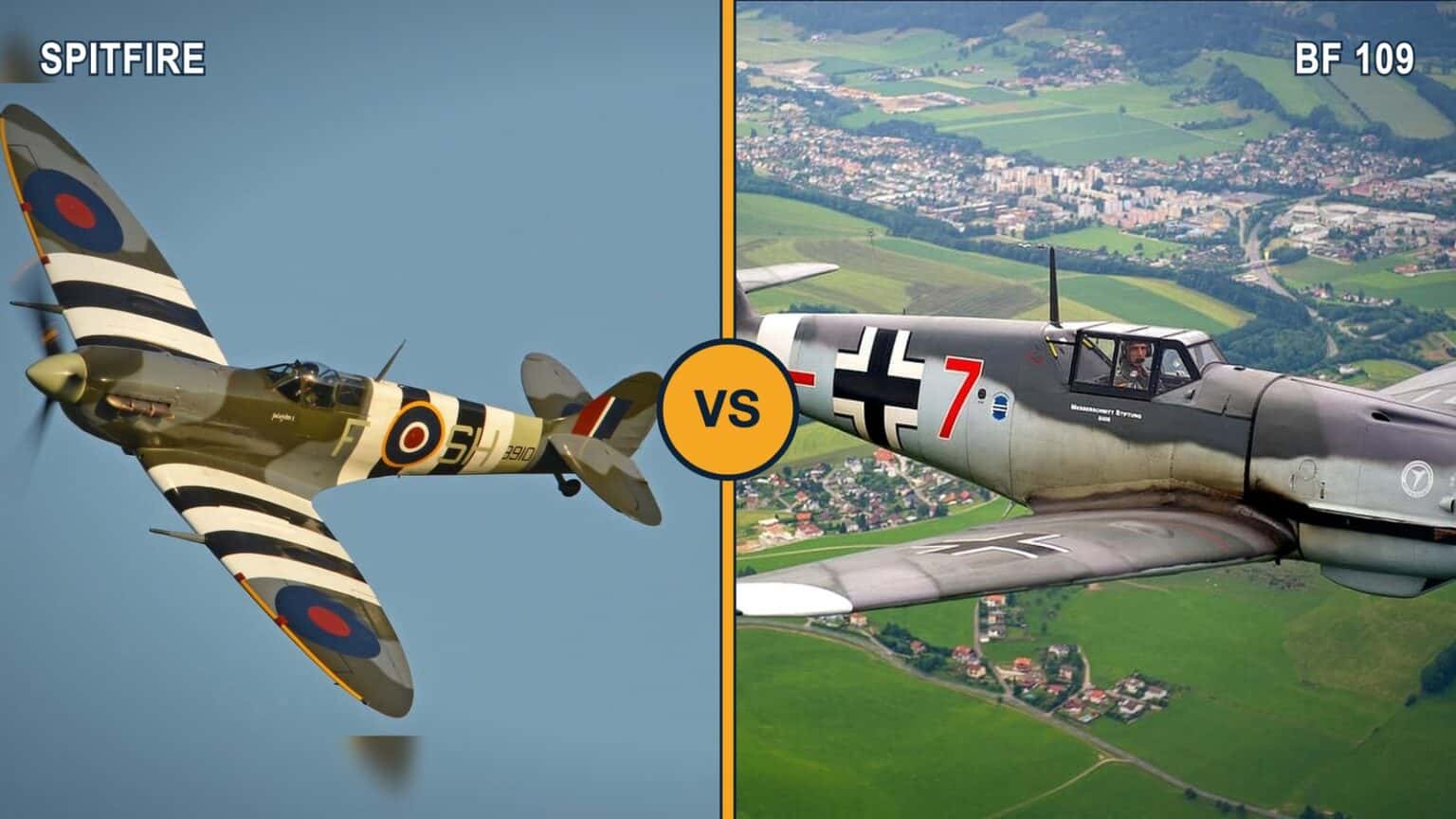
Against the RAF, the Fw 190A proved superior in all but turn radius to the Spitfire Mk. V when it arrived over France in August 1941. That lead lasted until the Spitfire Mk. IX appeared in late 1942 and early 1943. The Spitfire’s turn radius was its main advantage over both German fighters. For the Bf 109’s other great rival, see our Spitfire vs Bf 109 comparison.
Roles: interceptor, fighter-bomber and bomber destroyer
The Bf 109 began as an interceptor. Later models became bomber escorts, fighter-bombers, night, day and all-weather fighters, and reconnaissance aircraft.
The Fw 190 grew into a wider family. The A series was the fighter workhorse, the F series was a dedicated ground-attack version, and others flew as night fighters in the Wilde Sau (wild boar) tactic over burning German cities.
The A-8/R2 was the most numerous Sturmbock bomber destroyer, with some 900 built with 30 mm MK 108 cannon in the outer wings. That armor and firepower made it cumbersome, so the Sturmgruppen needed Bf 109 escorts.


In June 1942, Oberleutnant Armin Faber of JG 2 landed his Fw 190 A-3 at a British airfield by mistake. That gave the RAF a chance to test the Spitfire Mk. IX against the 190 and to work out how to counter it.
Production and war record
The Bf 109 is the most-produced fighter in history. Wikipedia gives 34,248 airframes built between 1936 and April 1945 in its summary and 33,984 in its production section, so treat about 34,000 as the safe figure.
More than a third of all Bf 109s were G-6s. Over 12,000 were built from 1943, though contradictory factory records do not allow an exact tally.
The Bf 109 also scored more aerial kills than any other aircraft of the war. Many came against poorly trained Soviet forces in 1941, and its top scorer, Erich Hartmann, was credited with 352 victories.
Part of that production came from forced labor. The SS supplied concentration camp prisoners to build Bf 109 parts at Flossenbürg and Gusen, and prisoners at Buchenwald made about 300 fuselages, tail sections and wings.
The Fw 190 A series totaled 13,291 aircraft. The Fw 190 was also flown by top aces, including Otto Kittel, Walter Nowotny and Erich Rudorffer.

How to tell a Bf 109 from an Fw 190
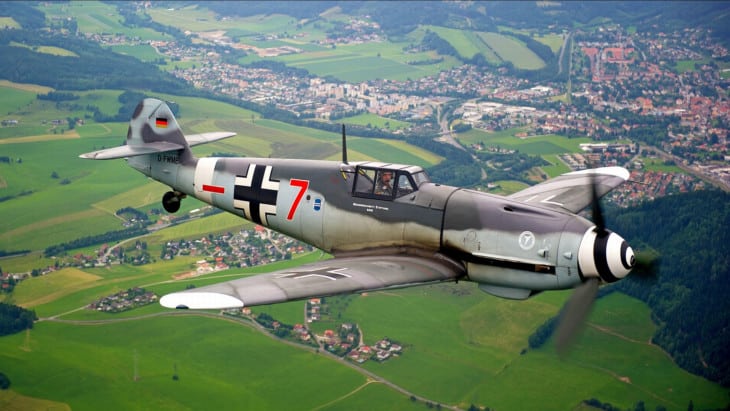
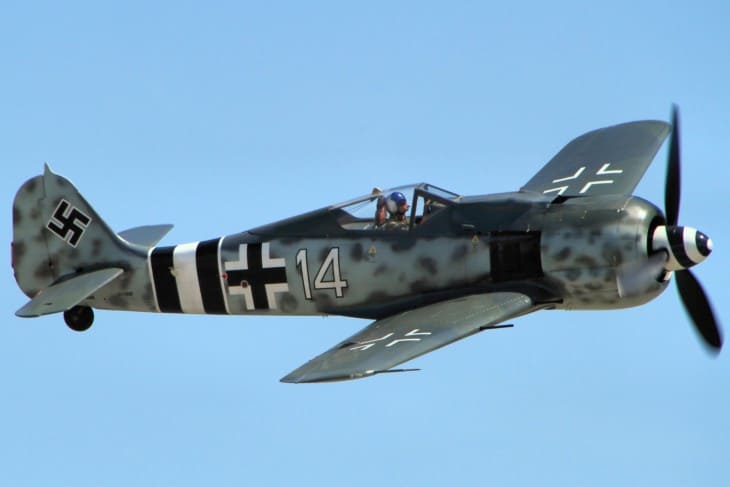
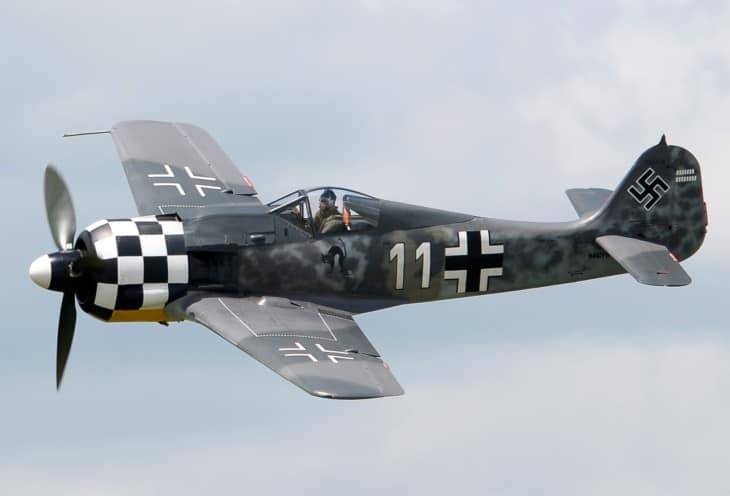
Look at the nose. The Fw 190’s broad, round cowling houses the BMW 801 radial, while the Bf 109 has a narrow, pointed nose over an inline engine.
The landing gear helps too. The Bf 109’s main legs are splayed and narrow, hinged at the wing root, while the Fw 190 sits on a wider stance.
Soviet pilots nicknamed the Bf 109 “the skinny one” for its sleek look compared with the sturdier Fw 190.
Which fighters still fly today?
Spain kept building the Bf 109 after the war as the Hispano HA-1109 and HA-1112 Buchon, and Buchons appeared in films such as Battle of Britain playing Bf 109Es. Some Hispano airframes were sold to museums, which rebuilt them as Bf 109s.
For the Fw 190, an A-5 recovered from a marsh near Leningrad flew again with its original BMW 801 engine on December 1, 2010. Flug Werk GmbH has also built reproductions since 1997, many of them flyable.
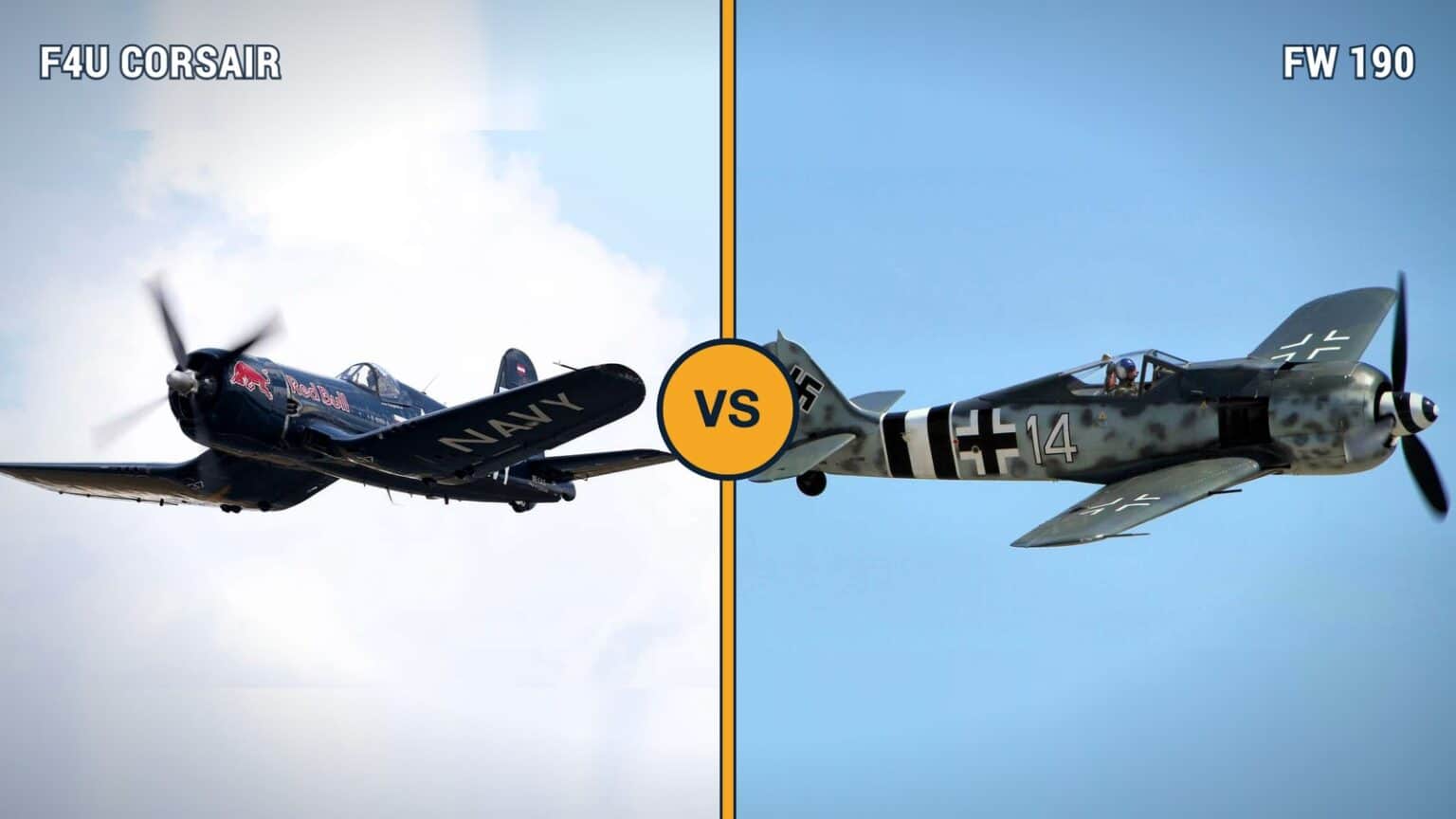
For more on the type histories, see our full guides to the Messerschmitt Bf 109 and the Focke-Wulf Fw 190. For the Fw 190’s American rival, see our F4U Corsair vs Fw 190 comparison.
The myth about this matchup
“One of these fighters was simply better” does not survive the record. The Fw 190A was better below about 20,000 ft and hit harder, while the Bf 109G climbed faster and flew higher. The Luftwaffe kept both in production to the end because each covered a gap in the other.
FAQ
Sources and references used for research and fact-checking.
About the Author

Tim is the owner and lead editor of AeroCorner since 2019, overseeing aviation content covering aircraft, airlines, airports, and the broader aviation industry. Through years of researching, writing, editing, and publishing aviation-focused content, he has developed extensive practical knowledge of commercial aviation and air travel. Based in Asia and a frequent traveler himself, Tim also brings firsthand passenger experience to AeroCorner’s coverage. Outside of publishing, he has also explored aviation firsthand through hands-on flight training in New Zealand.