



Table of Contents
| Question | B-24J Liberator | B-25J Mitchell |
|---|---|---|
| Class | Four-engine heavy bomber | Twin-engine medium bomber |
| First flight | 29 December 1939 | 19 August 1940 |
| Number built | About 18,500 | 9,816 |
| Defensive guns | Ten .50 caliber M2 Browning machine guns in four turrets and two waist positions | Four .50 caliber guns in two fuselage packages (standard J) |
| Best-known mission | Operation Tidal Wave, Ploiesti, 1 August 1943 | Doolittle Raid, 18 April 1942 (B-25B) |
| Nickname or name | “Flying Boxcar” | Named for General Billy Mitchell |
Heavy bomber vs medium bomber
The B-24 Liberator was built to carry bombs a long way. Its high-aspect-ratio Davis wing gave it high cruise speed and long range.
The B-25 Mitchell was a medium bomber with two engines and a twin tail. It was named for Brigadier General William “Billy” Mitchell.
The widget above puts the sizes, weights and speeds side by side. This page covers what the numbers do not show.


What the Liberator was built to do
The B-24 first flew on 29 December 1939. By September 1945, 18,482 had been built, which makes it the most-produced American military aircraft.
Ford Motor Company alone built 8,685. The Liberator also served as a Navy patrol bomber (the PB4Y-1), as the C-87 transport and as the C-109 fuel tanker.
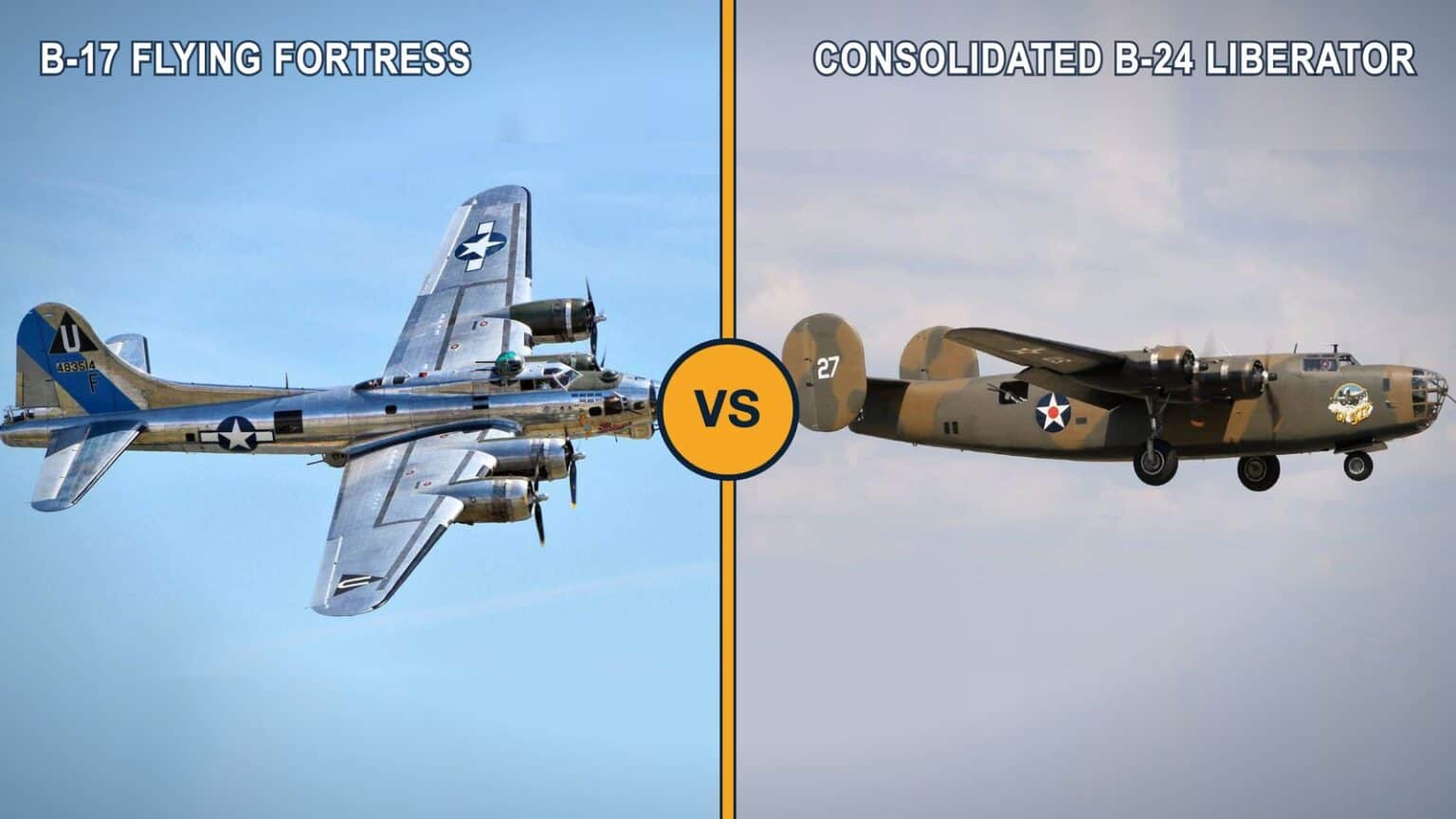
Its slab-sided fuselage earned it the nickname “Flying Boxcar”. Compared with the B-17, it was faster, flew farther and carried more bombs.
The B-24J, the version most people picture
The B-24J carried ten .50 caliber machine guns in four turrets and two waist positions. In Eighth Air Force combat configuration it carried 8,000 pounds (3,600 kg) of bombs.
Earlier models had a “greenhouse” nose that left the bomber open to head-on attack. The B-24H added a nose turret to answer that.
What the Mitchell was built to do
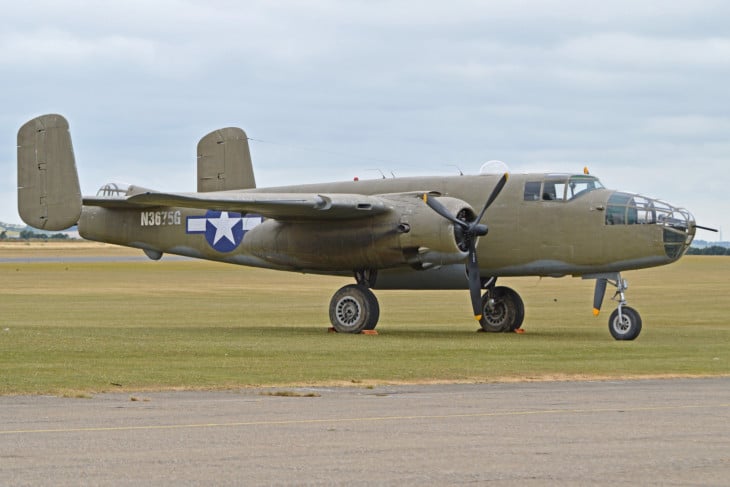
The B-25 first flew on 19 August 1940, and 9,816 were built. It carried a bombardier in a glass nose.
The standard B-25J had four .50 caliber guns in a pair of fuselage packages. A strafer version, the J-2, carried eighteen .50 caliber guns in total.
The B-25H went a different way. Most carried a lightweight T13E1 75 mm cannon in place of the heavy M4 cannon.

The trade-offs of the Liberator
The Davis wing that gave the B-24 its range had a cost. It was more susceptible to ice, which distorted the airfoil and cut lift.
Pilots found it less responsive when fully loaded, at altitude or in bad weather. A heavily loaded B-24 was also hard to fly below about 160 mph (257 km/h).
Each bomb bay could hold up to 8,000 pounds (3,600 kg), but crews rarely loaded that much because it cut range and altitude.
Where each one fought
In the Pacific, the B-24 was the standard heavy bomber because of its range. The B-17 was phased out there by mid-1943.
Peak overseas deployment came in June 1944, with 45.5 bomb groups. Liberators also served the RAF in Coastal Command and the RAAF, which received 287 of them.
The B-25 fought in the jungle. Low-level attack was the best tactic there, and B-25s used skip bombing against shipping.
The B-25J was the most-produced Mitchell, at 4,318 aircraft. The page for the type calls it the last factory series production of the B-25.
Mitchell variants and the Empire State Building
The Mitchell split into many versions. The B-25C was built at Inglewood, California, and the B-25D at Kansas City, Kansas.
The B-25H was built at Inglewood and 248 went to the Navy as the PBJ-1H. The H dropped the co-pilot seat, and the B-25J brought it back.
On 28 July 1945, a B-25D flew into the north side of the Empire State Building between the 79th and 80th floors in thick fog. Fourteen people died, 11 in the building and three aboard the aircraft.
After the war
The USAF kept the B-25 as a pilot and radar trainer, a weather reconnaissance aircraft and a transport. The last USAF flight was on 21 May 1960. The RCAF kept its Mitchells until October 1963.
Liberators left RAAF service in 1948, when Avro Lincolns replaced them. Both types survive today as museum pieces and as flying warbirds, such as the B-25J “Take-Off Time”.
Two famous missions
On 18 April 1942, 16 B-25B Mitchells took off from the carrier USS Hornet to bomb Japan in the Doolittle Raid. Fifteen reached the Chinese coast after about 13 hours of flight. The 16th flew to the Soviet Union and was interned.
On 1 August 1943, B-24 Liberators flew Operation Tidal Wave, a low-level attack on the Ploiesti oil refineries. Of 177 B-24s dispatched, 54 were lost.
Those two missions show the split. The Mitchell launched from a carrier deck. The Liberator flew long-range raids on strategic targets.
How to tell them apart
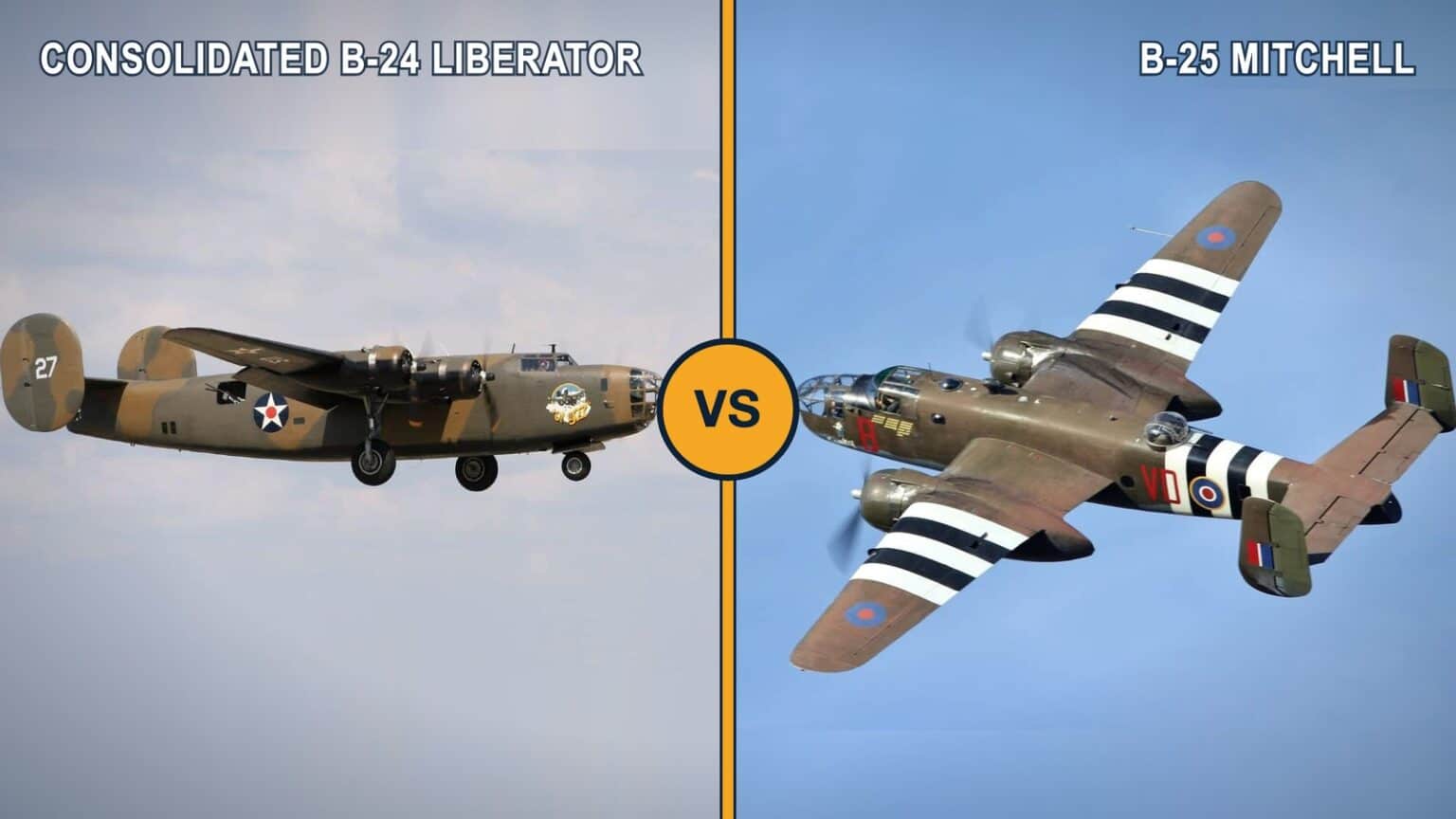
Count the engines first. The B-24 has four, and the B-25 has two. That one check separates a heavy bomber from a medium bomber at a glance.
The Liberator has the slab-sided fuselage that earned its “Flying Boxcar” nickname. The Mitchell has the glass bombardier nose and a much smaller frame.
The photos on this page show both, so the difference is easy to see side by side.
The cost of Tidal Wave
The 44th Bomb Group lost 11 of its 37 bombers on the Ploiesti raid. Colonels Leon W. Johnson and John R. Kane received the Medal of Honor, and three more airmen were awarded it after they were killed.
Which one was the better bomber
They were not rivals. One was a heavy bomber and the other a medium bomber, so they did different jobs.
If you want range and numbers, pick the B-24. If you want the famous carrier launch, pick the B-25.
The Liberator outproduced the Mitchell by roughly two to one, which tells you how many of them the war used.
The verdict
The B-24 is the heavy bomber built in the tens of thousands. The B-25 is the medium bomber that launched from a carrier. Pick the Liberator for scale and range, the Mitchell for the Doolittle story.
FAQ
Sources and references used for research and fact-checking.
About the Author

Tim is the owner and lead editor of AeroCorner since 2019, overseeing aviation content covering aircraft, airlines, airports, and the broader aviation industry. Through years of researching, writing, editing, and publishing aviation-focused content, he has developed extensive practical knowledge of commercial aviation and air travel. Based in Asia and a frequent traveler himself, Tim also brings firsthand passenger experience to AeroCorner’s coverage. Outside of publishing, he has also explored aviation firsthand through hands-on flight training in New Zealand.