



Table of Contents
B-17 vs B-24 at a glance
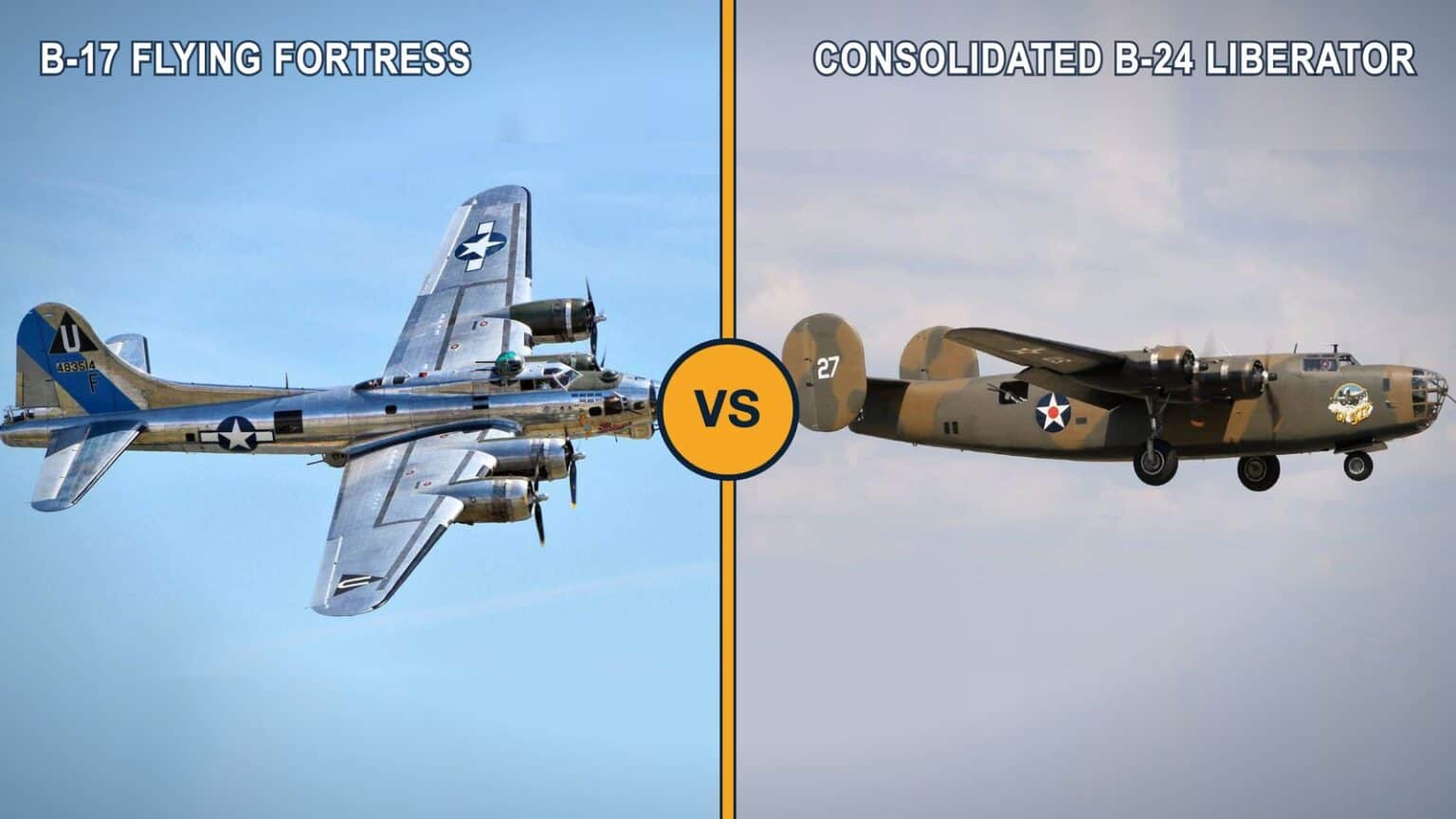
The B-24 Liberator was faster, had longer range and could carry about a ton more bombs than the B-17. The B-17 had a higher ceiling, a tougher airframe and gentler handling.
The two flew side by side in the Eighth Air Force. This page compares the late-war B-17G with the B-24J, the versions most crews flew.
The spec widget above sets the two side by side. This table covers what it does not.
| B-17 Flying Fortress | B-24 Liberator | |
|---|---|---|
| First flight | July 28, 1935 | December 29, 1939 |
| Service entry | April 1938 | 1941 |
| Number built | 12,731 (8,680 B-17G) | About 18,500 (8,685 by Ford) |
| Defensive guns | 13 .50 caliber machine guns (B-17G) | Up to 10 .50 caliber machine guns |
| Bomb load in Eighth Air Force use | Not stated in the sources used | 8,000 lb (3,600 kg) |
| Reputation | Durable, forgiving | Fast, long-legged, harder to fly |
Speed, range and bomb load: where the B-24 won
The B-24 used the Davis wing, a shoulder-mounted, high-aspect-ratio design that gave it high cruise speed and long range. On the spec widget the B-24J cruises at 215 mph (346 km/h) against 182 mph (293 km/h) for the B-17G.
Top speeds are close, at 297 mph (478 km/h) for the B-24J and 295 mph (474 km/h) for the B-17G.
Range is where spec sheets mislead. Published figures depend on the fuel and bomb load behind them, so the two widget ranges are not a like-for-like test. In service the Liberator is generally credited with the longer reach.
That reach put the B-24 on missions the B-17 could not easily fly. Long-range Liberators helped close the Mid-Atlantic gap and were credited in full or in part with sinking 93 U-boats.
It also carried more. In Eighth Air Force use it flew with 8,000 pounds (3,600 kg) of bombs, and sources credit it with about a ton more than the B-17.

Ceiling and toughness: where the B-17 won
The B-17 had the higher ceiling, 35,600 feet (10,900 m) against 28,000 feet (8,500 m) for the B-24J.
It was also the more robust airframe. Eighth Air Force pilot Wally Hoffman said a B-17 “can be cut and slashed almost to pieces by enemy fire and bring its crew home.”
The Davis wing paid for its efficiency. It was less tolerant of ice and damage than the B-17’s wing.

For the full specs, see the Boeing B-17 Flying Fortress page.
Handling and crew experience
The B-24 had a reputation as the harder aircraft to fly. It had poor low-speed performance, and pilot Lindell Hendrix said a heavily loaded B-24 was difficult to fly below 160 mph (260 km/h).
Pilots also said it became less responsive when fully loaded at altitude. The B-24 leaked fuel, and its transport cousin, the C-87, was notorious for leaking tanks and mid-air fires.
The B-24J carried up to ten machine guns in turrets and waist positions, and the interior photo below shows one waist gun.

For the full specs, see the Consolidated B-24 Liberator page.
What they did in combat
The B-17 carried much of the strategic bombing of Germany. Of roughly 1.5 million tons of bombs dropped by Allied aircraft on Nazi Germany and occupied territories, over 640,000 tons (42.6%) came from B-17s.
It paid heavily at times. On the second Schweinfurt raid, October 14, 1943, 291 B-17s attacked and 77 were lost, with about 650 of 2,900 crewmen not returning.
The B-24 suffered too. On August 1, 1943, 177 Liberators were dispatched against the Ploiesti oil refineries and 54 were lost.
Escort fighters changed the odds. In Big Week in February 1944, B-17 losses ran below 7% once escorts were present.

The bomber people forget
The B-17 is the famous one, but the B-24 was built in larger numbers. About 18,500 Liberators were made, including 8,685 by Ford, against 12,731 Flying Fortresses. The B-24 holds the record as the most-produced American military aircraft.
Beyond the bomber role
The Liberator’s range and cargo space made it useful far beyond the bomb run. The Navy and Coast Guard flew it as the PB4Y, and a purpose-built navalized derivative, the PB4Y-2 Privateer, had a single tall tail.
The C-87 transport version flew airlift routes including the Hump over the Himalayas, and the C-109 was a fuel tanker.
Ford alone built 8,685 of the Liberators.
Why the wings mattered
The Davis wing is the single biggest difference between the two designs. It is long and slender, which suits long-range cruising and is the source of the Liberator’s speed and reach.
The trade-off showed up in the air. Crews found the B-24 less forgiving when loaded, particularly at altitude, and its wing was less tolerant of ice and of battle damage.
The B-17 gave up some speed and reach for a sturdier structure. That is why accounts of Fortresses limping home with shredded tails, destroyed engines and flak-damaged wings are so common.
One example is a B-17 that collided with a Focke-Wulf Fw 190, lost an engine and still brought its crew home uninjured, as aviation author Martin Caidin reported.
Which versions are being compared?
Neither name is one aircraft. This page uses the B-17G, the final and most-built Fortress with 8,680 produced, against the B-24J.
Earlier B-17 designs carried seven machine guns, not 13, so a comparison of early models would read differently.
Which survive today
As of October 2025, three B-17s are in flying condition and about 50 survive in storage or on static display. The oldest is The Swoose, a B-17D that flew combat on the first day of US involvement in the war.
For other aircraft of the era, see the fastest planes of WWII.
B-17 vs B-24: who wins?
It depends on the mission. For range, speed and weight of bombs, the B-24 had the edge.
For altitude, survivability and ease of flying, the B-17 did.
FAQ
Sources and references used for research and fact-checking.
About the Author

Tim is the owner and lead editor of AeroCorner since 2019, overseeing aviation content covering aircraft, airlines, airports, and the broader aviation industry. Through years of researching, writing, editing, and publishing aviation-focused content, he has developed extensive practical knowledge of commercial aviation and air travel. Based in Asia and a frequent traveler himself, Tim also brings firsthand passenger experience to AeroCorner’s coverage. Outside of publishing, he has also explored aviation firsthand through hands-on flight training in New Zealand.