

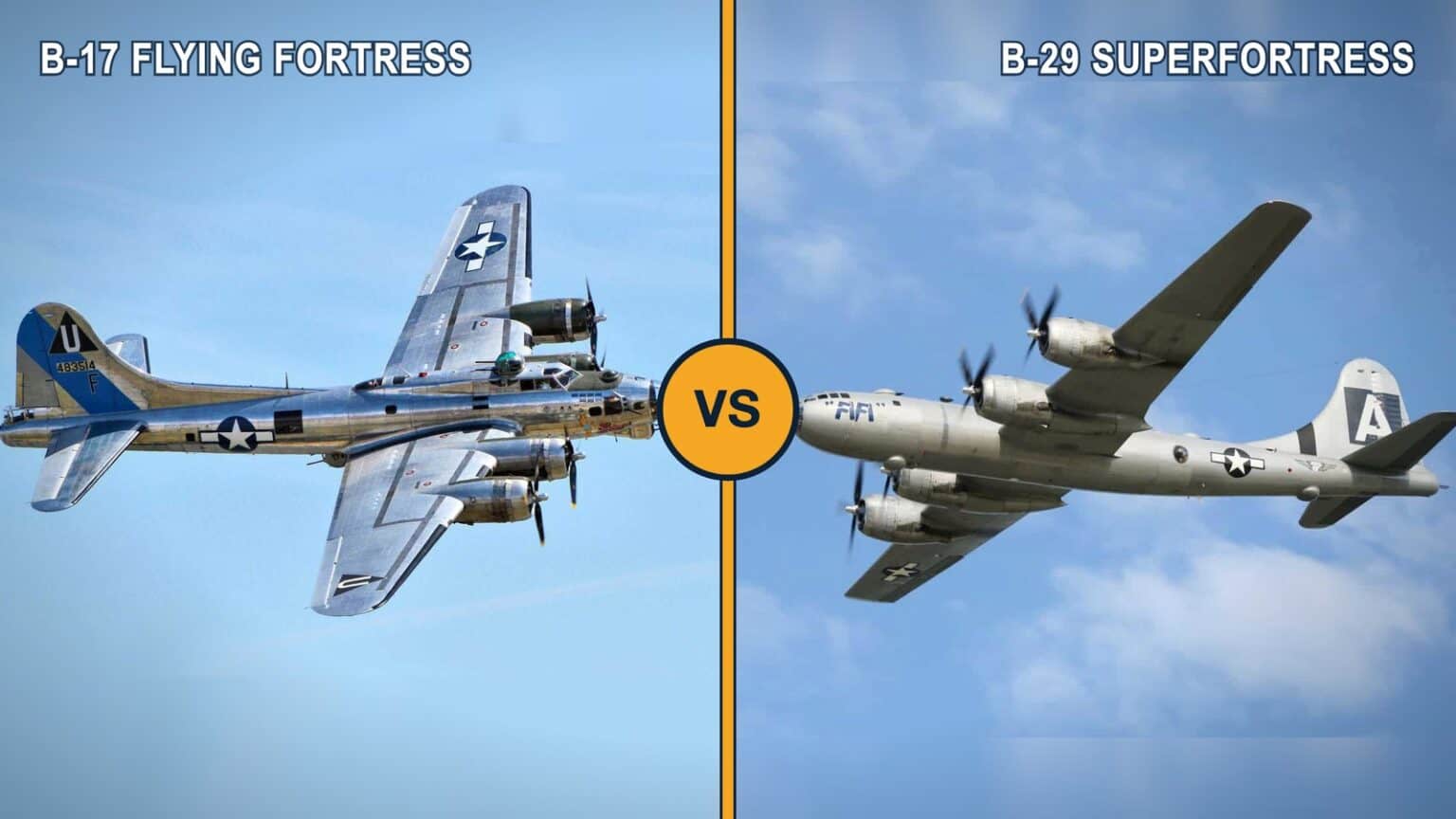


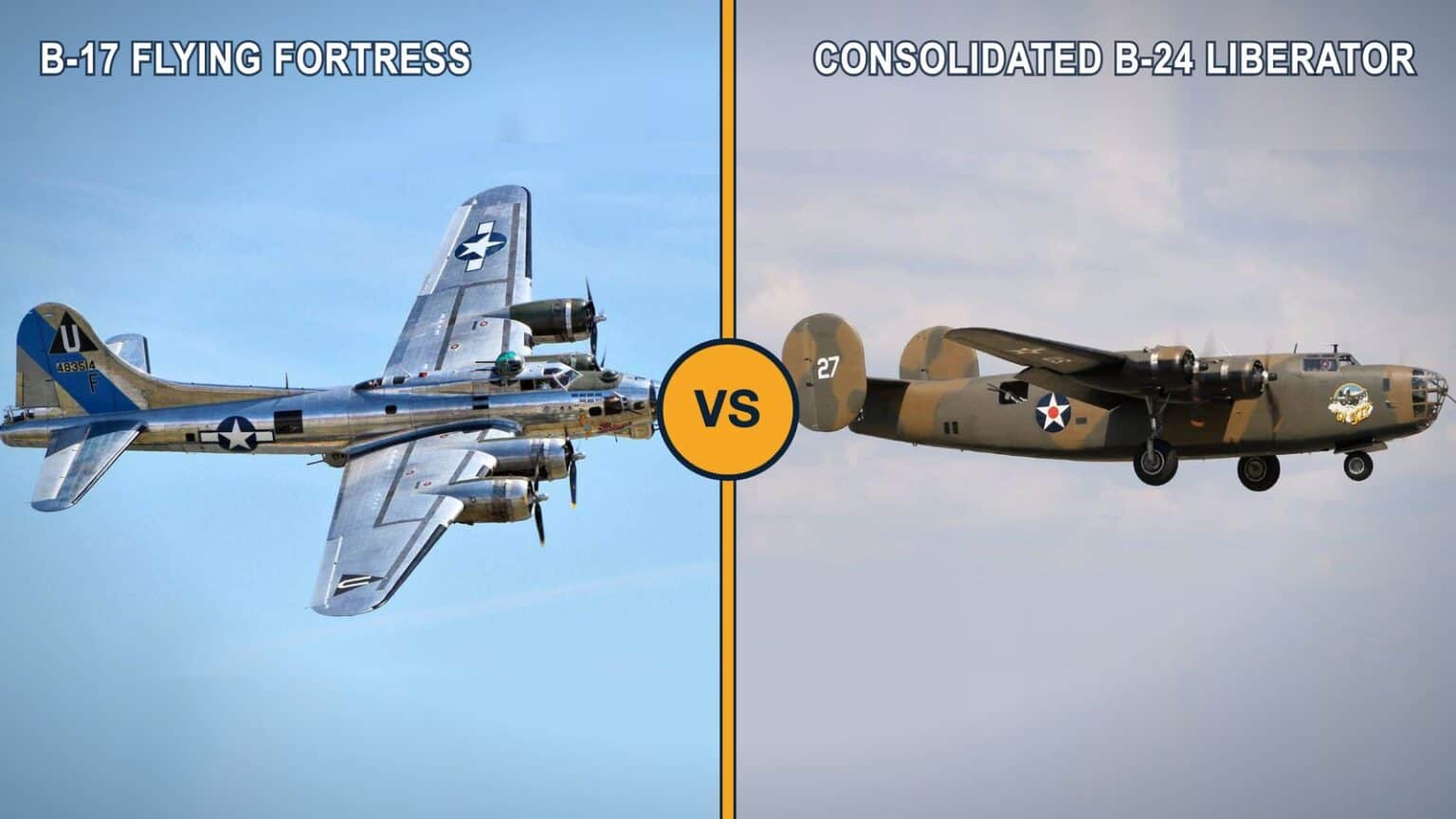
Table of Contents
| Boeing B-17G | Boeing B-29 | |
|---|---|---|
| Entered service | 1938 (first B-17s) | First combat mission 5 June 1944 |
| Number built | 12,731 (all B-17 versions) | 3,970 |
| Main theater | Europe | Pacific |
| Pressurized crew cabin | No | Yes |
| Defensive guns | Manned turrets | Remote-controlled turrets, sighted from crew stations |
| Best-known role | Daylight bombing of Germany | Firebombing of Japan, atomic bomb delivery |
Which versions this page compares
The panel compares the B-17G, the most-built Flying Fortress, with the baseline B-29, the most-built Superfortress version. Earlier B-17s were smaller and less powerful.
Which is better, the B-17 or the B-29?
The B-29 is the better aircraft on paper. It is bigger, faster, flies farther and carries more fuel.
The B-17 was the more important aircraft early on. It was in service by 1938 and, by Wikipedia’s count, dropped over 640,000 tons of bombs on Germany and occupied Europe, 42.6% of the Allied total.
The two were never rivals. The B-29 was designed as a far larger successor, and Boeing’s first design study for it was a pressurized derivative of the B-17.
Size: the B-29 is far bigger
The B-17G measures 74 ft 4 in · 22.66 m long. The B-29 measures 99 ft 0 in · 30.18 m.
The wingspan gap is wider, at 103 ft 9 in · 31.62 m for the B-17G against 141 ft 3 in · 43.05 m for the B-29.
The B-29 also stands taller, with a tail height of 27 ft 9 in · 8.46 m against 19 ft 1 in · 5.82 m.

Weight and engines: the B-29 is twice as heavy
The B-17G has a maximum takeoff weight of 65,500 lb · 29,700 kg. The B-29 is listed at 133,500 lb · 60,500 kg.
Empty weights are 36,135 lb · 16,391 kg and 74,500 lb · 33,793 kg.
The B-17G uses four Wright R-1820-97 Cyclone radials rated at 4 × 1,200 hp · 895 kW. The B-29 uses four Wright R-3350-23 Duplex-Cyclone radials at 4 × 2,200 hp · 1,641 kW.
Range and fuel: the B-29 flies farther
The panel lists a range of 2,000 mi · 3,220 km for the B-17G and 3,250 mi · 5,230 km for the B-29.
The B-29 carries far more fuel, 9,550 gal · 36,100 L · 26,000 kg of AvGas against 1,700 gal · 6,400 L · 4,600 kg.
That range mattered in the Pacific, where the targets lay long distances from the nearest bases.
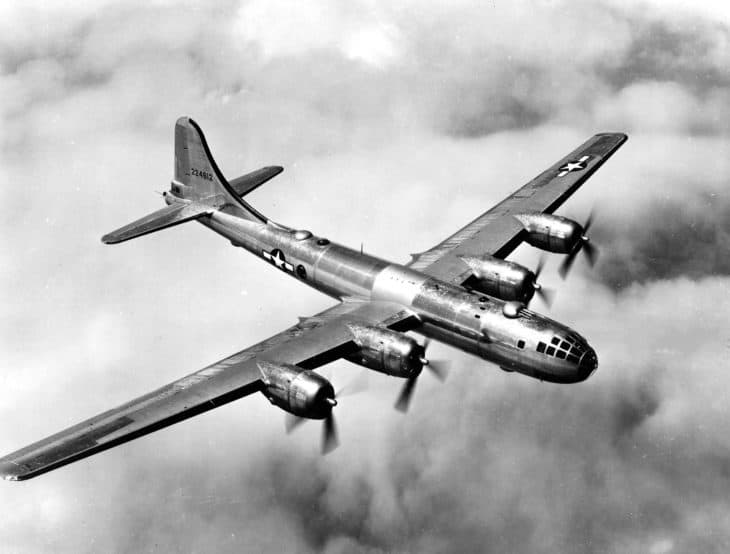

Speed and altitude: the B-29 is faster
Maximum speed is 295 mph · 474 km/h for the B-17G and 357 mph · 574 km/h for the B-29. Cruise speeds are 182 mph · 293 km/h and 220 mph · 354 km/h.
The listed service ceiling goes the other way, 35,600 ft · 10,900 m for the B-17G against 31,850 ft · 9,700 m for the B-29. Both climb at 900 ft/min · 5 m/s on the panel.
Treat the ceilings as a guide. Operational altitudes depended on load and mission.
Crew and cabin: the B-29 was pressurized
The panel lists 10 seats on the B-17G and a crew of 11 on the B-29.
The B-29 gave its crew full pressurization for the first time in an Allied production bomber, according to Wikipedia. B-17 crews flew at altitude in unpressurized aircraft, using oxygen masks and heavy clothing.

Defensive guns: manned versus remote
The B-17 relied on gunners in manned positions, including the Sperry ventral turret on early E models. Wikipedia notes its heavy defensive armament came at the expense of bomb load.
The B-29 used remote-controlled turrets sighted by periscopes, with an analog fire-control system that let one gunner direct several turrets.
Combat: Europe versus Japan
The B-17 flew in every World War II combat zone but is best known for the daylight campaign over Europe, alongside RAF Bomber Command’s night raids.
Early daylight raids without escort fighters were costly, and the USAAF suspended some deep missions until long-range escorts arrived.
The B-29’s first combat mission was flown on 5 June 1944 against Bangkok. On 15 June 1944 B-29s attacked the Yawata steel works, the first raid on the Japanese islands since the Doolittle Raid.
Modified Silverplate B-29s dropped the atomic bombs on Hiroshima and Nagasaki. They remain the only aircraft to deliver nuclear weapons in combat.
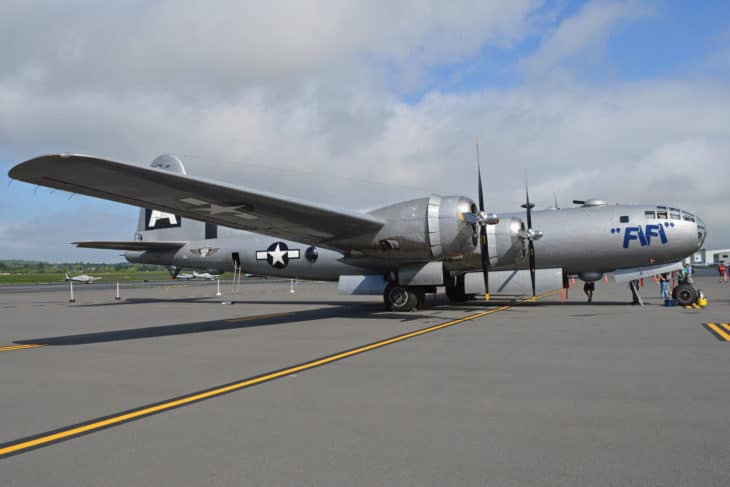
How to tell them apart
Start with the size. At a museum or an airshow the B-29 is the larger aircraft, with a wing roughly 37 ft · 11 m wider than the B-17G.
Then look at the nose. The B-29 has a rounded, heavily glazed nose for its pressurized crew compartment, while the B-17G has a more angular nose with gun positions.
Both have four radial engines and a single tail fin. The B-29 tail stands about 8 ft 8 in · 2.64 m taller.
The two also served in different places. A photo with a European airfield behind it is far more likely to show a B-17.
Production: the B-17 was built in larger numbers
Production of the B-17 ended in May 1945 after 12,731 had been built by Boeing, Douglas and Vega. Wikipedia ranks it the third-most produced bomber in history.
The B-29 reached 3,970 aircraft. It stayed in service through the 1950s and was retired in the early 1960s.
Surviving aircraft
As of October 2025, three B-17s were airworthy, according to Wikipedia, and about 50 more sit in storage or on display.
Texas Raiders, a B-17, was destroyed in 2022 when it collided with a Bell P-63 Kingcobra at an airshow.
Verdict: who wins?
The B-29 wins on size, weight, power, speed, range and technology. The B-17G wins on numbers, on its early start, and on its record over Europe.
If you want the more advanced bomber, it is the Superfortress. If you want the one that did more flying in the war, it is the Flying Fortress.
FAQ
Sources and references used for research and fact-checking.
About the Author

Tim is the owner and lead editor of AeroCorner since 2019, overseeing aviation content covering aircraft, airlines, airports, and the broader aviation industry. Through years of researching, writing, editing, and publishing aviation-focused content, he has developed extensive practical knowledge of commercial aviation and air travel. Based in Asia and a frequent traveler himself, Tim also brings firsthand passenger experience to AeroCorner’s coverage. Outside of publishing, he has also explored aviation firsthand through hands-on flight training in New Zealand.