

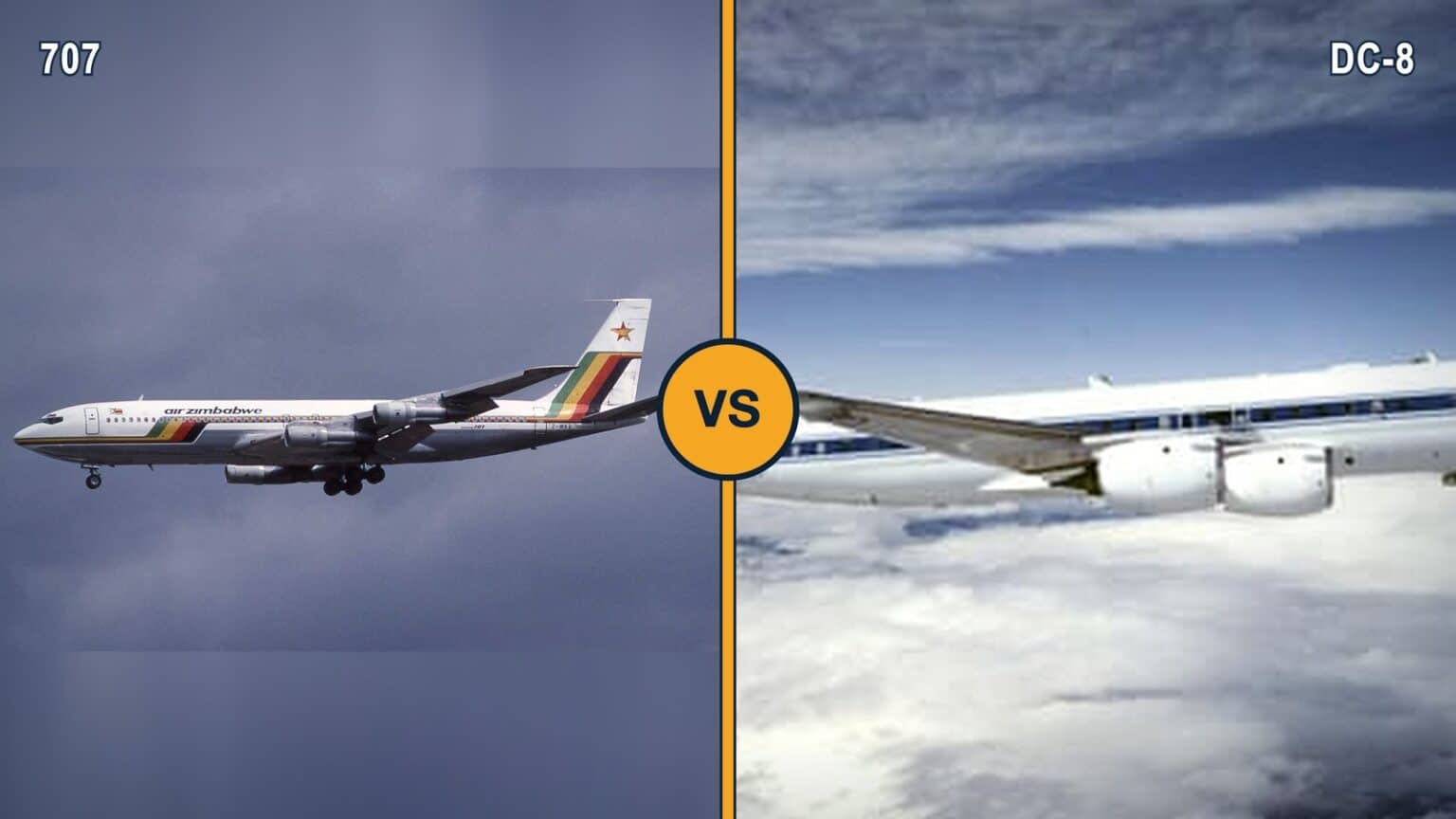

The Boeing 707 won the jet age. It flew first, entered airline service first and sold nearly twice as many aircraft as the Douglas DC-8.
The DC-8 had the last word in endurance. Its stretched and re-engined versions kept flying as freighters long after the last 707 airliners had gone.
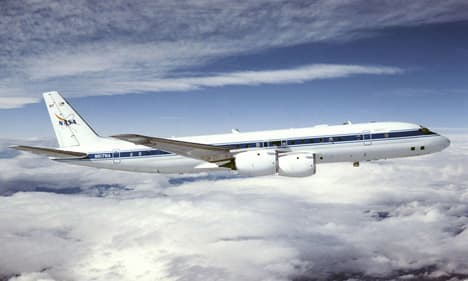
General
Boeing 707
Manufacturer
Boeing
ICAO code
B703
IATA code
703
Produced
1956–1978
Price
$10.5 million (1972)
Engine
4 × Pratt & Whitney JT3D-7
Engine type
Turbofan
Thrust
4 × 19,000 lbf · 85 kN
0% (total)
Wing tips
No winglets
Seats
194 economy · 147 business
Crew
3
Douglas DC-8
Manufacturer
Douglas
ICAO code
—
IATA code
—
Produced
1958–1972
Price
$150 million (1900)
Engine
4 × Pratt & Whitney JT3D-7 turbofans
Engine type
Turbofan
Thrust
4 × 19,000 lbf · 85 kN
0% (total)
Wing tips
No winglets
Seats
259 economy · 180 business
Crew
3
Dimensions
Boeing 707
Cabin width
11 ft 7 in
3.54 m
11 ft 7 in
3.54 m
+10%
Cabin height
7 ft 2 in
2.19 m
7 ft 2 in
2.19 m
+4%
Cabin length
111 ft 7 in
34.00 m
111 ft 7 in
34.00 m
-23%
Exterior length
152 ft 11 in
46.61 m
152 ft 11 in
46.61 m
-18%
Tail height
42 ft 0 in
12.80 m
42 ft 0 in
12.80 m
Fuselage diameter
12 ft 4 in
3.76 m
12 ft 4 in
3.76 m
+1%
Wing span
145 ft 9 in
44.42 m
145 ft 9 in
44.42 m
-2%
Baggage volume
158 ft 8 in
48.36 m
158 ft 8 in
48.36 m
-32%
Douglas DC-8
Cabin width
10 ft 7 in
3.22 m
10 ft 7 in
3.22 m
-9%
Cabin height
6 ft 11 in
2.10 m
6 ft 11 in
2.10 m
-4%
Cabin length
145 ft 0 in
44.19 m
145 ft 0 in
44.19 m
+30%
Exterior length
187 ft 4 in
57.10 m
187 ft 4 in
57.10 m
+23%
Tail height
—
—
—
Fuselage diameter
12 ft 2 in
3.71 m
12 ft 2 in
3.71 m
-1%
Wing span
148 ft 5 in
45.24 m
148 ft 5 in
45.24 m
+2%
Baggage volume
232 ft 3 in
70.80 m
232 ft 3 in
70.80 m
+46%
Weights
Boeing 707
Empty weight
148,300 lb
67,268 kg
148,300 lb
67,268 kg
-7%
Max payload
82,000 lb
37,100 kg
82,000 lb
37,100 kg
+15%
Fuel capacity
23,855 gal
90,301 L
23,855 gal
90,301 L
+0%
Max takeoff weight
334,000 lb
151,500 kg
334,000 lb
151,500 kg
-6%
Max landing weight
247,000 lb
112,000 kg
247,000 lb
112,000 kg
Douglas DC-8
Empty weight
158,738 lb
72,002 kg
158,738 lb
72,002 kg
+7%
Max payload
71,500 lb
32,300 kg
71,500 lb
32,300 kg
-13%
Fuel capacity
23,740 gal
89,866 L
23,740 gal
89,866 L
0%
Max takeoff weight
355,000 lb
161,000 kg
355,000 lb
161,000 kg
+6%
Max landing weight
—
—
—
Performance
Boeing 707
Max cruise speed
545 kt · 627 mph
1,009 km/h
545 kt
627 mph
1,009 km/h
+5%
Max speed
545 kt · 627 mph
1,009 km/h
545 kt
627 mph
1,009 km/h
Cruise speed
478 kt · 550 mph
885 km/h
478 kt
550 mph
885 km/h
-1%
Approach speed
140 kt · 161 mph
259 km/h
140 kt
161 mph
259 km/h
Rate of climb
2,000 ft/min
10 m/s
2,000 ft/min
10 m/s
Range
2,900 nm · 3,340 mi
5,370 km
2,900 nm
3,340 mi
5,370 km
-28%
Service ceiling
42,000 ft
12,800 m
42,000 ft
12,800 m
+20%
Takeoff distance
10,000 ft
3,050 m
10,000 ft
3,050 m
0%
Landing distance
6,250 ft
1,900 m
6,250 ft
1,900 m
-4%
Douglas DC-8
Max cruise speed
518 kt · 596 mph
959 km/h
518 kt
596 mph
959 km/h
-5%
Max speed
—
—
—
Cruise speed
483 kt · 556 mph
895 km/h
483 kt
556 mph
895 km/h
+1%
Approach speed
—
—
—
Rate of climb
—
—
—
Range
4,000 nm · 4,600 mi
7,410 km
4,000 nm
4,600 mi
7,410 km
+38%
Service ceiling
35,000 ft
10,700 m
35,000 ft
10,700 m
-17%
Takeoff distance
10,000 ft
3,050 m
10,000 ft
3,050 m
0%
Landing distance
6,500 ft
1,980 m
6,500 ft
1,980 m
+4%
Table of Contents
| Boeing 707 | Douglas DC-8 | |
|---|---|---|
| First flight | December 20, 1957 (prototype: July 15, 1954) | May 30, 1958 |
| First airline service | October 1958, Pan Am | September 1959, Delta and United |
| Number built | 1,010 | 556 |
| Later re-engining | Few; the 707 line ended in 1978 | About 110 as the CFM56-powered Super 70 |
| Military descendants | E-3 Sentry, E-6 Mercury, VC-137 Air Force One | Few; mostly research and cargo use |
Which versions this page compares
The panel above compares late, turbofan-powered versions of each jet. Both are listed with four Pratt & Whitney JT3D-7 engines. The first 707-120 and DC-8-10 airliners flew on older turbojets that were louder and thirstier.
Which is better, the Boeing 707 or the Douglas DC-8?
The 707 was the bigger success. It beat the DC-8 into the air, into airline service and into the order books.
The DC-8 was the sturdier long-term bet. Douglas stretched it far further and its late re-engined freighters outlived the 707 in civil service.
Both were built to the same brief, a four-engine swept-wing jet for the world’s airlines. Their best versions came out so close in performance that airlines often chose on price, delivery slots or loyalty.
Where the Boeing 707 wins
The Boeing 707 got there first. Boeing flew its 367-80 prototype in July 1954, years before the DC-8 flew, and the first production 707 flew on December 20, 1957.
Pan Am put the 707 into service in October 1958. The DC-8 followed in September 1959, so Boeing had nearly a year of head start.
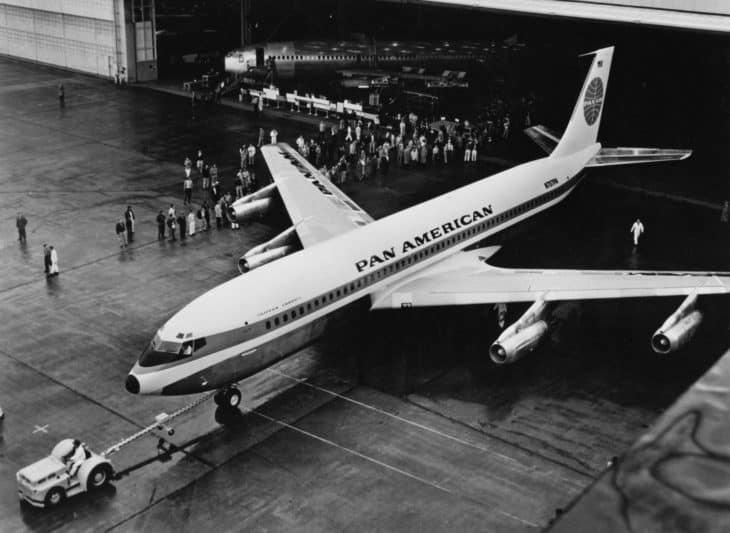
That lead turned into sales. Boeing built 1,010 707s against 556 DC-8s, according to Wikipedia’s production totals.
The 707 also had a second career that the DC-8 never matched. Its airframe became the E-3 Sentry radar plane and the E-6 Mercury, and the VC-137 version carried US presidents as Air Force One.
The panel above shows the 707 also lists a higher ceiling, 42,000 ft (12,800 m) against 35,000 ft (10,700 m) for the DC-8.
Where the Douglas DC-8 wins
The Douglas DC-8 was the more stretchable airframe. The Super 60 series, introduced in the mid 1960s, was much longer than the original and carried far more passengers than any early 707.
The panel shows the result. The DC-8 lists a range of 4,000 nm (4,600 mi, 7,410 km) against 2,900 nm (3,340 mi, 5,370 km) for the 707, and a cabin 145 ft (44.19 m) long against 111 ft 7 in (34.00 m).
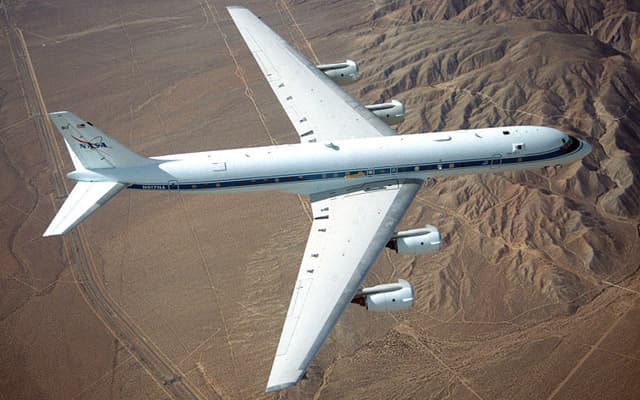
The DC-8 also holds a speed oddity. In August 1961 a DC-8 flown by Douglas test pilot Sheldon Fisher exceeded Mach 1 in a controlled dive at Edwards, reportedly the first airliner to break the sound barrier.
It was a test, not a service feature. But it showed the wing had real margin.
Why the DC-8 outlasted the 707
The answer is the engine swap. In the 1980s the Super 70 program replaced the old JT3D turbofans on about 110 DC-8s with quieter, more efficient CFM56 engines.
That gave the airframes a second life, mostly as freighters. The 707 had no equivalent re-engining program on the same scale, and its civil airliners faded away as noise rules tightened.
Some 707 airframes did keep working. They flew as military tankers, radar planes and transports long after the type left scheduled service.
The DC-8’s survival is now thin too. AeroCorner reported that only two DC-8s were still flying when one ran off the runway at Kinshasa.

How the engines changed both jets
Both airliners started life with Pratt & Whitney JT3C turbojets. Those engines were loud, smoky and hungry for fuel.
The big step came with the JT3D turbofan, which both makers adopted in the early 1960s. It added thrust, cut fuel burn and made the jets quieter, and it is the engine the panel above lists for both aircraft.
From then on the two designs were close rivals. Their cruise speeds are listed at 478 kt (550 mph, 885 km/h) for the 707 and 483 kt (556 mph, 895 km/h) for the DC-8, a gap most passengers would never notice.
Passenger jets that became freighters
Both jets also found work carrying cargo. Convertible and all-freight versions of each appeared in the early 1960s, and many passenger airframes were converted later.
The DC-8 was the better freighter in the long run, partly because of its longer cabin and partly because of the Super 70 engines. Many of the last DC-8s to fly commercially were cargo aircraft.
The 707 left cargo service sooner. As noise and fuel rules tightened, the older JT3D-powered freighters had few places left to fly.
What flying them was like
For passengers in 1958 or 1959, the difference between the two was small. Both cruised at jet speed, both carried several times the load of the piston airliners they replaced, and both cut the Atlantic crossing to a matter of hours.
Some airlines, Pan Am among them, flew both types. Splitting orders between Boeing and Douglas kept a carrier from depending on one maker, and gave it leverage on price.
The two jets also shared a look: four podded engines under swept wings, a tall tail and a long, slim fuselage. Seen from the ground, many travelers could not tell them apart.
That is why the rivalry is remembered as close even though the sales figures are not. The 707 sold more, but the DC-8 was never a failure.
Boeing 707 vs DC-8: the verdict
The 707 wins on timing, sales and legacy. It is the aircraft most people mean when they say the jet age began in 1958.
The DC-8 wins on stretch and long-term service life. A fair verdict is that Boeing won the market and Douglas built the more durable airframe.


Douglas merged with McDonnell in 1967, while Boeing used the 707 as the base for its whole later airliner family.
FAQ
The 707 was the bigger commercial success, with 1,010 built against 556 DC-8s. The DC-8 could be stretched further and lasted longer in service as a re-engined freighter. Neither is clearly the better aircraft in every way.
The 707. Boeing flew its production 707 on December 20, 1957 and Pan Am started service in October 1958. The DC-8 first flew on May 30, 1958 and entered service in September 1959.
Douglas built the DC-8 from 1958 to 1972, and the first aircraft flew on May 30, 1958. Wikipedia counts 556 built.
Many DC-8s were re-engined with CFM56 engines under the Super 70 program, which made them quieter and more efficient. Most then flew as freighters. The 707 was not re-engined on the same scale.
Yes. John Travolta has owned a vintage Boeing 707 that he flies himself. AeroCorner covers it in its John Travolta private jets article.
Sources and references used for research and fact-checking.
About the Author

Tim is the owner and lead editor of AeroCorner since 2019, overseeing aviation content covering aircraft, airlines, airports, and the broader aviation industry. Through years of researching, writing, editing, and publishing aviation-focused content, he has developed extensive practical knowledge of commercial aviation and air travel. Based in Asia and a frequent traveler himself, Tim also brings firsthand passenger experience to AeroCorner’s coverage. Outside of publishing, he has also explored aviation firsthand through hands-on flight training in New Zealand.