


Table of Contents
The FIFA World Cup 2026 has brought 48 nations and the world’s most expensive footballers to stadiums across the United States, Canada, and Mexico. But for the biggest names on the pitch, getting to the tournament was never going to involve a middle seat in economy. From a $75 million all-black Gulfstream to a Batman-themed trijet with a repossession story behind it, the men competing for the most coveted trophy in sport travel in a style that makes first class look unremarkable.
Private jet ownership has become as expected a perk of elite football stardom as the sponsorship deal and the mansion. The economics are straightforward: a player earning north of $50 million a year, with schedules that span six continents and require moves at short notice between Saudi Arabia, Brazil, or a pre-season camp in California, simply cannot rely on commercial aviation. The flexibility, privacy, and scheduling control of a private aircraft is not a luxury at that level. It is a working requirement. For a deeper look at how long-range private jets compare across categories, AeroCorner has a full breakdown of the aircraft that make these journeys possible.
Here is a look at how the World Cup’s brightest stars get from A to B, including a player who spent £240,000 chartering a Boeing 737 for a date night and another whose net worth tops $300 million but who has not yet bought a plane. Some of what follows will surprise you. Some of it is entirely on brand.
1. Cristiano Ronaldo (Portugal): Gulfstream G650


When it comes to private jet ownership among footballers, Cristiano Ronaldo has consistently set the benchmark. His current aircraft, a Gulfstream G650 acquired in late 2024 for approximately $73 million to $75 million, is one of the most capable business jets in production. It is also one of the most recognisable. The fuselage is finished in an all-black livery bearing Ronaldo’s CR7 initials and the silhouette of his iconic “Siu” goal celebration pose, making it identifiable from the tarmac before anyone has spotted a tail number. The interior is divided across three separate cabin zones, with beds, a private bathroom, an electric oven, a microwave, a multimedia system, and Wi-Fi. It seats up to 19 passengers.
Performance
Cabin
Ownership
The G650 has a range exceeding 7,000 nautical miles and a top speed of Mach 0.925. For a player who splits his time between Riyadh and Lisbon while maintaining commercial commitments across Europe, the Middle East, and Asia, the ability to fly continent to continent without a fuel stop is a genuine scheduling advantage. The aircraft can cover the distance from Saudi Arabia to the eastern seaboard of the United States in a single flight, a route that for commercial passengers requires either a connection in Europe or one of the handful of ultra-long-haul operations that serve the corridor.
This is not Ronaldo’s first high-end aircraft. Before the G650, he had operated a Bombardier Global Express XRS and earlier a Gulfstream G200. The G650 is the largest and most capable jet in his history of aircraft ownership. At 41, Ronaldo is participating in what is likely his fourth and final World Cup, and he will make the crossing from Saudi Arabia to the United States aboard an aircraft that costs more than the annual revenue of many professional football clubs outside the top European leagues. Portugal are in the tournament, and Ronaldo is in the squad. The jet is in the air.
2. Lionel Messi (Argentina): Gulfstream V

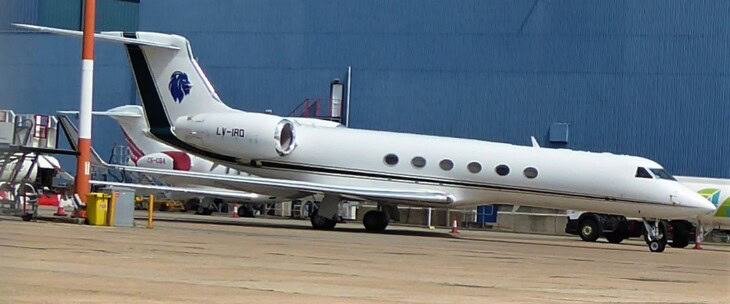
Where Ronaldo’s aircraft announces itself on the apron, Lionel Messi’s jet tells a quieter and more personal story. The Argentine captain flies in a Gulfstream V registered in Argentina as LV-IRQ, purchased in 2018 for around $15 million. The number 10, the shirt number Messi has worn at every club he has played for, sits on the tail. On the entrance steps, the names of his wife Antonella and their three sons Thiago, Mateo, and Ciro are engraved into the metal. The aircraft is less a display of wealth than a travelling home.
The Gulfstream V is a large-cabin, ultra-long-range business jet built for intercontinental distances. Configured for 14 passengers, Messi’s version converts to seven lie-flat beds, which matters considerably given that Argentina’s journey from Buenos Aires to World Cup venues in the United States involves some of the longest travel distances in international football. The interior received a full refurbishment in 2023, with new leather seating, Corian countertops, updated carpets, and refreshed woodwork throughout the cabin. The aircraft has accumulated years of transatlantic and transcontinental flights as Messi has moved between Barcelona, Paris, Miami, and the Argentine national team’s bases across South America.
Messi’s relationship with private aviation has attracted criticism at various points in his career. During his time at Paris Saint-Germain, aviation tracking accounts documented short flights between Paris and Barcelona on routes where commercial alternatives existed, drawing sustained commentary about carbon emissions. That chapter is behind him, but the public appetite for celebrity private jet tracking has, if anything, grown since then. At World Cup 2026, Argentina arrive as the defending champions, with Messi leading a squad that has more incentive than any other to be in peak condition from the opening group stage. The Gulfstream V, modest by the standards of this list, will have played its part in getting him there.
Gulfstream V vs. G650
The Gulfstream V and the G650 are made by the same manufacturer and share a broadly similar cabin format, but the G650 has a longer range (7,000+ NM vs. roughly 6,500 NM), higher top speed (Mach 0.925 vs. Mach 0.885), and a wider cabin. Ronaldo’s G650 cost five times what Messi paid for his GV in 2018 — though used Gulfstream Vs have appreciated significantly since.
3. Neymar Jr (Brazil): Dassault Falcon 900LX


No footballer’s private aviation story contains more plot twists than Neymar’s. The Brazilian forward began his career using an Embraer Legacy 100 as his primary long-haul aircraft. In 2016, that jet was repossessed after Brazilian tax authorities pursued him for approximately £33 million in unpaid taxes. Losing the aircraft to enforcement action is a chapter most players in his income bracket never have to navigate. Neymar did, and then he spent the following years building his way back to one of the more theatrical fleet acquisitions in the history of sport.
In 2024 to 2025, Neymar assembled what became known as his Batman collection: a Dassault Falcon 900LX valued at approximately $50 million, an Airbus H145 helicopter, and a replica of the Tumbler from The Dark Knight, all finished in coordinated black-and-gold Batman livery. The combined value of the collection was reported at around $65 million. The Falcon 900LX is a trijet, meaning it operates three engines rather than the twin-engine configuration standard on most large business jets. That third engine is not purely a marketing feature: it provides additional redundancy for extended overwater crossings and qualifies the aircraft for routing options that ETOPS-restricted twins cannot legally use. The aircraft has a range of approximately 4,000 nautical miles and accommodates up to 12 passengers in a wide cabin. Neymar also maintains a smaller fleet including an Embraer Phenom 100 and a Cessna Citation 680 for shorter domestic legs.
Neymar’s inclusion in Brazil’s World Cup 2026 squad under coach Carlo Ancelotti was one of the tournament’s most discussed selection decisions before the competition began. Having been sidelined for nearly three years by a serious ACL knee injury suffered during a World Cup qualifier in October 2023, the 34-year-old was named in Brazil’s final 26-man roster despite significant uncertainty about his match fitness. Whether he contributes meaningfully on the pitch is the open question of Brazil’s campaign. Regardless of playing time, he is one of the few players at this tournament whose private jet is as recognisable as his left foot. For context on what different business jet manufacturers bring to an aircraft like the Falcon, AeroCorner has a guide to the leading names in private jet manufacturing.
The repossession
Neymar’s original Embraer Legacy 100 was repossessed by Brazilian authorities in 2016 during a £33 million tax enforcement action. The Dassault Falcon 900LX — at roughly $50 million — represents a significant upgrade on the aircraft he lost.
4. Vinicius Jr (Brazil): Bombardier Global 6000


Vinicius Jr is 24 years old, plays for Real Madrid, and owns a Bombardier Global 6000. The trajectory that connects those facts covers roughly six years, from a 17-year-old arriving at the Bernabeu from Flamengo in 2018 to one of the most expensive footballers on the planet, the face of Real Madrid’s rebrand of its private fleet, and a key figure in Brazil’s World Cup 2026 campaign. The pace of that rise makes him one of the more striking examples of how quickly financial realities shift at the elite level of the game.
The Bombardier Global 6000 is an ultra-long-range aircraft with a range of approximately 6,000 nautical miles and a cruising speed of around 505 knots. It is a wide-body aircraft built for intercontinental travel, typically seating 13 to 14 passengers across a cabin that is notably quieter and wider than most large-cabin jets in its class. For Vinicius, whose schedule spans Madrid, Brazil, and the global commercial commitments that come with his commercial profile, the Global 6000 covers the necessary distances with one less stop than smaller alternatives would require. The aircraft, reportedly valued at around $16 million on the used market, appeared in social media posts including photos from the celebrations for his 24th birthday, held on board in July 2024.
At World Cup 2026, Vinicius arrives having established himself as one of the most dangerous forwards in club football, with Brazil leaning on him to fill much of the creative role that Neymar’s sustained injuries have left open for the past three seasons. The irony that Brazil now fields both their icon and their heir apparent aboard private jets at the same tournament is a marker of how the economics of elite South American football have shifted in a generation. Twenty years ago, top Brazilian internationals flew on chartered commercial aircraft or club-arranged group transport. Today, the leading players in the squad own aircraft that can cross the Atlantic without a fuel stop.
5. Kylian Mbappé (France): The $300M Man Who Still Charters

Kylian Mbappé is, by several measures, the most commercially valuable active footballer on earth. His move to Real Madrid, his sponsorship portfolio, and his reported career earnings since turning professional place his net worth north of $300 million. He captains France, one of the tournament favourites at World Cup 2026. He plays for the club broadly considered the most globally prominent in the sport. He does not own a private jet.
The backstory is among the more entertaining in recent football history. When Mbappé was 18 and beginning his rise at Paris Saint-Germain, he reportedly requested that the club provide him access to a private jet for 50 hours per week as part of his contract negotiations. PSG, which operates within financial fair play constraints and a management culture not oriented toward that particular class of player benefit, declined. Mbappé has since earned enough to purchase a full fleet outright, and yet he continues to charter on demand rather than commit to aircraft ownership. It is an unusual position at his wealth level, but not necessarily an irrational one. Chartering eliminates the ongoing costs of aircraft ownership: crew salaries, maintenance contracts, hangar fees, insurance, and depreciation. For someone whose career and travel patterns may still be evolving, the flexibility of chartering has its own logic.
France arrive at World Cup 2026 as one of the pre-tournament favourites, with Mbappé as captain and the centre of their attacking structure. Whether he eventually joins his contemporaries as a private jet owner or remains one of the world’s wealthiest athletes who prefers to pay per journey rather than own the asset outright, the PSG chapter has already made him a permanent footnote in the history of footballers and private aviation. If you are weighing private travel economics generally, AeroCorner has a full comparison of private jets versus first class across cost, flexibility, and comfort.
Charter vs. own: the rough maths
At Mbappé’s wealth level, owning a business jet typically becomes financially rational above roughly 200 hours of flying per year, once you account for fixed costs: crew salaries, maintenance contracts, storage, and depreciation. Below that threshold, on-demand chartering usually works out cheaper — and leaves the capital free to work elsewhere.
6. Marcus Rashford (England): A £240,000 Date Night

Marcus Rashford does not own a private jet. What he has demonstrated is a willingness to use chartered aviation in ways that generate attention regardless. The most discussed example: a £240,000 charter of a Boeing 737, a narrow-body commercial airliner configured to carry over 125 passengers on scheduled routes, used to fly Rashford and his then-fiancée Lucia Loi from London to New York for a romantic trip. The aircraft was, for that journey, operating as a private charter for two passengers.
The choice of aircraft is what makes the story stick. The Boeing 737 is not a business jet. It belongs to the same category as the aircraft operated by airlines on high-frequency routes across Europe and North America, the kind of plane most people board several times a year for holidays and business travel. Chartering one for a weekend trip abroad is an unusual decision even by the standards of a Premier League footballer’s spending patterns. A typical transatlantic charter on a business jet, such as a Gulfstream G550 or a Bombardier Global 6000, would run to a fraction of that cost. Rashford’s choice of a commercial-size aircraft for private use placed the story well outside the usual register of celebrity private aviation.
Rashford confirmed in Thomas Tuchel’s England squad for World Cup 2026 after spending the 2025-26 season on loan at Barcelona, he returns to international duty as one of England’s more experienced attacking options. The charter habit is well established. Private aviation has become embedded in the rhythm of a player whose career has involved constant movement between clubs in different countries, international camps, and the commercial schedule of a figure with significant brand commitments outside the game. Whether he eventually moves to ownership depends on how the next phase of his club career unfolds. For now, he is the most memorable illustration on this list that you do not need to own a jet to spend a very large amount on one. AeroCorner also covers how private jets handle international routing, which is relevant for any player navigating the kind of cross-border travel schedule England’s squad carries.
The six players above are far from the full picture. Private jet ownership and use runs deep across the squads gathered in the United States for this tournament. For a broader look at which athletes across all sports travel by private aircraft, AeroCorner’s guide to athletes with private jets covers the wider landscape, while the existing roundup of footballers with private jets covers the full historical list beyond just the World Cup 2026 roster. The aircraft have changed, the players have changed, and the values involved have grown considerably. What has not changed is that the world’s best footballers have spent decades finding ways to get to where they need to be, as fast as possible, on their own terms.
FAQ
Sources and references used for research and fact-checking.
- Inside The Luxurious World Of Cristiano Ronaldo's Private Jet - Simple Flying
- Inside The Luxurious World Of Lionel Messi's Private Jet - Simple Flying
- Neymar Jr. fulfilled a childhood dream with a $65,000,000 Batman fleet - Supercar Blondie
- Neymar Makes Brazil's FIFA 2026 World Cup Squad - FOX Sports
- Spain 2026 World Cup squad confirmed: Lamine Yamal stars - ESPN
- Marcus Rashford paid £240k to RENT Boeing 737 plane - Goal.com
Get the Newsletter
The latest aviation news and stories sent to your inbox.
About the Author

Tim is the owner and lead editor of AeroCorner since 2019, overseeing aviation content covering aircraft, airlines, airports, and the broader aviation industry. Through years of researching, writing, editing, and publishing aviation-focused content, he has developed extensive practical knowledge of commercial aviation and air travel. Based in Asia and a frequent traveler himself, Tim also brings firsthand passenger experience to AeroCorner’s coverage. Outside of publishing, he has also explored aviation firsthand through hands-on flight training in New Zealand.