

Table of Contents
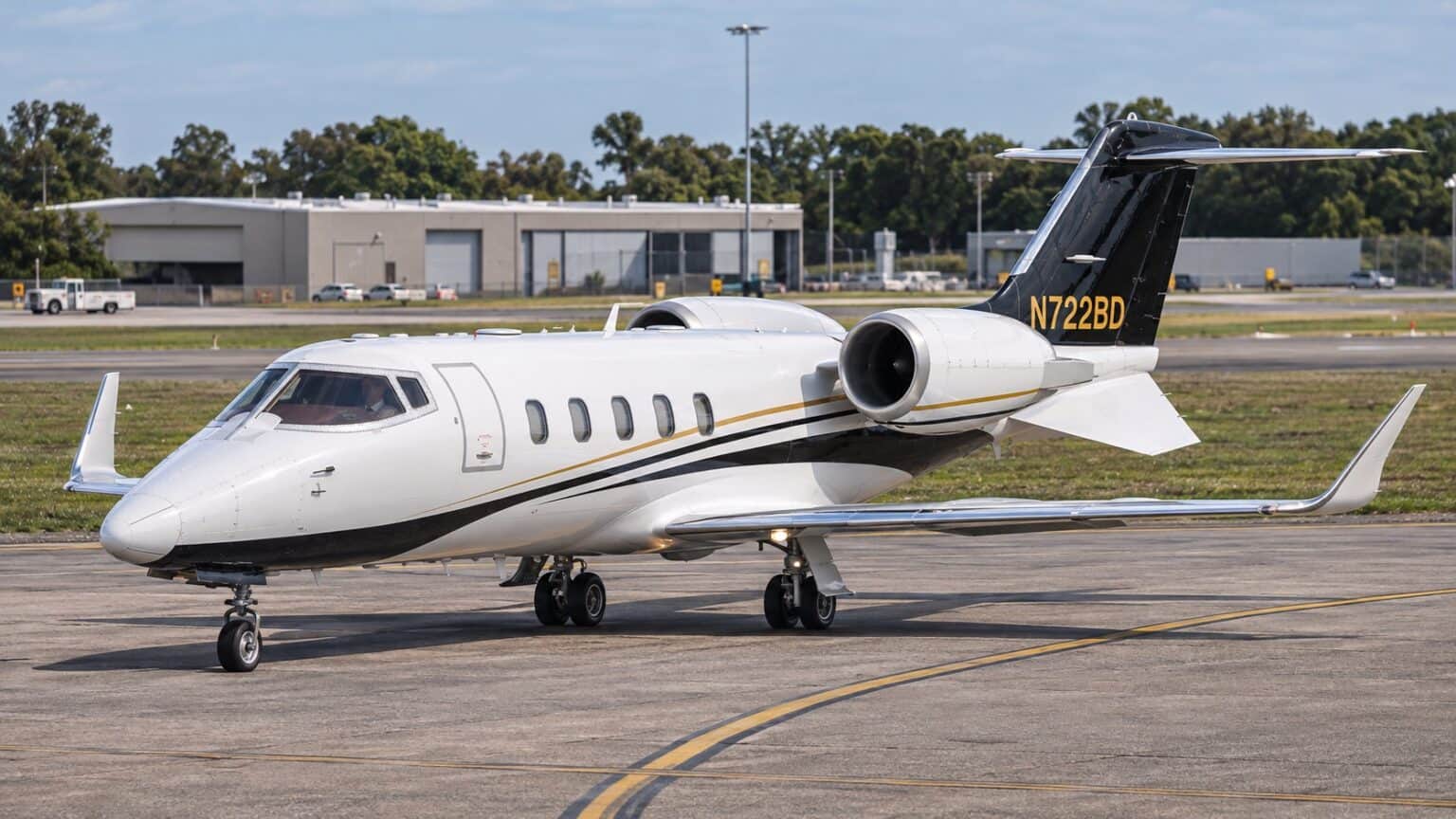
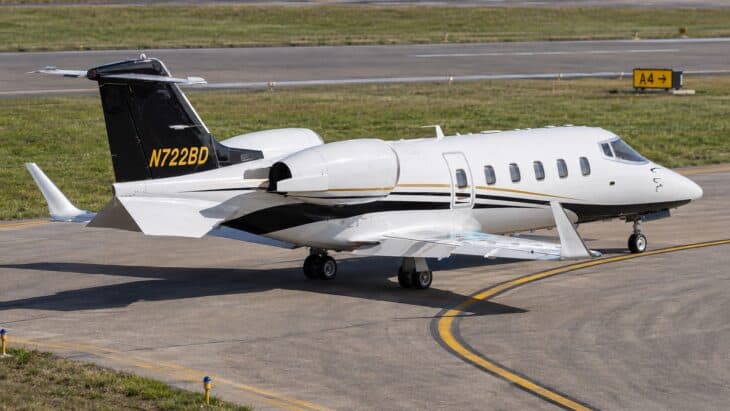
When a Learjet 60 went down near Greenacres, Florida, on November 1, 2026, killing all nine people aboard, one of the first public records reporters pulled was its FAA registration. It did not name a person. N722BD belongs to LR60271 LLC, at 1209 North Orange Street in Wilmington, Delaware.
That is not a sign of anything unusual about this jet, and the NTSB has not found a cause for the crash (our live coverage of the N722BD investigation tracks what is known). An owner that is a company, rather than a person, is simply what most private jets look like on paper.
So why does almost no one own a private jet in their own name? The answer is mostly about lawsuits and privacy, a little about paperwork, and much less about taxes than the internet assumes.
Why Are Private Jets Owned by LLCs?
Because a limited liability company puts a legal wall between the jet and everything else its owner has. If the aircraft is ever at the center of a lawsuit, the claim runs against the company that owns it, not against the owner’s house, business or investments.
The LLC also keeps the owner’s name off the public FAA registry search. The numbers show how standard this has become.
We counted every jet with 20 or fewer seats in the FAA’s downloadable registry database, released at the end of October 2026. Of 16,327 registered jets that size, 9,198 (56%) are owned by an LLC and only 468 (under 3%) by an individual.
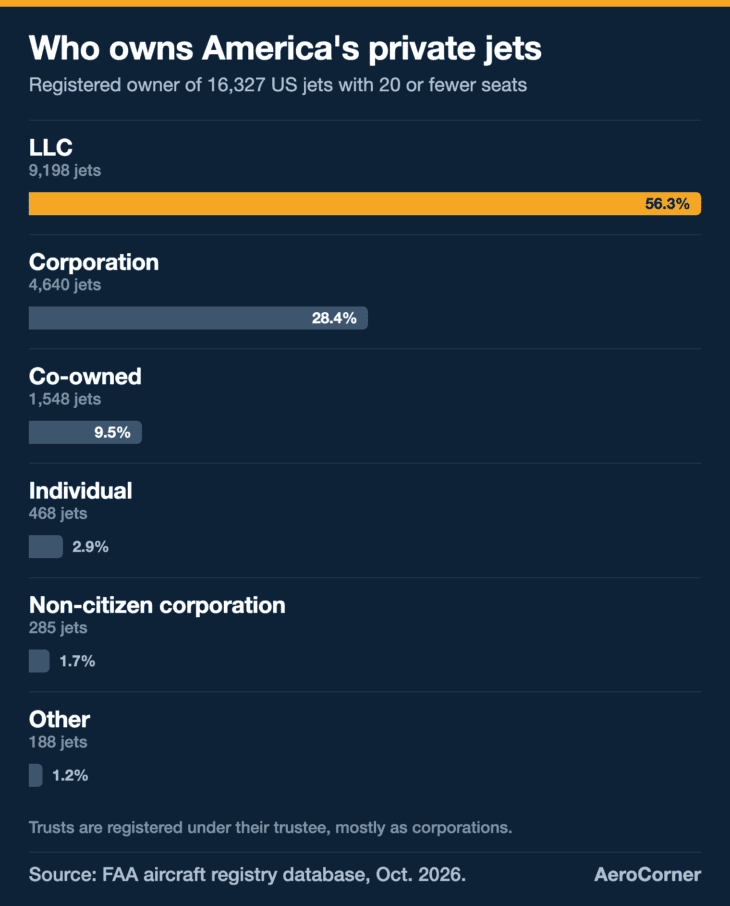
Across the whole US register, which includes Cessna 172s and homebuilts, LLCs own 88,238 of 318,181 aircraft, or 28%. When the GAO studied the registry in 2018, LLCs held 19% of registrations. For jets, the LLC is no longer one option among several. It is the default.
The answer at a glance
Liability: a single-purpose LLC keeps a crash or lawsuit away from the owner’s other assets. Privacy: the public registry shows the company and its agent’s address, not the person. Eligibility: the company must prove to the FAA that it counts as a US citizen, so foreign owners use trusts instead. Taxes are a minor reason, and moving the paperwork to Delaware rarely saves any.
The Main Reason: a Wall Around the Owner
A business jet is a multimillion-dollar machine that can cause catastrophic harm. A law firm primer from Foley & Lardner describes the usual setup plainly: buy the aircraft through a newly formed LLC, with the principal objective of shielding the individual or operating company behind it from liability for the aircraft’s operations.
That is why so many registry names look like N722BD’s. A company named after a model and serial number, like LR60271 for Learjet 60 serial 271, is typically set up to own one airframe, so a claim against it reaches that airframe and its insurance.
Federal law already narrows an owner’s exposure. Under 49 U.S.C. 44112, an owner, lessor or lender is liable for injury, death or damage caused by an aircraft only when it is in that party’s actual possession or operational control. The LLC adds a second layer for the cases where the owner does control the flights.
The Second Reason: Privacy, Built Into Delaware Law
US aircraft registrations are public by default. Anyone can type an N-number into the FAA’s registry search and see the owner’s name and address, which is exactly how the N722BD record surfaced within hours (our guide to how airplane tail numbers work explains what the letters and digits mean).
An LLC changes what that search returns. Delaware’s LLC Act requires a certificate of formation to list only the company’s name and its registered agent’s name and address, so the state file names no member.
The address on N722BD’s registration, 1209 North Orange Street, is the Corporation Trust Center, run by CT Corporation. In 2012 it was the registered agent address for at least 285,000 businesses. In the current registry, 302 aircraft list that one building, 80 of them jets.


The FAA still knows who you are
The registry’s public page shows only the LLC, but the paperwork behind it does not. To register an aircraft to an LLC, the FAA requires either the company’s formation documents or a signed statement naming every member and manager and their citizenship, because the company has to prove it qualifies as a US citizen.
Two newer federal changes pushed in opposite directions. Since March 28, 2025, private owners can ask the FAA to withhold their name and address from FAA websites, under a privacy provision in the FAA Reauthorization Act of 2024.
That opt-out has a catch: it covers only aircraft used privately, and the FAA excludes any aircraft “advertised for public hire.” A jet listed for charter cannot use it, so for those owners the LLC remains the main privacy tool.
Separately, the FAA’s LADD program lets owners filter their flights from the FAA data feeds that tracking websites use. Meanwhile, FinCEN’s March 2025 interim rule, later made permanent, exempted US companies from reporting their beneficial owners under the Corporate Transparency Act, so a US aircraft LLC does not report its owners to the Treasury either.
The Trap Inside the Shell: an LLC Cannot Sell Flights
Here is the part most owners learn from their lawyer. A company that exists only to own and fly an aircraft, and gets paid by its owner or its affiliates for the trips, is what the industry calls a flight department company.
Foley’s primer says that structure often violates the Federal Aviation Regulations. Private flying under Part 91 generally bars an operator from receiving any form of payment for providing flights, and an exception for company aircraft does not apply to an entity whose sole purpose is flight operations.
Carrying paying passengers takes an air carrier or operating certificate under Part 135, the charter rulebook (see how Part 121 and Part 135 differ). An owner who wants the jet to fly paying customers has to go through a company that holds that certificate, rather than the LLC selling seats itself.
Getting this wrong is expensive. In August 2021 the FAA proposed $1,228,671 in civil penalties against five companies for alleged illegal charter flights, including $344,672 against an Iowa company it said flew 16 paid passenger flights without the required certificate.
Foreign Owners Use Trusts, and Utah Banks Hold the Title
Only US citizens, resident aliens and qualifying US companies can register an aircraft in the US. For an LLC, the FAA applies the corporate test: a US citizen as president, at least two-thirds of the managers US citizens, and at least 75% of the voting interest held by US citizens.
A foreign owner has two main routes. A US company owned by foreigners can register a jet if at least 60% of its flight hours are in the US, under 14 CFR 47.9. Or a US trustee holds title, and under 47.7 the foreign beneficiaries may hold no more than 25% of the power to direct that trustee.
Those trustees are why a quiet state ranks so high in jet ownership. In the October 2026 data, 1,586 private jets are registered to a name ending in “trustee,” and 1,008 of them list a Utah address. The two biggest names, TVPX Aircraft Solutions and Bank of Utah, are both in the Salt Lake City area.
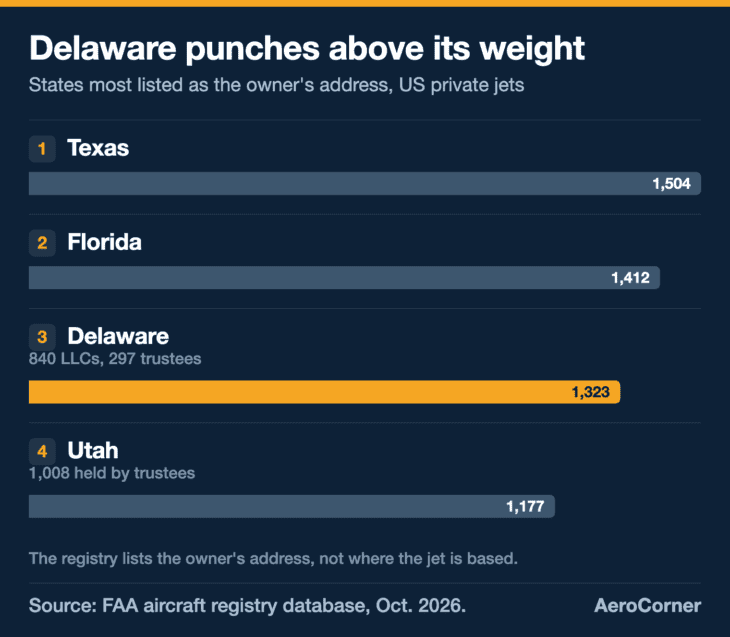
Delaware is the third most common owner address for private jets, with 1,323, behind Texas and Florida. Of those, 840 belong to LLCs and 297 are held by trustees.
This is also where regulators worry. The GAO found in 2020 that the FAA “generally relies on self-certification of registrants’ eligibility and does not verify key information,” and that opaque structures such as shell companies and foreign-owned trusts can be used to own aircraft associated with money laundering. Of its 15 recommendations, four had been implemented by December 2025.
The Myth: It Is a Delaware Tax Dodge
Myth: owners register jets in Delaware to dodge sales tax
Delaware has no state or local sales tax, but that rarely helps an aircraft owner. AOPA’s legal team says registering an aircraft in another state is unlikely to result in any sales or use tax savings, because use tax follows where the aircraft is based and flown, not where its company is filed.
The tax story is the one people repeat, and it is mostly wrong. States collect use tax on aircraft kept within their borders, and AOPA notes that some send people to airports to copy tail numbers while others may use ADS-B flight data to spot aircraft.
The bigger surprise is how few private-jet LLCs are in Delaware at all, at least on paper. Only 840 of the 9,198 LLC-owned jets, about 1 in 11, give a Delaware address on the registry.
The registry records the owner’s address, not the state where the company was formed, so plenty of Texas or Florida addresses belong to Delaware LLCs. The point stands: the LLC is what matters, and Delaware is just one popular place to form one.
What the Registry Tells a Passenger, and What It Does Not
The registry answers “who owns this jet.” It does not answer “who is flying it,” and for a passenger that second question is the one that counts.
The LLC on the registry may not be the company that sells you the flight. If you are paying for a flight, the operator needs a Part 135 certificate, and the FAA publishes a weekly list of certificated operators and the aircraft each is authorized to fly, searchable by N-number.
The FAA’s own advice is to ask to see the operator’s Air Carrier or Operating Certificate before you pay, and to walk away if they refuse. Our explainer on how air charter works covers the booking side.
The FAA lists red flags too. They include no Federal Excise Tax on the bill, no safety briefing or briefing cards, any paperwork that tries to hand you “operational control,” and a pilot coaching passengers on what to tell an FAA inspector.
So the next time a jet makes the news and its owner turns out to be a string of letters and numbers in Wilmington, you know what you are looking at. It is a legal wrapper around one airplane, built to contain a lawsuit and keep a name off a website, and it tells you nothing yet about who was at the controls.
Sources and references used for research and fact-checking.
- Federal Aviation Administration, FAA Registry N-Number Inquiry: N722BD
- Federal Aviation Administration, Releasable Aircraft Database Download
- Federal Aviation Administration, Aircraft Registration Database: Definitions of Data Fields
- FAA Civil Aviation Registry, Limited Liability Companies (registration guidance)
- Legal Information Institute, Cornell Law School, 14 CFR 47.7: United States citizens and resident aliens
- Legal Information Institute, Cornell Law School, 14 CFR 47.9: Corporations not U.S. citizens
- Legal Information Institute, Cornell Law School, 49 U.S.C. 44112: Limitation of liability
- State of Delaware, Delaware Code Title 6, Chapter 18, 18-201: Certificate of formation
- Delaware Division of Revenue, Step 4: Learn About Gross Receipts Taxes
- Wikipedia, Corporation Trust Center
- Foley & Lardner, A Primer on Structuring Aircraft Ownership: Avoiding Illegal Flight Department Companies
- AOPA Pilot Protection Services, Evasive maneuver
- Federal Aviation Administration, FAA Moves to Protect Aircraft Owners' Private Information
- Federal Aviation Administration, Request to Withhold Aircraft Ownership Data
- Federal Aviation Administration, Limiting Aircraft Data Displayed (LADD)
- FinCEN, Beneficial Ownership Information Reporting
- U.S. Government Accountability Office, Aircraft Registration: Actions Needed to Strengthen FAA Oversight (GAO-20-164)
- U.S. Government Accountability Office, Aircraft Registrations: Risks Remain from Efforts to Obscure Ownership Information (GAO-24-107495)
- Federal Aviation Administration, FAA Proposes $1.2M in Civil Penalties Against Five Companies for Alleged Illegal Charter Flights
- Federal Aviation Administration, Thinking of Chartering an Aircraft?
- Federal Aviation Administration, FAA-certificated Aircraft Operators (Legal Part 135 holders)
Get the Newsletter
The latest aviation news and stories sent to your inbox.
About the Author

Tim is the owner and lead editor of AeroCorner since 2019, overseeing aviation content covering aircraft, airlines, airports, and the broader aviation industry. Through years of researching, writing, editing, and publishing aviation-focused content, he has developed extensive practical knowledge of commercial aviation and air travel. Based in Asia and a frequent traveler himself, Tim also brings firsthand passenger experience to AeroCorner’s coverage. Outside of publishing, he has also explored aviation firsthand through hands-on flight training in New Zealand.