

Table of Contents
Walk down a jet bridge and put your hand on the wall of the aircraft as you step aboard. It curves away from you in both directions, because you are stepping into a cylinder.
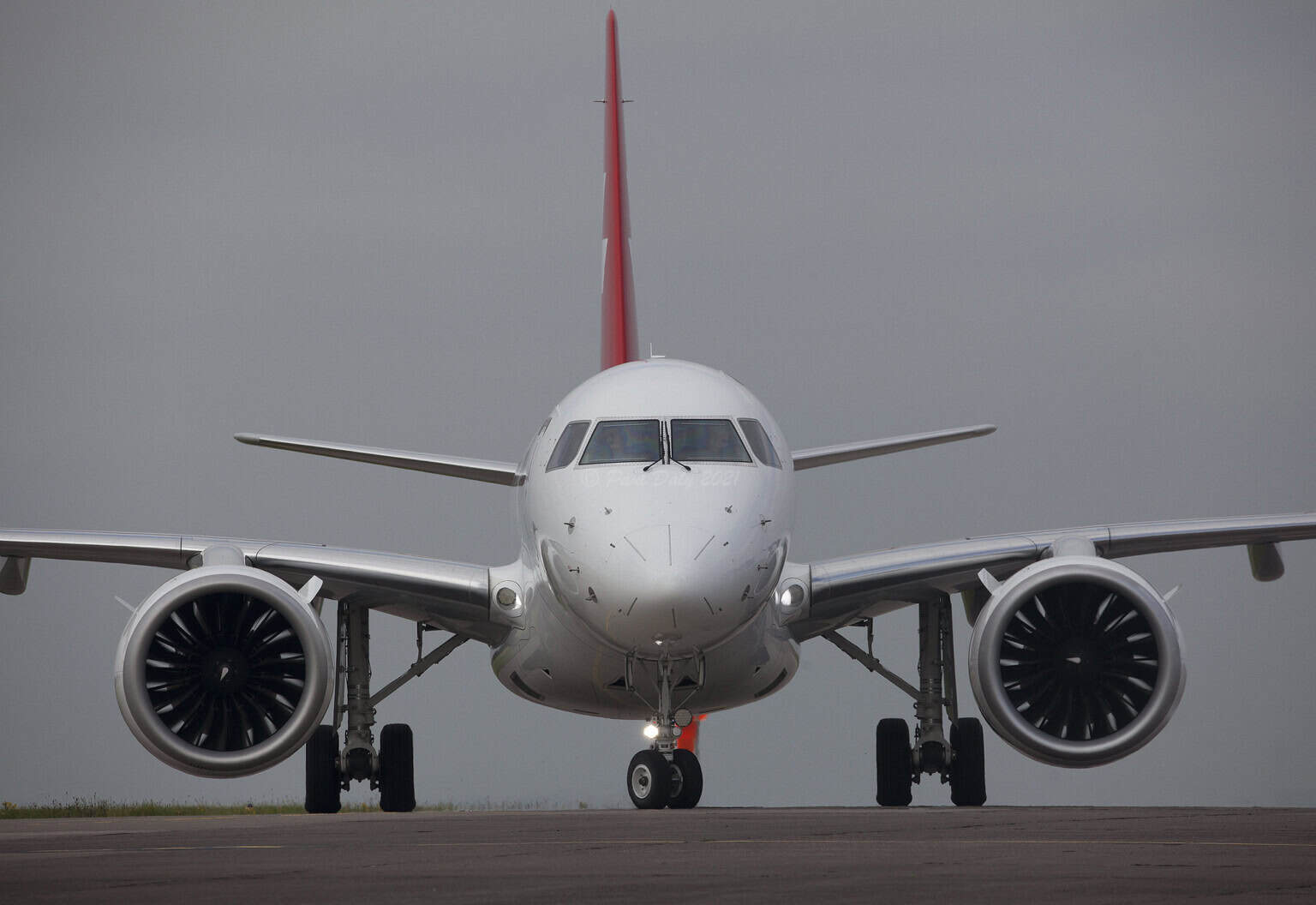
Every jet airliner ever put into airline service has been shaped roughly the same way: a long tube, wings bolted to the middle, a tail at the back. Seventy years of competition between Boeing, Airbus, Douglas, Lockheed, Tupolev and Embraer, and nobody has shipped anything else.
That looks like a failure of imagination. It is the opposite. The tube is the answer to a problem so unforgiving that every serious alternative has died on it, and the reason has almost nothing to do with aerodynamics.
What Is a Fuselage?
The fuselage is the body of the aircraft: the structure that holds passengers, cargo, flight deck and systems, and that the wings, tail and landing gear all attach to. The word comes from the French fuselé, meaning spindle-shaped.
But the definition misses the interesting part. On any aircraft that flies high enough to need a pressurized cabin, the fuselage is not primarily a container. It is a pressure vessel that happens to have seats in it.
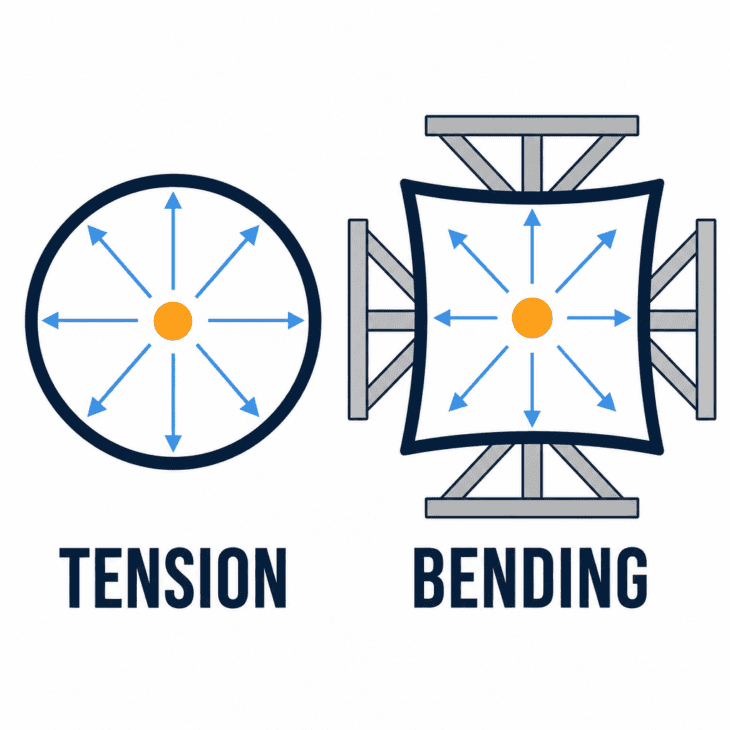
That single job dictates the shape. A circular cross-section carries internal pressure purely by stretching, with no part of the structure being bent. Any other shape has to fight pressure by bending, and bending is expensive in weight.
The answer in one paragraph
An airliner is a tube because a cylinder is the lightest possible way to hold cabin pressure. Pressure in a circular shell is carried as pure tension spread evenly around the ring, so the skin can be astonishingly thin. Flatten that shape anywhere and the panels start bending instead of stretching, which means heavier frames, heavier skin and a worse aircraft. Everything else about the fuselage, including how many seats fit across it, follows from that one constraint.
The Fuselage Is a Pressure Vessel First
At cruising altitude the cabin holds roughly 8 to 9 pounds per square inch more pressure than the air outside. That number sounds small until you multiply it by the area it acts on.
A Boeing 737 forward entry door is about 34 inches wide and 72 inches tall (86 by 183 cm). That is roughly 2,450 square inches, and at 8.6 psi the cabin is pushing it outward with about 21,000 pounds (9,500 kg) of force.
Why nobody can open a door in flight
That 21,000-pound figure is the real reason cabin doors cannot be opened at altitude, and it is not a lock doing the work. Airliner doors are plug doors: they are slightly larger than the hole they fill and must swing inward before they can move outward. Cabin pressure holds them shut with roughly the force of five cars, and no human is going to win that argument. The doors become openable only once the cabin has equalised with the outside air on the ground.
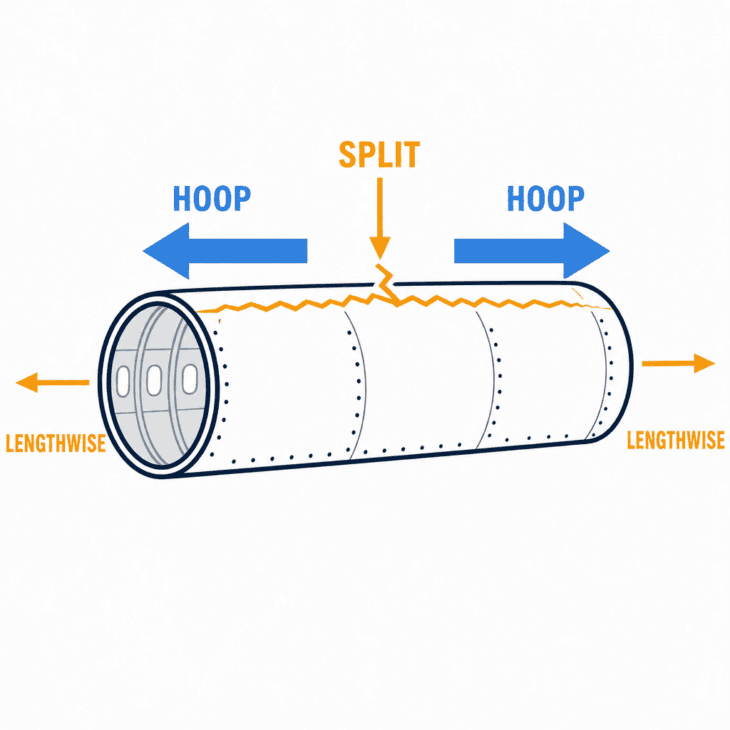
Now apply that same pressure to the whole shell. In a thin-walled cylinder, the stress running around the circumference, called hoop stress, is exactly twice the stress running along the length of the tube.
The engineering shorthand is simple. Hoop stress equals pressure times radius divided by skin thickness. Longitudinal stress is the same thing halved.
Two things fall out of that formula, and both shape the aircraft you fly on. The first is that a wider cabin is disproportionately expensive: double the radius and you double the stress in the skin, so a wide-body needs a thicker, heavier shell for the same pressure.
The second is that pressurized tubes fail by splitting lengthwise, not by snapping in half. The bigger stress is the one trying to pull the skin apart along an axial line, exactly the way a hot dog splits in a pan.
A flat panel has no such trick available. Push on a flat sheet from one side and it deflects, so the load has to be taken in bending by heavy frames and bulkheads behind it. That is the whole reason square fuselages do not exist above a few thousand feet.
What Is Actually Holding the Skin On
Because the circle does so much of the work, the skin itself can be shockingly thin. The upper fuselage skin panels on the early Boeing 737 were 0.036 inches of aluminium (0.9 mm), which is about the thickness of a credit card.
That skin is not doing the job alone. Modern fuselages use semi-monocoque construction, a stressed shell braced from the inside by two families of members running at right angles to each other.
Stringers and longerons run lengthwise. They carry the tension and compression that appear when the whole fuselage bends like a beam, and they stop the thin skin from buckling between supports.
Frames run around the circumference. They hold the cross-section in its circular shape and spread concentrated loads, such as the wing attachment or a landing gear leg, into the surrounding structure.
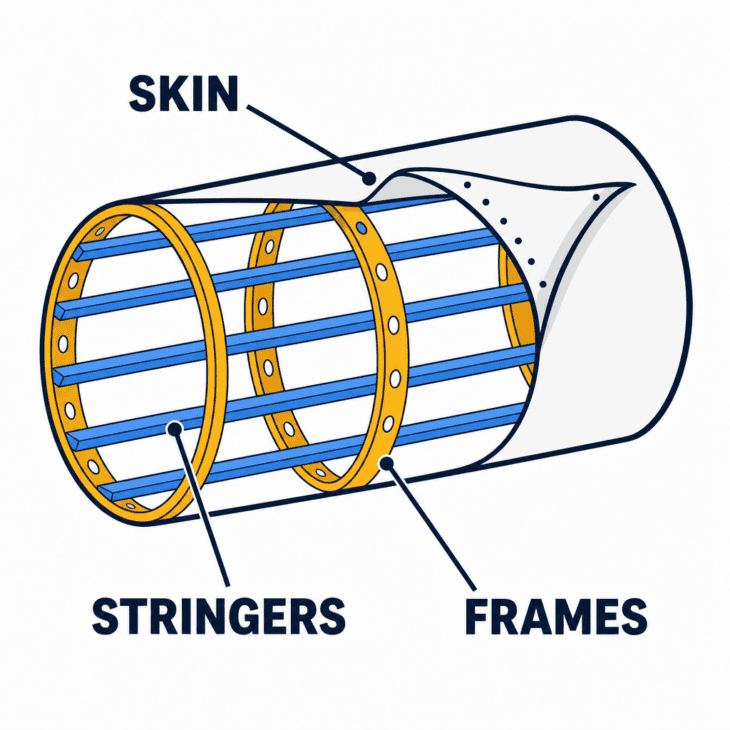
There is a third layer, and it exists purely because of that lengthwise failure mode. Tear straps are bands bonded around the fuselage at intervals, designed to catch a crack that is running axially and stop it before it can unzip the aircraft.
The most famous test of that idea failed. When Aloha Airlines Flight 243 lost its roof in 1988, the NTSB found the separation had started at a bonded lap joint and that the tear straps had come unbonded, so the controlled decompression the designers expected never happened.
Roughly 18 feet (5.5 m) of upper fuselage left the aircraft in one piece, and the crack had run exactly the way the formula says it should: lengthwise.
The other detail worth knowing is that most fuselages are not one perfect circle. A 737’s cross-section is two circular arcs of different radius, an upper lobe and a lower lobe, joined at the cabin floor.
That floor is not just something to walk on. It is a structural tension tie holding the two lobes in shape against the pressure trying to round them out.
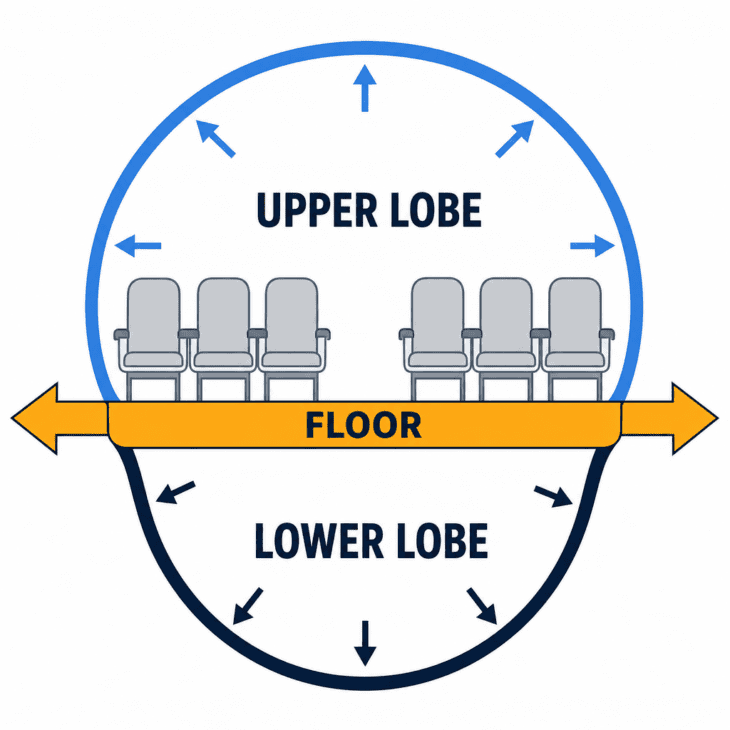
The Airbus A380 does the same trick vertically, with two decks bracing a very tall section. The principle is identical: wherever the shell stops being circular, something has to be pulling across the gap.
Your Seat Width Was Decided in the 1950s
Here is the part that surprises people. The cross-section is the single most permanent decision in an aircraft programme, because stretching a fuselage is easy and widening one is not.
Adding length means inserting extra barrel sections ahead of and behind the wing, reusing the same frames, the same skin panels and the same tooling. Changing the diameter means new frames, new skins, new jigs, new floor beams and a fresh structural certification. In practice it means a new aircraft.
So the width gets locked in once, at the start, and then it never moves. The number that decides how wide your economy seat is on a 737 today was set during a sales fight with Douglas before the jet age had properly begun.
The prototype (1954)
132 inches wide. Boeing’s Dash 80 demonstrator is roomy enough for two-plus-two seating and nothing more.
First widening
Out to 144 inches. Boeing widens the section for five-abreast seating and to share tooling with the KC-135 tanker.
Douglas responds
The DC-8 launches at 147 inches. Three inches wider than the 707, and the airlines notice immediately.
The final width
Boeing goes to 148 inches. Six-abreast economy, and the cross-section the 720, 727 and 737 would all inherit.
The 737 MAX rolling out of Renton in 2026 is therefore flying with a cabin width chosen to beat the DC-8. The Airbus A320, designed a generation later with a clean sheet, came out about six inches wider across the cabin, and that gap has never closed.
Six inches does not sound like much until it is divided among six seats and an aisle. It is roughly the difference between a 17-inch and an 18-inch economy seat, which is why the same airline’s A320 often feels less cramped than its 737 on an identical route.
| Aircraft | Fuselage width (outside) | Cabin width (inside) | Typical economy layout | Typical seat width |
|---|---|---|---|---|
| Boeing 737 MAX 8 | 12 ft 4 in (3.76 m) | 11 ft 7 in (3.54 m) | 3-3 | About 17 in |
| Airbus A320neo | 13 ft 0 in (3.95 m) | 12 ft 1 in (3.70 m) | 3-3 | About 18 in |
| Boeing 787-9 | 18 ft 11 in (5.77 m) | 18 ft 0 in (5.49 m) | 3-3-3 | About 17 in |
| Airbus A350-900 | 19 ft 7 in (5.96 m) | 18 ft 5 in (5.61 m) | 3-3-3 | About 18 in |
The same story repeats one size up. Our 787 and 737 comparison shows how far apart the two families sit, but the sharper contest is the 787 against the A350, where roughly five inches of extra cabin width lets Airbus offer 18-inch seats nine-abreast while Boeing’s nine-abreast layout lands nearer 17.
The Myth: A Blended Wing Would Obviously Be Better
The assumption to drop
“Tube-and-wing is just legacy thinking, and the blended wing body loses on inertia, not on merit.” The aerodynamic case for the blended wing is genuinely strong. It has never been the thing standing in the way. What blocks it is the cabin: a wide, flat, non-circular pressure vessel that has to be certified for people.
The blended wing body is the perennial alternative. Instead of a tube with wings attached, the whole airframe is one lifting shape, so the lift comes from the entire body and there is far less surface area dragging through the air for the payload carried.
The efficiency gains are real and have been demonstrated repeatedly in wind tunnels and subscale flight tests. The problem starts the moment you try to pressurize the cabin.
A flattened centre-body cannot carry pressure in pure tension. Research on pressurized non-circular cabins finds that the upper surface bulges outward under the combined load of cabin pressure and wing bending, which degrades the very lift-to-drag ratio the shape was chosen for.
Stiffen it enough to stop the bulging and you add structural weight, which eats the efficiency advantage. Stress also concentrates toward the edges of the cabin rather than distributing evenly, so the fixes are local and heavy.
Then there is the rule that has quietly killed more cabin concepts than aerodynamics ever has. Under 14 CFR 25.803, an airliner carrying more than 44 passengers must be shown to evacuate everyone in 90 seconds with half of its exits unavailable.
A tube is very good at that. Everyone is at most a few seats from an aisle, and every aisle runs to an exit. In a wide, deep cabin, a large share of passengers sit far from any door, which makes the 90-second demonstration genuinely hard rather than merely inconvenient.
Passengers sitting far off the centreline also feel a lot more vertical motion in a turn, because they are further out on the arc. And the finished aircraft still has to fit airport gates, taxiways and jet bridges designed around tubes.
None of this makes the concept dead. JetZero is building a full-scale blended wing demonstrator at Scaled Composites in Mojave under a four-year, $235 million US Air Force programme, with first flight tracking toward late 2027 and a production Z4 targeted around 2030. United Airlines has invested.
Notice which door it is coming through. The military tanker and transport mission, and freight generally, are exactly the applications where you do not have to certify a 90-second passenger evacuation or sell anyone on the ride quality of seat 12K.
If the blended wing does reach airline service, the tube will not have been beaten by a better idea. It will have been beaten by a shape that finally solved the cabin problem the tube solved in 1954.
So the next time you duck through that doorway and feel the wall curve away from your hand, you are touching the answer. The curve is not styling and it is not tradition.
It is the only shape that lets a wall thinner than a credit card, made of ordinary aircraft aluminium, hold back eight or nine pounds per square inch, tens of thousands of times, across decades of service, without anyone on board giving it a thought.
Sources and references used for research and fact-checking.
- MIT Department of Materials Science and Engineering (David Roylance), Pressure Vessels
- Electronic Code of Federal Regulations, 14 CFR 25.803 - Emergency evacuation
- Embry-Riddle Aeronautical University, Introduction to Aerospace Flight Vehicles, Aerospace Structures
- University of Portland (citing NTSB report AAR-89/03), Revisiting Aloha Airlines Flight 243: A Corrosion Engineer's Standpoint
- Chinese Journal of Aeronautics (ScienceDirect), A deformation criterion of pressurized non-circular cross-section cabin and its effects on cruise performance of BWB civil aircraft
- Aviation Week, JetZero Reveals Revised BWB Design As Demonstrator Takes Shape
Get the Newsletter
The latest aviation news and stories sent to your inbox.
About the Author

Tim is the owner and lead editor of AeroCorner since 2019, overseeing aviation content covering aircraft, airlines, airports, and the broader aviation industry. Through years of researching, writing, editing, and publishing aviation-focused content, he has developed extensive practical knowledge of commercial aviation and air travel. Based in Asia and a frequent traveler himself, Tim also brings firsthand passenger experience to AeroCorner’s coverage. Outside of publishing, he has also explored aviation firsthand through hands-on flight training in New Zealand.