

Table of Contents
The semi-private carrier did not want the dead airline’s Boeing 757s. It wanted the paperwork that lets an airline fly more than 30 passengers.
JSX, the Dallas carrier that sells seats on jets flying from private terminals, has bought New Pacific Airlines out of bankruptcy. New Pacific, the former Northern Pacific Airways, stopped flying on Nov. 26, 2025, after years of trying to build an Anchorage hub with Boeing 757s.
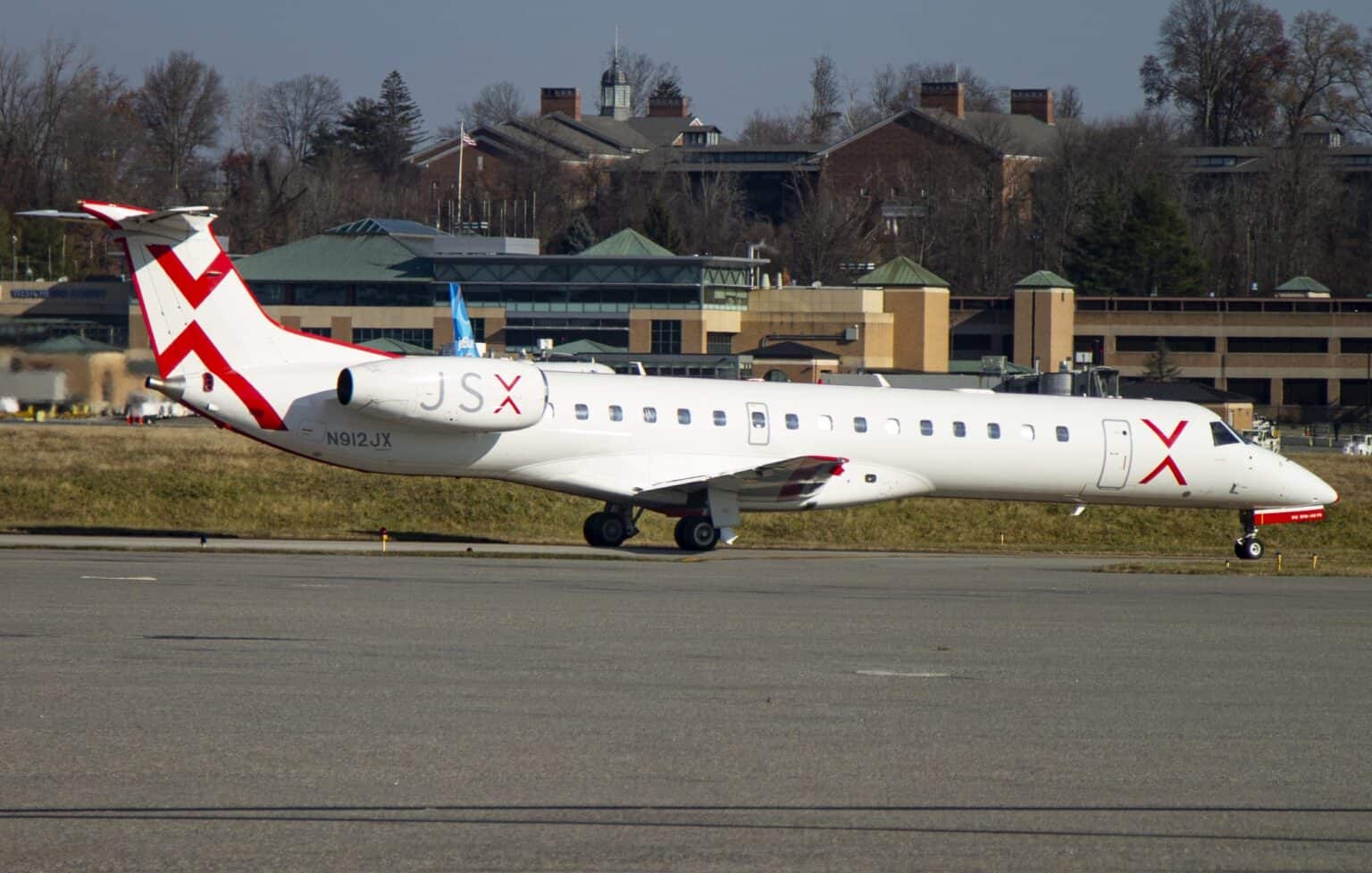
What JSX gets is New Pacific’s FAA Part 121 certificate, the airline-grade license. In a Nov. 20, 2026 filing with the Department of Transportation, New Pacific said it will restart with Embraer ERJ-145 jets fitted with 42 seats, 12 more than JSX sells on the same airplane today.
Why JSX’s 50-Seat Jets Carry 30
The ERJ-145 was built as a 50-seat regional jet. JSX flies it with 30, and the empty space is not only about legroom.
JSX flies as a public charter under Part 135, the rulebook for charter and on-demand flying, which caps its aircraft at 30 passenger seats. Flying as a public charter is also what lets it board from private terminals, where customers can check in about 20 minutes before departure, instead of the airline terminal and its TSA checkpoint.
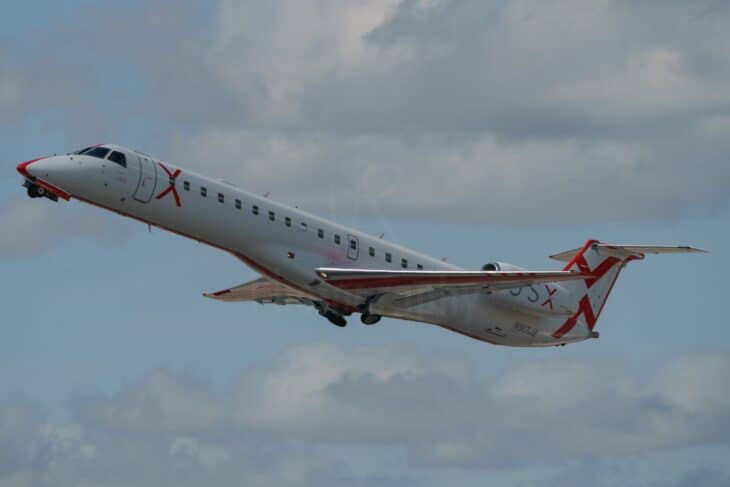
Scheduled airlines fly under Part 121, which brings heavier requirements on pilots, training and maintenance. Our guide to Part 121 vs Part 135 walks through the differences. A 42-seat ERJ-145 is legal under Part 121 and not as a Part 135 public charter, which is the whole reason JSX needed a 121 certificate.
Rather than certify a new airline, JSX bought a dormant one. New Pacific’s certificate was for sale.
The 757 Airline That Never Reached Asia
Northern Pacific Airways was proposed in 2021 as a 757 airline linking the mainland U.S. with Tokyo and Seoul through a stopover in Anchorage. It spent $6 million renovating space in Anchorage’s North Terminal, according to the Anchorage Daily News.
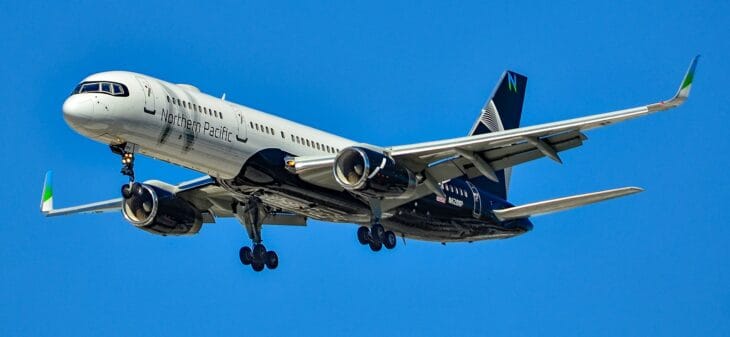

The scheduled Anchorage flights never began. Russia closed its airspace to U.S. carriers in 2022, which former Anchorage mayor Dave Bronson said removed the efficient route to Asia, and Simple Flying reports the carrier lacked the ETOPS approval it needed for the alternatives.
So the airline kept reinventing itself. It started domestic flights from Ontario, California, to Las Vegas in July 2023, renamed itself New Pacific in September 2023 and dropped scheduled flying in April 2024 for charters, including a deal to fly NHL teams in 757s cut down to 78 premium seats.
Its parent, FLOAT Alaska, also owned Ravn Alaska, which ended its flights in August 2025. New Pacific followed in November, with president Tom Hsieh telling staff the company was “unable to continue to fund the losses in our business.”
What JSX Paid For, and What It Left Behind
FLOAT Alaska filed for Chapter 11 in January 2026 with about $90 million in debts. A court-run auction on March 18 offered three Boeing 757-200s parked at Mojave, spare parts and the Part 121 certificate, according to Aerospace Global News.
One of those 757s, N629NP, had no engines, having been stripped to keep its two sisters flying. JSX’s plan does not include them: View from the Wing notes the bankruptcy disposed of the 757s.
A court approved the sale of New Pacific to JSX in August 2026, FlightGlobal reported. The deal stayed quiet until the Nov. 20 filing.
The filing lays out a small airline. New Pacific would start with two ERJ-145s leased from Delux Public Charter, JSX’s sister company, and grow to six by the fifth month.
Its first-year projection is 10,106 flights and about 309,000 passenger boardings, on sectors averaging about 1.2 hours gate to gate. Staff would grow to 104 people.
The timing matters too. The filing came days before New Pacific reached a year out of service, the point at which DOT rules call for a dormant carrier’s authority to be revoked, and it asks the DOT to waive its 45-day notice so the airline can restart once the FAA finishes its certification review.
Why a 30-Seat Airline Wants an Escape Hatch
JSX has grown into a real airline in all but name. It started flying in 2016 and began 2026 with 53 aircraft, targeting 64 by year-end, its president David Drabinsky told AirlineGeeks in August.
That growth made it a target. American Airlines, Southwest and the Air Line Pilots Association have pushed regulators to close what they call the public charter “loophole,” with ALPA president Jason Ambrosi saying in 2023 that some carriers use it “to cut costs by skirting lifesaving safety rules.”
In June 2024 the FAA said it would revise the rules for public charter operators. Then-administrator Mike Whitaker said a company “effectively operating as a scheduled airline” may need to follow the same rules as one.
That rulemaking was never closed. View from the Wing reports the FAA’s current agenda lists it as a long-term action with no next step set, so a Part 121 certificate gives JSX somewhere to go if the 30-seat model is ever squeezed.
What JSX Has Not Said Yet
JSX has not named routes or a start date. Asked about the deal, it said only that it “is continually evaluating opportunities to support its long-term growth.”
The filing describes New Pacific as a Part 121 supplemental carrier flying charters for JSX under a wet lease, with tickets sold as public charters. Proposed routes would average about 230 to 345 miles (370 to 556 km), according to Simple Flying.
Whether 42 seats can still board from a private terminal is the open question. View from the Wing notes federal security rules provide for scheduled and public charter flights with 31 to 60 seats outside the usual secure area, though airport certification rules mean it would not work everywhere, and Part 121 pilots must retire at 65.
In June 2026, CEO Alex Wilcox told AeroTime that JSX was “in no rush to upgauge.” Its first upgauge will fly on a certificate written for a 757 airline that never reached Asia.
Sources and references used for research and fact-checking.
- FlightGlobal, JSX plans to restart bankrupt New Pacific Airlines
- AeroTime, JSX to bring New Pacific Airways back into operation after bankruptcy
- Simple Flying, JSX Buys Bankrupt Airline In Major Expansion Beyond 30-Seat Semi-Private Flights
- View from the Wing, JSX Buys New Pacific Airlines: 42 Seat Jets Could Bring Its Private Terminal Flights To More Travelers
- Anchorage Daily News, Airline that planned to fly Alaskans to Asia goes belly up
- Aerospace Global News, New Pacific Airlines' fleet of Boeing 757s to be auctioned off
- AirlineGeeks, FAA Moves to Restrict Public Charter Flights
- AirlineGeeks, JSX Plans Double-Digit Fleet Growth, Eyes New Regions
- Private Jet Card Comparisons, JSX marks 10 years of saving flyers from crowded airports
Get the Newsletter
The latest aviation news and stories sent to your inbox.
About the Author

Tim is the owner and lead editor of AeroCorner since 2019, overseeing aviation content covering aircraft, airlines, airports, and the broader aviation industry. Through years of researching, writing, editing, and publishing aviation-focused content, he has developed extensive practical knowledge of commercial aviation and air travel. Based in Asia and a frequent traveler himself, Tim also brings firsthand passenger experience to AeroCorner’s coverage. Outside of publishing, he has also explored aviation firsthand through hands-on flight training in New Zealand.