

Table of Contents
On an average day in 2026, about 105,000 scheduled airline flights take off somewhere in the world. That is the count from OAG, the airline schedules company: 35,378,010 flights in the schedule from December 29, 2025, through the week ending November 29, 2026, or 105,292 a day.
Flight trackers tell a bigger story. On July 23, 2026, Flightradar24 tracked 287,364 flights in a single day, and only 153,359 of them were what it calls commercial. Both numbers are right. They just count different things.
How Many Flights Are There Per Day Worldwide?
The best answer for airline flights is about 105,000 a day. OAG’s count covers one-way flights in airline schedules, the published timetables that passengers book from, for the 2026 schedule year.
The UN’s aviation agency lands in the same place from the other direction. In its 2026 Safety Report, ICAO says airlines carried about 5 billion passengers on 38 million flights in 2025, for scheduled commercial air transport by airplanes over 5,700 kg (12,566 pounds). That works out to roughly 104,000 flights a day.
What neither figure includes is everything else in the sky: private jets, flight schools, air ambulances, military aircraft, gliders and drones. Add those in and the daily total climbs far higher, which is where the tracker numbers come from.
The count at a glance
Scheduled airline flights: about 105,000 a day in 2026 (OAG, 105,292 average through November 29). Scheduled flights in 2025: 38 million, about 104,000 a day (ICAO). Every flight tracked on July 23, 2026, the record day for commercial flights: 287,364 (Flightradar24). Flights in US airspace: more than 17 million in 2025, about 46,600 a day (FAA).
Five ways to count a day of flights
There is no single official world count of flights per day. There are schedules, annual statistics, tracking networks and national air traffic counts, and each answers a slightly different question.
| What is counted | Source and period | Flights per day |
|---|---|---|
| Every flight tracked on the commercial record day (airline, private, military, gliders, drones) | Flightradar24, July 23, 2026 | 287,364 |
| Commercial flights tracked, record day (passenger, cargo, charter, some business jets) | Flightradar24, July 23, 2026 | 153,359 |
| Scheduled airline flights, daily average | OAG, Dec. 29, 2025 to Nov. 29, 2026 | 105,292 |
| Scheduled commercial flights, daily average (38 million a year) | ICAO, 2025 | About 104,000 |
| Flights in US airspace, daily average (more than 17 million a year) | FAA, 2025 | About 46,600 |
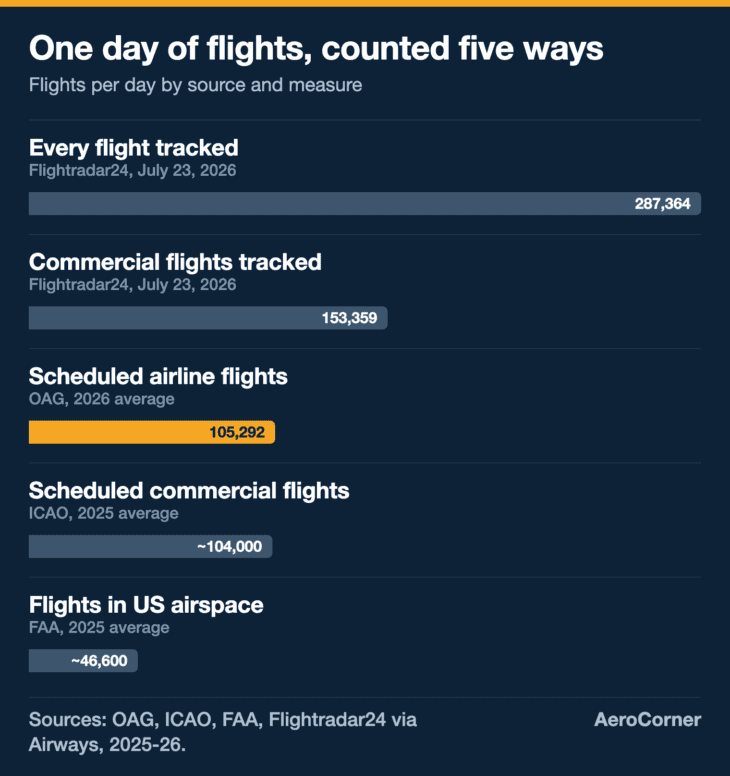
The shape is the story. Airline schedules and ICAO’s statistics agree to within about 1%, so the airline answer is solid. The tracker’s all-flights number for its record day is almost three times larger, and the gap is general aviation, business jets and military traffic that no airline timetable lists.
The US figure is a separate scope again. The FAA counted more than 17 million flights in 2025, its busiest year in more than 15 years. That is a national air traffic count, not an airline timetable, so it cannot be read as the US share of the world’s scheduled flights.
Why the numbers differ
Scheduled is not the same as tracked. OAG counts the flights airlines publish for sale. A tracker like Flightradar24 counts the aircraft its network of receivers actually picks up, which includes everything that broadcasts a position, from a cargo 777 to a crop duster. How those networks see aircraft is its own subject, covered in how flight tracking sees small planes.
A record day is not an average day. The 287,364 and 153,359 figures are peaks, set on a Thursday in late July. The OAG and ICAO numbers are averages that include the quiet weeks of January and February.
“Commercial” means different things. Flightradar24’s commercial category takes in passenger, cargo and charter flights plus some business-jet operations, according to Airways Magazine’s report of the record. ICAO’s count is scheduled commercial air transport by airplanes over 5,700 kg (12,566 pounds), so it leaves out small charters and air taxis.
287,364 is not the number of airline flights
The figure that circulates after a record day is Flightradar24’s total for every category it tracks. Only 153,359 of the 287,364 flights on July 23, 2026 were commercial, about 53%. The rest were business and private flights, gliders, helicopters, government and some military flights, and drones. It is a tracking record, not a count of every flight on Earth.
Coverage changes the count. A tracker can only count what it hears. Flightradar24 added space-based ADS-B positions from Aireon in February 2026, Airways reported, so a new tracker record may partly reflect a bigger network, not only more flying.
How the number got here
Airline flying is growing slowly, not booming. ICAO’s preliminary statistics put 2024 at 37.4 million departures, up 5.1% on 2023, which is about 102,000 a day in a leap year.
2025 reached 38 million flights, about 104,000 a day, and OAG’s 2026 schedule averages 105,292. Growth has cooled: OAG puts November 2026 seat capacity at 484.4 million, up only 0.9% on November 2025, with the Middle East the region losing the most capacity.
The tracker records climb faster. Flightradar24’s previous commercial record was 137,225 flights on July 13, 2023, so the July 2026 day beat it by 16,134 flights, or 11.8%.
What 105,000 flights a day looks like
IATA expects airlines to carry 5.1 billion passengers in 2026, up 2.4% on 2025. Spread across the year, that is roughly 14 million passenger trips every day.
Those flights are not spread evenly. In 2025, OAG counted eight routes averaging 100 or more flights a day, led by Jeju to Seoul Gimpo at 194 a day, a story told in why Seoul-Jeju is the busiest route in the world. Melbourne to Sydney followed at 134 and Jeddah to Riyadh at 130.


Timing matters too. The FAA’s ten busiest days of 2025 all topped 54,000 flights, led by July 17 at 56,676, and Thursdays remain the busiest day of the week in US airspace. For the hubs that carry the biggest share, see the busiest airports in the world by flights per day.
A day’s flights are also not all airborne at once. Each one spends only part of the day in the air, so the number flying at any moment is a fraction of the daily total, which is the question behind how many planes are in the sky right now.
FAQ
Sources and references used for research and fact-checking.
- OAG, Global aviation market briefing: frequency and capacity statistics
- OAG, Air Travel Statistics 2025
- ICAO, Uniting Aviation, Our latest Safety Report spotlights aviation's progress and its most urgent challenge
- ICAO Annual Report 2024, World Air Transport 2024
- Federal Aviation Administration, The Slice, week of January 5, 2026: busiest days in 2025
- Airways Magazine, Flightradar24 Tracks Record 153,359 Commercial Flights in One Day
- IATA, Middle East disruptions and high fuel prices halve airline industry profitability
Get the Newsletter
The latest aviation news and stories sent to your inbox.
About the Author

Tim is the owner and lead editor of AeroCorner since 2019, overseeing aviation content covering aircraft, airlines, airports, and the broader aviation industry. Through years of researching, writing, editing, and publishing aviation-focused content, he has developed extensive practical knowledge of commercial aviation and air travel. Based in Asia and a frequent traveler himself, Tim also brings firsthand passenger experience to AeroCorner’s coverage. Outside of publishing, he has also explored aviation firsthand through hands-on flight training in New Zealand.