

Table of Contents
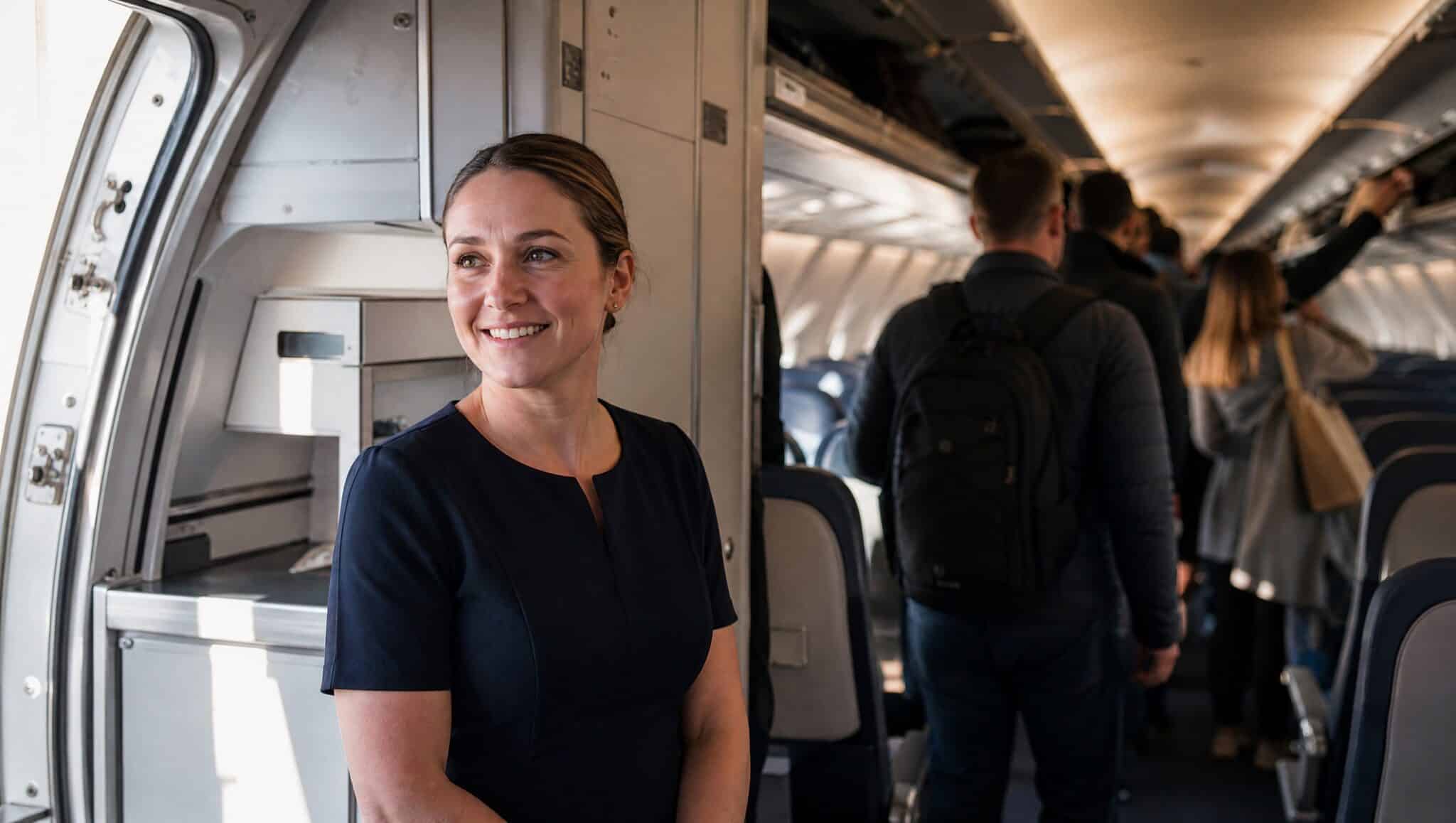
It is 6:40 in the morning and a flight attendant is standing at the door of a 737, greeting 170 passengers, settling an argument about bin space in row 12, and confirming that everyone in an exit row can actually open one.
At most US airlines, historically, none of that counted as paid work. The clock that pays the salary did not start until the cabin door closed and the aircraft pushed back from the gate.
That one quirk explains almost everything confusing about flight attendant pay: why the advertised hourly rate looks generous, why the annual total does not match it, and why the last four years of contract fights have been about boarding more than about raises.
How Much Do Flight Attendants Make?
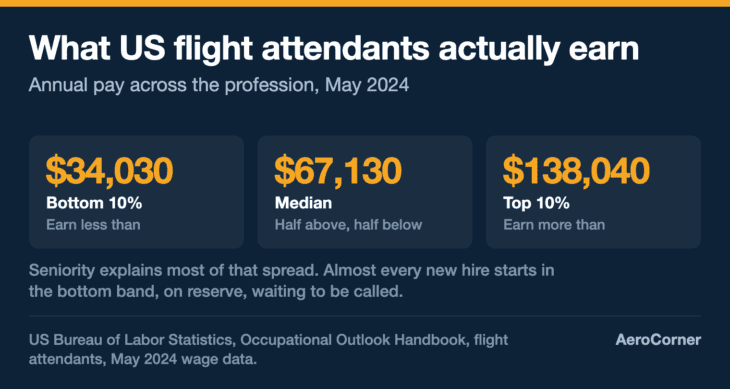
The median US flight attendant earned $67,130 a year as of May 2024, according to the Bureau of Labor Statistics. The bottom 10 percent made less than $34,030. The top 10 percent cleared $138,040.
That is a four-fold spread inside a single job title, and seniority accounts for most of it. But the structure underneath the number is what makes this job genuinely unusual among skilled professions.
The answer in one line
Median US flight attendant pay was $67,130 in May 2024, ranging from under $34,030 at the bottom tenth to over $138,040 at the top. Pay is calculated per flight hour rather than per hour worked, so boarding, deplaning and gate delays have historically fallen outside the paid clock.
The pay clock starts when the door closes
Airlines pay cabin crew for block time: the interval from the moment the aircraft pushes back from the gate to the moment it parks at the other end. It is the same measure used to pay pilots, and flight attendant contracts inherited it decades ago.
Everything outside that window is, in the traditional structure, unpaid. That includes the report time before the flight, the safety and security checks, the entire boarding process, deplaning at the far end, and the sit between two flights.
It also includes the delay you are most annoyed by. If the aircraft sits at the gate with the door open waiting for a connecting passenger, that is unpaid time for the crew working the cabin. Once the door shuts and the aircraft pushes, the clock runs, even if the jet then queues for an hour on a taxiway.
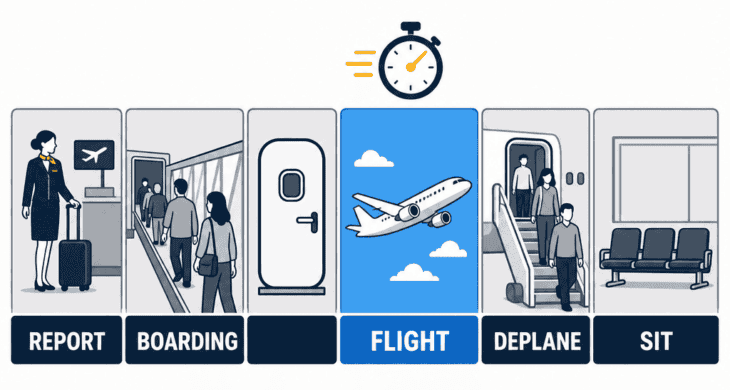
Crews describe this as the hardest part of the day being the part nobody pays for. Boarding happens four or five times in a busy domestic pairing, and by union estimates the unpaid portion of a working day can run to five or six hours.
Which is why the choreography passengers do notice, from the aisle scan to the reason flight attendants sit on their hands during takeoff, sits on either side of a pay boundary most travellers have never heard of.
What a flight attendant paycheck is actually made of
Block pay is the bulk of it, but not all of it. Union contracts have spent decades bolting on floors and supplements to compensate for the hours the hourly rate ignores.
| Component | What it pays for | Typical shape |
|---|---|---|
| Flight (block) pay | Pushback to arrival at the gate | The headline hourly rate, and most of the paycheck |
| Boarding pay | Time at the door before departure | Half the hourly rate, where the contract has won it |
| Duty and trip rigs | Long days with little actual flying | Minimum floors, commonly 1 hour credited per 2 hours on duty |
| Per diem | Meals and incidentals away from base | A few dollars for every hour away from home base |
| Reserve guarantee | Being available on call | A guaranteed monthly total, often around 75 to 78 hours |
| Overtime | Nothing | Air carrier employees are exempt from federal overtime rules |
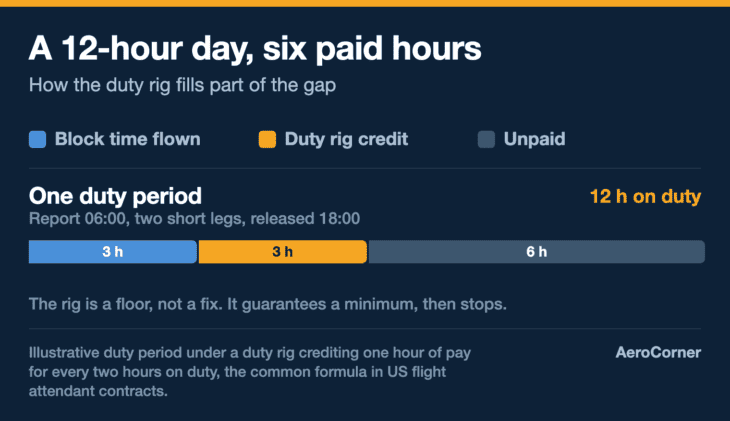
The rigs are the most important line in that table and the least understood. A duty rig credits a minimum amount of paid flight time per hour on duty, commonly one hour of pay for every two hours at work.
So a crew member who reports at 6:00 a.m., flies two short legs, waits four hours between them, and is released at 6:00 p.m. does not get paid for three hours of block time. The rig floor lifts that 12-hour day to a minimum of six paid hours.
Per diem sounds generous until you see the rate. United publishes $2.97 an hour domestic and $3.54 an hour international, paid on every hour away from base, including the ones spent asleep in a hotel.
There is no overtime. Ever.
Section 13(b)(3) of the Fair Labor Standards Act exempts employees of air carriers subject to the Railway Labor Act from federal overtime requirements. A flight attendant on a 14-hour duty day earns the same rate as on the first hour, no matter how long the day runs.
Why the hourly rate flatters the salary
United’s published scale starts new flight attendants at $38.21 per flight hour and climbs with each year of service, with the top of the scale reaching $100.13 by 2030 under the current agreement. Those are respectable numbers on paper.
The trap is multiplying them by a normal working year. A full-time line is typically 75 to 90 flight hours a month, not the 160 or so hours a salaried employee works, because the hours being counted are a subset of the hours being worked.
Run $38.21 across 80 flight hours a month and the result is roughly $36,700 a year before per diem, boarding pay and premiums. That is how a job advertising a rate near $40 an hour produces a first-year salary the Bureau of Labor Statistics puts in the mid-thirties.
The pilot career has the same shape, which is why the economics of becoming an airline pilot also look punishing at the start and generous at the end. Both professions front-load the pain and back-load the money.
The reserve years are the part nobody warns you about
New hires do not get to choose their flying. They go on reserve, meaning they sit at home or in a crash pad on call, waiting to be assigned a trip when someone calls in sick or an aircraft goes out of position.
Reserve carries a monthly guarantee, often somewhere around 75 to 78 hours, so the paycheck has a floor. What it does not have is a schedule, a predictable weekend, or a reliable way to hold a second job.
How long that lasts depends entirely on hiring. At a fast-growing carrier it can be months. At a stagnant one it has stretched to years, which is a large part of the answer to whether the job is worth it for anyone weighing the move.
Sara Nelson, president of the Association of Flight Attendants, has put it bluntly: first-year flight attendants are getting close to state minimum wages. That was the argument that finally moved the industry.
The contracts that finally started paying for boarding
Boarding pay went from a union talking point to an industry standard in four years, and it happened in a very specific order.
June 2022
Delta breaks the seal. Facing an AFA organizing drive among its non-union cabin crew, Delta becomes the first US carrier to pay for boarding, at half the hourly rate for a fixed window of 40 to 50 minutes depending on the flight.
April 2024
Southwest ratifies. TWU Local 556 members approve a four-year deal by 81 percent, with a 22.3 percent immediate raise plus premium pay for extended duty days and long ground time.
September 2024
American follows, with a union contract. Around 28,000 flight attendants ratify an APFA agreement including boarding pay at 50 percent of the hourly rate against published boarding times, effective that October.
May 2026
United completes the set. AFA-CWA members ratify by 82 percent: a 31 percent average wage increase, boarding pay at half rate for every actual boarding, $741 million in retroactive pay, and sit pay for scheduled sits over two and a half hours.
Note what boarding pay is not. At most carriers it is half the hourly rate, applied to a scheduled window rather than to the actual chaos, so it narrows the unpaid gap without closing it.
United’s version is the most complete so far because it pays for every boarding that actually happens, which matters enormously on a four-leg day. It is also worth an estimated 7 to 8 percent on top of the wage increase.
The myth: layovers are paid vacation
The misconception
That a 22-hour layover in Rome is a paid day in Rome. Layover time earns per diem only, a few dollars an hour intended to cover meals, and none of it counts as flight time toward the paycheck.
The travel is real, and for many crew it is the reason they stay. But it is compensation in the sense that a hotel room is compensation, not in the sense that wages are.
The related myth is that a big crew means big payroll. It does not work that way either: staffing is set by regulation rather than service level, which is the real reason behind how many flight attendants are on a plane, and each of them is paid on the same block-hour basis.
The most expensive misconception, though, is the one airlines relied on for decades: that boarding is not really work. Four contracts in four years have now priced it, and the industry has quietly conceded the point.
So the next time you shuffle down the aisle and someone smiles at you from the front of the cabin, the honest framing is this. Until recently, that smile was free. Now it costs the airline about half an hourly rate, and the crew had to fight for years to make it cost anything at all.
Sources and references used for research and fact-checking.
- U.S. Bureau of Labor Statistics, Flight Attendants: Occupational Outlook Handbook
- U.S. Department of Labor, Wage and Hour Division, Field Operations Handbook, Chapter 24: Section 13(b)(3) Air Carrier Exemption
- NPR, Flight attendants don't earn their hourly pay until aircraft doors close. Here's why
- United Airlines, Flight Attendant Pay
- Association of Flight Attendants-CWA, United Flight Attendants Ratify New Contract
- Association of Professional Flight Attendants, TA2024 Contract Summary
Get the Newsletter
The latest aviation news and stories sent to your inbox.
About the Author
Tim is the owner and lead editor of AeroCorner since 2019, overseeing aviation content covering aircraft, airlines, airports, and the broader aviation industry. Through years of researching, writing, editing, and publishing aviation-focused content, he has developed extensive practical knowledge of commercial aviation and air travel. Based in Asia and a frequent traveler himself, Tim also brings firsthand passenger experience to AeroCorner’s coverage. Outside of publishing, he has also explored aviation firsthand through hands-on flight training in New Zealand.