

Table of Contents
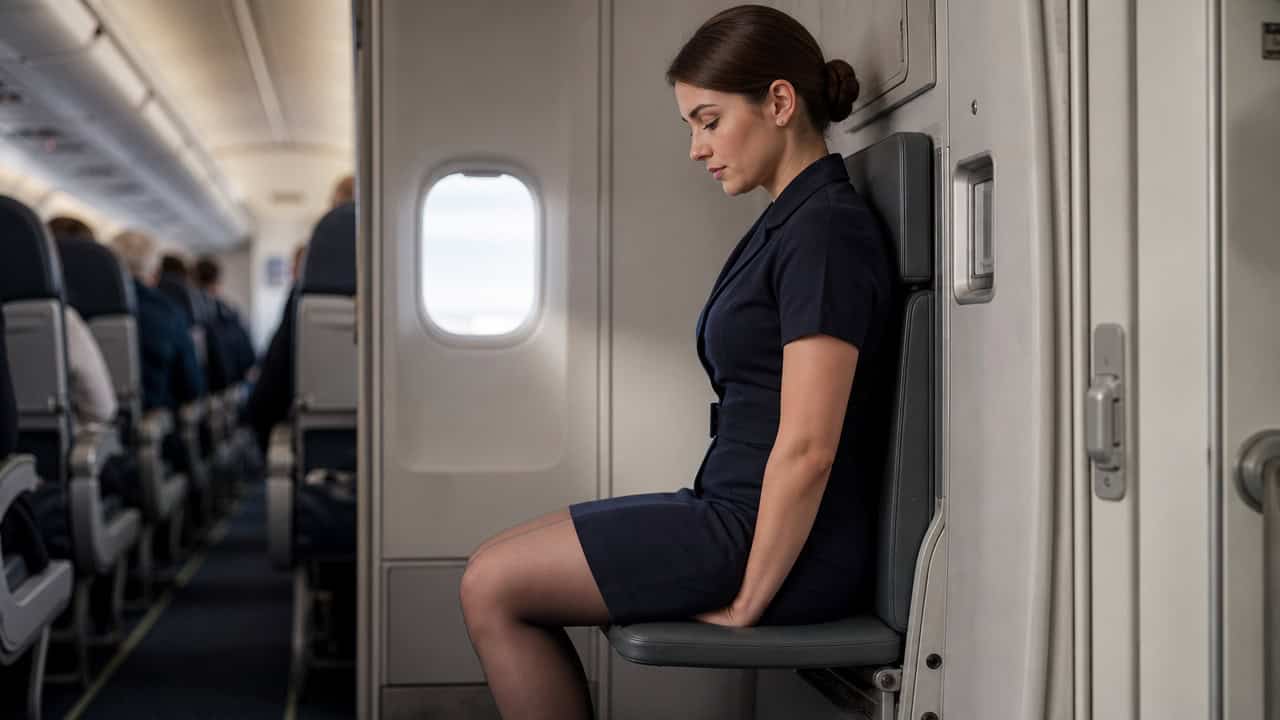
The seatbelt sign chimes off and the aircraft starts to roll toward the runway. Glance at the jump seat near the door and you will usually see the same thing: a flight attendant sitting bolt upright, hands tucked flat under their thighs, eyes fixed on nothing in particular.
It looks like the one moment of the flight when the crew finally gets to stop. It is closer to the opposite. The same crew who spent the last half hour managing boarding have switched into a completely different, silent mode of work.
For the roughly 30 seconds before and after every takeoff and landing, that flight attendant is quietly running a rehearsed emergency plan through their head, and the seated position itself is doing real work too. Here is what is actually happening, and why the hands matter as much as the checklist.
The Short Answer
Flight attendants sit on their hands during takeoff, landing, and taxi because those minutes are set aside for a required silent safety review, often called the “30 second review.” The seated, brace-ready position keeps them physically prepared if something goes wrong in the same instant.
It is not boredom, nerves, or a superstition. It is a scripted mental walk-through of the exact things a crew member would need to do in an emergency: which exits are usable, where the equipment is, who might need help, and the precise words they would shout.
At a glance
During taxi, takeoff, and landing, flight attendants sit in a brace ready position and silently rehearse their emergency duties: nearest exits, equipment locations, who might need assistance, and the exact commands to shout. It is required on every flight, not optional.
The Silent Review Every Flight Attendant Runs
Takeoff, landing, taxi, and anything below 10,000 feet other than cruise flight are officially defined as “critical phases of flight” under FAA regulation 14 CFR 121.542. It is the same regulation behind the sterile cockpit rule up front, which bans pilots from non-essential chatter during those exact minutes.
The rule dates to 1981, after accident investigators kept finding the same pattern: crews distracted by idle conversation missed warning signs during the busiest, least forgiving part of a flight. The fix was simple. Protect that window from anything that is not essential to flying or securing the aircraft.
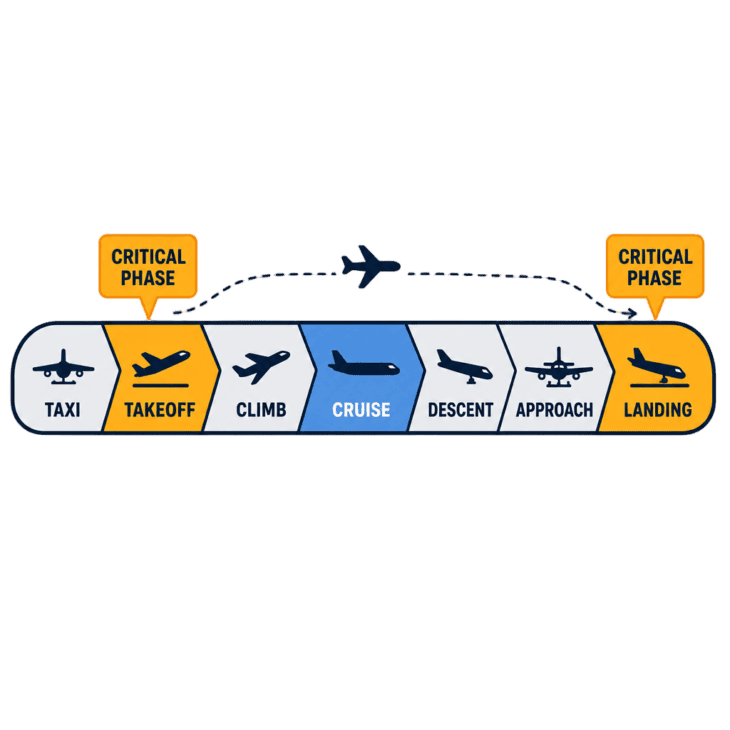
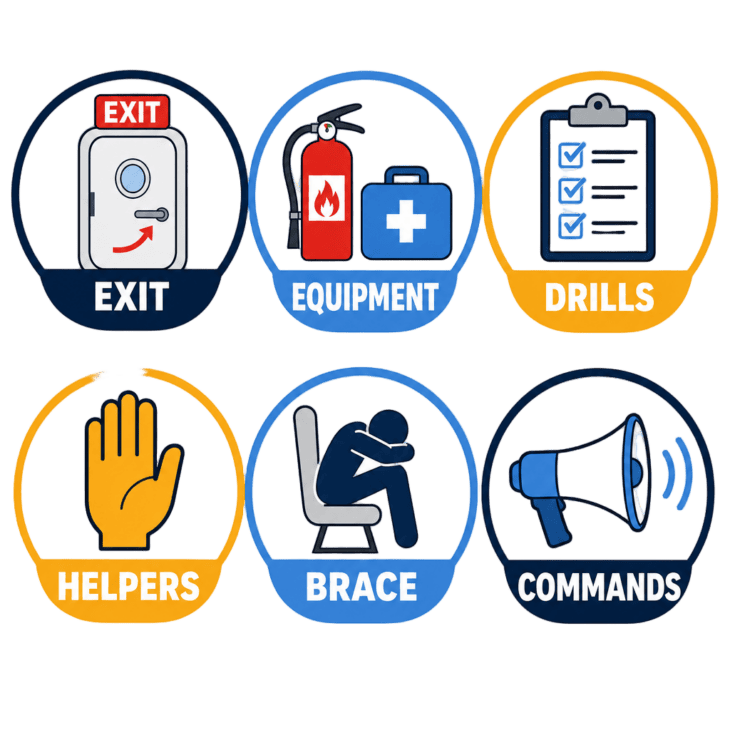
For cabin crew, that same window is when the silent review happens. Airlines each have their own name for it, commonly built around an acronym like OLDABC: operation of the exit, location of emergency equipment, drills, able-bodied passengers who could help, brace position, and commands.
Run silently, it takes about 30 seconds. A flight attendant mentally confirms which exit is theirs, whether it is usable if the aircraft has stopped somewhere unexpected, and pictures the exact phrase they would shout: “Brace, brace,” or “Release seatbelts, get out, leave everything.”
It happens on every single takeoff and landing, on every flight, whether the crew has flown that route a thousand times or once. The point is not to anticipate a specific problem. It is to make the response automatic if one ever shows up.
Why the Hands Specifically
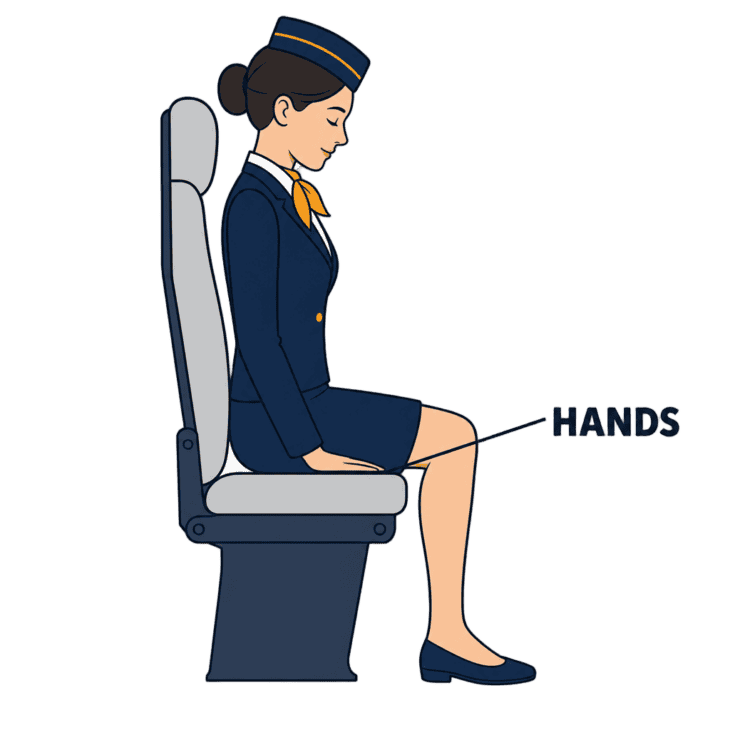
The posture is not incidental. Sitting upright, chin slightly down, spine against the seatback, and hands secured is a version of the brace position itself, so a crew member is already partly braced if a sudden deceleration or hard landing happens without warning.
Tucking the hands under the thighs also removes the instinct to reach for something. A free hand under stress tends to grab an armrest, a buckle, or a tray table, none of which helps, and some of which can cause an injury that leaves a crew member unable to assist anyone else.
There is also a discipline element. Physically committing to stillness makes it easier to resist checking a phone, chatting with a colleague, or getting up early, the same distractions the sterile cockpit rule is written to keep out of the flight deck at the same moment.
Why this window matters
Boeing’s own accident data for 2022 found takeoff and initial climb accounted for 21 percent of fatal accidents, and final approach and landing another 46 percent, a combined 67 percent, despite those phases making up only a few minutes of an average flight.
The Myth: They Are Just Resting
The common read on a quiet, hands-tucked flight attendant is that they are off duty for a moment, nervous, or simply out of tasks until the seatbelt sign goes off. It is an easy assumption, because from the outside, stillness looks like nothing is happening.
The myth
A flight attendant sitting quietly with hands out of sight looks like they are resting or waiting out the boring part of the flight. In reality they are working through a required, trained, and checked safety procedure.
Every flight attendant trains and is periodically checked on this exact routine, alongside the rest of the emergency procedures covered when becoming a flight attendant. It is not a suggestion crews pick up informally. It is drilled until it happens the same way under pressure.
Asiana Airlines Flight 214 showed why that readiness matters. When the Boeing 777 struck the seawall short of the runway in San Francisco in July 2013, the senior cabin crew member, a role also known as the flight purser, spotted fire outside a door and ordered an evacuation before the flight deck confirmed it was needed.
The NTSB’s investigation credited that crew’s fast, independent action with helping limit the loss of life in an accident that happened in exactly the window the silent review covers: on final approach, seconds from touchdown, with no time to consult anyone.
That is the real function of the 30 seconds. It is not decorative caution. It is a rehearsed skill, built flight after flight, so that if the critical phase ever goes wrong, the response does not have to be invented on the spot.
So next time the aircraft lines up for takeoff, look at the jump seat again. The stillness is not a pause in the job. For those 30 seconds, it is the job.
Sources and references used for research and fact-checking.
- Simple Flying, Take Off And Landing: The Importance Of Silent Review For Cabin Crew
- Cornell Law School Legal Information Institute (e-CFR), 14 CFR 121.542 - Flight crewmember duties
- SKYbrary Aviation Safety, Sterile Flight Deck
- Boeing, Statistical Summary of Commercial Jet Airplane Accidents
- National Transportation Safety Board, Accident Report AAR-14/01: Asiana Airlines Flight 214
Get the Newsletter
The latest aviation news and stories sent to your inbox.
About the Author

Tim is the owner and lead editor of AeroCorner since 2019, overseeing aviation content covering aircraft, airlines, airports, and the broader aviation industry. Through years of researching, writing, editing, and publishing aviation-focused content, he has developed extensive practical knowledge of commercial aviation and air travel. Based in Asia and a frequent traveler himself, Tim also brings firsthand passenger experience to AeroCorner’s coverage. Outside of publishing, he has also explored aviation firsthand through hands-on flight training in New Zealand.