

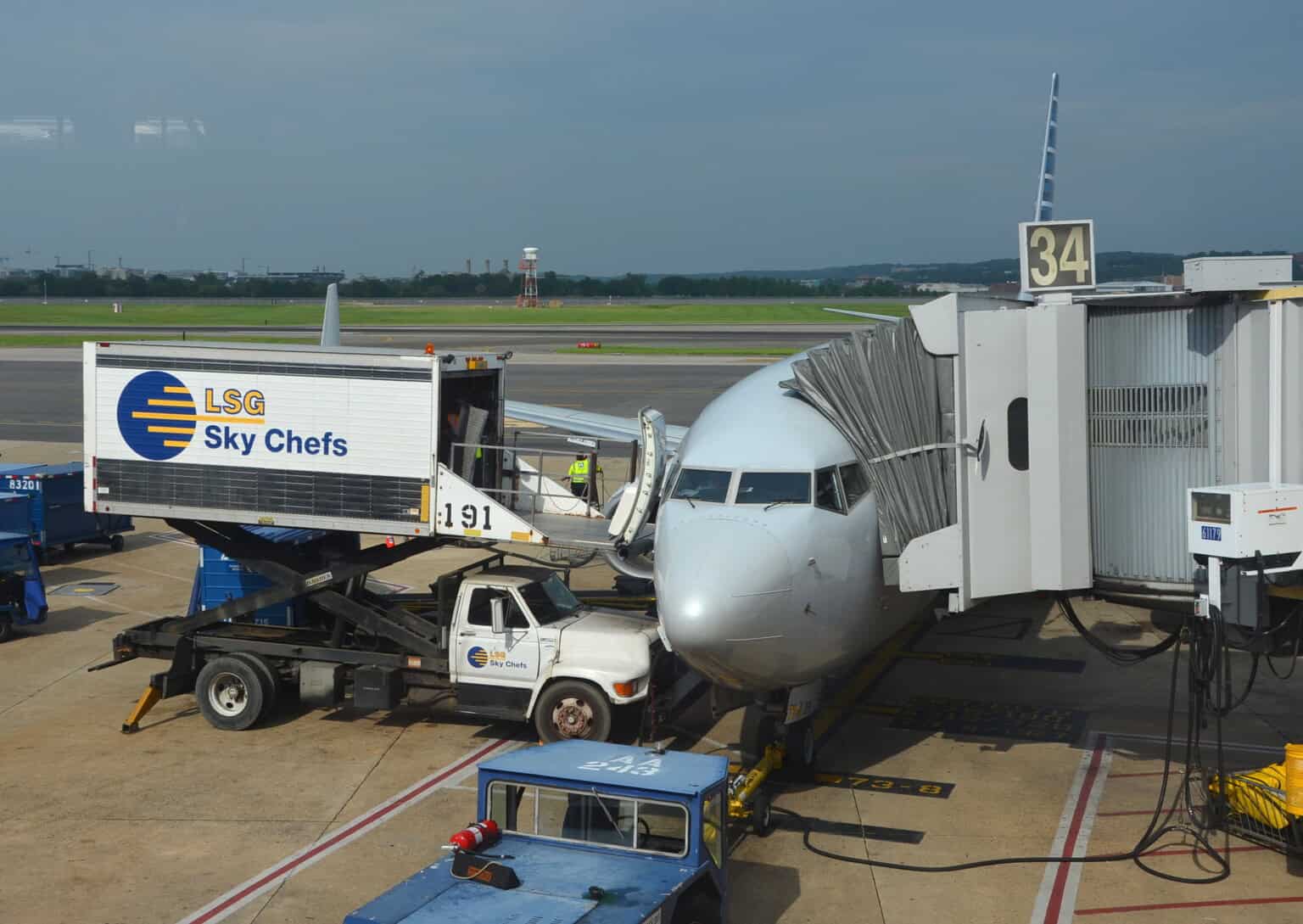
Table of Contents
A tray lands on your table about ninety minutes into the flight. It is warm, it is sealed, and it arrived from a galley the size of a closet with no stove in it.
Nothing on that tray was cooked on the aircraft. It was cooked in a windowless industrial kitchen near the airport, chilled hard, held cold for a day or more, driven across the ramp in a refrigerated truck, and lifted through a door in the side of the fuselage on a scissor lift.
Most people never think about that truck until it does something strange. In August 2026 it did: the Washington Post reported that President Trump had left Air Force One at Ankara in an airport catering truck, a story we covered as the Air Force One decoy flight.
The vehicle worked as cover for the same reason it works as a kitchen: it belongs on a ramp, it is opaque, and nobody looks at it. This is what it is actually doing the rest of the time.
How airplane food is made: cook, chill, wait, reheat
Airline catering runs on a process called cook-chill. Food is cooked to roughly ninety percent done in a large ground kitchen, dropped to refrigerator temperature as fast as possible, held cold through every step of its journey, and finished in the aircraft oven only once you are airborne.
Everything else about the system follows from that one decision. The menus, the trucks, the timing, the reason your chicken is slightly dry: all of it exists to move a cooked meal across a day and a city without letting it warm up.
The system in one sentence
An airline meal is cooked once on the ground, chilled to 41°F (5°C) or below within a couple of hours, kept in that cold state through assembly, storage and the drive to the aircraft, and then reheated exactly once in the galley. The aircraft has ovens, not a kitchen.
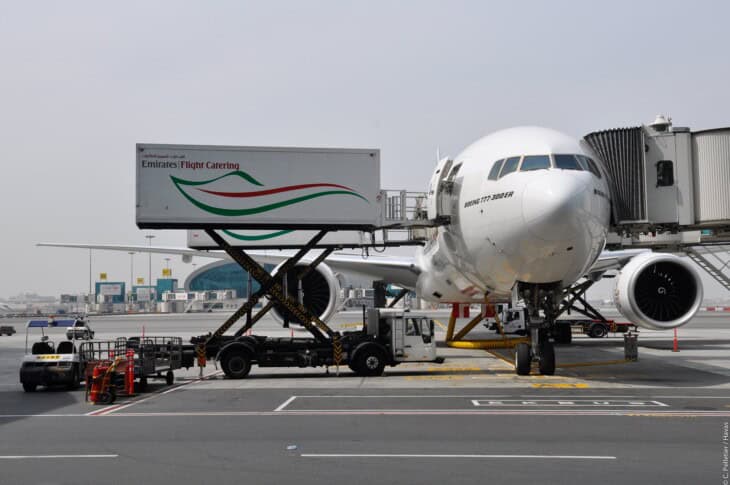
The flight kitchen no passenger ever sees
Most large airports have one or more catering units within a few minutes’ drive of the ramp. They are food factories, not restaurants, and the big ones are enormous.
Emirates Flight Catering at Dubai describes its site as the largest facility of its kind in the world, with a built-up area of more than 56,000 square meters and over 100 airline customers served from that single location. A kitchen at that scale is closer to an automotive plant than to a hotel banqueting operation.
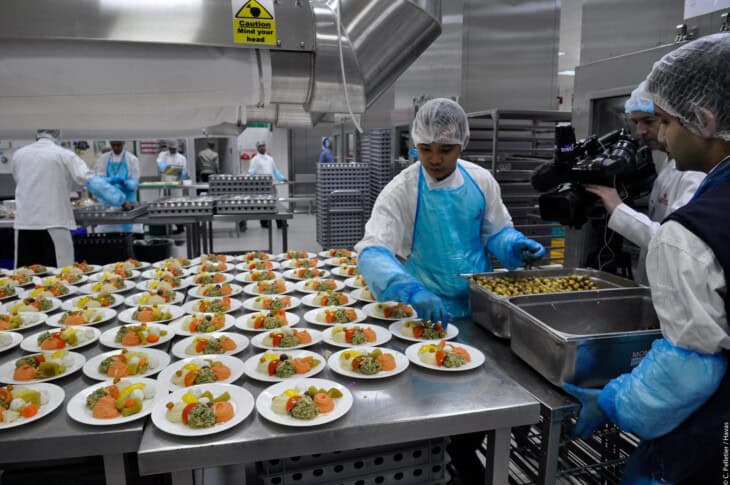
The critical step is the blast chiller. Cooked food has to get down to 41°F (5°C) or below quickly, and good operations aim to have it out of the hot zone and into cold storage inside about ninety minutes of leaving the stove.
From there the meal is assembled on a moving line. Trays are built component by component, sealed, and stacked into the aluminum carts you see crew wheeling down the aisle, each one labeled for a specific aircraft, a specific galley, and a specific cabin.
| Stage | What happens | Typical timing |
|---|---|---|
| Menu and load planning | The airline sets the menu; the caterer receives passenger counts and special-meal orders | Months out, finalized in the last 24 hours |
| Cooking | Hot dishes are cooked to roughly 90 percent done in the ground kitchen | 1 to 3 days before departure |
| Blast chilling | Food is driven down to 41°F (5°C) or below, ideally within about 90 minutes | Immediately after cooking |
| Tray assembly | Trays are built on a line, sealed, and loaded into labeled carts | 12 to 24 hours before departure |
| Delivery | A refrigerated high-loader truck brings the carts to the aircraft doors | 1 to 2 hours before departure |
| Reheat and serve | Galley convection or steam ovens finish the dish to a safe serving temperature | In flight |
The whole chain is run under HACCP, the hazard-analysis framework used across food manufacturing. In practice that means temperature is measured and logged at every handover, and anything that has drifted out of range for too long is thrown away rather than argued about.

The truck is the interesting part
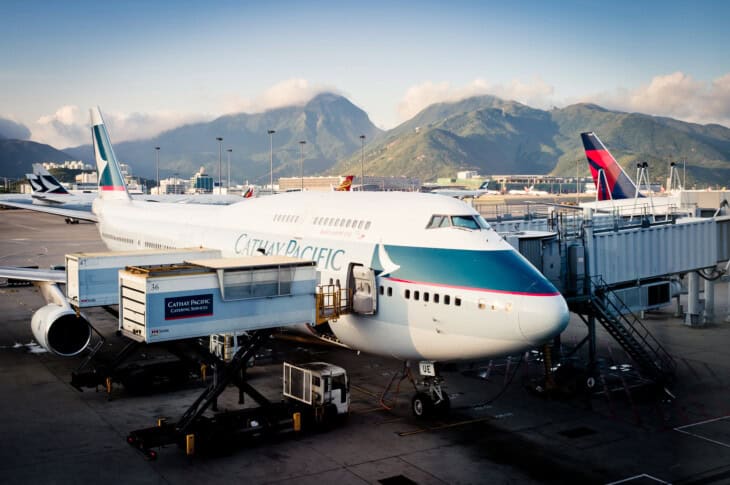
A catering high-loader is a truck with an insulated box body mounted on a scissor lift. The body rises bodily until its floor is level with a cabin door sill, a bridge plate extends across the gap, and the carts are rolled straight into the galley.
That is why the vehicle looks so odd on a ramp. It is not a delivery van with a ladder, it is a small room that goes up and down.
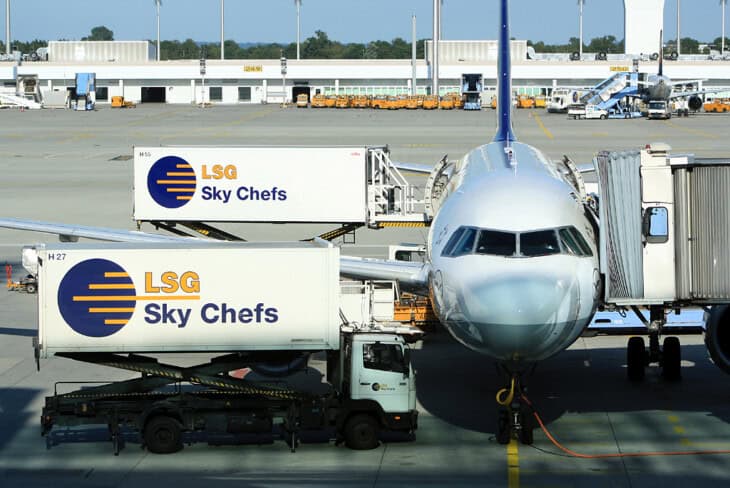
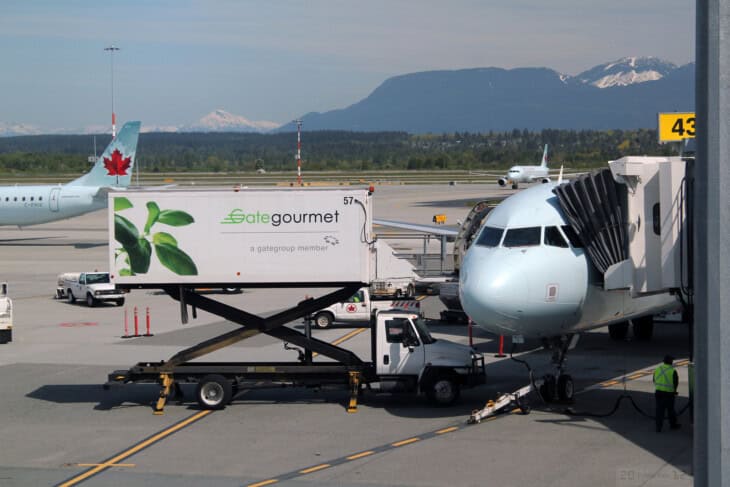
Loading usually happens through a door on the opposite side of the aircraft from the jet bridge, which is why it often runs at the same time as boarding. The catering slot is one of the parallel tasks squeezed into the 45-minute aircraft turnaround, alongside fueling, cleaning, and baggage.
Carts come off in a deliberate order. First-class and business carts go on first and go to the forward galleys; economy follows, distributed to the galleys that will serve each block of seats.
Sequencing matters because a cart in the wrong galley is not a minor annoyance at 35,000 feet. It cannot be swapped, and on a full aircraft it cannot easily be walked past a service cart already in the aisle, which is one of several reasons boarding takes as long as it does when catering is still working.
Why a catering truck made a good hiding place
The reason the Ankara story worked is the reason the equipment exists. A high-loader box is enclosed, it docks flush against a door on the far side of the aircraft, and it is such a routine sight during a turnaround that nobody on the ramp gives it a second look. It is the single least remarkable vehicle at any gate in the world.
Why the captain and first officer never eat the same thing
On February 3, 1975, a Japan Air Lines Boeing 747 flew from Anchorage toward Copenhagen carrying ham omelettes loaded at the Alaskan stop. The published epidemiological study counted 196 of 344 passengers struck down with staphylococcal food poisoning, most of them admitted to hospital on arrival.
The cause was traced to a single cook in the Anchorage kitchen with infected lesions on two fingers of his right hand, combined with meals that had sat far too long at temperatures far too warm before serving. It remains the most serious catering-borne outbreak in airline history.
One kitchen, 196 sick passengers
The 1975 Japan Air Lines outbreak is the event the modern cold chain is built against. Investigators found the omelettes had been held at room temperature for hours, then refrigerated at only 50°F (10°C), which is warm enough for staphylococcus to keep producing toxin. Every temperature log in a flight kitchen today traces back to that flight.
The lasting operational legacy is in the cockpit. After 1975, airlines widely adopted the practice of serving the two pilots different meals, ideally prepared in different batches, so that one bad dish cannot incapacitate both people who can land the aircraft.
It is worth being precise about this, because it is usually reported wrongly. There is no FAA regulation requiring split crew meals. It is airline policy and standard operating procedure at most carriers, which is a different thing from federal law, and a handful of operators do not do it at all.
Many crews go further and eat at staggered times rather than together, so that if a meal is going to cause symptoms, they appear in one pilot while the other is still untouched. That buys the time to divert.
The meal you did not eat is a biosecurity problem
Here is the part almost nobody knows. When an international flight lands in the United States, the leftover food on board is not ordinary trash.
Under USDA rules it is classed as regulated garbage, because meat and plant material arriving from abroad can carry animal and plant diseases. It has to be removed under supervision, moved sealed, and incinerated or sterilized rather than sent to landfill.
That applies to the untouched sealed roll and the unopened cheese as much as to genuine scraps. IATA has spent years arguing that the rules are broader than the biosecurity risk justifies, and a limited program now allows some clean aluminum, paper, and plastic to be pulled out for recycling instead.
It is also why airlines are cautious about over-catering. A meal that flies out and comes back is not just a wasted meal, it is a fuel burn and a disposal fee.
The myth: it is microwaved slop
The standard complaint is that airline meals are microwaved. They are not, and the real answer is less flattering to the food than the myth is.
The myth
“Airplane food is bad because they microwave it.” Aircraft galleys generally use convection or steam ovens, not microwaves. The problem is not the reheating method, it is that the dish was designed to survive being cooked, chilled, stored for a day and reheated once, and every recipe decision serves that constraint before it serves flavour.
Menu development is built around what survives the chain. Sauces are engineered not to split on reheating, proteins are chosen for their tolerance of a second heating, and anything crisp is a lost cause before it leaves the kitchen.
Cost sets the ceiling. Industry estimates commonly put an economy meal at somewhere around ten to fifteen dollars to produce and a long-haul premium-cabin meal at well over a hundred, which is most of the reason the two experiences feel like different industries.
And then there is your own body, which is the other half of the story. Cabin pressure, dryness, and noise measurably blunt your perception of salt and sweetness, which is a separate question we answer in full in why airplane food tastes so bad.
Special meals are the one part of the system a passenger controls. The IATA codes on your booking, VGML for vegan, AVML for Asian vegetarian, KSML for kosher and around thirty others, are ordered as individually labeled trays, which is why most airlines close requests roughly 24 hours before departure and why a late request usually cannot be honored.
That deadline is not the airline being unhelpful. By then your specific tray has already been cooked, chilled, labeled, and assigned to a cart.
So the next time a tray arrives at your seat, the interesting question is not what is on it. It is that the food was cooked a day or two ago in a factory a few miles away, and has been held within a few degrees of one temperature ever since.
It reached you through a door you never saw, on a truck built to become a room.
It is a genuinely impressive logistics achievement wrapped around a slightly disappointing chicken.
Sources and references used for research and fact-checking.
- The Lancet (via PubMed), Staphylococcal food poisoning aboard a commercial aircraft
- Emirates Flight Catering, Company Information: Emirates Flight Catering
- Global Food Safety Resource, Gate Gourmet Ensures Quality Airline Catering
- Airways Magazine, Explained: The Secret World of Airline Catering
- IATA, International Catering Waste: A Case for Smarter Regulation
- U.S. Customs and Border Protection, CBP, USDA Partner With IATA for First International Airline Recycling Program
Get the Newsletter
The latest aviation news and stories sent to your inbox.
About the Author

Tim is the owner and lead editor of AeroCorner since 2019, overseeing aviation content covering aircraft, airlines, airports, and the broader aviation industry. Through years of researching, writing, editing, and publishing aviation-focused content, he has developed extensive practical knowledge of commercial aviation and air travel. Based in Asia and a frequent traveler himself, Tim also brings firsthand passenger experience to AeroCorner’s coverage. Outside of publishing, he has also explored aviation firsthand through hands-on flight training in New Zealand.