

Table of Contents
He was never caught. Five men who copied him within seven months all were, and a year to the day after his jump, the FAA signed a rule to make sure nobody could leave an airliner his way again.
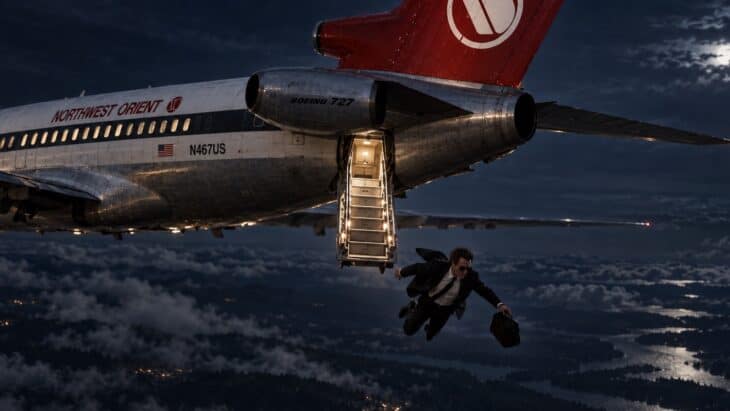
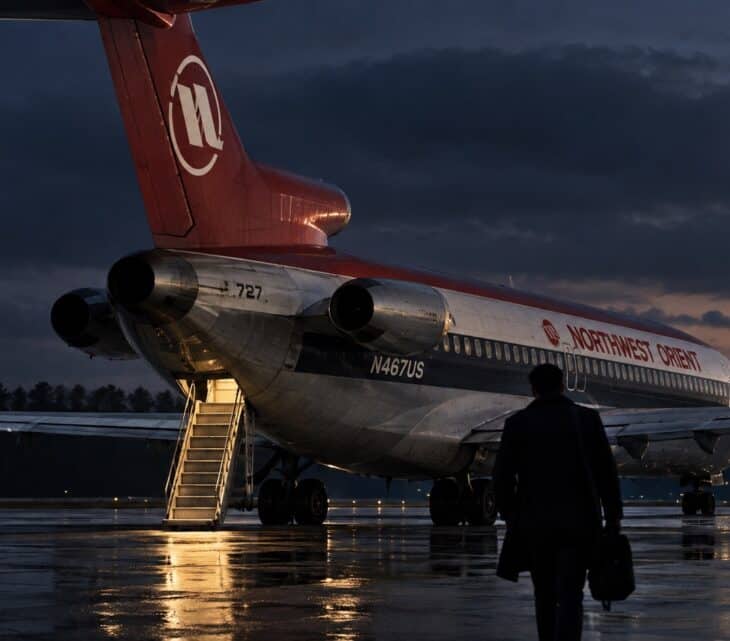
On November 24, 1971, a man who bought his ticket as Dan Cooper hijacked Northwest Orient Flight 305 and parachuted from the rear airstair of a Boeing 727 somewhere over southwest Washington with $200,000 in ransom.
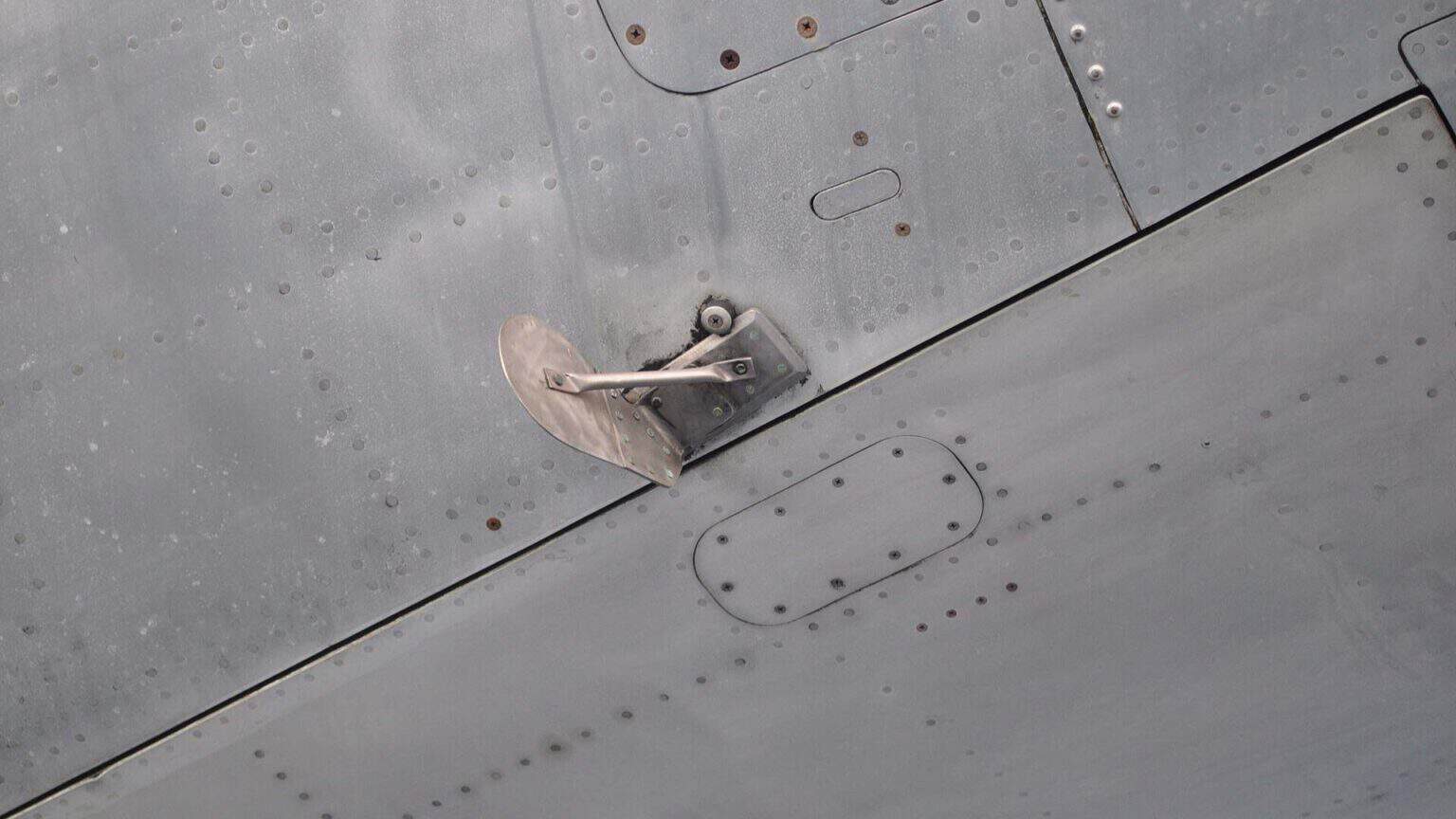
The answer to the next hijacker was a spring-loaded metal paddle bolted beside the stair. The industry named it the Cooper vane, and it exists because the 727 had a door that could be opened in flight.
The 727 Had an Exit Nobody Imagined Using in the Air
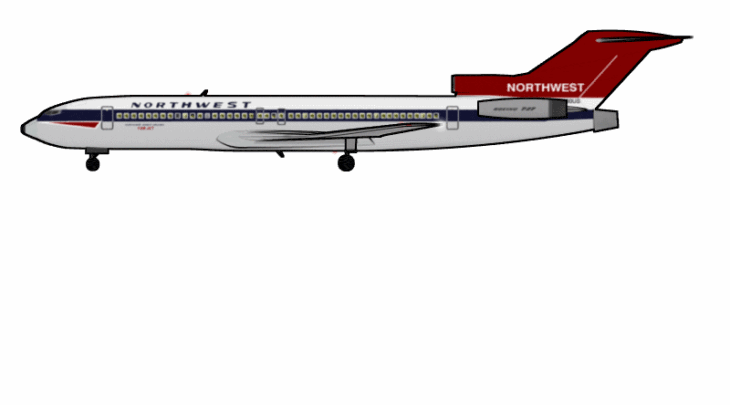
The 727 was built to serve small airports without much ground equipment. So it carried its own staircase, a ventral airstair that lowers from the underside of the fuselage, beneath the three tail-mounted engines.
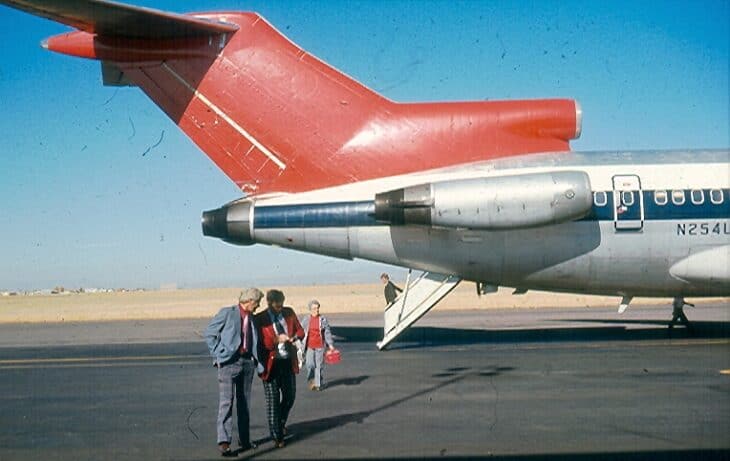
Rear-engined jets of the era shared the idea. The McDonnell Douglas DC-9, the BAC One-Eleven and the Caravelle all had stairs or ramps that dropped from the rear of the fuselage.
Cooper understood what that meant. Once the passengers were released in Seattle, he ordered the crew to fly toward Mexico City, with a refueling stop in Reno, and to keep the landing gear down, the flaps at 15 degrees, the cabin unpressurized and the aircraft no higher than 10,000 feet.
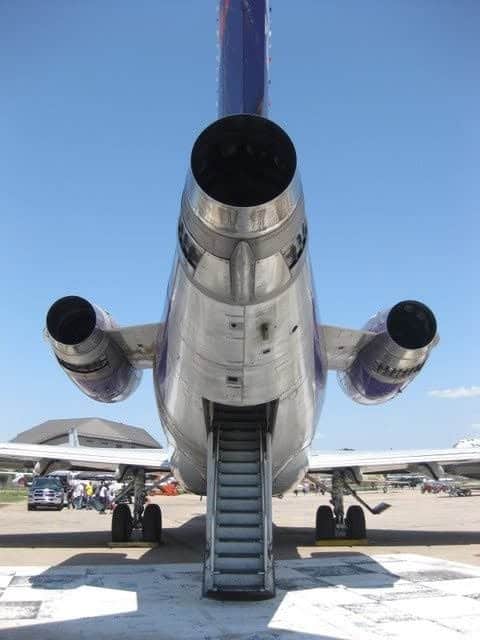
He wanted the airspeed kept near 100 knots, about as slow as the jet could fly without stalling. He also demanded the aft exit open and the stair extended. At around 8:13 p.m. the crew felt the tail pitch, a sign the stair had dropped under a weight.
Nobody on board saw him go. The jet landed in Reno with the stair still down and the cabin empty behind the cockpit.
Five Copycats in Seven Months, and Every One Was Caught
The trick spread fast. Richard LaPoint jumped from a Hughes Airwest DC-9 over the Colorado plains on January 20, 1972, with $50,000. He was picked up within hours and sentenced to 40 years.

On April 7, Richard McCoy Jr. took United Flight 855, a 727, demanded $500,000 and four parachutes, and jumped over Utah. He was arrested two days later.
On May 5, Frederick Hahneman hijacked Eastern Air Lines Flight 175, another 727, out of Allentown, Pennsylvania, for $303,000. He opened the rear stairs over Honduras, his country of birth, and surrendered at the U.S. Embassy in Tegucigalpa on June 2.
Robb Heady jumped from United Flight 239 near Reno on June 2 and was soon captured. On June 23, Martin McNally jumped from an American Airlines 727 over Indiana with $500,000 and lost the money on the way out.
That makes five parachute escapes from airliners in the first half of 1972, and more hijackers who demanded parachutes but never jumped. The pattern was obvious: the ransom was the goal, and the rear exit was the getaway.
The FAA Signed the Fix One Year to the Day Later
The FAA issued its proposal, Notice 72-15, on June 20, 1972. Three days later, McNally was out over Indiana.
The final rule, Amendments 25-34 and 121-99, was signed in Washington by FAA Administrator John H. Shaffer on November 24, 1972, exactly one year after Cooper’s jump. It ran in the Federal Register on November 30 under the heading “Rear Exit Security.”
The requirement was blunt. On every large passenger-carrying turbojet flown by U.S. airlines, each ventral exit and tailcone exit had to be designed so it could not be opened during flight, with a placard next to the handle saying so.
“The purpose of these amendments is to make it clear that any attempt to hijack a large passenger-carrying turbojet-powered airplane and escape therefrom by parachute will be a futile effort.”
Federal Aviation Administration, November 24, 1972
The rule took effect on December 31, 1972. Airlines had until August 28, 1973, to modify their fleets, an 8-month window the FAA widened from the 6 months it first proposed.
One commenter argued the rule was pointless and airlines should simply refuse every ransom. The FAA rejected that, writing that “every possible step must be taken” to deter people from boarding aircraft to hijack them and escape by parachute.
How a Paddle Beats a Hijacker
The rule said what the exit had to do, not how. On the 727 and on DC-9s with ventral stairs, the answer was the Cooper vane.
It is a small paddle on a spring, connected to a plate beside the stairway. On the ground the spring holds the paddle square to the fuselage, and the plate stays clear so the stair works normally.
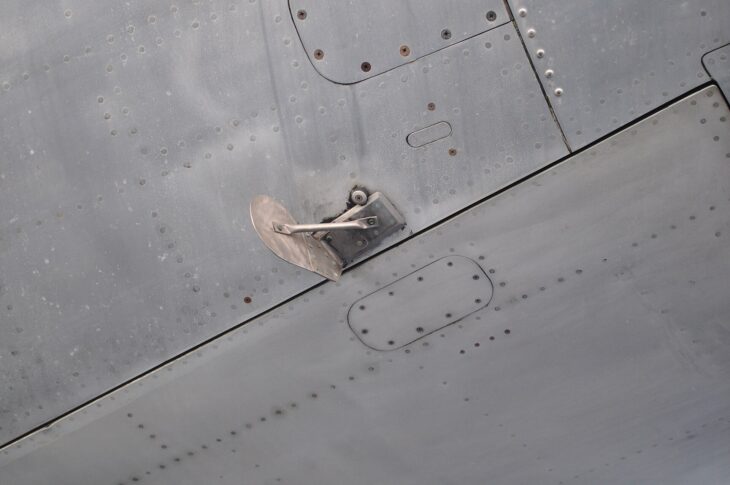
Once the jet is moving fast enough, the airflow presses the paddle flat against the fuselage. That swings the plate underneath the stair and blocks it from lowering. After landing, the spring pulls the paddle back and the stair is free again.
There is no switch for a crew member to forget, and no lock a hijacker can order the pilots to release. The air itself holds the door shut, which is exactly why it worked.
Why a Hardware Fix Mattered More Than a Manhunt
Every copycat was caught, and still they kept coming, because each one believed he would be the one who got away. Arrests were not stopping them, so the FAA took away the exit.
The rear-exit rule was one layer of a wider response. After the Southern Airways Flight 49 hijacking in November 1972, U.S. airline passengers had to be physically screened starting January 5, 1973, the beginning of the checkpoint every traveler knows today.
The pattern of a single attack rewriting aircraft design repeated three decades later. After September 11, the fix was a hardened flight deck, a story told in how United 93 led to 6,000 new cockpit doors.
In both cases, regulators stopped trying to predict the next attacker and changed the airplane instead.
The Rule Is Still There. So Is the Mystery.
The requirement from 1972 still sits in federal aviation law, as 14 CFR 121.310(k) for U.S. airlines and 14 CFR 25.809 for how transport jets are designed. Any airliner with a belly or tailcone exit has to keep it shut in flight.
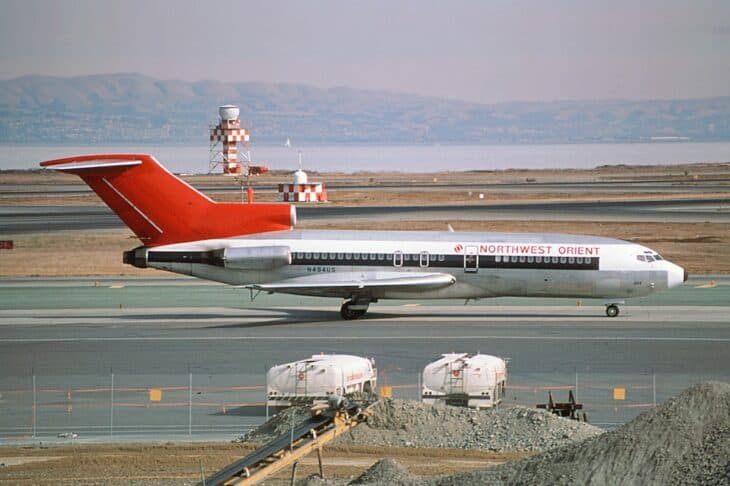
The 727 itself has almost gone. Boeing built 1,832 of them between 1962 and 1984, and as of January 2026 only a handful were still flying commercially, mostly cargo and charter work in Kenya, the United States, Uruguay and Venezuela.
Cooper’s trail went cold in the rain. The only confirmed trace of the ransom was found in February 1980, when 8-year-old Brian Ingram dug up 290 decaying $20 bills, $5,800 in all, at Tena Bar on the Columbia River, about 9 miles (14 km) downstream from Vancouver, Washington.
The FBI suspended its active investigation on July 8, 2016, after 45 years and a 66-volume case file. File releases in 2026 are still turning up suspects the Bureau once checked and ruled out.
Nobody knows whether Cooper survived the jump, or who he was. The only piece of him still flying is a spring-loaded paddle beside a 727’s back stairs.
Sources and references used for research and fact-checking.
- Federal Register, Vol. 37, No. 231, November 30, 1972, Rear Exit Security: Large Passenger-Carrying Turbojet Powered Airplanes (Docket 12006, Amdts. 25-34 and 121-99)
- U.S. Department of Transportation, National Transportation Library, Part 121: Amendment 121-99
- Legal Information Institute, Cornell Law School, 14 CFR 121.310, Additional emergency equipment
- Legal Information Institute, Cornell Law School, 14 CFR 25.809, Emergency exit arrangement
- Wikipedia, D. B. Cooper
- Wikipedia, D. B. Cooper copycat hijackings
- Wikipedia, Cooper vane
- Wikipedia, Airstair
- Wikipedia, Boeing 727
- Fox 56, Frederick Hahneman and the 1972 Eastern Air Lines hijacking
- Wikipedia, Southern Airways Flight 49
- AeroTime, How one elusive man changed aircraft design: The D.B. Cooper story
- Newsweek, Who was DB Cooper? FBI update on mystery 1971 plane hijacker
Get the Newsletter
The latest aviation news and stories sent to your inbox.
About the Author

Tim is the owner and lead editor of AeroCorner since 2019, overseeing aviation content covering aircraft, airlines, airports, and the broader aviation industry. Through years of researching, writing, editing, and publishing aviation-focused content, he has developed extensive practical knowledge of commercial aviation and air travel. Based in Asia and a frequent traveler himself, Tim also brings firsthand passenger experience to AeroCorner’s coverage. Outside of publishing, he has also explored aviation firsthand through hands-on flight training in New Zealand.