

Table of Contents
Every time the Antonov An-225 Mriya comes up, someone offers the same consolation: there is a second one, it is most of the way built, and Ukraine is going to finish it. Almost every part of that sentence is doing more work than the evidence supports.
A second An-225 airframe is real. Construction began in 1989 and stopped in 1994, and it has never been finished. The widely repeated claim that it is 70 percent complete came from a German newspaper, and Antonov itself publicly corrected it.
The company’s own progress figure is from late 2022 and has not been updated since. Work was paused in 2024 until the war ends. And in April 2025, the airfield where the airframe sits was hit by a Russian drone strike that started a fire large enough to register on NASA satellites.
The Second Mriya Was Built for a Spacecraft That Flew Once
The An-225 was not designed to be a freighter. It was an enlarged derivative of the An-124 Ruslan, stretched and given two extra engines so it could carry the Buran orbiter on its back, the Soviet answer to the Space Shuttle.
The timing was cruel. Buran made its only spaceflight, uncrewed, on 15 November 1988, five weeks before the An-225 made its own maiden flight on 21 December. Boris Yeltsin canceled the Buran program in 1993.
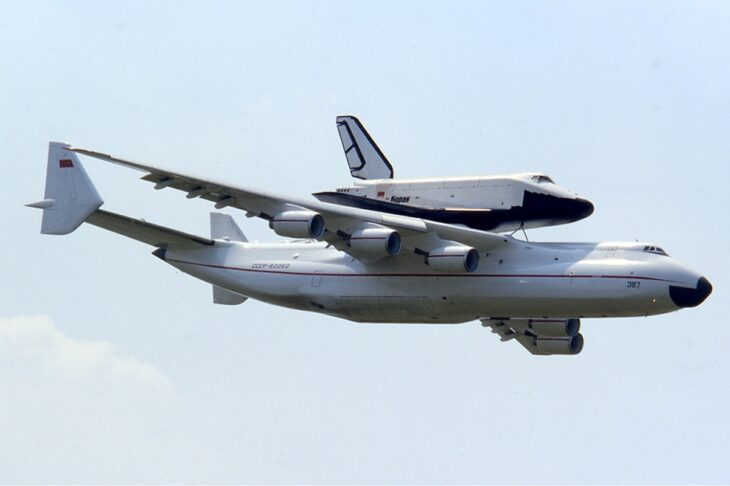
A second airframe was laid down in 1989 to the same purpose. Work halted in 1994, three years after the Soviet Union that ordered it had ceased to exist, and the reason was the obvious one: there was no longer a spacecraft to carry and no longer a budget to build the carrier.
It was not quite abandoned. In September 2006, with demand for outsize airlift climbing, Antonov decided to complete it. By August 2009 it was reported that no completion had happened and the work had been abandoned again.
That is the pattern the second Mriya has followed since 1994. It is announced, it is costed, and then nothing is built. The airframe stayed where it was made, at the Antonov Serial Production Plant at Sviatoshyn Airfield on the northwestern edge of Kyiv, not at the Hostomel field where the finished aircraft lived.
“70 Percent Complete” and “30 Percent” Are Not Measuring the Same Thing
The 70 percent figure is the one that travels, and it is not nothing. Wikipedia and several aviation outlets put the second airframe at 60 to 70 percent complete, dated variously to 2009 and 2016, and attributed to “different sources.”
What that figure describes is structure. Fuselage sections, wings, tail and landing gear were fabricated in the late 1980s and early 1990s. A partially assembled airframe is a genuine head start on building an aircraft.
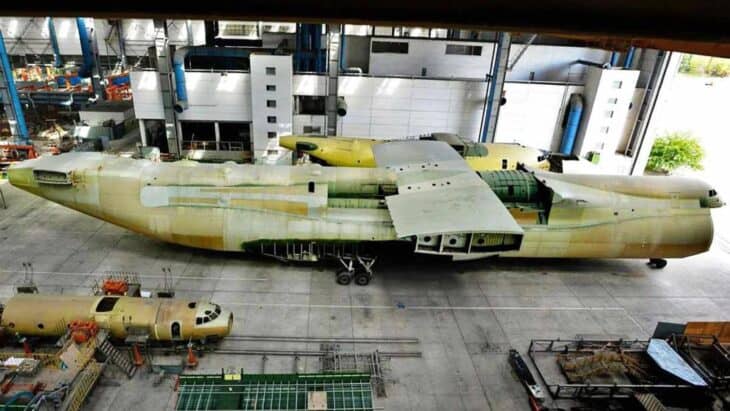
It is not the same thing as a flyable aircraft being most of the way done. When the German newspaper Bild reported the aircraft as about 70 percent complete in 2022, Antonov pushed back on the framing directly.
Antonov general director Yevhen Havrylov gave a different number at Leipzig/Halle Airport in late 2022: by expert estimate, he said, about 30 percent of components could be used for the second aircraft.
Confusingly, the same executive’s 30 percent was reported a second way. In November 2022, Air Data News quoted Havrylov saying assembly had “already reached 30% of the planned work,” at an undisclosed facility, using parts from the unfinished airframe, salvage from the destroyed aircraft, and new manufacture.
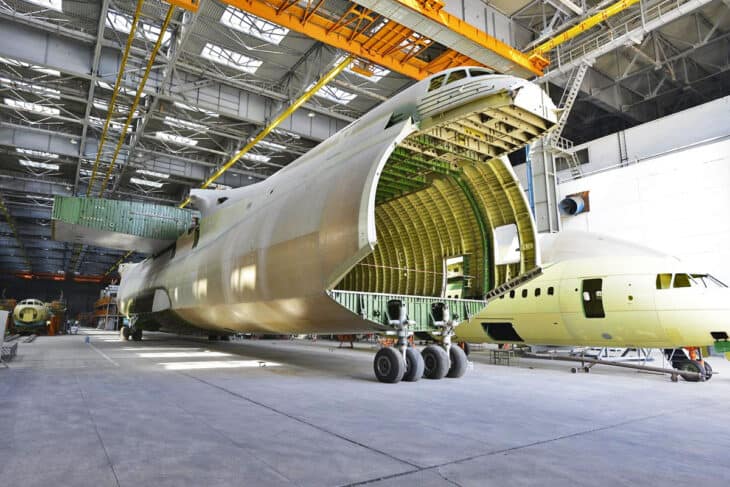
Those are two very different claims. Thirty percent of parts being reusable is a statement about a parts inventory; 30 percent of the work being done is a statement about progress. Both have been cited as Antonov’s position, and neither has been updated in nearly four years.
The money has moved the same way. Ukraine’s state defense conglomerate Ukroboronprom initially put restoration above $3 billion and more than five years. By November 2022, Antonov’s own estimate was roughly $500 million, and later reporting put the figure in excess of 500 million euros.
What the finished aircraft could actually do
The An-225 held the record for the heaviest single item ever carried by air: a generator weighing 418,834 pounds (189,980 kg). Its record total payload was 559,600 pounds (253.8 tonnes). It spread that load across six engines and 32 wheels, with a wingspan of 290 feet (88.4 m). Only one was ever completed.
Then the Airfield Caught Fire
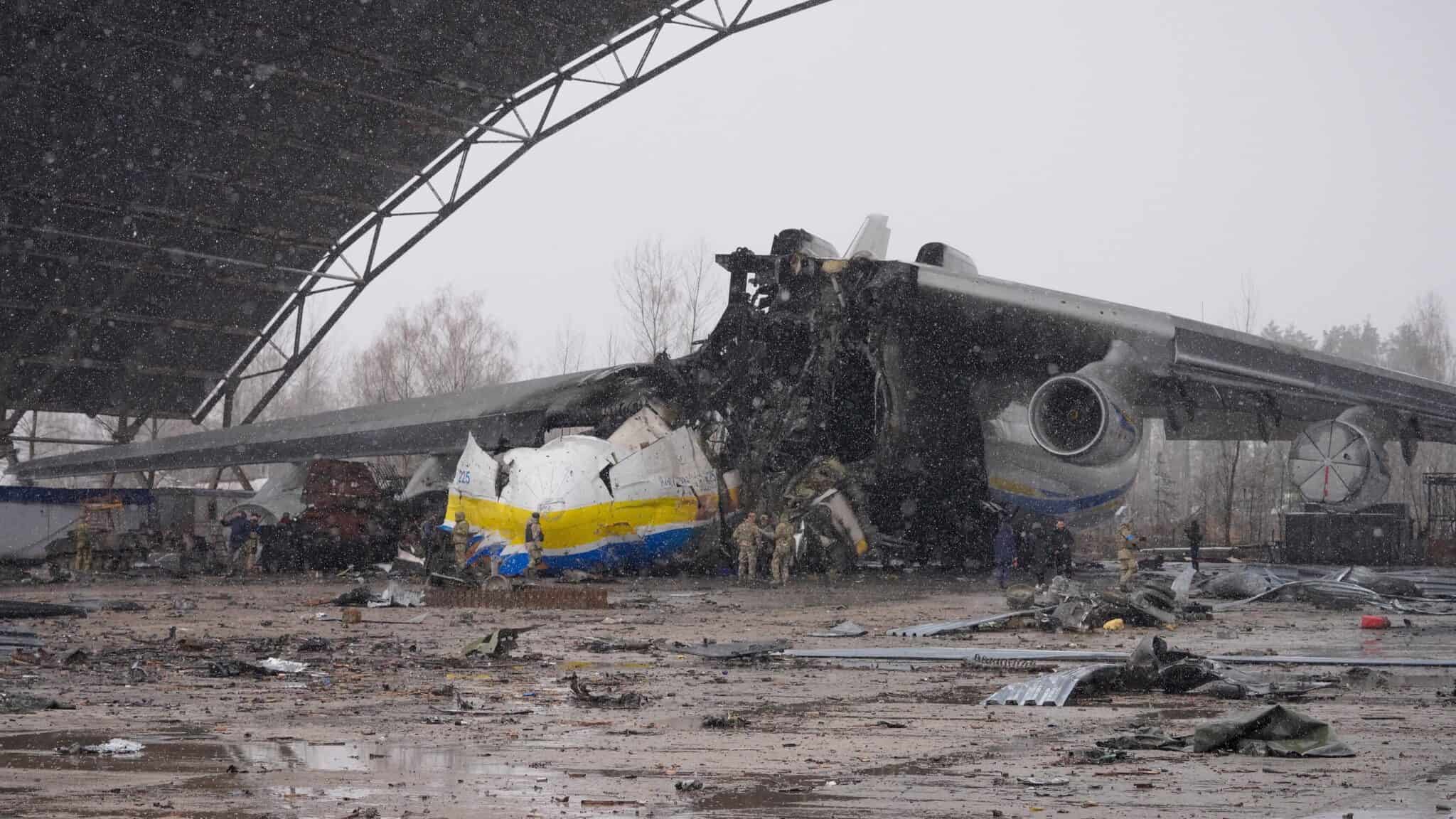
The completed An-225 was destroyed at Hostomel on 27 February 2022, during the battle for the airport in the opening days of the invasion. It had flown its last commercial service on 5 February and was undergoing an engine change when Russian forces reached the field.
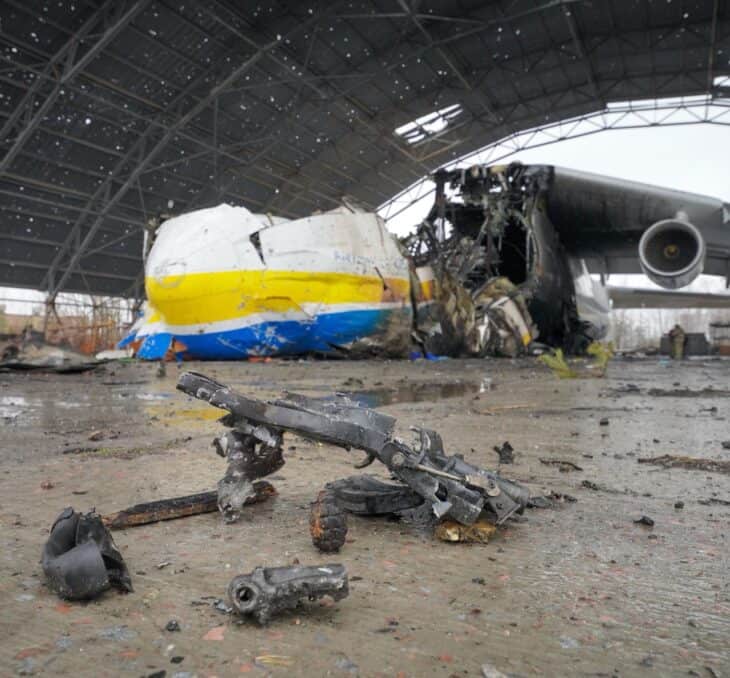
The second airframe survived that year. After Russian forces withdrew from northern Ukraine in spring 2022, it was reported intact, despite artillery strikes on the hangar complex housing it at Sviatoshyn.
Then the project went quiet. By September 2024, Ukrainska Pravda reported that Antonov had paused further work until the end of hostilities.
On the night of 11 to 12 April 2025, Russian long-range drones struck Sviatoshyn Airfield, where Antonov’s plant also produces An-196 strike drones. The largest hangar of the Antonov Serial Production Plant was the reported target, and NASA satellite fire data recorded extensive burning across the site.
Several outlets then reported that the unfinished An-225 was destroyed in that fire, reasoning from its known position at the struck hangar. Every one of those reports is hedged, and they trace back to satellite imagery and a single Polish military site rather than to anyone with access to the building.
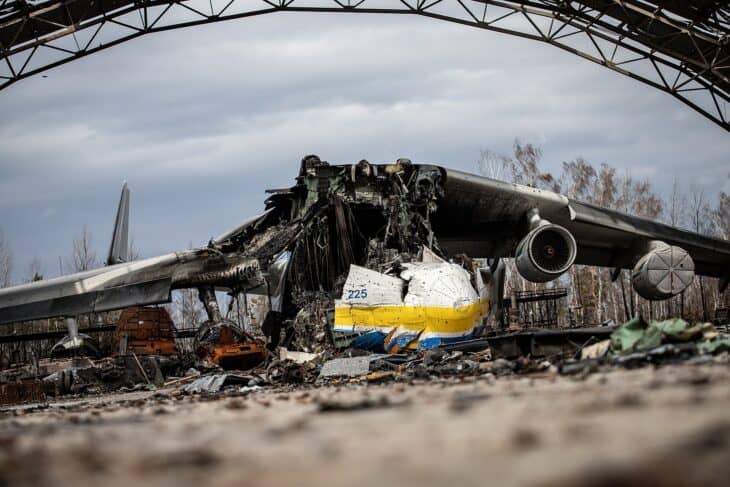
Nobody has confirmed it. Antonov has not said the airframe was destroyed, and it has not said the airframe survived. Ukraine’s government has not addressed it, and Wikipedia’s An-225 article still does not carry the claim at all.
On 27 February 2026, on the fourth anniversary of the destruction, Aerospace Global News reported that Antonov had provided no substantive update in the previous year. That silence is the most recent fact in this story.
What Actually Hauls Outsize Cargo Now
The practical answer is the aircraft the An-225 was built from. The An-124 carries up to about 330,000 pounds (150 tonnes) internally, which is less than the Mriya but more than anything Boeing or Airbus builds, and it is the airframe the heavy-lift charter market actually runs on.

There are not many of them, and politics has cut the available fleet roughly in half. As of late 2020 the three civil operators were Antonov Airlines with seven aircraft, Russia’s Volga-Dnepr with twelve, and Maximus Air Cargo with one.
Sanctions took the Russian half off the Western market. One Volga-Dnepr An-124 has been stuck at Toronto Pearson since 2022, and in 2026 Canada’s Federal Court refused to release it.
Antonov Airlines itself no longer flies from Ukraine. It relocated to Leipzig/Halle in Germany in 2022 and operates its seven An-124s from there, which is why Havrylov was in Leipzig when he gave the 30 percent figure.

That relocation has not made the fleet safe. In August 2026, an explosive-rigged drone was found near a Ukrainian cargo aircraft at a German airport, shutting the airport down.
Which leaves the second Mriya where it has been since 1994: unfinished, unfunded, and now unaccounted for. The honest status is not “Ukraine is rebuilding the world’s largest plane.” It is that a partially built airframe sat in a hangar for three decades, a war reached the hangar, and the company that owns it has stopped saying anything at all.
Sources and references used for research and fact-checking.
- Wikipedia, Antonov An-225 Mriya
- The Aviationist, Here's What We Know About The Second An-225 Antonov Wants To Build
- Air Data News, Antonov reveals production of a second An-225 Mriya in secret location
- Aerospace Global News, 4 years after its destruction, will the Antonov An-225 Mriya ever fly again?
- FlyMag, Unfinished Second An-225 'Mriya' Prototype Reportedly Destroyed in Kyiv Airfield Strike
- Defence Industry Europe, Russian drone strike targets Antonov airfield in Kyiv used for long-range UAV production
- Wikipedia, Antonov An-124 Ruslan
- Wikipedia, Antonov Airlines
Get the Newsletter
The latest aviation news and stories sent to your inbox.
About the Author

Tim is the owner and lead editor of AeroCorner since 2019, overseeing aviation content covering aircraft, airlines, airports, and the broader aviation industry. Through years of researching, writing, editing, and publishing aviation-focused content, he has developed extensive practical knowledge of commercial aviation and air travel. Based in Asia and a frequent traveler himself, Tim also brings firsthand passenger experience to AeroCorner’s coverage. Outside of publishing, he has also explored aviation firsthand through hands-on flight training in New Zealand.