Heavy Business Jets
Airbus A340 Private Jet
ICAO: A343
The next-generation corporate jet with airliner scale and global reach

The latest aviation news and stories sent to your inbox.
The Airbus ACJ320neo takes the proven A320neo platform and adapts it for the world of ultra-large business aviation. With new-generation engines, improved aerodynamics, and extended range, it offers intercontinental capability and a spacious cabin tailored for heads of state, corporations, and private owners.


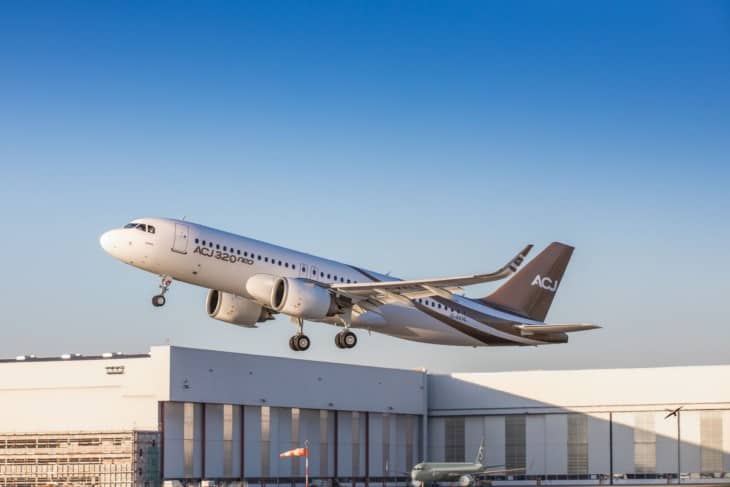
The ACJ320neo is a corporate derivative of the A320neo family developed to provide airline-scale cabins for heads of state, corporations, and private operators. The type evolved from Airbus efforts in the 2010s to offer longer range and lower operating cost than previous corporate jets, and it entered service with civil and government operators later in the same decade. The program adapted airliner production standards to the corporate market while retaining commonality with the A320neo line.
Design retains the A320neo airframe with modifications for auxiliary fuel and cabin outfitting. It is offered with Pratt & Whitney PW1100G or CFM International LEAP-1A high-bypass turbofan engines and carries fuel and systems that extend range well beyond the standard single-aisle layout. Cruise performance and maximum takeoff weight are consistent with the A320neo transport category, and cabin arrangements are highly customized to carry small groups with significant range and comfort rather than airline-style seating density.
In service the ACJ320neo has been used for government transport and by corporate operators seeking intercontinental capability in a single-aisle platform. Its legacy lies in bringing airliner-scale cabin volume and range to the business aviation market while maintaining commonality with a large commercial family, influencing further corporate conversions of airliner types.
Airbus pursued a corporate-jet offering to address demand for large-cabin, long-range executive transports that maintain airliner-level reliability. Market analysis identified requirements for bespoke interiors, extended on-board autonomy, and discreet military and government transport options. Airbus engaged completion specialists early to align factory delivery with post-delivery outfitting workflows.
The program structured factory-to-completion logistics so airframes could be transferred directly to independent completion centers or outfitted through Airbus’ own services. This approach reduced non-revenue ferry flights and allowed simultaneous production and customization planning. Certification of completed interiors followed supplemental type approval processes adapted for large, bespoke cabins.
Early demonstrator activities focused on validating large-format VIP systems such as advanced cabin management, auxiliary fuel installations, and enhanced environmental control packages. Test activity also covered weight and balance effects from heavy furnishings and partitioning. The development phase emphasized modularity in cabin systems to shorten completion lead times for diverse customer requirements.
Cabin architecture emphasizes flexibility, supporting formal conference areas, private suites, and multiple service zones within the single-aisle fuselage. Modular partitions, integrated lavatory suites, and variable galley locations allow operators to tailor social and private spaces without major structural modification. Lighting and acoustic treatments are specified for extended cruise comfort.
The aircraft incorporates dedicated installations for increased fuel capacity in the wings and optional auxiliary tanks in cargo areas where structural margins permit. Structural reinforcements and floor loading considerations accommodate heavy furnishings and built-in service equipment. Cargo and baggage systems are adapted to mixed loads typical of VIP missions, including secure storage for equipment and baggage.
Systems philosophy centers on airline-grade reliability with added redundancy in cabin systems. Cabin management integrates entertainment, communications, and mission systems with secure data links. Environmental control systems are sized for reduced crew complement and long-duration flights, while water and waste systems are scaled for prolonged autonomy and multiple passenger service points.
Range and endurance vary significantly with interior fit and additional fuel installations; operators commonly select configurations optimized for transcontinental or intercontinental sectors. Cruise efficiency benefits from wing aerodynamic refinements introduced on the parent airframe, yielding long-range cruise capability in typical VIP mission profiles. Payload capability is adjusted to balance passenger comfort and fuel load.
Operational climb and cruise regimes follow commercial performance envelopes but mission planning accounts for heavier cabin fitments and alternate fuel loads. Long-endurance missions emphasize fuel management and alternate airport considerations in flight planning. Airport performance remains compatible with the parent design’s field performance, supporting operations into major international gateways.
Operational limitations for certain outsize cabin modules can include cargo door constraints and ground handling for oversized items. Noise and emissions operate within the airframe’s certified environmental standards, but interior outfitting can influence weight and balance margins, requiring specific takeoff and landing performance evaluations for heavily equipped examples.
The ACJneo family exists as a suite of corporate derivatives rather than a single distinct model. Each member adapts the base airframe to different cabin volumes and mission ranges, enabling operators to select a fuselage length and payload capacity suited to specific needs. Differences are primarily in fuel provisioning and maximum takeoff weight allowances.
Completion-level differentiation produces sub-variants distinguished by installed auxiliary fuel arrangements and mission equipment suites. Some examples emphasize medevac or government transport configurations with specialized communication and defensive measures, while others maximize cabin comfort and privacy for private owners. These distinctions are managed through supplemental approvals.
Operators and completion centers sometimes produce one-off conversions with bespoke structural changes, but regulatory authorities treat those as unique modifications subject to case-by-case certification. The family approach allows cross-crew training and operational commonality across different fuselage lengths when cockpit and systems retain the base type conformity.
Commercial Service
Operators employ the type primarily on long overwater and point-to-point executive missions where cabin volume and range provide distinct advantages. Typical use includes government state transport, corporate travel between international business hubs, and high-end charter operations. Turnover between missions often involves specialized ground handling and cabin reconfiguration services.
Maintenance practices merge airline-level scheduled maintenance with completion-specific checks for high-use cabin systems. Operators commonly enroll in manufacturer support programs to manage maintenance of integrated mission equipment. The completion pedigree influences depot-level repairs and parts provisioning for non-standard interior components.
Operational deployment requires close coordination between flight operations, completion specialists, and ground handlers to manage bespoke equipment and security requirements. Crew training addresses differences in cabin systems management and emergency procedures arising from modified interiors. Mission planning often integrates secure communications and privacy provisions.
Operators
State governments and governmental agencies are frequent users where secure transport and extended reach are priorities. Corporate flight departments operating multinational schedules also adopt the type to consolidate travel requirements into a single long-range platform. A segment of the private market acquires factory-delivered airframes for large family or corporate use.
Specialist charter operators market the type to ultra-high-net-worth clients and for ad hoc government missions, offering turnkey cabin services and bespoke interior management. Completion centers remain key stakeholders, offering maintenance and refurbishment services to sustain lifecycle value. Flight crews typically hold type ratings aligned with the base commercial design for regulatory consistency.
The program demonstrates a production-to-completion model that influences how manufacturers address non-standard, low-volume variants of commercial types. It highlights the economic and logistical advantages of integrating completion planning into early production schedules, reducing delivery lead times for individualized airframes. The approach informs later factory-completion relationships across the industry.
Technological lessons include the integration of large-scale VIP systems into a certified transport category without major compromise to core airframe performance. The program clarified procedures for supplemental approvals of complex interior systems, shaping certification pathways for future bespoke conversions. Maintenance and support paradigms evolved to combine airline logistics with specialized completions expertise.
Market impact centers on validating the demand for airliner-scale corporate transports in global executive and government sectors. The type offers an operational template for balancing cabin volume with long-range capability, informing choices by operators and completion houses. Successor developments and new offerings in the VIP airliner segment reference the logistical and regulatory practices refined during this program.
Sources and references used for research and fact-checking.