

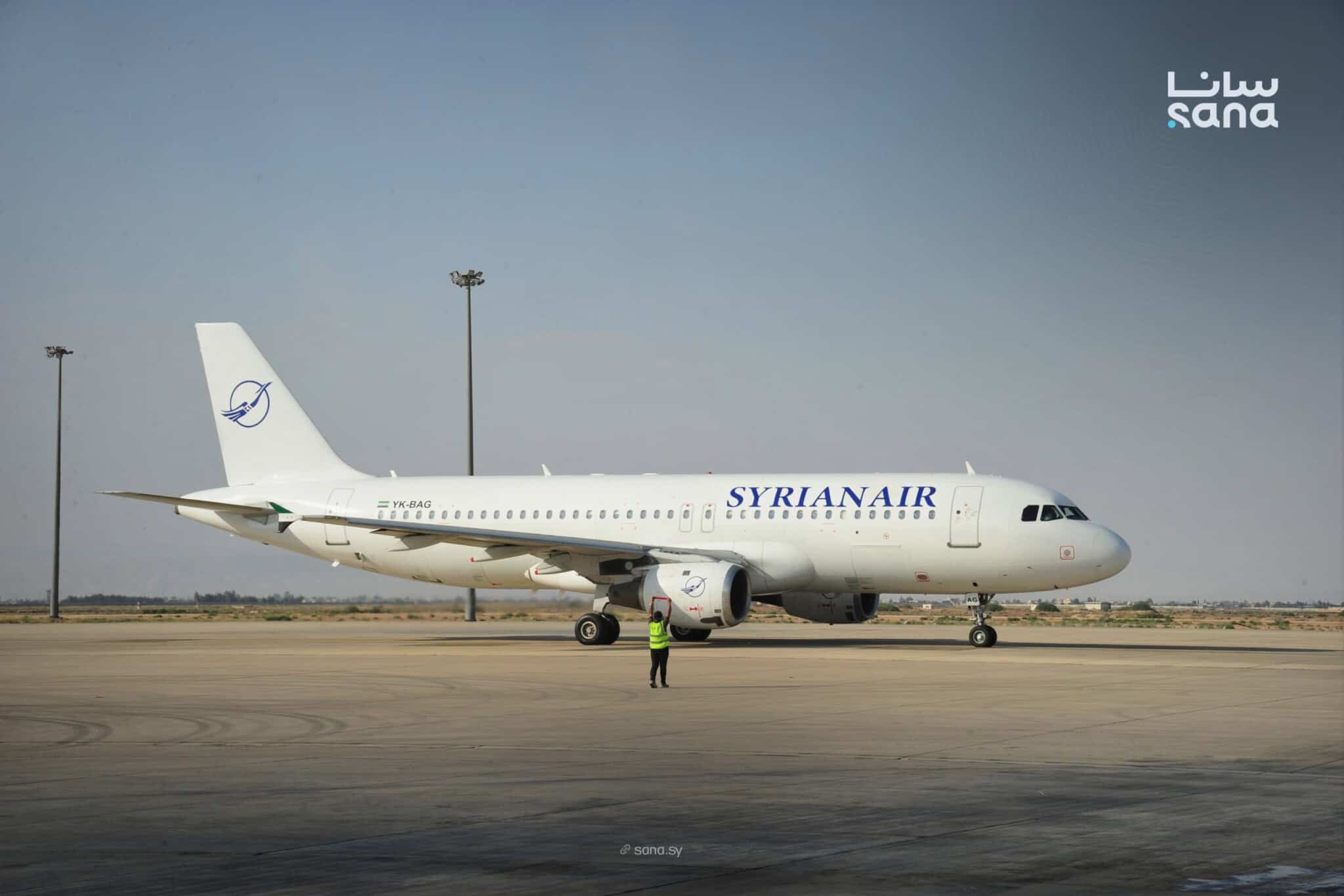
Syrian Airlines has registered the first two of a planned eight Airbus A320 jets, the state news agency SANA reported on August 30, 2026. The aircraft, registered YK-AKI and YK-AKJ, are the first Western airliners the carrier has added since international sanctions were eased following the fall of Bashar al-Assad in December 2024.
Both are A320-200s fitted with 156 seats in a two-class layout of 12 business and 144 economy, according to SANA. Six more aircraft are due in stages under a fleet-renewal program linked to the reconstruction of Damascus International Airport.
What is being delivered, and by whom
The eight jets are funded through a 250 million US dollar financing package arranged in 2025 by a consortium led by the Qatari fund UCC Holding, alongside several Turkish construction groups. Aviation database ch-aviation reported the arrangement covers up to 10 A320s.
The financing sits inside a much larger project to rebuild Damascus airport, run by Qatar’s Urbacon Holding under a contract signed in December 2025. Omar al-Hosari, who heads Syria’s civil aviation authority, said the goal was “not limited to increasing the number of aircraft, but to building a more efficient and competitive national carrier.”
Syrian Airlines chief executive Captain Anwar Akkad said the jets would give the airline “greater operational flexibility.” The build dates of the two aircraft were not disclosed; the A320-214 and A320-232 designations refer to the earlier A320ceo generation rather than the re-engined Airbus neo.
A fleet rebuilt from near-collapse
Syrian Airlines spent more than a decade largely cut off from the global aviation system. European Union sanctions imposed in 2012, layered on earlier US measures, blocked the carrier’s access to Airbus and Boeing spare parts, Western financing, and much of the airspace it once used.
By this year the airline was operating only a handful of aircraft, with about two active A320s, several more in long-term storage, and one jet wet-leased from another Syrian operator. It served roughly 14 destinations, most of them regional.
Rejoining the international system takes more than airplanes. A carrier needs steady parts supply, insurance cover, maintenance approvals, overflight and landing rights, and safety oversight that other regulators are willing to trust.
Sanctions relief restarts that process rather than completing it. The same tools work in reverse elsewhere: US sanctions on Mahan Air still keep that Iranian carrier out of most Western markets years after they were imposed.
The airport is the anchor
This deal is as much about infrastructure as aircraft. Urbacon’s Damascus airport rebuild is the main project, and the jet financing rides alongside it. Delivery of all eight aircraft is staged, and the full timeline has not been made public.
For now, the two jets add capacity that Syrian Airlines badly needs as passenger demand recovers. It is a modest step against the size of the rebuilding job, but the first in years that moves in the right direction.
Sources and references used for research and fact-checking.
Get the Newsletter
The latest aviation news and stories sent to your inbox.
About the Author

Tim is the owner and lead editor of AeroCorner since 2019, overseeing aviation content covering aircraft, airlines, airports, and the broader aviation industry. Through years of researching, writing, editing, and publishing aviation-focused content, he has developed extensive practical knowledge of commercial aviation and air travel. Based in Asia and a frequent traveler himself, Tim also brings firsthand passenger experience to AeroCorner’s coverage. Outside of publishing, he has also explored aviation firsthand through hands-on flight training in New Zealand.