

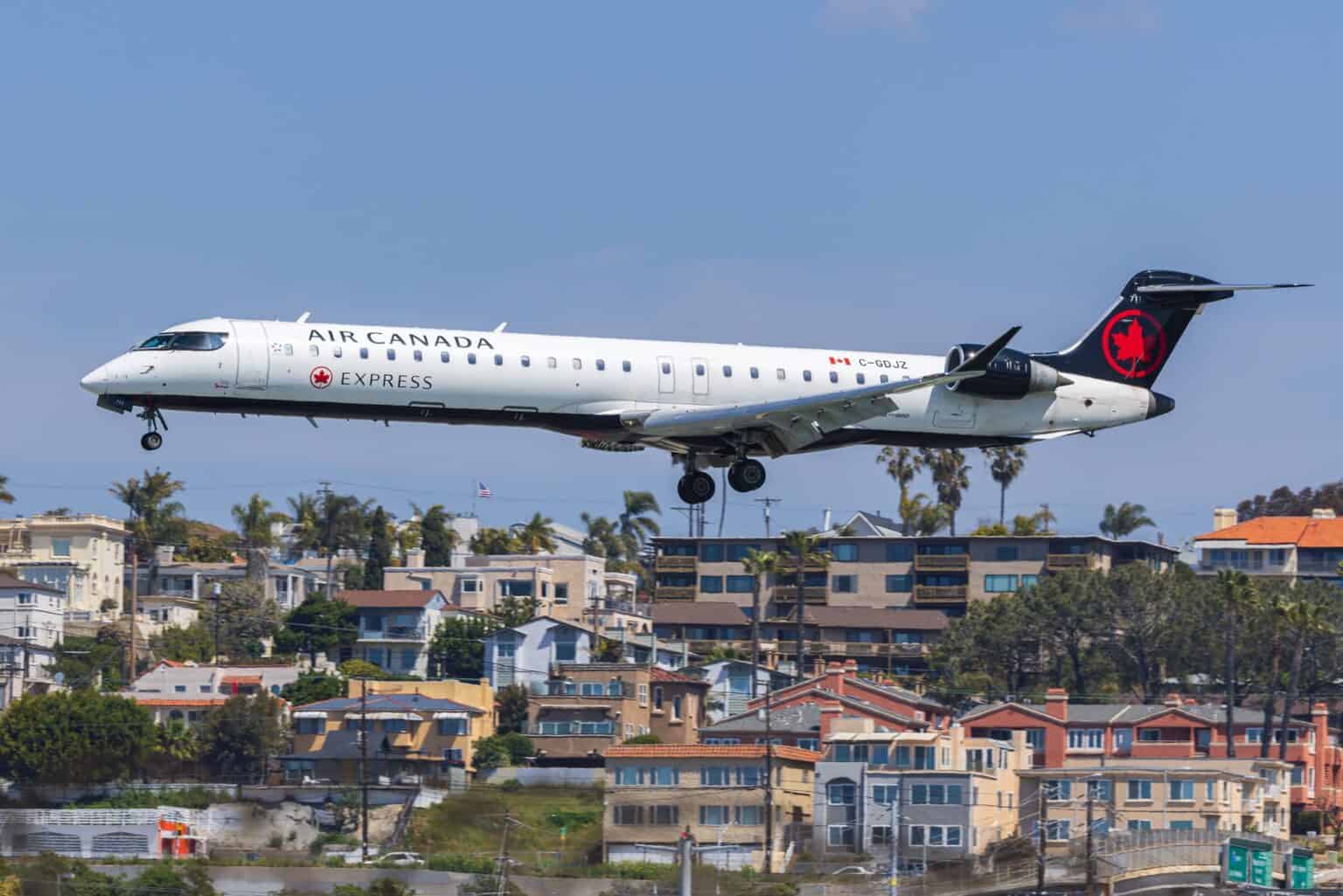
The FAA held flights bound for San Diego International Airport at their departure airports across the West on Friday morning, October 16, 2026, as Santa Ana winds forced the airport to turn its single runway around. A ground delay program followed, and at the time of writing it runs until 11:59 p.m. Friday.
When the FAA issued the program, it put the average assigned delay at 88 minutes and the longest at 2 hours 31 minutes. Shortly after 10 a.m. it added a second ground stop, this time for nearby departures.
What the FAA’s advisories show
The ground stop ran from 8:26 a.m. Pacific time and was set to end at 9:45 a.m., according to an advisory from the FAA’s Air Traffic Control System Command Center. It gave the cause as “weather / wind” and covered flights departing airports under five FAA en route centers: Los Angeles, Oakland, Salt Lake City, Denver and Albuquerque.
The advisory said San Diego was “currently transitioning to an east configuration” and told airlines to expect a ground delay program. FOX 5 San Diego reported that the stop was lifted around 9:45 a.m. and replaced by that program.
The program came at 9:19 a.m. It covers arrivals from 8:43 a.m. until 11:59 p.m. Friday, from anywhere in the contiguous US, and its only comment is “SAN east configuration.”
It caps San Diego at 22 arrivals an hour from 9 a.m. to 5 p.m., then 24 in the evening. FAA NAS Status showed the airport landing and taking off on Runway 9 at that rate, and at 9:51 a.m. it also listed departures from San Diego running 16 to 30 minutes late.
At 10:10 a.m. the Command Center issued the second stop, running from 9:59 a.m. to 11:15 a.m. for flights departing within Los Angeles Center’s airspace. It coded the cause “volume / multi-taxi,” which NAS Status lists as airport departure volume, and again rated the chance of an extension as medium.
A ground delay program works differently from a ground stop. Instead of holding every flight, the FAA gives each San Diego-bound flight a departure time that spreads arrivals out to the capped rate, so most of the waiting happens on the ground at the origin airport.
AeroCorner found no published count of delayed or canceled San Diego flights at the time of writing.
Why an east wind slows San Diego down
San Diego International is the busiest single-runway airport in the United States, according to the airport authority. Its one 9,401-foot strip handles every arrival and departure.
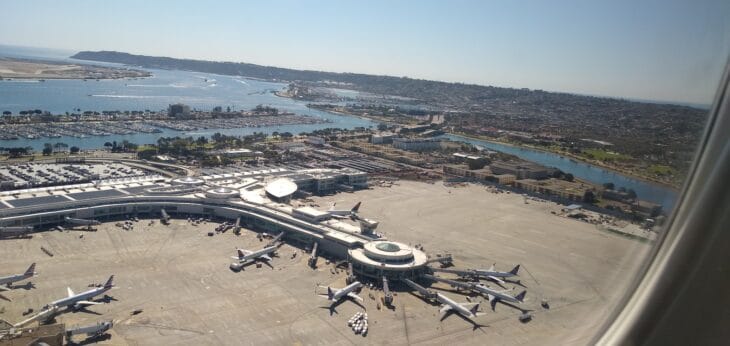

Normally the airport uses it toward the west, as Runway 27. The FAA’s 2014 capacity profile for SAN found that configuration in use about 99% of the time in good weather in 2009 and 2010, handling 48 to 57 takeoffs and landings an hour.
Santa Ana winds blow the other way, offshore from the northeast and east. Because airplanes take off and land into the wind where they can, an east wind turns the whole operation around onto Runway 9.
The National Weather Service’s forecast for the airport called for the east wind to build through the day. It predicted northeast winds gusting to 16 knots from 9:30 a.m., then east-northeast winds gusting to 21 knots from 1 p.m., with spells of winds from 100 degrees gusting to 29 knots, nearly in line with the runway, between 1 and 5 p.m.
The same forecast flagged low-level wind shear from 8 to 9:30 a.m.: east-northeast winds of 25 knots at 2,000 feet above the airport, over light and variable winds at the surface.
The FAA’s notices give no reason for the 22-arrival rate beyond wind and the east configuration. The 2014 profile notes that a full-length taxiway runs along only one side of the runway, so surface traffic and runway crossings can trim its capacity slightly.
Las Vegas also slowed, and what Saturday looks like
The FAA also put Las Vegas Harry Reid International under its own wind ground delay program from 10 a.m. to 10:59 p.m., averaging 64 minutes with a maximum of 132.
Elsewhere in Southern California, Los Angeles International was landing on its east-facing Runways 6L and 7R, but NAS Status showed no delay program there or at Ontario, Burbank or John Wayne shortly after 10 a.m. Ontario recorded a peak gust of 45 knots at 8:20 a.m.
The wind also raises the fire risk. The weather service has a High Wind Warning in force for the San Diego County valleys until 8 p.m. Saturday, while FOX Weather reported several wildfires breaking out across Southern California on Thursday in the season’s first Santa Ana event.
On the current forecast, Saturday looks easier at the airport. The weather service expects the Santa Ana winds to weaken slowly through Saturday and to die out by Sunday, and its airport forecast calls for light and variable winds at San Diego from late Friday evening into Saturday morning.
The FAA had not announced any San Diego program for Saturday at the time of writing. Last weekend’s Fleet Week delays at SFO showed how quickly such programs change.
Sources and references used for research and fact-checking.
- FAA ATCSCC, ATCSCC Advisory 077: SAN/ZLA CDM Ground Stop, October 16, 2026
- FAA ATCSCC, ATCSCC Advisory 090: SAN/ZLA CDM Ground Delay Program, October 16, 2026
- FAA ATCSCC, ATCSCC Advisory 098: SAN/ZLA CDM Ground Stop (second stop), October 16, 2026
- FAA ATCSCC, ATCSCC Advisory 094: LAS/ZLA CDM Ground Delay Program, October 16, 2026
- FAA, NAS Status: airport events and airport status information
- San Diego International Airport, History of SAN
- FAA, San Diego International (SAN) Airport Capacity Profile, 2014
- National Weather Service San Diego, Area Forecast Discussion, 501 AM PDT Fri Oct 16 2026
- National Weather Service, Terminal Aerodrome Forecast KSAN 161432Z and METARs KSAN, KONT
Get the Newsletter
The latest aviation news and stories sent to your inbox.
About the Author

AeroCorner News is the aviation news desk of AeroCorner.com. It covers accidents and incidents, safety rulings, airline and airport disruption, and new aircraft. It works from primary sources such as the NTSB, FAA, EASA and the manufacturers' own announcements.