

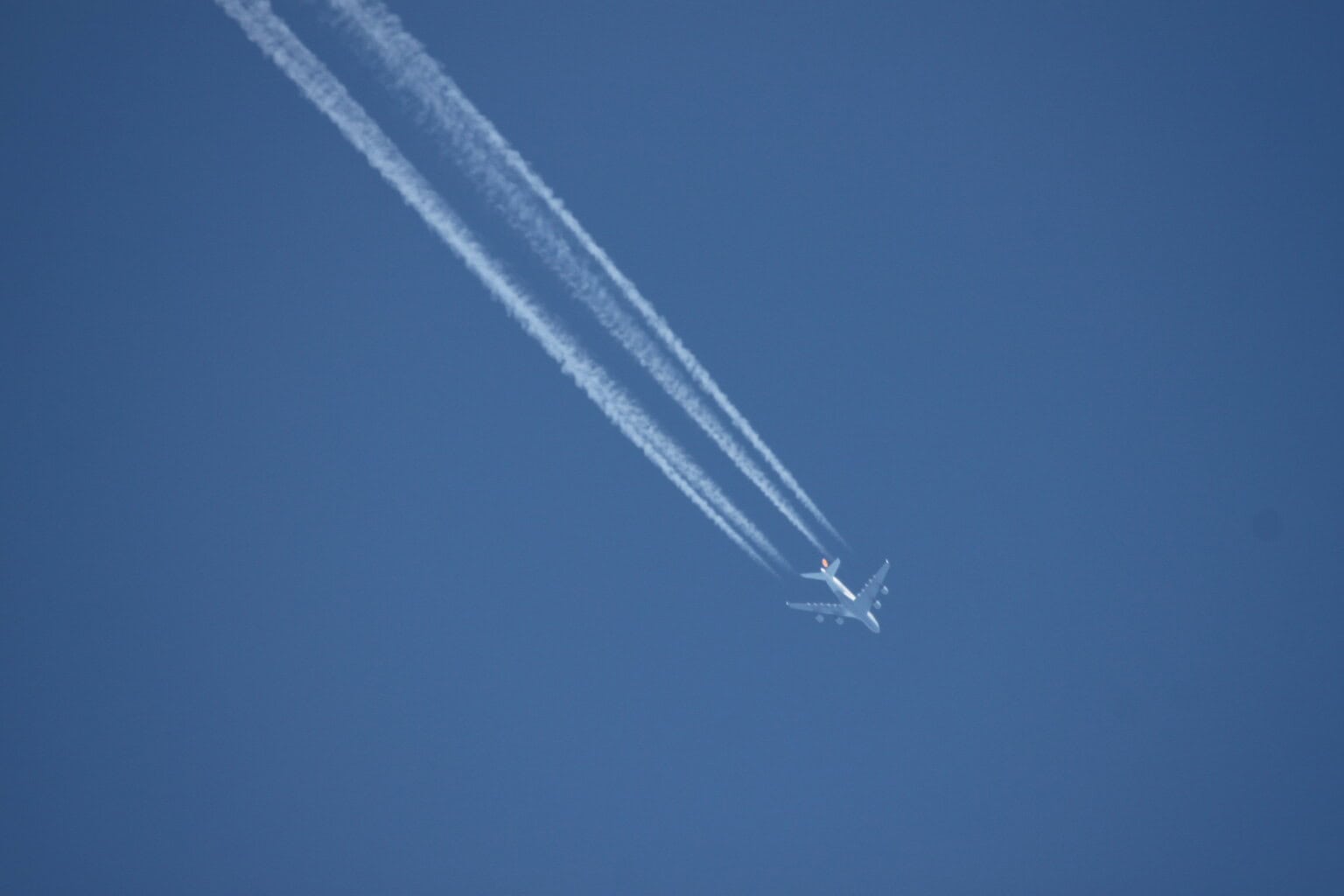
On August 18, 2026, the UK government, Google and NATS launched Operation Blue Skies, a 30-month trial testing whether small changes to flight paths can reduce the climate-warming contrails aircraft leave over the North Atlantic. It is the first trial of contrail avoidance across an entire block of oceanic airspace.
How the Trial Works
The trial runs in NATS-controlled Shanwick oceanic airspace, the eastern North Atlantic corridor used by roughly 10,000 flights a year during the relevant hours. NATS manages that stretch with no radar coverage, the same kind of oceanic control covered in our explainer on flying over the ocean with no radar.
Google’s AI models forecast where contrails are most likely to form and persist, by identifying narrow, pancake-shaped bands of ice-supersaturated air at cruising altitude. When a flight is set to cross one of those bands, controllers can shift its altitude by up to 2,000 feet (610 m) to route around it.
The tests run on only 20 to 40 chosen days each winter, for seven to eight hours during quieter traffic periods, across two winters in 2026 and 2027. Not every flight will be rerouted, and deviations happen only when they are safe and operationally practical.
Why Contrails Matter for the Climate
Shanwick airspace alone accounts for roughly 5% of contrail-driven warming worldwide, according to the trial’s organizers, concentrated in the winter months when ice-supersaturated air is more common.
Researchers have found that persistent contrails, sometimes called contrail cirrus, can trap roughly as much heat as the aviation industry’s carbon dioxide emissions, even though a single contrail lasts hours rather than centuries.

Smaller contrail-avoidance trials have run before, largely limited to single airlines or short pilot programs. Operation Blue Skies is the first attempt to apply the same approach across an entire block of oceanic airspace, testing whether it can work at commercial scale.
Keir Mather, the UK’s aviation minister, said the government wants to test “small tweaks to flight paths over the Atlantic” to cut the vapour trails planes leave behind.
The trial costs about £5 million ($6.8 million). The UK government is providing a £2.65 million grant, while Google is contributing about £1.4 million in AI research, engineering and computing time rather than cash.
The wider consortium includes the Met Office, Contrails.org, Imperial College London and the University of Cambridge, who will assess whether the reroutes actually cut contrail formation once the trial data comes in.
It follows a string of other aviation climate efforts this year, from new sustainable aviation fuel mandates to a Boeing, Lufthansa and Rolls-Royce fuel-saving flight test using a modified 787.
The fuel trade-off
Diverting a flight by up to 2,000 feet burns roughly 1% more fuel, about 220 pounds (100 kg) extra on an average aircraft, a cost researchers are weighing against the climate benefit of fewer contrails.
An early-stage trial
Operation Blue Skies has just begun and has not yet published results. Airlines may see more denied route requests on test days, and crews will not always know why a deviation was ordered.
Sources and references used for research and fact-checking.
Get the Newsletter
The latest aviation news and stories sent to your inbox.
About the Author

Tim is the owner and lead editor of AeroCorner since 2019, overseeing aviation content covering aircraft, airlines, airports, and the broader aviation industry. Through years of researching, writing, editing, and publishing aviation-focused content, he has developed extensive practical knowledge of commercial aviation and air travel. Based in Asia and a frequent traveler himself, Tim also brings firsthand passenger experience to AeroCorner’s coverage. Outside of publishing, he has also explored aviation firsthand through hands-on flight training in New Zealand.