

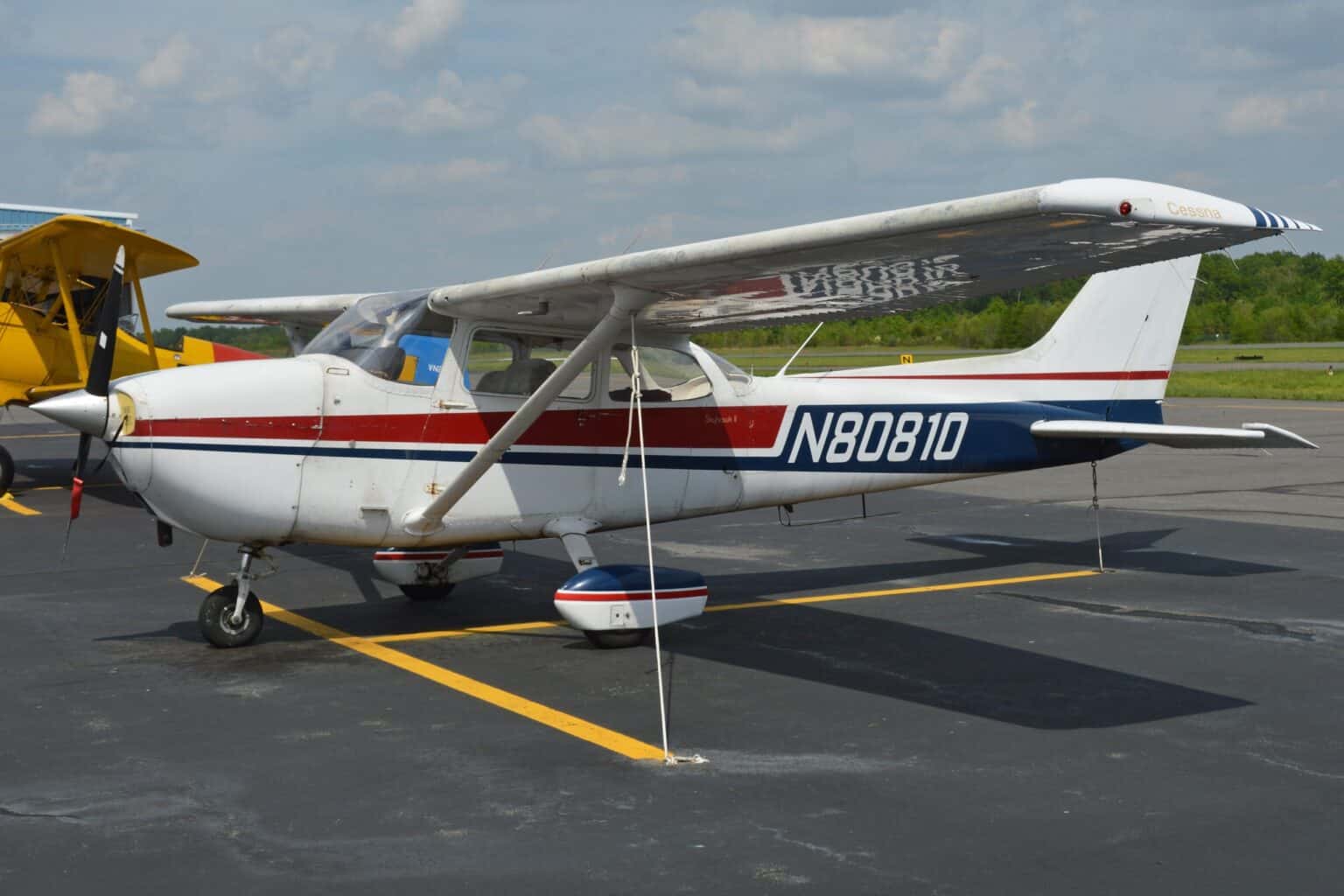
Cessna 172 N57BM overturned and came to rest on its roof at John Wayne Airport in Orange County at about 2:38 p.m. on Saturday, November 7, 2026. The flight school that operates it says jet blast from a departing airliner flipped it, while an airport spokesperson put it down to high winds.
Airport officials told CBS Los Angeles that two people were aboard and that no one was hurt. A crane later lifted the aircraft back onto its wheels so it could be towed away.
Two accounts of the same few seconds
The airport said the aircraft overturned on the ACI Jet ramp, a general aviation apron run by a fixed-base operator, “due to high winds,” the Los Angeles Times reported. The spokesperson added that there was no further impact on airport operations.

Orange County Flight Center, which says it owns the plane, gave a different cause. It told CBS Los Angeles the Cessna flipped “because of a jet blast from a United or Southwest airline jet that was allowed to takeoff as our aircraft was leaving the ramp towards the taxiway.”
The school said a flight instructor and a student were aboard. One of its directors also told the station that a major reconstruction and realignment project at the airport is “adversely” affecting general aviation aircraft and that “flight safety may be jeopardized.”
Radio traffic points the same way as the school. In ground control audio described by Simple Flying, the pilot of another Cessna taxiing behind N57BM reported that the aircraft had flipped and said they had been “blasted” by a United Boeing 737.
The official accounts have shifted too. CBS Los Angeles said fire and airport officials first described the plane as parked in its stall with no one aboard, before airport officials said a pilot and a passenger were inside.
United, the FAA and the NTSB did not immediately respond to the Los Angeles Times. At the time of writing, no NTSB case for N57BM appears in the board’s CAROL database, and no airline flight has been publicly identified.
| Source | Cause given | Who was aboard |
|---|---|---|
| John Wayne Airport spokesperson | High winds | Pilot and passenger, no injuries |
| Orange County Flight Center | Jet blast from a departing United or Southwest jet | Flight instructor and student |
| Pilot taxiing behind, on ground control | Jet blast from a United 737 | Not stated |
The aircraft and the weather
FAA registry records show N57BM is a 1973 Cessna 172M Skyhawk with a Lycoming O-320-series engine. It is registered to Huerta Holdings Inc. of Santa Ana, with a certificate valid until August 2027.
The airport’s automated weather station did not record a windy afternoon. Its observations at 1:53 p.m. and 2:53 p.m. recorded wind of 6 knots, clear skies and 84 to 86°F (29 to 30°C), with no gusts reported.
Those reports capture the conditions at one sensor at the moment of each observation. They cannot rule out a brief gust on the ramp in between, but they give no sign of the high winds the airport’s statement describes.
Wind has flipped a Cessna at John Wayne Airport before. On November 20, 2023, a Cessna with one person aboard ended up upside down beside a taxiway as gusts reached about 50 mph (80 km/h), ABC7 reported at the time.
How jet blast flips a light aircraft
Jet exhaust stays fast for hundreds of feet behind an airliner’s engines, and a light single like the Cessna 172 has little weight to resist it. FAA Advisory Circular 90-66C, written for operations at airports without a tower, tells pilots to “give yourself ample distance behind a jet.”
The same circular notes that almost half of the jet blast incidents reported to the Aviation Safety Reporting System happened on taxiways, in run-up areas and near runways. The other half happened on ramps, where aircraft park close together and maneuver tightly.
The NTSB closed a similar case this year. On March 6, 2026, a Cessna 182 taxiing at Flagstaff, Arizona, flipped inverted behind a parked CRJ700 after maintenance personnel had brought both of its engines to takeoff power for a test, leaving its two occupants with minor injuries.
The board estimated the Cessna was about 240 feet behind the jet, and noted that a CRJ700 at maximum thrust on one engine produces a 60 mph (97 km/h) blast 290 feet away. It blamed the maintenance personnel’s decision to run the engines in front of an active taxiway, and their failure to tell ATC.
No figures have been published for Saturday’s event. What would settle the dispute at Santa Ana is where N57BM sat relative to any departing jet, and how much power that jet was using at the time.
What happens next
Whether the NTSB opens a case depends largely on the damage. Federal rules (49 CFR 830.2) count an event as an aircraft accident when it happens after people board with the intention of flight and the aircraft is substantially damaged, and the extent of N57BM’s damage has not been released.
The construction the school raised is real. Contractor FlatironDragados reported in June that it was more than a year into a three-year, $102 million reconstruction and realignment of Taxiway A at the airport. The school’s statement, as reported, does not say how that work bears on Saturday’s event.
Saturday’s event came a day after another at the same airport, when Southwest flight WN3396 declared an emergency after departing Orange County and diverted to LAX.
Sources and references used for research and fact-checking.
- FAA Registry, N-Number inquiry: N57BM
- NOAA Aviation Weather Center, KSNA METARs, November 7, 2026
- FAA, Advisory Circular 90-66C, Non-Towered Airport Flight Operations (6/6/23), para 9.12.3.4 Jet Blast
- NTSB, CAROL case WPR26LA122, Cessna 182M N71518, Flagstaff AZ, March 6, 2026 (final)
- eCFR, 49 CFR 830.2 Definitions
Get the Newsletter
The latest aviation news and stories sent to your inbox.
About the Author

AeroCorner News is the aviation news desk of AeroCorner.com. It covers accidents and incidents, safety rulings, airline and airport disruption, and new aircraft. It works from primary sources such as the NTSB, FAA, EASA and the manufacturers' own announcements.