

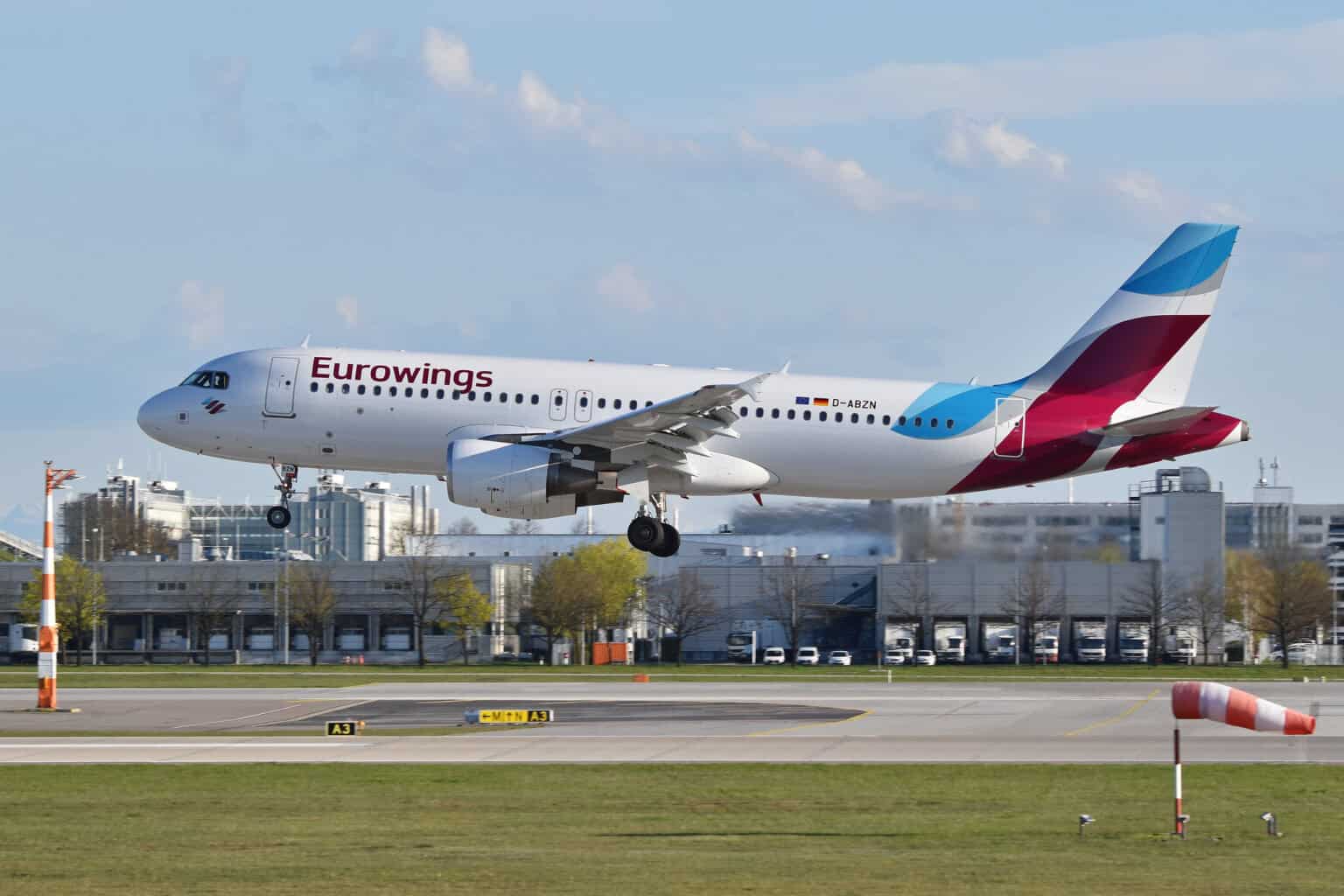
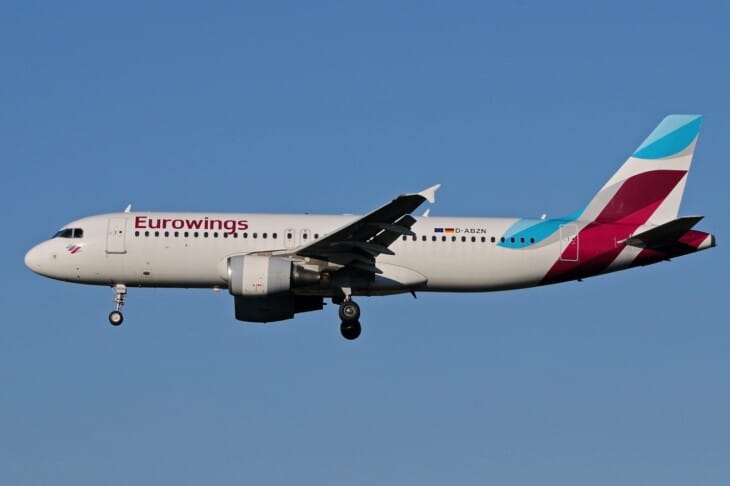
A Eurowings Airbus A320 flying from Ibiza to Düsseldorf on Wednesday, September 9, 2026, diverted twice in one evening. It landed first in Toulouse after the airline learned a checked bag was on board without its owner, then in Cologne because Düsseldorf’s night curfew had begun.
Flight EW9503, registration D-ABZN, was carrying 156 passengers, according to aeroTELEGRAPH, which first reported the story. A Eurowings spokesperson told the outlet the bag was aboard because of an error during loading.
Two diversions in one evening
The jet left Ibiza at 7:35 p.m. local time, 85 minutes behind its 6:10 p.m. schedule, according to a timeline published by One Mile at a Time. The error came to light in flight, and the airline said a landing at the nearest airport was arranged immediately for safety reasons.
The A320 landed in Toulouse at 8:37 p.m. A security check there took about two and a half hours, aeroTELEGRAPH reported, and the aircraft took off again at 11:20 p.m.
That delay created the second problem. Düsseldorf Airport lets scheduled jets land until 11 p.m. and accepts delayed arrivals until 11:30 p.m., or until midnight for airlines with a maintenance base there, according to the airport’s operating rules.
A flight leaving Toulouse at 11:20 p.m. could not make any of those windows. The A320 landed instead at Cologne Bonn, which operates around the clock, at 12:53 a.m., and Eurowings arranged ground transport for all 156 passengers.
One Mile at a Time estimates they reached Düsseldorf between 3 and 4 a.m., roughly seven hours after their scheduled 8:35 p.m. arrival.
Why one stray bag can turn a flight around
The rule behind the first diversion is called passenger-baggage reconciliation. Under the EU’s aviation security regulation, Implementing Regulation 2015/1998, airlines must match each checked bag to a passenger who has boarded and must be able to identify bags whose owners did not.
If the passenger is not on board, the regulation treats the bag as unaccompanied. Unless the reason is recorded as beyond the passenger’s control, the bag has to come off the aircraft and be screened again before it can be loaded.
On the ground, that means a delayed departure while ramp staff dig one suitcase out of the hold. Once the aircraft is airborne, the only way to take the bag off is to land, which is why a routine flight diversion followed.
Neither report says whose bag it was, why its owner was not on the flight, or how it came to be loaded.
A rule written after two bombings
The rule exists because unaccompanied bags have brought down airliners. On June 23, 1985, a bomb in a suitcase checked in Vancouver by a passenger who never boarded exploded aboard Air India Flight 182 off the coast of Ireland, killing all 329 people on board.
New international standards requiring airlines to match passengers with their bags came into force in 1987, according to a history in Transport Security International by John Vermilye, who chaired the industry working group that drew up the procedures.
Those procedures were in place but not applied on December 21, 1988, Vermilye writes, when a bomb in interline luggage whose passenger did not board destroyed Pan Am Flight 103 over Lockerbie, Scotland. It killed 270 people, 11 of them on the ground.
Checked-bag screening has since become the main defense. ICAO wrote hold baggage screening into its security standards in 2006, Vermilye notes, and the airline trade body IATA has argued that rescreening a bag already cleared by enhanced methods, on the same equipment, adds no real value.
The EU rule still requires an unmatched bag to be unloaded and checked again, as aeroTELEGRAPH points out. So a crew that learns of one in flight has few options other than landing, and a late-evening diversion can run straight into a curfew.
What is not yet known
Eurowings has not said whose bag was on board, why its owner was not, or how the loading error happened. The account above rests on the airline’s brief statement and on press reports, not on any published investigation.
Sources and references used for research and fact-checking.
Get the Newsletter
The latest aviation news and stories sent to your inbox.
About the Author

Tim is the owner and lead editor of AeroCorner since 2019, overseeing aviation content covering aircraft, airlines, airports, and the broader aviation industry. Through years of researching, writing, editing, and publishing aviation-focused content, he has developed extensive practical knowledge of commercial aviation and air travel. Based in Asia and a frequent traveler himself, Tim also brings firsthand passenger experience to AeroCorner’s coverage. Outside of publishing, he has also explored aviation firsthand through hands-on flight training in New Zealand.